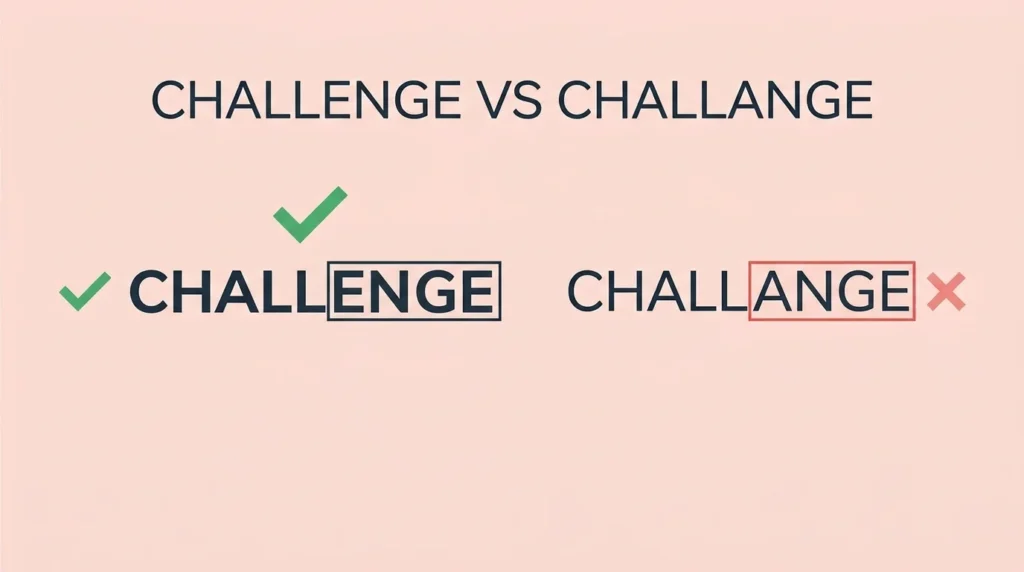

Challenge is the correct spelling. Challange is a misspelling and should not be used in standard English. The word challenge can be a noun meaning a difficult task, test, or competition, and it can also be a verb meaning to question, oppose, invite someone to compete, or test someone’s ability. If you are writing an email, essay, report, application, or social media post, use challenge.
What Is the Difference Between Challenge and Challange?
The difference is simple:
- Challenge — correct spelling
- Challange — incorrect spelling
The two forms are easy to confuse because they look almost identical. The important difference is the vowel after the double l:
Challenge → chall + enge
Challange → chall + ange
Only challenge is the standard English spelling.
For example:
Correct: Learning a new language can be a challenge.
Incorrect: Learning a new language can be a challange.
The incorrect form does not represent a different meaning, a British spelling, an American spelling, or a special informal version. It is simply a spelling error. Standard dictionaries list challenge as the English word.
Why Does Challenge Matter?
Spelling may seem like a small detail, but errors can affect how clearly and professionally your writing is received.
Imagine writing:
“Thank you for giving me this challange.”
The reader can probably understand what you mean. However, the spelling error is unnecessary, especially in a job application, academic assignment, business email, proposal, or formal report.
Correct spelling helps your writing look finished and reliable.
The word challenge is also extremely common. It appears in everyday conversation, education, business, technology, sports, politics, law, and academic writing. Because you are likely to use it often, learning its spelling correctly is worth the effort.
The Core Rule
Rule: Always spell the word as CHALLENGE — with “ENGE” after the double L.
The correct spelling is:
C-H-A-L-L-E-N-G-E
The incorrect spelling is:
C-H-A-L-L-A-N-G-E
The easiest part to focus on is the middle:
challENGE ✅
challANGE ❌
Do not change the e to a.
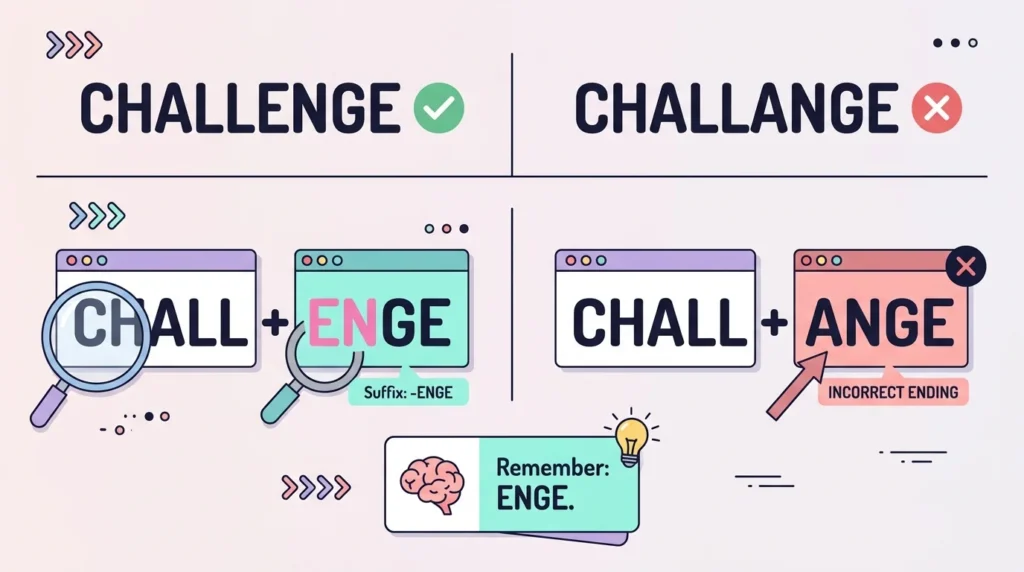
A useful spelling breakdown
challenge
- cha
- ll
- enge
Think:
chall + enge = challenge
Not:
chall + ange = challange
This small visual distinction is enough to prevent the mistake for most writers.
How to Use Challenge Correctly
Challenge is both a noun and a verb.
A noun names a person, place, thing, idea, or situation. As a noun, challenge can describe something difficult, a competition, an invitation to compete, or an objection to something.
A verb describes an action. As a verb, challenge can mean to test someone, invite someone to compete, question something, or refuse to accept something without examination.
Challenge as a noun
Use challenge when you are talking about a difficult task, situation, test, or competition.
Examples:
- Starting a new business is a major challenge.
- She accepted the challenge with confidence.
- The exam was a real challenge.
- Learning to speak another language can be a rewarding challenge.
- The team faces a difficult challenge this season.
Challenge as a verb
Use challenge when someone tests, questions, confronts, or invites another person to compete.
Examples:
- The coach challenged the players to improve.
- She challenged the decision.
- He challenged me to a race.
- The journalist challenged the official’s claim.
- The new project will challenge the entire team.
The verb commonly appears in patterns such as challenge someone to do something and challenge something.
Correct Examples
Here are original examples showing how challenge works in different types of English.
Conversation
- “I know the hike will be difficult, but I enjoy a good challenge.”
- “Are you challenging me to a race?”
- “The main challenge is completing the project before Friday.”
- “Thank you for giving me the opportunity to take on this challenge.”
School
- “The mathematics problem was a challenge, but I solved it after reviewing the formula.”
- “Our teacher challenged us to find another solution.”
Workplace
- “Our biggest challenge this quarter is reducing delivery delays.”
- “The manager challenged the team to improve customer satisfaction.”
Social Media
- “Today I accepted a new fitness challenge.”
- “Every difficult challenge teaches you something new.”
Academic Writing
- “Rapid technological change presents a significant challenge for educational institutions.”
- “The researchers challenged the assumption that the two groups responded in the same way.”
Notice that challenge does not have one fixed meaning. Its exact meaning depends on the sentence.
Incorrect vs. Correct
| Incorrect | Correct | Why |
|---|---|---|
| This is a difficult challange. | This is a difficult challenge. | The correct spelling contains enge, not ange. |
| We accepted the challange. | We accepted the challenge. | Challange is not the standard spelling. |
| The project is a big challange. | The project is a big challenge. | The vowel after ll should be e. |
| She enjoys every new challange. | She enjoys every new challenge. | Challenge is the established English form. |
| He gave me a challange. | He gave me a challenge. | The noun is spelled challenge. |
| This exam will challange you. | This exam will challenge you. | The verb also uses the same spelling. |
| They challanged the decision. | They challenged the decision. | The past tense is formed from challenge, not challange. |
| The task is challanging. | The task is challenging. | The related adjective keeps the e pattern before the suffix. |
| She is the strongest challanger. | She is the strongest challenger. | The noun challenger comes from challenge. |
| We face many challanges. | We face many challenges. | The plural is formed from the correct base word. |
The key point is that correcting only the original noun is not enough. Once you learn challenge, you should also learn its common related forms.
Why People Spell Challenge as Challange
This mistake has several understandable causes.
1. The pronunciation does not clearly reveal the spelling
English spelling and pronunciation do not always match letter for letter.
Challenge is pronounced approximately /ˈtʃæl.ɪndʒ/ in both major varieties of English. The unstressed middle vowel is not pronounced like a strong, clearly separated e sound. That can make the spelling harder to reconstruct from sound alone.
In other words, you can know the word perfectly well when speaking and still hesitate when writing it.
2. The spelling resembles words ending in -ange
English contains many familiar words with -ange, including:
- change
- range
- arrange
- exchange
- strange
That visual pattern can encourage writers to produce challange.
But challenge belongs to a different spelling pattern.
3. Fast typing creates small errors
When people type quickly, they often rely on memory rather than consciously spelling each word.
A single vowel can change:
challenge → challange
The writer may not notice the error because the rest of the word looks correct.
4. Phonetic spelling can interfere
English learners sometimes write a word according to how they think it sounds.
This is called phonetic spelling: writing a word based mainly on its pronunciation rather than its established spelling.
Because the middle vowel in challenge is not strongly pronounced, learners may have difficulty remembering whether the written form uses e or a.
5. Spellcheck is not a substitute for spelling knowledge
Spellcheck can help, but it should not be your only defense.
A spellchecker may catch challange, but automated tools are not perfect. They may miss errors, especially when a misspelled form resembles another valid word or when the software’s dictionary behaves differently.
Knowing the spelling yourself is more reliable.
Common Mistakes Checklist
Mistake 1: Writing “challange”
Problem: You replace the e in challenge with a.
Why it happens: The ending resembles words such as change and range.
Fix: Remember challENGE.
Mistake 2: Writing “chalenge”
Problem: You remove one of the two l letters.
Why it happens: The word’s pronunciation may make the repeated consonant less obvious.
Fix: Memorize the opening as CHALL.
Mistake 3: Writing “chellenge”
Problem: You change the first vowel from a to e.
Fix: Break the word into:
CHA + LL + ENGE
Mistake 4: Writing “challanging”
Problem: You create the wrong base form before adding -ing.
Correct: challenging
Mistake 5: Writing “challanged”
Problem: You add -ed to the misspelled form.
Correct: challenged
Mistake 6: Writing “challanger”
Problem: You carry the misspelling into the person noun.
Correct: challenger
Learning the whole word family is more effective than memorizing only one isolated spelling.
Challenge in Real English
1. Grammatically correct and natural
“Starting a new job can be a challenge.”
This is completely natural everyday English. Challenge is commonly used for something difficult that requires effort, ability, determination, or adjustment. Expressions such as face a challenge, accept a challenge, meet a challenge, and rise to the challenge are also well established.
2. Grammatically correct but dependent on context
“She challenged the report.”
This sentence can be grammatically correct, but the intended meaning needs context. Challenge can mean questioning whether something is true, accurate, legal, or acceptable. In formal writing, you may need to explain exactly what was questioned if the reader could misunderstand the sentence.
3. Natural in competitive situations
“He challenged me to a game of chess.”
This is a standard and natural construction. The pattern challenge someone to something or challenge someone to do something is widely used when one person invites another to compete or prove an ability.
4. Natural in professional English
“The company faces several challenges.”
This is especially common in business English. A challenge can be a difficult situation, responsibility, or problem requiring effort and skill. Professional writing frequently uses expressions such as face a challenge, address a challenge, overcome a challenge, and pose a challenge.
5. Not a spelling variation
“Challange” may appear in informal online writing, search queries, comments, or user-generated content, but its appearance does not make it an accepted spelling. If you are writing standard English, choose challenge. A misspelling may be understandable to readers, but it is still a spelling error.
American vs. British English
There is no American-versus-British spelling difference here.
Both American and British English use:
challenge ✅
Neither standard variety uses:
challange ❌
The pronunciation shown in major learner dictionaries is also essentially the same across British and American English, although pronunciation details can vary by speaker and accent.
So you do not need to remember two versions.
Whether you are writing for readers in the United States, United Kingdom, Canada, Australia, or elsewhere, the standard spelling is challenge.
Formal vs. Informal Usage
The word challenge works in both formal and informal English.
Informal
- “That exam was a challenge.”
- “Want to take on the challenge?”
- “I love a good challenge.”
Professional
- “The project presents several operational challenges.”
- “The company faces significant challenges in expanding internationally.”
- “The team was challenged to improve performance.”
Academic
- “The study identifies several challenges associated with the proposed approach.”
- “The findings challenge the assumption that the two variables are independent.”
The spelling does not change according to formality.
Challange is not an informal alternative to challenge.
Challenge Word Family
Learning the related forms makes the spelling much easier.
| Word | Part of Speech | Example |
|---|---|---|
| challenge | noun | The task is a challenge. |
| challenge | verb | They challenge the decision. |
| challenged | past tense/past participle | She challenged the claim. |
| challenging | adjective/present participle | It was a challenging task. |
| challenger | noun | The challenger entered the competition. |
| challenges | plural noun / third-person verb | The team faces challenges. |
Notice the consistent spelling:
challenge → challenged → challenging → challenger → challenges
The incorrect form challange should not be used as the base for any of these words.
Comparison Table
| Feature | Challenge | Challange |
|---|---|---|
| Standard English spelling | ✅ Yes | ❌ No |
| Dictionary word | ✅ Yes | ❌ No |
| Can be a noun | ✅ Yes | ❌ No |
| Can be a verb | ✅ Yes | ❌ No |
| Used in formal writing | ✅ Yes | ❌ No |
| Used in academic writing | ✅ Yes | ❌ No |
| Used in everyday English | ✅ Yes | ❌ No |
| American English | ✅ Yes | ❌ No |
| British English | ✅ Yes | ❌ No |
| Correct spelling to memorize | Challenge | Do not use |
Memory Trick
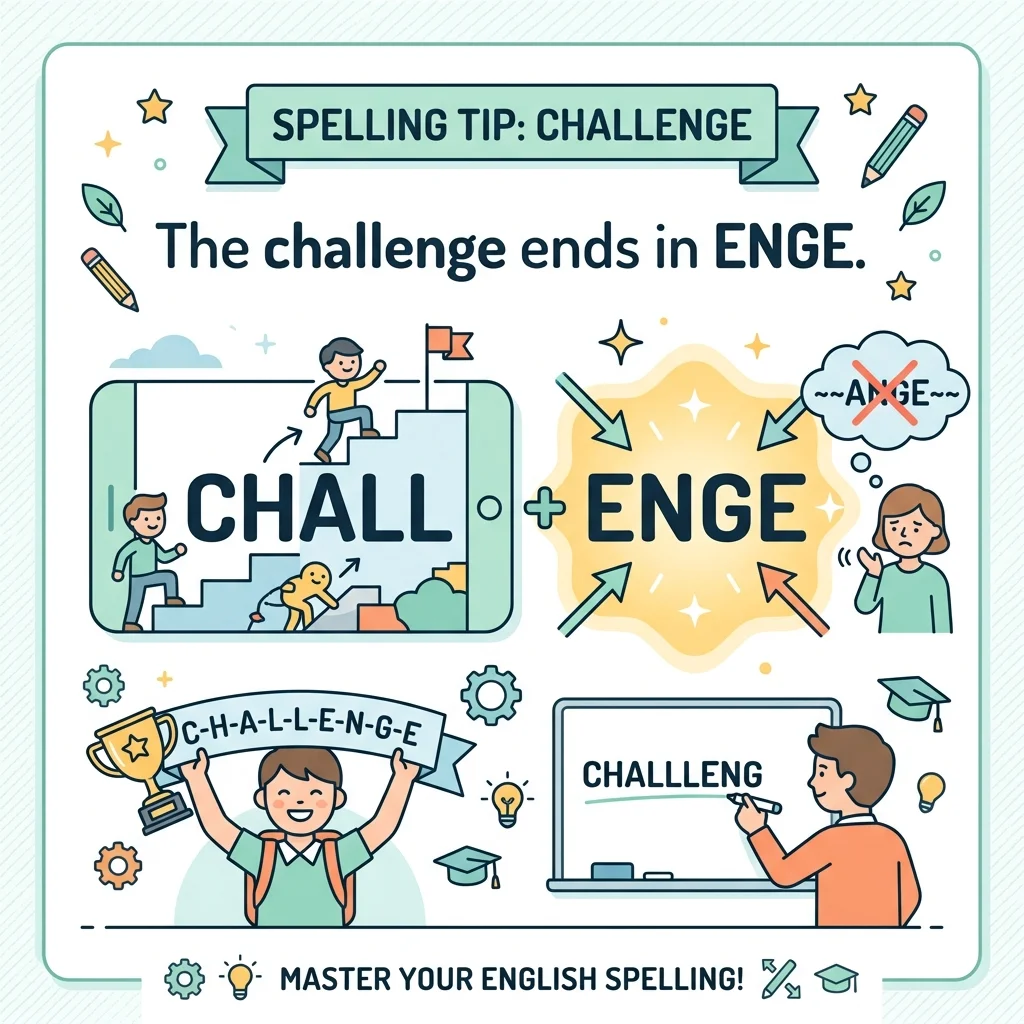
Remember: “The challenge ends in ENGE.”
Look at the final part:
challENGE
Think:
A challenge is difficult, but spelling it should not be a challenge: remember ENGE.
You can also visualize the word in two parts:
CHALL + ENGE
Whenever you are unsure, ask yourself:
“Is it ENGE or ANGE?”
The answer is:
ENGE → challenge ✅
Real-Life Situations
Job Interview
Correct:
“One of the biggest challenges in my previous position was managing a growing team.”
This sounds natural and professional.
Business Meeting
Correct:
“Our biggest challenge is completing the project on time.”
Here, challenge refers to a difficult situation.
Correct:
“I appreciate the opportunity to take on this new challenge.”
This is suitable for professional correspondence.
Text Message
Correct:
“That sounds like a fun challenge!”
The word works just as naturally in casual communication.
Academic Essay
Correct:
“Rapid urbanization presents a major challenge for local governments.”
This use is appropriate in formal academic writing.
Debate
Correct:
“The evidence challenges the assumption that the policy was effective.”
Here, challenge means to question or dispute an assumption.
Sports
Correct:
“The player accepted the challenge and entered the competition.”
Here, challenge relates to competition.
Read More: Well Deserved vs. Well-Deserved: Which Is Correct?
Expert Tips
Tip 1: Memorize the difficult part, not the whole word
You probably already know how to begin challenge. The part that causes trouble is ENGE.
Focus your memory on:
challENGE
Tip 2: Learn the word family together
Instead of memorizing only:
challenge
learn:
challenge → challenged → challenging → challenger → challenges
This creates a stronger spelling pattern in your memory.
Tip 3: Do not rely on pronunciation alone
English has many words whose spelling cannot be predicted perfectly from their pronunciation.
If you are uncertain, visual memory is often more useful than trying to sound out the word.
Tip 4: Slow down when writing important documents
A five-second proofreading check can catch:
- challange
- chalenge
- chellenge
- challanging
- challanged
This matters most in resumes, applications, reports, academic assignments, and client communication.
Tip 5: Watch the vowel after “ll”
When your eyes reach:
chall_
ask:
E or A?
Choose E:
challenge
FAQ
Is “challange” a correct English word?
No. Challange is a misspelling of challenge. It is not an alternative spelling with a different meaning.
How do you spell challenge?
The correct spelling is:
C-H-A-L-L-E-N-G-E
The easiest part to remember is ENGE at the end of the word.
Is challenge spelled with one L or two?
Challenge has two consecutive l letters:
chall…
The full spelling is c-h-a-l-l-e-n-g-e.
Why do people write “challange”?
The error can result from pronunciation, fast typing, visual similarity with words ending in -ange, or remembering the word incorrectly. The unstressed vowel in the pronunciation does not make the spelling obvious to every writer.
Is “challange” acceptable in informal English?
No. Informal writing can contain intentional misspellings, especially in jokes, usernames, or stylistic online writing, but challange is not the standard informal spelling of challenge. Use challenge in normal writing.
Is challenge a noun or a verb?
It can be both.
As a noun:
“The exam was a challenge.”
As a verb:
“The evidence challenges the theory.”
What is the plural of challenge?
The plural is challenges.
Example:
“The company faces several challenges.”
What is the past tense of challenge?
The past tense is challenged.
Example:
“She challenged the decision.”
How do you spell challenging?
The correct spelling is:
challenging
Not:
challanging
The word is formed from challenge with the spelling adjusted before -ing.
Read More: Training vs Trainning: Which Spelling Is Correct?
Is challenge spelled differently in British English?
No. Challenge is the standard spelling in both British and American English. There is no standard British form challange.
What is the easiest way to remember challenge?
Remember:
CHALL + ENGE
Or simply:
“The challenge ends in ENGE.”
Mini Quiz
| # | Question | Answer | Explanation |
|---|---|---|---|
| 1 | Which spelling is correct: challenge or challange? | Challenge | The standard spelling uses enge, not ange. |
| 2 | Fill in the blank: “Learning a language is a ______.” | challenge | The noun describes something difficult that tests ability or effort. |
| 3 | Choose the correct sentence: A) “She challanged the decision.” B) “She challenged the decision.” | B | The past tense is challenged. |
| 4 | Fill in the blank: “He ______ me to a race.” | challenged | Challenge is a verb, and its past form is challenged. |
| 5 | Which is correct? A) challanging B) challenging | B | The correct form is challenging. |
| 6 | Correct the sentence: “This is a difficult challange.” | “This is a difficult challenge.” | Replace challange with the standard spelling challenge. |
| 7 | Is “challange” an American spelling? | No | American English uses challenge. |
| 8 | Is “challange” a British spelling? | No | British English also uses challenge. |
| 9 | Fill in the blank: “The company faces several ______.” | challenges | The plural of challenge is challenges. |
| 10 | Which memory pattern is correct? A) chall + ange B) chall + enge | B | The correct word is chall + enge. |
Quick Summary
Challenge is the correct spelling, while challange is a misspelling. The word challenge can function as both a noun and a verb. As a noun, it can describe a difficult task, situation, competition, or test. As a verb, it can mean to test someone, invite someone to compete, or question or oppose something. The main spelling point is the vowel after the double l: challENGE, not challANGE. There is no American-versus-British spelling difference. To remember it, focus on the ending ENGE and learn related forms such as challenged, challenging, challenger, and challenges. When in doubt, always choose challenge.