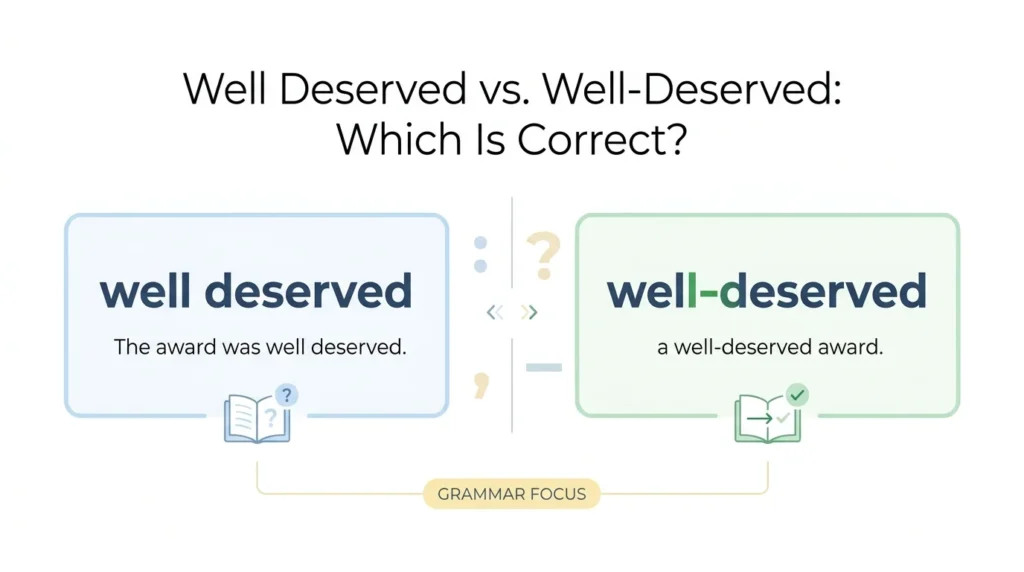

Both “well deserved” and “well-deserved” are correct. The difference is usually their position in a sentence. Use well-deserved when the phrase comes directly before a noun, as in “a well-deserved award.” Use well deserved when it comes after a linking verb, as in “The award was well deserved.” The meaning stays essentially the same; the hyphen reflects how the words function together.
What Is “Well Deserved”?
Well deserved means that something was fully earned, justified, or rightly received because of someone’s actions, effort, qualities, or achievements.
For example:
- Her promotion was well deserved.
- He received a well-deserved promotion.
- The team earned a well-deserved victory.
- Their success is well deserved.
The expression is built from well, an adverb that intensifies the meaning, and deserved, an adjective or past-participial form related to the verb deserve.
The core meaning does not change when the hyphen appears. What changes is the grammatical position of the phrase.
Dictionaries recognize both the open form well deserved and the hyphenated form well-deserved. One major dictionary, for example, specifically shows well-deserved before a noun while giving examples such as “the promotion is well deserved.”
Why It Matters
The difference may look tiny, but correct hyphenation makes your writing easier to read.
Compare:
She received a well-deserved award.
with:
The award was well deserved.
Both sentences are correct. The first uses well-deserved because the phrase directly modifies the noun award. The second uses well deserved because the phrase comes after the linking verb was.
This matters particularly in professional writing, academic work, applications, reports, congratulations, recommendations, and edited content. A small punctuation choice can signal that you understand how compound modifiers work.
The good news is that you do not need to memorize dozens of complicated rules. Once you recognize the position of the phrase, the choice is usually straightforward.
The Core Rule
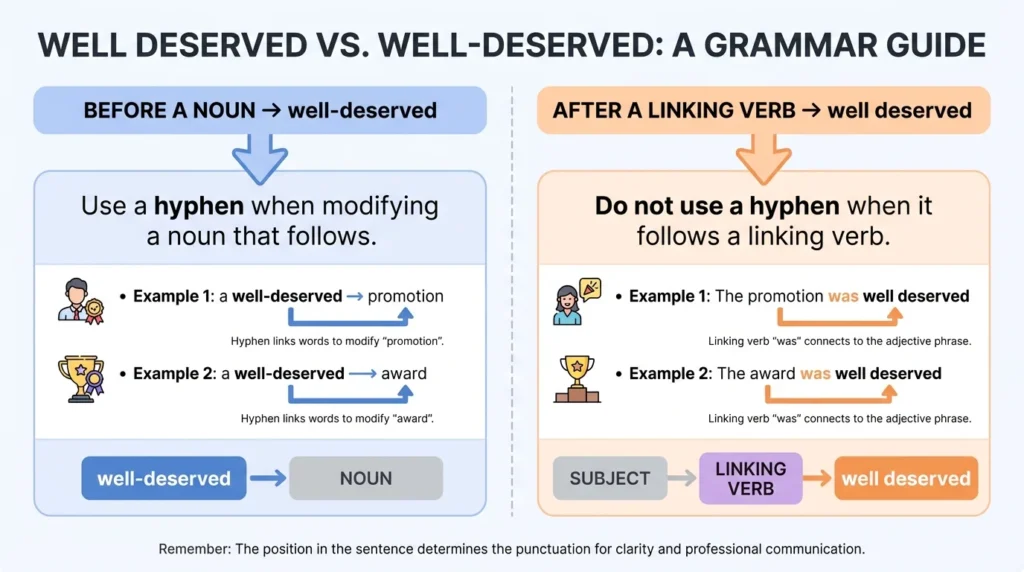
Before a noun: usually use “well-deserved.”
After a linking verb: usually use “well deserved.”
Before a noun
Use the hyphen when well + deserved works together as a compound modifier directly before a noun.
- a well-deserved reward
- a well-deserved break
- a well-deserved promotion
- a well-deserved victory
- a well-deserved reputation
After a linking verb
Leave out the hyphen when the phrase appears after a linking verb such as is, are, was, were, seems, or looks.
- The reward was well deserved.
- Her promotion is well deserved.
- The victory was well deserved.
- His reputation is well deserved.
Read More: Training vs Trainning: Which Spelling Is Correct?
This follows the broader pattern used with many temporary compound adjectives: compounds placed before a noun are commonly hyphenated, while the same compounds used after the noun or linking verb are commonly written open.
How to Use “Well-Deserved”
Use well-deserved when the expression directly describes a noun that follows it.
The basic pattern is:
well-deserved + noun
Examples:
- a well-deserved reward
- a well-deserved vacation
- a well-deserved promotion
- a well-deserved compliment
- a well-deserved opportunity
- a well-deserved victory
The hyphen joins the words into one compound modifier.
Workplace Example
After five years of excellent performance, Maya received a well-deserved promotion.
Here, well-deserved describes promotion, so the hyphenated form is appropriate.
Academic Example
The student received a well-deserved scholarship.
Again, the compound modifier comes immediately before the noun scholarship.
Social Media Example
Congratulations on your well-deserved success!
The phrase directly modifies success, so well-deserved is the natural choice.
When the noun comes immediately after the phrase
A useful test is to look at what comes next.
a well-deserved break
a well-deserved award
a well-deserved rest
a well-deserved victory
If well deserved is functioning as one unit immediately before that noun, the hyphen helps show the reader that the two words belong together.
How to Use “Well Deserved”
Use well deserved without a hyphen when the expression comes after the noun it describes, especially after a linking verb.
The common pattern is:
noun + linking verb + well deserved
Examples:
- The break was well deserved.
- Her award was well deserved.
- His promotion was well deserved.
- Their victory was well deserved.
- The praise was well deserved.
Here, well deserved is not sitting directly before the noun as a compound modifier.
Notice the Difference
She received a well-deserved award.
The award was well deserved.
The meaning is almost identical. The grammatical position changes, so the hyphenation changes.
This distinction is directly reflected in dictionary examples.
Correct Examples
Here are original examples covering common real-world situations.
- Conversation:
“After working all weekend, you deserve a well-deserved break.” - Email:
“Congratulations on your well-deserved promotion.” - Workplace:
“Her leadership earned her a well-deserved place on the executive team.” - School:
“The student received a well-deserved scholarship.” - Academic writing:
“The researcher received well-deserved recognition for the study.” - Social media:
“A well-deserved win after months of preparation!” - Interview:
“I believe the award was well deserved because the team exceeded every target.” - Business report:
“The company received a well-deserved reputation for reliable customer service.” - Personal message:
“Enjoy your vacation—you’ve earned this well-deserved rest.” - Formal announcement:
“The committee concluded that the candidate’s recognition was well deserved.”
Notice that the form changes according to sentence structure, not according to whether the writing is formal or informal.
Incorrect vs. Correct
| ❌ Incorrect | ✅ Correct | Why |
|---|---|---|
| She received a well deserved award. | She received a well-deserved award. | The compound modifier comes directly before the noun award. |
| He earned a well deserved promotion. | He earned a well-deserved promotion. | The phrase modifies promotion before the noun. |
| They enjoyed a well deserved vacation. | They enjoyed a well-deserved vacation. | The compound adjective precedes vacation. |
| It was a well deserved victory. | It was a well-deserved victory. | The modifier comes before victory. |
| She took a well deserved rest. | She took a well-deserved rest. | The phrase directly modifies rest. |
| The award was well-deserved. | The award was well deserved. | After the linking verb was, the phrase is normally open. |
| His success is well-deserved. | His success is well deserved. | The expression follows the linking verb is. |
| Their victory was well-deserved. | Their victory was well deserved. | The compound is being used predicatively rather than before the noun. |
| Her promotion is well-deserved. | Her promotion is well deserved. | The phrase follows is and describes the subject. |
| The recognition was well-deserved. | The recognition was well deserved. | The normal open form is used after the linking verb. |
The word usually matters here. Hyphenation practices can vary among style guides and established compounds, so the position-based rule is a strong practical guide rather than an absolute law covering every English compound.
Read More: Onethird vs One Third: Which Is Correct?
Why People Make This Mistake
The words sound exactly the same
When you hear someone say well deserved, you cannot hear the hyphen.
That creates a natural problem for learners. Spoken English does not tell you whether the writer should use one word, two words, or a hyphenated compound.
For example, these sound essentially the same:
a well-deserved award
The award was well deserved.
The difference becomes visible only in writing.
The spelling looks interchangeable
Because the meaning stays the same, writers often assume the spelling must also stay the same.
That is understandable, but English frequently changes hyphenation depending on grammatical position.
Compare:
- a well-known author
- the author is well known
and:
- a well-written report
- the report is well written
The same general pattern helps explain well-deserved and well deserved.
Autocomplete does not understand every sentence
Spellcheckers and autocomplete tools are useful, but they do not always make the final grammatical decision for you.
A writing program may recognize well-deserved as a valid word without knowing whether your particular sentence requires the hyphen.
For example:
The award was well-deserved.
may look perfectly acceptable to a spellchecker even when your chosen style follows the conventional open form:
The award was well deserved.
Always consider the phrase’s role in the sentence rather than relying only on software.
Learners may overgeneralize the rule
Some writers learn:
“Compound adjectives need hyphens.”
They then hyphenate every occurrence.
That is too broad.
The more useful rule is:
Compound modifiers before a noun are commonly hyphenated; the same temporary compounds after a linking verb are commonly open.
There are exceptions, which is why dictionaries and style guides remain useful.
Common Mistakes Checklist
1. Writing “well deserved award”
Problem: The compound modifier appears immediately before award without a hyphen.
Better:
a well-deserved award
Why: The two words work together as one modifier before the noun.
Read More: Goodmorning vs Good Morning: Which One Is Correct?
2. Writing “was well-deserved”
Problem: The writer carries the hyphen into the predicate position.
Better:
The award was well deserved.
Why: The expression follows the linking verb was.
3. Assuming the meaning changes
The hyphen does not normally create a different meaning here.
well deserved and well-deserved express the same basic idea of something being rightly earned or merited.
4. Treating the hyphen as part of the pronunciation
It is not.
A hyphen is a writing mark. It does not create a separate spoken word or a new pronunciation.
5. Hyphenating automatically
Do not add a hyphen merely because two words appear next to each other.
First ask:
Are these words functioning together as a compound modifier before a noun?
If yes, well-deserved is usually appropriate.
“Well Deserved” in Real English
Before a noun: “well-deserved”
In everyday and professional English, well-deserved is very natural when it appears before a noun. Expressions such as “well-deserved break,” “well-deserved award,” “well-deserved promotion,” and “well-deserved victory” are established and easy for readers to process. The hyphen visually signals that well and deserved work together to describe the noun that follows.
After a linking verb: “well deserved”
After a linking verb, well deserved is the natural open form in many edited styles: “The award was well deserved” or “Her success is well deserved.” Here, the phrase describes the subject rather than acting as a compound modifier immediately before a noun. This is not a different meaning or a different pronunciation. It is primarily a difference in grammatical position and hyphenation.
At the end of a sentence: “well deserved”
You will often see well deserved standing at the end of a sentence, especially in congratulations and informal praise:
That win was well deserved.
You earned it. It was well deserved.
Your success is well deserved.
This construction is natural because the phrase follows the linking verb and completes the description of the subject. It is also common in professional communication when someone is being praised for an achievement.
American vs. British English
There is no meaningful American-versus-British difference in the basic usage rule for this phrase.
Both varieties use well-deserved as a compound modifier before a noun and commonly use well deserved after a linking verb.
For example:
- American: a well-deserved award
- British: a well-deserved award
and:
- American: The award was well deserved.
- British: The award was well deserved.
Dictionary evidence also treats well deserved and well-deserved as forms of the same expression rather than as separate American and British words.
Formal vs. Informal Usage
The hyphenation rule does not change simply because your writing becomes more formal.
Formal writing
Use the form required by the sentence:
The committee presented her with a well-deserved honor.
Her recognition was well deserved.
These forms are appropriate for reports, recommendations, academic writing, business correspondence, and official announcements.
Informal writing
The same distinction applies:
Enjoy your well-deserved break!
You earned it. The break was well deserved.
The key issue is sentence structure, not formality.
Read More: In Line vs Inline: Which One Is Correct?
Comparison Table
| Feature | Well deserved | Well-deserved |
|---|---|---|
| Basic meaning | Rightly earned or merited | Rightly earned or merited |
| Hyphen | No | Yes |
| Typical position | After a linking verb | Before a noun |
| Grammar role | Predicate adjective/phrase | Compound modifier |
| Example | The award was well deserved. | A well-deserved award |
| Common in conversation | Yes | Yes |
| Common in professional writing | Yes | Yes |
| American English | Used | Used |
| British English | Used | Used |
| Meaning difference | Usually none | Usually none |
A Simple Decision Test
When you are unsure, use this three-step test:
- Find the phrase “well deserved.”
- Look at what comes immediately after it.
- If it directly modifies a noun, use “well-deserved.” If it follows a linking verb, normally use “well deserved.”
For example:
She received a well-deserved award.
The phrase comes before award → use the hyphen.
Now:
The award was well deserved.
The phrase follows was → leave the hyphen out.
Memory Trick
Remember:
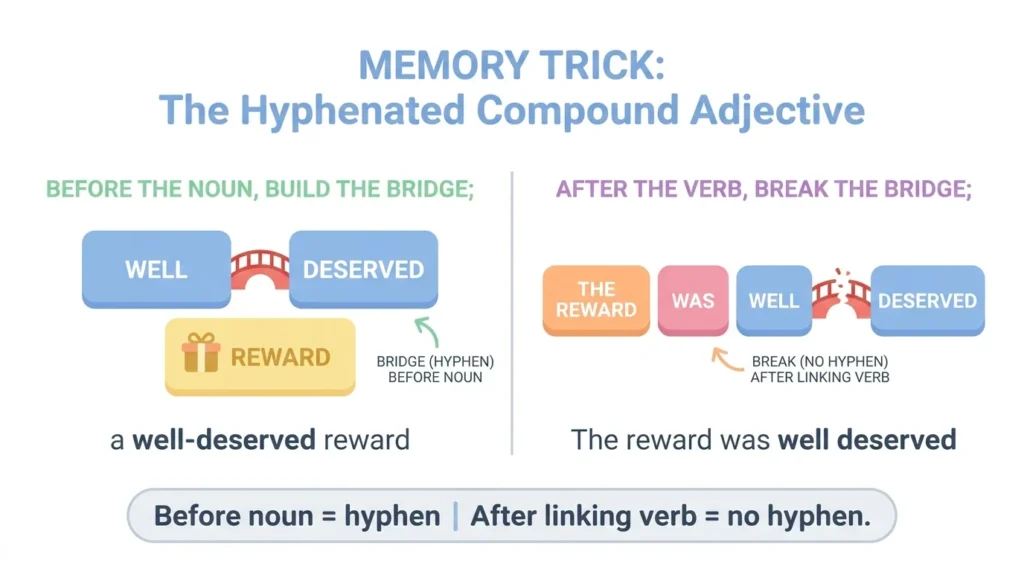
Before the noun, build the bridge. After the verb, break the bridge.
The hyphen is the bridge joining well and deserved when they work together before a noun.
- well-deserved + noun
- noun + well deserved
Think:
A well-deserved reward.
The reward was well deserved.
If you remember those two sentence patterns, most cases become automatic.
Real-Life Situations
In an interview
“I was pleased to receive the award because I felt it was well deserved.”
The phrase comes after felt it was, so no hyphen is needed.
In a workplace email
“Congratulations on your well-deserved promotion!”
The phrase comes before promotion, so use the hyphen.
In a text message
“That was a well-deserved win!”
The phrase directly modifies win, so use well-deserved.
In an academic essay
“The researcher received well-deserved recognition for the originality of the study.”
The compound modifier appears before recognition.
In a formal report
“The recognition was well deserved after years of consistent performance.”
The phrase follows was, so use the open form.
Expert Tips
Tip 1: Look for the noun, not just the word “deserved”
Many writers stare at deserved and wonder whether it needs a hyphen.
Instead, look at the entire phrase.
Ask:
Is “well deserved” immediately describing a noun?
If yes, well-deserved is normally the right choice.
Tip 2: Rewrite the sentence if you are still unsure
You can often make the structure obvious by changing the sentence.
She received a well-deserved award.
can become:
The award she received was well deserved.
The meaning stays almost identical, but the grammatical position changes.
Tip 3: Do not confuse a hyphen with an en dash or em dash
The mark in well-deserved is a hyphen (-).
It is not:
- an en dash (–)
- an em dash (—)
A hyphen connects words within a compound. It should not be replaced with a longer dash.
Tip 4: Follow your publication’s style guide when required
General English gives you a strong starting rule, but publishers, newspapers, universities, and organizations can have house styles.
If your workplace or publication has a specific hyphenation policy, follow it consistently.
Tip 5: Dictionaries can help with established compounds
Hyphenation is not governed by one universal formula for every compound in English. Some compounds become established forms and can behave differently from temporary compounds.
When a phrase seems unusual, check a reliable dictionary or the style guide used by your publication.
FAQ
Is “well deserved” grammatically correct?
Yes. Well deserved is grammatically correct, particularly when the phrase follows a linking verb.
The award was well deserved.
Is “well-deserved” grammatically correct?
Yes. Well-deserved is correct when it functions as a compound modifier before a noun.
She received a well-deserved award.
Which is correct: “well deserved” or “well-deserved”?
Both are correct. The choice usually depends on sentence position. Use well-deserved before a noun and well deserved after a linking verb.
Is “a well deserved award” correct?
In standard edited English, it is normally written a well-deserved award because the compound modifier comes before the noun award.
Is “the award was well-deserved” correct?
You may encounter this form, and some style systems retain hyphens in certain compounds after linking verbs. However, the conventional position-based form for this expression is the award was well deserved.
Does the hyphen change the meaning?
No. The hyphen normally does not change the basic meaning of well deserved. It shows how the words function together in the sentence.
Can I say “well deserved” at the end of a sentence?
Yes. This is very common.
Your success is well deserved.
That victory was well deserved.
Is “well deserved” one word?
No. It is normally written as two words when used in the open form: well deserved.
The compound modifier before a noun is normally well-deserved, with a hyphen.
Should “well deserved” be capitalized?
Normally, no. Capitalize it only when it appears where capitalization is otherwise required, such as at the beginning of a sentence or in a title according to your chosen title style.
A well-deserved award.
Well deserved!
Is “well deserved” formal English?
Yes. It is perfectly acceptable in formal English.
The recognition was well deserved.
The hyphenated form is also appropriate in formal writing:
She received a well-deserved honor.
Is “well-deserved” always hyphenated?
Not in every grammatical position or every possible style system. The safest general rule for this expression is to hyphenate it when it is a compound modifier before a noun and normally leave it open after a linking verb. Established compounds and house styles can create exceptions.
Quick Summary
Well deserved and well-deserved have essentially the same meaning: something is rightly earned, merited, or justified. The main difference is how the phrase functions in a sentence. Use well-deserved when it comes before a noun as a compound modifier: “a well-deserved award.” Use well deserved when it follows a linking verb: “The award was well deserved.” The hyphen helps connect words that work together before a noun. It does not change the pronunciation or basic meaning. This pattern works in everyday conversation, emails, professional writing, academic work, and formal communication. When unsure, identify the noun being described and check whether the phrase comes before it.
Quiz
| # | Question | Answer | Explanation |
|---|---|---|---|
| 1 | She received a ___ promotion. A) well deserved B) well-deserved | B) well-deserved | The phrase comes directly before promotion as a compound modifier. |
| 2 | The promotion was ___. A) well deserved B) well-deserved | A) well deserved | The phrase follows the linking verb was. |
| 3 | Fill in the blank: “They enjoyed a ___ vacation.” | well-deserved | It directly modifies vacation. |
| 4 | Fill in the blank: “Their vacation was ___.” | well deserved | It follows the linking verb was. |
| 5 | Correct the sentence: “He earned a well deserved award.” | He earned a well-deserved award. | The compound modifier comes before award. |
| 6 | Correct the sentence: “Her success was well-deserved.” | Her success was well deserved. | The phrase follows was in the standard position-based pattern. |
| 7 | Which is correct? A) a well-deserved victory B) a well deserved victory | A) a well-deserved victory | The phrase modifies victory before the noun. |
| 8 | Which is correct? A) The victory was well-deserved. B) The victory was well deserved. | B) The victory was well deserved. | The phrase follows the linking verb was. |
| 9 | Fill in the blank: “Congratulations on your ___ achievement!” | well-deserved | It comes directly before achievement. |
| 10 | Fill in the blank: “Your achievement is ___.” | well deserved | It follows the linking verb is. |