

Training is the correct spelling, while trainning is incorrect in standard English. Training can mean the process of learning or teaching skills, preparing for a sport or activity, or developing a particular ability. The base verb is train, and its -ing form is made by simply adding -ing: train → training. Never write trainning in a resume, email, assignment, report, website, or other standard English writing.
What Is Training?
Training is the -ing form of the verb train and is also commonly used as a noun.
As a verb form, it describes an action that is happening or continuing:
- She is training for a marathon.
- The company is training new employees.
- He is training to become a pilot.
As a noun, training refers to the process of learning, teaching, practicing, or preparing for a particular skill, job, activity, or competition. It can also refer to the preparation of a person or system through data in computing and machine learning.
For example:
- The new employees need more training.
- She completed her safety training.
- The athlete is doing intensive training.
- The AI model requires extensive training data.
The spelling does not change according to the meaning.
Training is correct in every one of these uses.
Why It Matters
A one-letter spelling error may seem harmless, but trainning can make otherwise professional writing look careless.
This matters especially when the word appears in:
- Resumes and job applications
- Business emails
- Training manuals
- Company websites
- Academic assignments
- Reports and proposals
- Course descriptions
- Certificates
- Social media posts
- Workplace documents
Compare:
We provide professional trainning for new employees.
with:
We provide professional training for new employees.
The meaning is still understandable in the first sentence, but the spelling is wrong. In professional communication, avoidable spelling errors can distract readers and weaken the impression of accuracy.
The Core Rule
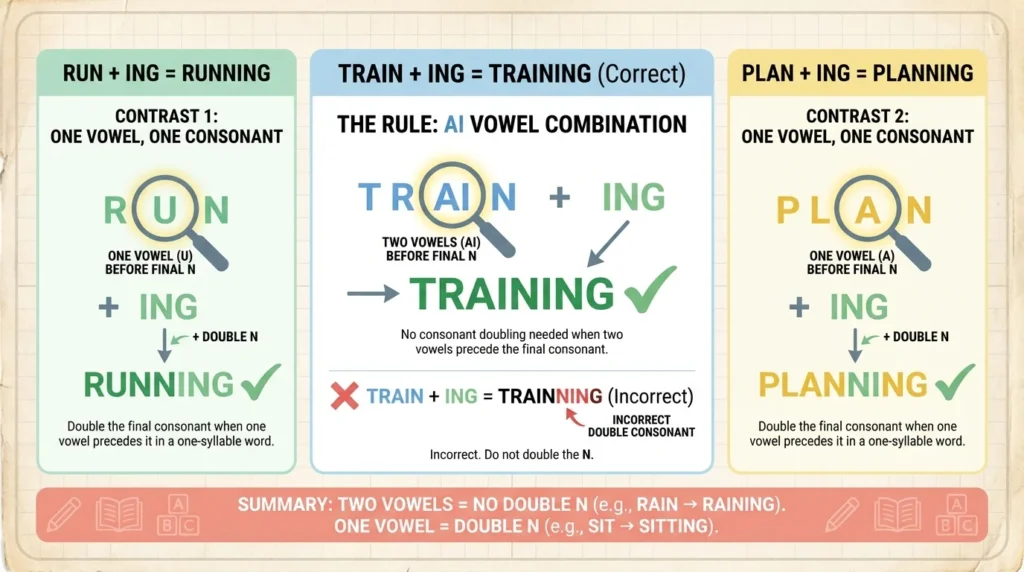
Rule: train + -ing = training. Do not double the final n.
The easiest way to remember it is:
TRAIN → TRAINING
Not:
TRAIN → TRAINNING
Why? Because train ends with the vowel combination ai followed by n. The standard consonant-doubling rule does not apply when two written vowels come immediately before the final consonant.
Read More: Onethird vs One Third: Which Is Correct?
Compare:
| Base verb | Correct -ing form |
|---|---|
| run | running |
| sit | sitting |
| plan | planning |
| stop | stopping |
| swim | swimming |
| train | training |
| rain | raining |
| read | reading |
| paint | painting |
| clean | cleaning |
The important difference is the spelling pattern before the final consonant.
run → one vowel before n → running
train → two written vowels, ai, before n → training
How to Use Training
The word training is used in several common ways.
Training as a noun
When training refers to instruction, preparation, or skill development, it is normally a noun.
Examples:
- The company provides employee training.
- Her medical training took several years.
- We need additional safety training.
- The school offers teacher training.
In this use, training is generally an uncountable noun when referring to the activity or process as a whole.
That is why these forms are natural:
- I received training.
- She needs more training.
- They provide training for staff.
When you need to identify one particular event, course, or session, use a countable noun:
- a training session
- a training course
- a training program
- a training workshop
- a training seminar
Training as a verb form
Training can also be the present participle of train.
For example:
- I am training for the competition.
- She is training new staff.
- They are training to become firefighters.
- He has been training every morning.
The spelling remains training.
Training for a sport
Training is also commonly used for physical preparation.
- The team is in training.
- She is training for the national championship.
- His training starts at six in the morning.
- The players have a training session this afternoon.
Cambridge lists this sporting meaning as preparation for a sport or competition.
Training in the workplace
Workplace English uses training constantly.
Common expressions include:
- employee training
- staff training
- safety training
- leadership training
- sales training
- technical training
- customer-service training
- workplace training
- on-the-job training
- professional training
For example:
All new employees must complete safety training before starting work.
Correct Examples
Here are original examples showing how training works in different real-life contexts.
- Conversation:
“I can’t meet tonight because I have football training.” - Email:
“Please confirm whether the training session will begin at 9 a.m.” - Workplace:
“The company provides customer-service training for all new employees.” - Resume:
“Completed advanced training in digital marketing and analytics.” - Job interview:
“My previous training prepared me to handle difficult customers.” - School:
“The students received first-aid training before the field trip.” - Academic writing:
“Professional training can influence how effectively employees apply new procedures.” - Social media:
“Six weeks of training, and I’m finally ready for race day!” - Sports:
“She is training for her first international competition.” - Business website:
“Our training programs help managers develop practical leadership skills.” - Technology:
“The system requires additional training data to improve its performance.” - Everyday writing:
“His experience as a volunteer was valuable training for his future career.”
Incorrect vs. Correct
| ❌ Incorrect | ✅ Correct | Why |
|---|---|---|
| We offer employee trainning. | We offer employee training. | Train takes -ing without doubling the n. |
| She completed her trainning yesterday. | She completed her training yesterday. | The extra n is not part of the standard spelling. |
| The staff need more trainning. | The staff need more training. | Training is the standard noun. |
| He is trainning for the race. | He is training for the race. | The present participle is training. |
| The company provides safety trainning. | The company provides safety training. | The spelling remains training in compound expressions. |
| I attended a trainning course. | I attended a training course. | Training modifies course. |
| Our new trainning program starts Monday. | Our new training program starts Monday. | No extra n is added. |
| She needs professional trainning. | She needs professional training. | The noun is spelled with one n after ai. |
| We are trainning new employees. | We are training new employees. | Training is the -ing form of train. |
| His military trainning was extensive. | His military training was extensive. | Trainning is a spelling error, not a regional variant. |
| The trainer is conducting trainning today. | The trainer is conducting training today. | The standard spelling is always training. |
| Online trainning is available. | Online training is available. | The same spelling applies in digital and workplace contexts. |
Why People Make This Mistake
The most important reason is overgeneralization.
English has a real rule that sometimes doubles the final consonant when -ing is added. Learners see examples such as:
- run → running
- sit → sitting
- plan → planning
- swim → swimming
- stop → stopping
It is therefore easy to assume:
“The verb ends in n, so I should double the n.”
But that is not how the rule works.
Phonetic similarity
The words training, running, and beginning all contain an n sound, but pronunciation alone does not determine whether the letter should be doubled.
Spelling depends on the structure of the base word.
Spelling overlap
Words such as running and planning create a visual pattern:
run + ning
plan + ning
A learner may then unconsciously apply the same pattern to:
train + ning
That produces the incorrect trainning.
Read More: Goodmorning vs Good Morning: Which One Is Correct?
Overgeneralization
This is the main grammar-learning problem: taking a rule that works in some cases and applying it to every similar-looking case.
The doubling rule is conditional. It does not mean:
“Double the final consonant whenever you add -ing.”
Autocomplete and spellcheck
Typing quickly can also cause the mistake. If you have seen trainning repeatedly online, your brain may accept it as familiar even though familiarity does not make a spelling standard.
Spellcheck can help, but it should not replace understanding. A dictionary or reliable spelling reference is more useful when you are uncertain.
Translation interference
English learners may also transfer spelling patterns from another language. A word that looks as though it should contain a double consonant in one language may not follow the same pattern in English.
The safest strategy is to learn the English word as a complete form:
train → training
rather than relying only on pronunciation.
Common Mistakes Checklist
1. Writing “trainning”
What happens: You add an unnecessary second n.
Why: You are applying the doubling rule too broadly.
Avoid it: Remember that train contains ai before its final n.
2. Writing “trainned”
The same confusion can appear in the past-tense form.
Correct:
train → trained
Incorrect:
train → trainned
The final n is not doubled.
3. Writing “trainner”
The noun is:
trainer
Not:
trainner
The same base spelling remains visible.
4. Thinking “trainning” is British English
It is not a British spelling variant.
Standard English uses:
training
in both British and American English.
5. Relying only on sound
The sound of a word does not tell you how many letters to write.
Use the spelling of the base verb as your starting point.
6. Assuming every short verb doubles its final consonant
Not every short verb follows the doubling pattern.
Compare:
- run → running
- sit → sitting
- train → training
- rain → raining
- clean → cleaning
The letters immediately before the final consonant matter.
7. Using “a training” automatically
When training means the general activity or process, it is normally uncountable.
Natural:
I received training.
More specific:
I attended a training session.
In some varieties of English, especially in international business contexts, a training can be encountered, but a training session, a training course, or simply training is usually clearer and more broadly natural in standard international usage.
Training in Real English
Grammatically correct
Training is completely standard English. It works naturally as a noun for instruction or preparation and as the present participle of train. Expressions such as employee training, safety training, sports training, and training for a competition are ordinary English. The spelling does not change between these uses. The important point is that the correct form always contains one n after the ai: training.
Grammatically possible but unnatural
Some expressions involving training may be understandable but sound less natural depending on the context. For example, “I attended a training” can occur in international workplace English, but many speakers would prefer “I attended a training session,” “I attended a training course,” or simply “I attended training.” The issue here is not spelling or basic grammar; it is countability and natural word choice.
Natural, everyday English
In everyday English, speakers commonly say “I have training,” “I’m in training,” “I’m training for a race,” “I completed the training,” or “We need more training.” When referring to a specific event, training session, training course, or training workshop is often the clearest choice. The exact phrase depends on the context, but the spelling training never changes.
Read More: In Line vs Inline: Which One Is Correct?
American vs. British English
There is no spelling difference between American and British English for training.
Both use:
training
Neither standard variety uses:
trainning
Some English spelling differences do exist between the two varieties, but training is not one of them.
For example:
- American English: training
- British English: training
The pronunciation is also essentially the same, with the word commonly represented as /ˈtreɪ.nɪŋ/.
Formal vs. Informal Usage
Training works in both formal and informal English.
Formal
- employee training
- professional training
- vocational training
- technical training
- mandatory safety training
- staff training requirements
Example:
All employees must complete mandatory safety training before accessing the facility.
Informal
- football training
- gym training
- training for a race
- training every morning
Example:
I can’t come tonight. I’ve got training.
The spelling is identical in both registers.
Comparison Table
| Feature | Training | Trainning |
|---|---|---|
| Standard English spelling | ✅ Yes | ❌ No |
| Base word | train | train |
| Formation | train + -ing | Incorrect formation |
| Meaning | Learning, preparation, or the act of training | No standard English meaning |
| Used as a noun | Yes | No |
| Used as a verb form | Yes | No |
| Used in American English | Yes | No |
| Used in British English | Yes | No |
| Suitable for formal writing | Yes | No |
| Suitable for resumes | Yes | No |
| Suitable for academic writing | Yes | No |
| Correct spelling | training | trainning |
When Do We Double the Final Consonant?
Understanding the wider rule makes training much easier to remember.
English often doubles the final consonant before -ing when a short stressed syllable ends in a consonant-vowel-consonant pattern.
Examples:
- run → running
- sit → sitting
- stop → stopping
- plan → planning
- swim → swimming
For longer words, stress matters too:
- begin → beginning
- prefer → preferring
- admit → admitting
Cambridge explains that consonant doubling is associated with specific spelling and stress conditions, and specifically notes that the final consonant is not doubled when two written vowels occur before it.
Now look at train:
t-r-a-i-n
The letters immediately before the final n are ai, two written vowels.
Therefore:
train + ing → training
not:
train + ing → trainning
Compare these patterns
| Pattern | Base word | -ing form |
|---|---|---|
| Short vowel + consonant | run | running |
| Short vowel + consonant | sit | sitting |
| Short vowel + consonant | stop | stopping |
| Two written vowels + consonant | train | training |
| Two written vowels + consonant | rain | raining |
| Two written vowels + consonant | clean | cleaning |
| Two written vowels + consonant | read | reading |
| Two written vowels + consonant | paint | painting |
The spelling pattern is more reliable than simply listening for the final consonant sound.
Memory Trick
Use this simple mnemonic:
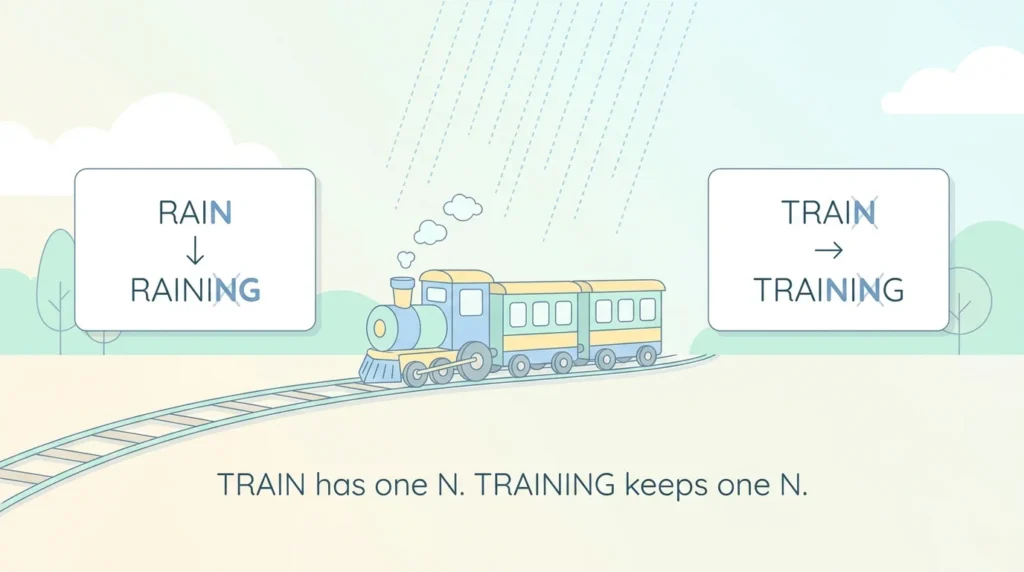
TRAIN has one N. TRAINING keeps the one N.
Or remember:
RAIN → RAINING
TRAIN → TRAINING
If rain does not become rainning, then train does not become trainning.
Think:
AI stays calm; N stays single.
That gives you a quick visual check whenever you hesitate.
Read More: Stigmatism vs. Astigmatism: Which Word Is Correct?
Real-Life Situations
Job interview
Question: “What professional training have you completed?”
Good answer:
“I completed advanced customer-service training and received additional training in conflict resolution.”
Workplace meeting
A manager might say:
“We need to schedule training for the new software before the system goes live.”
Not:
“We need to schedule trainning.”
Subject: Staff Training Schedule
The next staff training session will take place on Monday at 10 a.m.
Text message
“Can’t make dinner tonight. I’ve got training.”
Here, training is natural and informal.
Resume
Professional Training:
Digital Marketing, SEO, Project Management, and Business Communication
A resume is exactly the kind of document where spelling training correctly matters.
Academic writing
“Professional training can improve employees’ ability to apply newly introduced procedures.”
The word remains training even in formal academic prose.
Expert Tips
Start with the base word
When spelling an -ing form, do not begin with the sound of the finished word.
Start with:
train
Then add:
-ing
You get:
training
Learn spelling families
Instead of memorizing only one word, connect related forms:
- train
- trains
- trained
- training
- trainer
- trainee
- retrain
- retraining
Seeing the family makes the spelling pattern easier to retain.
Watch for the “double consonant” trap
When you see a word such as running, ask why the n is doubled.
It is not simply because the word ends in n.
There is a specific spelling condition behind the doubling.
Do not invent a spelling from pronunciation
Training sounds like it has a strong n sound, but that does not mean the written word needs two n’s.
English spelling and pronunciation do not always correspond one-to-one.
Use the correct phrase for countability
Prefer:
- employee training
- a training session
- a training course
- a training program
- several training sessions
rather than automatically treating training as a countable event.
Remember the past form too
If you know:
train → trained
you can reinforce the same spelling family:
train → training → trainer → trained
There is no reason to insert an extra n.
Common Related Forms
| Word | Correct? | Example |
|---|---|---|
| train | ✅ | I train every morning. |
| trained | ✅ | She trained as a teacher. |
| training | ✅ | He completed his training. |
| trainer | ✅ | The trainer explained the exercise. |
| trainee | ✅ | Each trainee received a handbook. |
| retrain | ✅ | The company will retrain its staff. |
| retraining | ✅ | Staff retraining begins next month. |
| trainning | ❌ | Incorrect spelling |
| trainned | ❌ | Incorrect spelling |
| trainner | ❌ | Incorrect spelling |
How to Remember Training vs Trainning
Use the three-step test:
- Find the base word: train.
- Look before the final n: the letters are ai.
- Add -ing without doubling: training.
So:
TRAIN + ING = TRAINING
This approach is better than memorizing a complicated exception because it connects the correct spelling to the underlying word structure.
FAQ
Is “training” or “trainning” correct?
Training is correct. Trainning is an incorrect spelling in standard English.
Why is “trainning” wrong?
Because the final n in train does not need to be doubled before adding -ing. The word contains the vowel combination ai before the final consonant, so the usual consonant-doubling pattern does not apply.
What is the correct spelling of training?
The correct spelling is:
T-R-A-I-N-I-N-G
There is only one n after ai and another n as part of -ing.
Is “trainning” a British spelling?
No. Trainning is not a standard British spelling. British and American English both use training.
Is training a noun or a verb?
It can be both, depending on the sentence. As a noun, training can mean instruction or preparation. As the present participle of train, it can describe an ongoing action, as in “She is training for a race.”
Can I say “a training”?
It depends on the variety and context. In some international workplace English, a training is encountered. However, training is normally uncountable when referring to the general process. For one specific event, a training session, a training course, or a training workshop is usually more natural.
What is the plural of training?
When training means instruction or the process of developing skills, it is normally uncountable, so you generally do not write trainings. Use phrases such as training sessions, training courses, or training programs when you mean separate events or programs.
What is the past tense of train?
The past tense is trained.
Correct:
She trained for six months.
Incorrect:
She trainned for six months.
Why does running have two n’s but training has one?
Running follows a consonant-doubling pattern because run ends in a single vowel followed by a single consonant. Train has the vowel combination ai before its final n, so it does not meet that pattern.
Is “training” pronounced differently from “trainning”?
There is no standard English pronunciation corresponding to trainning as a separate word. Training is commonly pronounced /ˈtreɪ.nɪŋ/.
Is “training” used in professional English?
Yes. It is extremely common in workplace English, including phrases such as employee training, professional training, safety training, and on-the-job training.
Mini Quiz
| # | Question | Answer | Explanation |
|---|---|---|---|
| 1 | Which spelling is correct: training or trainning? | Training | The base word is train, and the final n is not doubled. |
| 2 | Complete: “She is ___ for the marathon.” | training | The -ing form of train is training. |
| 3 | Choose: “We provide employee training / trainning.” | training | Training is the standard noun. |
| 4 | Correct the sentence: “He completed his trainning yesterday.” | “He completed his training yesterday.” | The extra n must be removed. |
| 5 | Which is correct: trained or trainned? | trained | The past form also keeps a single n. |
| 6 | Fill in the blank: “The company offers safety ___.” | training | Safety training is the standard expression. |
| 7 | Which spelling is correct: “training session” or “trainning session”? | training session | Training is the correct spelling. |
| 8 | Correct the sentence: “I am trainning new employees.” | “I am training new employees.” | Training is the present participle of train. |
| 9 | Why isn’t the n doubled in training? | Because train has ai before the final n. | The usual consonant-doubling pattern does not apply. |
| 10 | Choose the more natural phrase for one specific event: “a training” or “a training session.” | a training session | Training is generally uncountable when referring to the process; session makes the individual event countable. |
Quick Summary
Training is the correct spelling, and trainning is incorrect in standard English. The word comes from the verb train plus the suffix -ing: train + ing = training. The final n is not doubled because train contains the two written vowels ai before the final consonant.
This is different from words such as run → running and plan → planning, where the consonant-doubling rule applies. Training can function as a noun or as the present participle of train. It is used in workplace, academic, sports, professional, and everyday English. American and British English both spell it training. When referring to one specific event, training session or training course is often clearer than a training.