
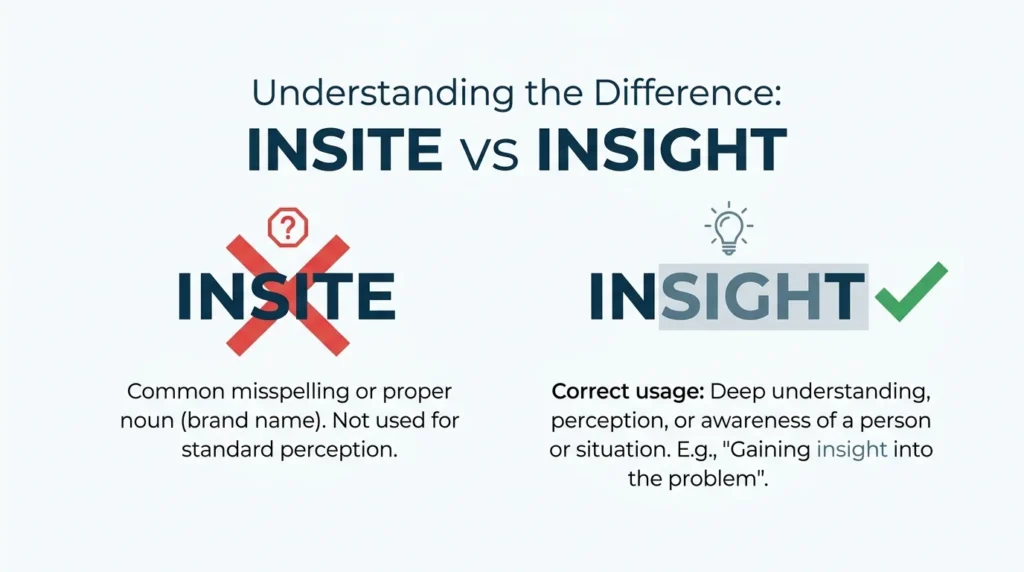

Insight is the correct standard English word when you mean a deep or clear understanding of a person, problem, situation, or idea. Insite is normally a misspelling in this context. However, InSite or INSITE can be correct when it is the official name of a company, product, software program, project, or other proper noun.
If you are writing, “The research gave us valuable ___ into customer behavior,” the correct word is insight.
What Is the Difference Between Insite and Insight?
The insite vs insight question is mainly a spelling issue rather than a comparison between two ordinary English vocabulary words.
Insight is a noun. It refers to clear, deep understanding or to a particular realization that helps someone understand something better. Dictionaries also recognize both countable uses, such as “an insight” or “several insights,” and uncountable uses, such as “considerable insight.”
Insite, by contrast, should not replace insight when you mean understanding.
That does not mean the letter sequence InSite can never appear correctly. Organizations and software products may choose InSite, Insite, or INSITE as an official proper name. In that situation, you reproduce the name exactly as its owner styles it.
Compare:
- She has excellent insight into customer behavior.
- The study produced several useful insights.
- We installed INSITE software.
- The report gave us valuable insite into the problem. ❌
The last sentence is incorrect because the writer means understanding, not a proper name.
Why the Correct Spelling Matters
Writing insite instead of insight can look like a small typo, but it is especially noticeable in places where accuracy matters.
Imagine writing:
“Our analysis provides valuable insite into market trends.”
The reader can probably understand the intended meaning, but the spelling mistake may reduce confidence in the proofreading of the report.
The same problem can occur in:
- job applications
- academic assignments
- professional emails
- research papers
- business presentations
- marketing reports
- client proposals
- website content
The distinction matters even more because InSite can genuinely be a proper name. A writer therefore needs to distinguish between an ordinary vocabulary word and an official name rather than assuming every appearance of InSite is a typo.
The Core Rule
RULE: If you mean understanding, perception, or a revealing realization, write insight with -sight.
Use InSite/Insite/INSITE only when that spelling is part of an official proper name.
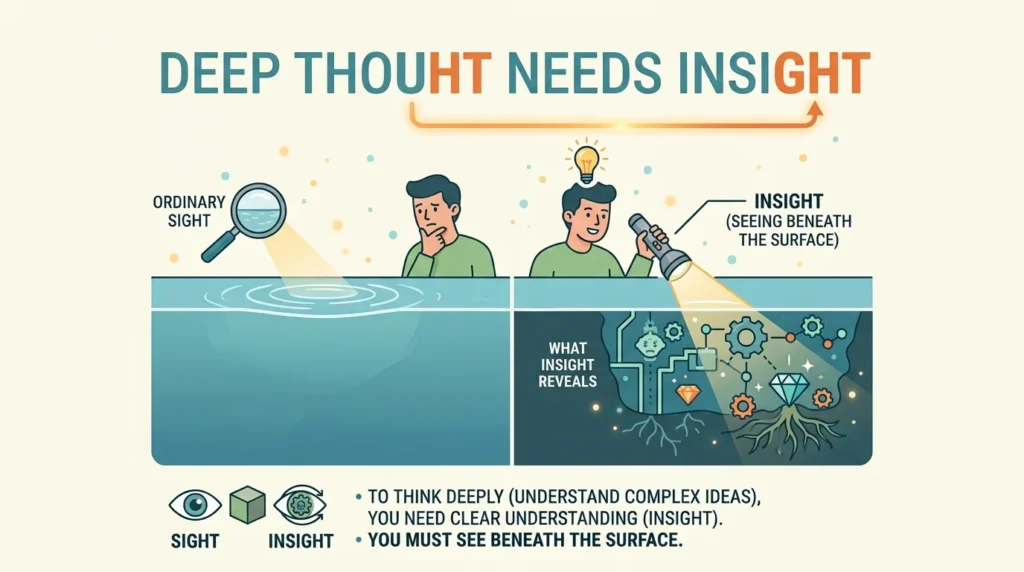
The spelling makes more sense if you notice the word sight inside insight. The modern meaning is mental rather than physical: insight allows you to understand what is beneath the surface of a situation.
Major dictionary entries define insight as a noun connected with deep understanding and discernment.
How to Use Insight Correctly
Use Insight for Deep Understanding
Use insight when someone understands a situation more deeply than before.
Example:
Her years of experience gave her insight into how customers make purchasing decisions.
The sentence does not merely mean that she possesses information. It suggests that she understands an important pattern or underlying reason.
Use An Insight for One Particular Realization
Insight can be countable.
You can therefore write:
- an insight
- one insight
- a useful insight
- several insights
- three important insights
This use refers to individual observations or realizations.
Example:
The interview produced three unexpected insights about employee motivation.
Dictionary evidence recognizes insight as a variable noun and gives insights as its plural form.
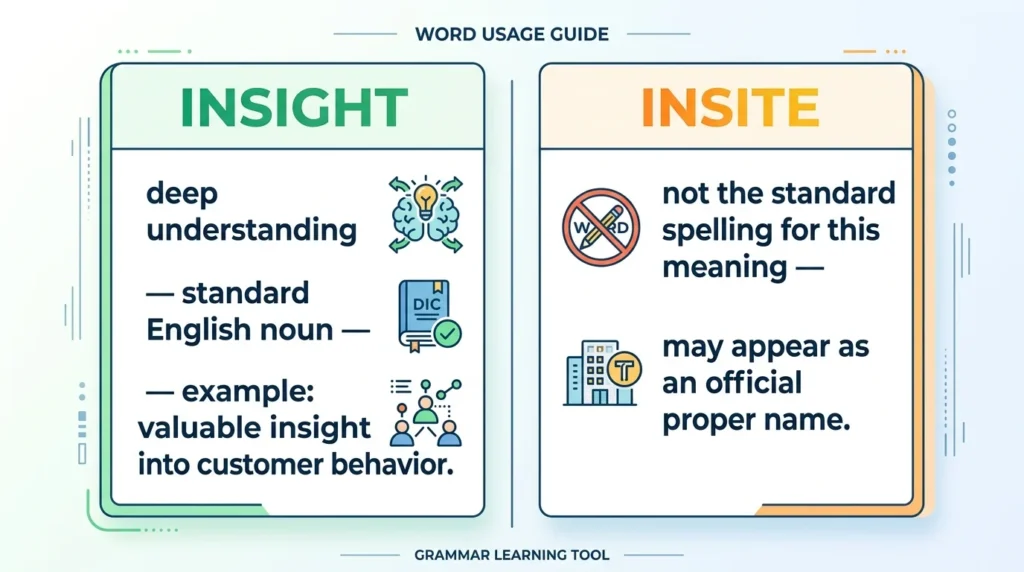
Use Insight as an Uncountable Noun
The word can also describe a general ability or quality of understanding.
Example:
She handled the conflict with patience and remarkable insight.
Here, you are not counting individual realizations. Insight describes her overall depth of understanding.
Compare:
- Countable: He shared two valuable insights.
- Uncountable: He showed considerable insight.
Both constructions are standard.
Insight Into Is an Especially Useful Pattern
When insight is followed by the thing being understood, insight into is a standard and highly natural construction.
Examples include:
- insight into consumer behavior
- insight into the problem
- insight into human relationships
- insight into how the system works
- insight into the causes of the decline
Major dictionary examples repeatedly use the construction insight into when describing understanding of a subject or situation.
Do Not Use Insight as a Normal Verb
Insight functions as a noun in standard uses discussed here.
❌ The research insights us into customer behavior.
✅ The research gives us insight into customer behavior.
If you need a verb, choose one that expresses the intended action:
- understand
- reveal
- explain
- discover
- recognize
- analyze
You can also use the related adjective insightful, meaning that something shows clear or perceptive understanding.
Correct Examples of Insight
These original examples show how insight works across different situations.
- Conversation: Talking to my grandfather gave me new insight into how the neighborhood has changed.
- Email: Your feedback gave us useful insight into the problem with the checkout process.
- School: The novel offers insight into the main character’s fear of failure.
- Workplace: Customer interviews provided valuable insight into why users cancel their subscriptions.
- Meeting: Priya shared an insight that changed the team’s approach to the launch.
- Social media: The video gives viewers an interesting insight into how handmade glass is produced.
- Academic writing: The findings provide insight into the relationship between sleep and attention.
- Business: The sales data revealed several important insights about seasonal demand.
- Job interview: Working with international clients gave me insight into different communication styles.
- Research: The experiment produced an unexpected insight into how participants responded to uncertainty.
- Personal reflection: Keeping a journal gave him greater insight into his decision-making habits.
- Management: Her experience gave her considerable insight into resolving disagreements between teams.
Read More: Faring vs Fairing: What’s the Difference?
Notice how insight can refer either to general understanding or to one or more individual realizations.
Insite vs Insight: Incorrect and Correct Examples
| ❌ Incorrect | ✅ Correct | Why |
|---|---|---|
| The survey gave us useful insite. | The survey gave us useful insight. | The sentence refers to understanding, so insight is required. |
| She has excellent insite into human behavior. | She has excellent insight into human behavior. | Insight is the standard noun for deep understanding. |
| The article contains several valuable insites. | The article contains several valuable insights. | The plural of insight is insights. |
| His experience provided insite into the industry. | His experience provided insight into the industry. | Understanding is meant, not a proper name. |
| The research insights customer behavior. | The research provides insight into customer behavior. | Insight is not being used as a normal verb here. |
| She gave me an insite into the process. | She gave me an insight into the process. | One particular realization can be called an insight. |
| We gained several insight from the interviews. | We gained several insights from the interviews. | A plural determiner such as several requires the plural form. |
| The report gave us a valuable insight into five unrelated findings. | The report gave us valuable insights into five unrelated findings. | Multiple distinct findings are more naturally expressed with the plural. |
| His comment gave me insight of the problem. | His comment gave me insight into the problem. | Insight into is the standard construction for understanding something. |
| The professor showed a great insite into the subject. | The professor showed great insight into the subject. | Insight is the correct noun, and the uncountable construction works naturally here. |
Why People Write Insite Instead of Insight
The Words Sound the Same When Insite Is Read as a Name
A learner who hears /ˈɪn.saɪt/ cannot determine from sound alone whether the middle letters should be site or sight.
The pronunciation of insight contains no separate spoken sound corresponding to the letters gh, so a spelling based purely on sound can easily become insite. Dictionary pronunciation guides show insight pronounced with the first syllable stressed.
Site and Sight Already Cause Confusion
English contains two familiar words that sound alike:
site = a place or location
sight = vision, something seen, or the ability to see
Because insight contains the sound of site, writers may unconsciously substitute the more familiar spelling.
The meaning of insight, however, is historically and conceptually associated with sight, not with a physical site or location.
Writers May Overgeneralize From Words Ending in -site
English contains familiar compounds and expressions involving site, such as:
- website
- campsite
- worksite
- job site
- construction site
A writer may therefore assume that the final sound in insight should also be written site.
That pattern does not apply here.
Brand Names Can Make InSite Look Like an Alternative Spelling
This source of confusion is real.
InSite and INSITE are used as official names by companies and software products. Seeing those names repeatedly online can make insite appear to be a normal alternative spelling of insight, even though the two uses belong to different categories.
Autocomplete and Spellcheck Cannot Always Determine Your Meaning
A spelling tool works from context and its own vocabulary. Proper names complicate the task.
If InSite is recognized as a company or product name, a program may allow it even when you actually meant insight. Likewise, autocomplete may reproduce a previously typed proper name.
Do not rely on the absence of a red underline as proof that a word fits your intended meaning.
Translation Can Encourage Sound-Based Spelling
This mistake is not tied to one particular first language.
English learners who first encounter insight in speech may try to reproduce the sound with familiar spelling patterns. Because the silent gh cannot be heard, insite is an understandable phonetic guess.
The solution is to connect spelling with meaning: insight contains sight.
Read More: Check-In vs. Check In: Which One Is Correct?
Common Mistakes Checklist
Before submitting important writing, check for these errors:
- Writing insite when you mean understanding.
This is the central error. Search for insite during proofreading and replace it with insight unless it is genuinely a proper name. - Automatically correcting every InSite to insight.
Do not alter an official company, software, product, or project name. Verify how the organization styles its own name. - Writing insites as the plural.
The correct plural is insights. - Treating insight only as countable.
“Several insights” is correct, but so is uncountable “considerable insight.” - Treating insight only as uncountable.
You may correctly say “an insight” when referring to one specific realization. - Using insight as a verb.
Write “gave insight,” “provided insight,” “revealed,” or another appropriate verb instead. - Confusing insight with in sight.
Insight concerns understanding. In sight is a two-word phrase referring to something visible or within reach. - Confusing insight with incite.
Insight is a noun connected with understanding. Incite is a verb meaning to stir or move people toward action.
Insite vs Insight in Real English
Grammatically Correct English
Insight works as both a countable and uncountable noun. You can therefore write “an important insight,” “three useful insights,” or “considerable insight.” A particularly established pattern is insight into + subject, as in “The study provides insight into consumer behavior.” These constructions are standard in everyday, professional, and academic English.
Grammatically Possible but Less Natural English
A sentence can sometimes be understandable without sounding like the wording most speakers would naturally choose. For example, “The report gives an insight about the process” communicates the idea, but “gives insight into the process” will usually be smoother when you mean deeper understanding of how something works. Do not mechanically replace every preposition, though; choose wording based on the exact relationship you want to express.
Natural Everyday English
In everyday speech and writing, people commonly say that something gave them insight, provided insight, offered insight, or gave them an insight into something. When discussing several separate discoveries, insights sounds natural: “The interviews gave us some useful insights.” When describing someone’s general perceptiveness, the uncountable form works naturally: “She has remarkable insight.” These patterns also align with established dictionary examples and collocations.
Formal vs Informal Usage
There is no rule that makes insight exclusively formal or informal. The word works in both settings.
Formal and Professional English
Formal writing often uses constructions such as:
- provide insight into
- offer insight into
- gain insight into
- valuable insights
- research insights
- strategic insights
- customer insights
Example:
The findings provide further insight into the factors affecting employee retention.
Informal English
In conversation, simpler constructions often sound more relaxed:
- That gave me a new insight.
- I finally gained some insight into what happened.
- That’s an interesting insight.
- Talking to her helped me understand it better.
In very casual conversation, speakers may choose understanding, idea, or realization instead of insight when they do not need the stronger sense of deep perception.
Insite vs Insight Comparison Table
| Feature | Insight | Insite |
|---|---|---|
| Standard spelling for deep understanding | Yes | No |
| Main grammatical role | Noun | Usually not an ordinary vocabulary word in this meaning |
| Meaning | Deep understanding, perception, or a revealing realization | No standard alternative meaning equivalent to insight |
| Singular countable form | an insight | an insite ❌ |
| Plural | insights | insites ❌ when understanding is meant |
| Uncountable use | Yes | No in this meaning |
| Common construction | insight into something | — |
| Appropriate in essays | Yes | No, unless it is an official name |
| Appropriate in professional emails | Yes | Only as a verified proper name |
| Can appear as a brand/product name | Yes, depending on the name | Yes |
| Related spelling clue | contains sight | resembles site |
Insight, In Sight, Site, Sight, and Incite
The spelling problem becomes easier when the related forms are separated clearly.
| Term | Meaning | Example |
|---|---|---|
| insight | deep understanding | The research gave us insight into the issue. |
| in sight | visible or within reach | The finish line is finally in sight. |
| site | a place or location | Construction started at the new site. |
| sight | vision or something seen | The waterfall was an impressive sight. |
| incite | encourage or stir up action | The speech was accused of trying to incite unrest. |
The two-word phrase in sight has a genuinely different meaning from the one-word noun insight.
Incite is also grammatically different: it is a verb, while insight is a noun.
Memory Trick
Remember:
Deep thouGHT needs insiGHT.
Both thought and insight keep the letters ght.
You can also picture the word this way:
IN + SIGHT = seeing deeply into something
You are not talking about a physical site. You are mentally “seeing” beneath the surface of an idea or situation.
Read More: Skiid vs Skied: Which Spelling Is Correct?
Real-Life Situations
Job Interview
Interviewer: What did your previous role teach you?
Natural answer:
“Working directly with customers gave me valuable insight into what influences their buying decisions.”
Using insite here would look like a spelling error in a written application.
Business Meeting
A manager might say:
“Our customer interviews produced three useful insights.”
The plural works because the manager is talking about three separate findings.
Professional Email
Correct:
“Thank you for your feedback. It gave us useful insight into the difficulties users are experiencing.”
This wording is professional without sounding overly formal.
Text Message
You might write:
“That conversation gave me a completely new insight into why she made that decision.”
You could also use the more casual:
“Now I understand why she did it.”
Both are natural; the second simply uses more everyday vocabulary.
Exam or Academic Assignment
Correct:
“The narrator’s changing attitude provides insight into the central conflict of the novel.”
In academic analysis, insight is useful when you are describing what evidence helps a reader understand at a deeper level.
Expert Tips
- Proofread by meaning, not only by spelling.
Ask, “Do I mean understanding?” If yes, the word is almost certainly insight. - Look for the word sight inside insight.
This is more reliable than trying to spell the word from pronunciation. - Remember that insight has two noun patterns.
Use insight for general understanding and an insight/insights for individual realizations. - Use insight into when you are unsure about the preposition.
It is an established construction for describing understanding of a subject. - Do not “correct” verified proper names.
If an organization officially calls a product InSite or INSITE, preserve its spelling. - Watch for a second error after fixing insite.
Changing insites to insight is not enough if the sentence requires the plural insights. - Use simpler vocabulary when insight sounds unnecessarily abstract.
Depending on the sentence, understanding, realization, observation, or perspective may communicate the idea more precisely.
Quick Summary
Insight is the correct standard spelling when you mean deep understanding, clear perception, or a useful realization. Insite should not be used as an alternative spelling in ordinary sentences, although InSite, Insite, or INSITE may legitimately appear as an official proper name. Insight is a noun and can be countable (“an insight,” “several insights”) or uncountable (“great insight”). A common and natural construction is insight into something. Do not confuse insight with in sight, meaning visible or within reach, or incite, a verb meaning to stir people toward action. The easiest spelling reminder is to notice sight inside insight: deep thought needs insight.
FAQ
Is insite a real word?
Insite is not the standard spelling of the noun meaning deep understanding. If that is your intended meaning, write insight. However, InSite, Insite, or INSITE may be legitimate when used as an official proper name, such as a company or software name.
Which is correct: insite or insight?
Use insight when talking about understanding, perception, or a revealing realization.
Correct: Her comments gave me valuable insight.
How do you spell insight?
The correct spelling is:
I-N-S-I-G-H-T
A useful clue is that it contains the complete word sight.
Is insight one word or two words?
Insight is one word when it means understanding.
In sight is two words when you mean visible, approaching, or within reach.
Compare:
“The interviews gave us insight.”
“The finish line is in sight.”
The two-word phrase has a separate dictionary meaning.
Is insight singular or plural?
It can be singular, plural, or uncountable depending on the sentence.
- an insight
- one insight
- several insights
- some insight
- considerable insight
The regular plural is insights.
Can I say “an insight”?
Yes. An insight means one particular realization or piece of deep understanding.
Example:
“She had an important insight while reviewing the results.”
Can I say “some insights”?
Yes. Some insights refers to multiple observations or realizations.
Example:
“The interviews produced some unexpected insights.”
If you mean understanding in a general sense, you can also say some insight.
What is the difference between insight and knowledge?
Knowledge is information or understanding someone possesses. Insight usually suggests seeing a deeper relationship, cause, pattern, or truth within that information.
Someone may know many facts about a problem without yet having much insight into why the problem occurs.
What is the adjective form of insight?
The common adjective is insightful.
Example:
“She made an insightful observation.”
The adjective describes something that shows clear or perceptive understanding.
Is “insight into” correct?
Yes. Insight into is a well-established construction.
Examples:
- insight into human behavior
- insight into the company’s strategy
- insight into why the experiment failed
Dictionary examples frequently use this pattern.
What’s the difference between insight and incite?
Insight is a noun meaning deep understanding.
Incite is a verb meaning to stir, encourage, or move people toward an action.
Example:
“The study provides insight into the conflict.”
“The inflammatory message could incite further violence.”
The words also differ in stress: insight stresses the first syllable, whereas incite stresses the second.
Mini Quiz
| # | Question | Answer | Explanation |
|---|---|---|---|
| 1 | Choose the correct word: “The report gave us valuable ___ into customer behavior.” A) insite B) insight | B) insight | The sentence refers to understanding, so insight is the correct standard spelling. |
| 2 | Fill in the blank: “The interviews produced several useful ___.” | insights | Several requires the plural form insights. |
| 3 | Correct the sentence: “Her experience gave her excellent insite into the industry.” | Her experience gave her excellent insight into the industry. | Insight is the noun meaning deep understanding. |
| 4 | Choose the correct form: “The end of the project is finally ___.” A) insight B) in sight | B) in sight | In sight is the two-word phrase meaning visible or approaching. |
| 5 | True or false: “Insight” can only be an uncountable noun. | False | It can be uncountable, but it can also be countable: an insight, two insights. |
| 6 | Fill in the blank: “The professor shared an interesting ___ about the results.” | insight | One particular realization can be called an insight. |
| 7 | Correct the sentence: “The data insights us into customer preferences.” | The data gives us insight into customer preferences. | Insight is functioning as a noun here, not a verb. |
| 8 | Choose the best sentence: A) The study offers insight into the problem. B) The study offers insite into the problem. | A | When understanding is intended, the correct spelling is insight. |
| 9 | A software product is officially named “InSite Pro.” Should you automatically change it to “Insight Pro”? | No. | Official proper names should retain their verified spelling. |
| 10 | Fill in the blank: “After reviewing the evidence, Maya had a sudden ___.” | insight | A single sudden realization can be described as an insight. |