
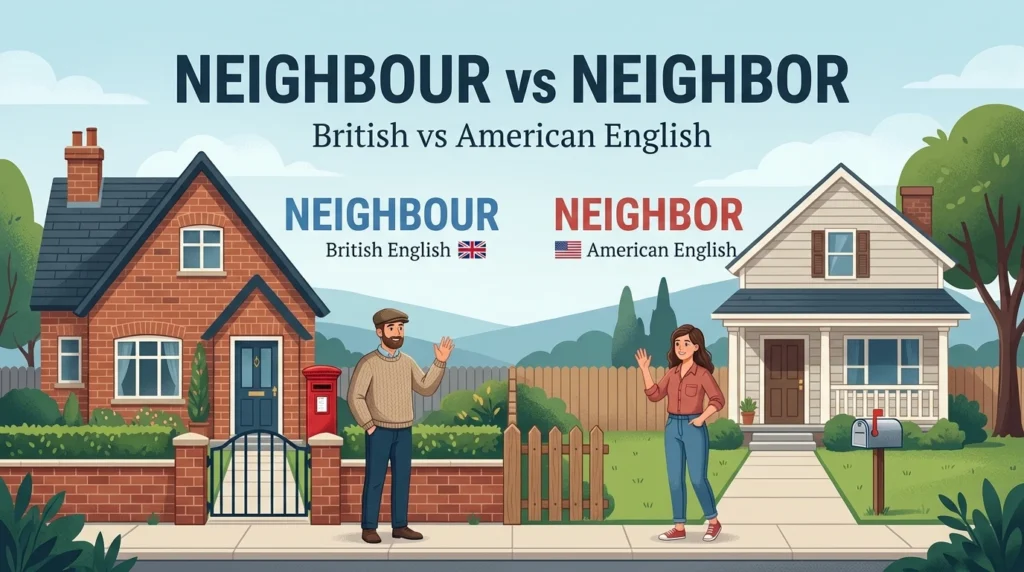

Neighbour and neighbor are both correct spellings of the same English word. Neighbour is the standard spelling in British English, Australian English, and many other varieties that follow British spelling conventions. Neighbor is the standard spelling in American English. Both refer to someone who lives near you. The difference is regional spelling, not meaning or pronunciation. Choose the spelling that matches your audience, and use it consistently throughout your writing.
What Is the Difference Between Neighbour and Neighbor?
The difference between neighbour and neighbor is the letter u. British English retains the u in this word, while American English generally omits it.
Both words are nouns when they refer to a person living nearby. They can also be used as verbs, meaning to live near or next to someone or something.
Examples:
- British English: Our new neighbour introduced herself yesterday.
- American English: Our new neighbor introduced herself yesterday.
- British English: The school neighbours a public park.
- American English: The school neighbors a public park.
The meaning remains the same. Neither spelling is inherently more correct than the other; correctness depends on the variety of English you are using.
Why It Matters
Choosing between neighbour and neighbor may seem like a minor detail, but consistent spelling helps your writing look professional and carefully edited.
Here are situations where the distinction matters:
- School assignments: Follow the spelling conventions your teacher or institution expects.
- Business emails: Use the spelling appropriate for your company’s location and audience.
- Website content: Match your spelling to your target market, especially when writing for American or British readers.
- Academic writing: Follow the style guide or institutional requirements.
- Published books: Maintain a consistent spelling convention throughout the manuscript.
- International communication: Recognize that both forms are correct so you do not mistakenly correct another writer.
For example, a website targeting customers in the United States should normally use neighbor. A publication aimed at readers in the United Kingdom should normally use neighbour.
The goal is not to memorize one spelling as universally correct. It is to understand which spelling belongs to your audience.
The Core Rule
American English: neighbor
The letter u is omitted.
Example: My neighbor is a teacher.
British English: neighbour
The letter u is retained.
Example: My neighbour is a teacher.
Remember that the same regional pattern usually applies to related words:
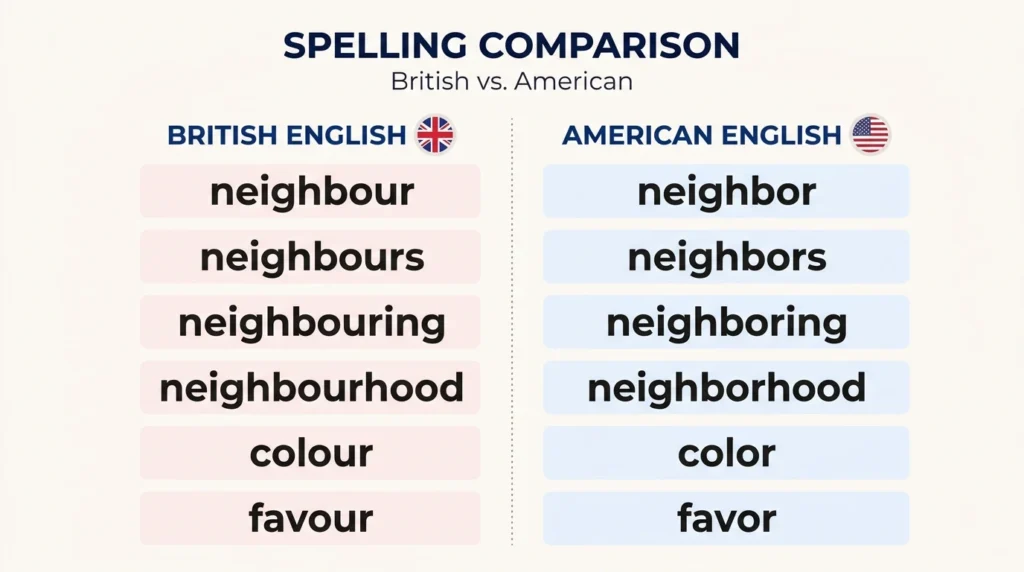
- American: neighbors, neighboring, neighborhood.
- British: neighbours, neighbouring, neighbourhood.
How to Use Neighbour and Neighbor
Use neighbor in American English
Choose neighbor when writing for an American audience or following American spelling conventions.
Examples:
- Our neighbor brought us a homemade cake.
- The neighbors organized a community meeting.
- A neighboring town opened a new library.
- We moved into a friendly neighborhood.
Use neighbour in British English
Choose neighbour when following British spelling conventions.
Examples:
- Our neighbour brought us a homemade cake.
- The neighbours organized a community meeting.
- A neighbouring town opened a new library.
- We moved into a friendly neighbourhood.
Follow the same pattern in related words
The spelling difference extends beyond the singular noun. Changing only neighbour to neighbor while leaving related words in another spelling system can make a document inconsistent.
Use this table as a guide.
| Word form | American English | British English |
|---|---|---|
| Singular noun | neighbor | neighbour |
| Plural noun | neighbors | neighbours |
| Verb | neighbor | neighbour |
| Third-person verb | neighbors | neighbours |
| Past tense | neighbored | neighboured |
| Present participle | neighboring | neighbouring |
| Related noun | neighborhood | neighbourhood |
| Related adjective | neighborly | neighbourly |
Correct Examples of Neighbour vs Neighbor
These examples show how to use both spellings naturally in different situations.
Everyday conversation
- American: My neighbor helped me carry the groceries upstairs.
- British: Our neighbour invited us to dinner on Saturday.
Emails and messages
- American: Hi, could you ask our neighbor to move the car from the driveway?
- British: Dear Mrs. Brown, thank you for informing us about the new neighbour.
School and academic writing
- American: The student interviewed a neighbor about changes in the community.
- British: The report examines how neighbours support older people living alone.
Workplace communication
- American: Our office is located in a neighborhood with several restaurants.
- British: The company works with neighbouring businesses on local projects.
Social media and community announcements
- American: Shout-out to our neighbors for helping us clean up the park!
- British: A big thank you to all our neighbours for making the street festival a success.
All ten examples are correct within their respective spelling conventions.
Incorrect vs Correct: Common Spelling Mistakes
The examples below focus on inconsistent regional spelling and incorrect assumptions about the two forms.
| Incorrect or inconsistent | Correct version | Why |
|---|---|---|
| My neighber lives nearby. | My neighbor lives nearby. (US) | Neighber is not the standard spelling. |
| My neighber lives nearby. | My neighbour lives nearby. (UK) | The standard British spelling is neighbour. |
| My neighbor is visiting our neighbourhood. | My neighbor is visiting our neighborhood. (US) | The American noun is neighborhood. |
| My neighbour is visiting our neighborhood. | My neighbour is visiting our neighbourhood. (UK) | The British form retains the u. |
| Our neighbors are very friendly. (in a British-style document) | Our neighbours are very friendly. | Match the spelling to the chosen British style. |
| Our neighbours are very friendly. (in an American-style document) | Our neighbors are very friendly. | Match the spelling to the chosen American style. |
| We have a neighborly relationship. (in consistent British prose) | We have a neighbourly relationship. | The related adjective follows British spelling. |
| The neighboors called us. | The neighbors called us. (US) | The standard plural adds s, not an extra o. |
| The neighboors called us. | The neighbours called us. (UK) | The British plural also adds s to the standard spelling. |
| Our neighbering town is growing. | Our neighboring town is growing. (US) | The American participle uses neighboring. |
| Our neighbering town is growing. | Our neighbouring town is growing. (UK) | The British participle uses neighbouring. |
| Neighbour is always misspelled. | Neighbour is correct in British English. | The word is a valid regional spelling. |
A useful distinction: writing an American spelling in a British document is usually a style inconsistency, not proof that the word is universally misspelled. The same applies in reverse.
Why People Make This Mistake
1. The pronunciation is the same
Both spellings are normally pronounced alike. When you hear the word, you cannot tell whether the writer intended neighbor or neighbour.
You must choose based on spelling conventions rather than sound.
2. The difference is only one letter
The two forms look almost identical. This makes it easy to overlook the regional distinction, particularly when switching between American and British websites or books.
3. Writers overgeneralize spelling rules
People often learn that British English uses colour and American English uses color. They may correctly recognize the pattern but forget to apply it to neighbour and its related forms.
4. Spell-check tools use different language settings
A spell checker configured for American English may flag neighbour. One configured for British English may flag neighbor.
Neither warning automatically means that the word is wrong. Check the document’s language settings before changing the spelling.
5. Translation and language learning create confusion
Learners may encounter both forms in textbooks, online lessons, and translated materials. They may assume that one spelling has a different meaning or that the extra u changes pronunciation.
It does not. This is a regional spelling difference, not a difference in meaning.
Read More: Speach vs Speech: Which Spelling Is Correct?
Neighbour vs Neighbor in Real English
Grammatically correct
Both neighbour and neighbor are grammatically correct when used according to the appropriate spelling convention. For example, “My neighbour lives next door” follows British spelling, while “My neighbor lives next door” follows American spelling. Both sentences use the noun correctly, and both express the same idea. The spelling choice does not change the sentence’s grammar, meaning, or basic pronunciation.
Grammatically possible but inconsistent
A sentence such as “My neighbour lives in a quiet neighborhood” is understandable, and each spelling is recognizable. However, it combines a British form with an American form. In a document that aims to follow one spelling convention, this mixture is best avoided. It is a consistency issue rather than a grammatical error. Use neighbourhood for British English or neighborhood for American English.
Natural, everyday English
In everyday conversation and writing, people use whichever spelling is standard in their variety of English. An American might write, “Our neighbor brought over some cookies,” while a British speaker might write, “Our neighbour brought over some biscuits.” Both are natural sentences. The word itself is not more formal, polite, friendly, or correct in one spelling. Choose the form your readers expect and keep it consistent.
American vs British English
The difference between neighbor and neighbour is a genuine American-British spelling distinction.
| American English | British English |
|---|---|
| neighbor | neighbour |
| neighbors | neighbours |
| neighboring | neighbouring |
| neighbored | neighboured |
| neighborhood | neighbourhood |
| neighborly | neighbourly |
| color | colour |
| favor | favour |
| honor | honour |
| labor | labour |
American English generally omits the u in this group of words, whereas British English retains it.
What about Canadian English?
Canadian English does not follow every British or American spelling convention in exactly the same way. Both neighbour and neighbor occur in Canadian usage.
For Canadian writing, follow the relevant Canadian dictionary, organizational style guide, or publication requirements rather than assuming that every word must match either American or British English.
What about Australian and New Zealand English?
Neighbour is the usual spelling in Australian and New Zealand English. Writers following these conventions should generally use neighbour, neighbours, and neighbourhood.
Formal vs Informal Usage
There is no meaningful formal-versus-informal distinction between these spellings.
- Formal writing: Use the spelling convention required by your organization, publication, school, or university.
- Informal writing: Use the spelling familiar in your local variety of English.
- Professional writing: Maintain consistency across emails, reports, presentations, and website content.
- Creative writing: Follow the intended setting and narrative voice. If a character uses American English, neighbor may suit the dialogue; British English dialogue may use neighbour.
Neither form is inherently more polite or more professional than the other.
Neighbour vs Neighbor: Comparison Table
| Feature | Neighbour | Neighbor |
|---|---|---|
| Standard regional variety | British English | American English |
| Meaning | Person or thing nearby | Person or thing nearby |
| Pronunciation | Normally the same | Normally the same |
| Singular | neighbour | neighbor |
| Plural | neighbours | neighbors |
| Present participle | neighbouring | neighboring |
| Related noun | neighbourhood | neighborhood |
| Is it correct? | Yes | Yes |
| Suitable for US-focused content | Not usually the default | Yes |
| Suitable for UK-focused content | Yes | Not usually the default |
Memory Trick: Keep or Drop the U
Here is an easy way to remember the difference:
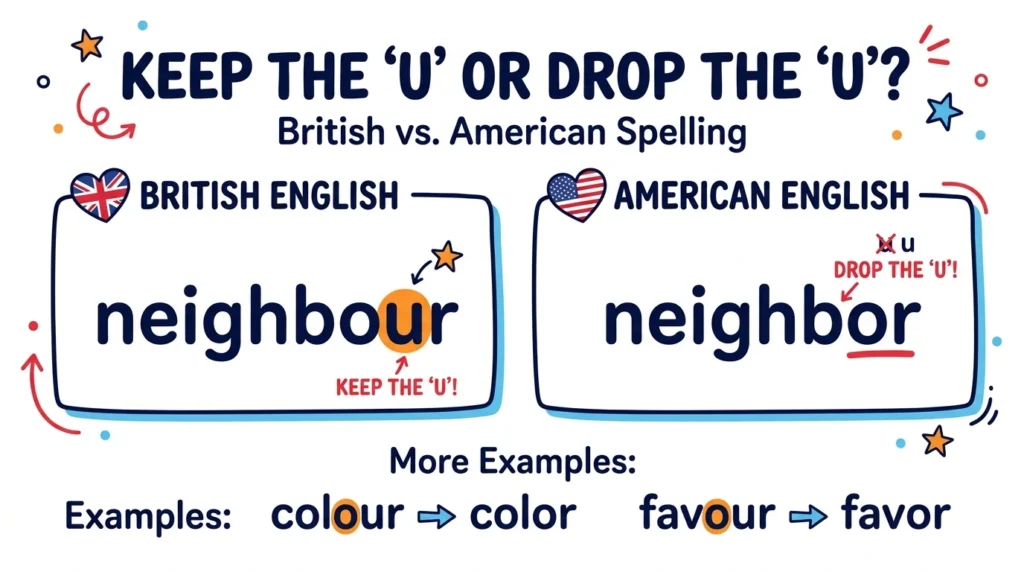
British English keeps the U; American English drops the U.
Think of these pairs together:
- British: colour — American: color
- British: favour — American: favor
- British: honour — American: honor
- British: neighbour — American: neighbor
The trick is simple: if you are writing for American readers, choose neighbor. If you are writing for British readers, choose neighbour.
Do not rely on the mnemonic alone for every English word, because regional spelling patterns have exceptions. For this particular pair, however, it works well.
Neighbour vs Neighbor in Real-Life Situations
Situation 1: Writing a job application
You are applying for a job at a company in New York. Your cover letter mentions volunteering in your community.
Write:
“I regularly work with my neighbors on local improvement projects.”
Use neighbors because the application follows American English.
Situation 2: Sending a British business email
You are writing to a property manager in London.
Write:
“Our neighbour has reported a problem with the shared entrance.”
Use neighbour because the message follows British spelling.
Situation 3: Publishing a blog post
Your website targets American homeowners. You are writing about building stronger communities.
Use neighbor, neighbors, and neighborhood throughout the article.
Situation 4: Completing an English examination
Your teacher asks you to write an essay using British English.
Choose neighbour and the related British forms. If the exam specifies a particular spelling standard, follow that instruction.
Situation 5: Editing an international report
Your report contains contributions from American and British colleagues. Before publication, choose a house style based on the intended audience and apply it consistently to the final document.
Expert Tips
- Set your spell checker before writing. Choose American or British English to reduce unnecessary spelling warnings.
- Check related words, not just the main keyword. A search for neighbor should also prompt you to check neighborhood and neighboring.
- Do not correct valid regional spellings automatically. First determine which English variety the writer is using.
- Follow the publication’s house style. A company’s established style guide takes priority over personal preference.
- Use consistency as your final editing test. Search your document for both spellings before publishing.
- Remember that Canada can differ. Canadian spelling has its own conventions, and either form may appear depending on the word and context.
FAQ
Is neighbour or neighbor correct?
Both are correct. Neighbour is the standard British English spelling, while neighbor is the standard American English spelling. Choose according to your intended audience.
Does neighbour mean something different from neighbor?
No. Both spellings have the same core meaning: a person who lives nearby, or something situated close to another person or place.
Is neighbour a British spelling?
Yes. Neighbour is the standard spelling in British English and is also commonly used in Australian and New Zealand English.
Is neighbor an American spelling?
Yes. Neighbor is the standard American English spelling.
How do you spell the plural of neighbour?
In British English, the plural is neighbours. In American English, it is neighbors.
Is it neighborhood or neighbourhood?
Both are correct. Neighborhood is American English, while neighbourhood is British English.
Is it neighboring or neighbouring?
Use neighboring in American English and neighbouring in British English.
Why does British English include the letter u?
British English retains the u in several words ending in -our, including colour, favour, and neighbour. American English generally uses the shorter -or forms in this group.
Can I use neighbour in an American essay?
You can use it when quoting someone or deliberately preserving another spelling convention. However, if the essay is expected to follow standard American English, neighbor is the appropriate choice.
Which spelling should international writers use?
Choose the form that best matches your target readers or the publication’s style guide. If your audience is mixed, consistency is more important than treating either form as universally superior.
Are neighbour and neighbor pronounced differently?
They are normally pronounced the same way. The difference is in spelling, not in the usual pronunciation.
Which spelling should I use for an SEO article?
Use the form that matches your target market. For a US-focused article, use neighbor. For a UK-focused article, use neighbour. Keep the related spellings consistent throughout the page.
Mini Quiz: Neighbour vs Neighbor
Test your understanding with these ten questions.
| No. | Question | Answer | Explanation |
|---|---|---|---|
| 1 | Choose the American spelling: neighbour or neighbor? | Neighbor | American English omits the u. |
| 2 | Choose the British spelling: neighbor or neighbour? | Neighbour | British English retains the u. |
| 3 | Fill in the blank: My ___ brought me some flowers. (American English) | neighbor | The sentence follows American spelling. |
| 4 | Fill in the blank: Our ___ invited us to tea. (British English) | neighbour | The sentence follows British spelling. |
| 5 | Choose the American plural: neighbours or neighbors? | Neighbors | The American plural is formed by adding s to neighbor. |
| 6 | Choose the British form: neighborhood or neighbourhood? | Neighbourhood | The British form retains the u. |
| 7 | Correct the sentence for American English: “My neighbour lives in a quiet neighborhood.” | My neighbor lives in a quiet neighborhood. | Both words now follow American spelling. |
| 8 | Correct the sentence for British English: “Our neighbor lives in a quiet neighbourhood.” | Our neighbour lives in a quiet neighbourhood. | Both words now follow British spelling. |
| 9 | True or false: Neighbour and neighbor have different core meanings. | False | They are regional spellings of the same word. |
| 10 | You are writing for a British newspaper. Which form should you normally use? | Neighbour | It follows the newspaper’s likely British spelling convention. |
Quick Summary
Neighbour and neighbor are two correct spellings of the same English word. The main difference is regional: British English uses neighbour, while American English uses neighbor. Both refer to a person living nearby and can also describe something situated close to another person or place. The same spelling pattern appears in related words: neighbours/neighbors, neighbouring/neighboring, and neighbourhood/neighborhood. Australian and New Zealand English generally follow the British form, while Canadian usage can vary. To write clearly, identify your target audience, follow the relevant style guide, and keep your spelling consistent throughout the document. Neither spelling is universally superior; the correct choice depends on the English variety you are using.