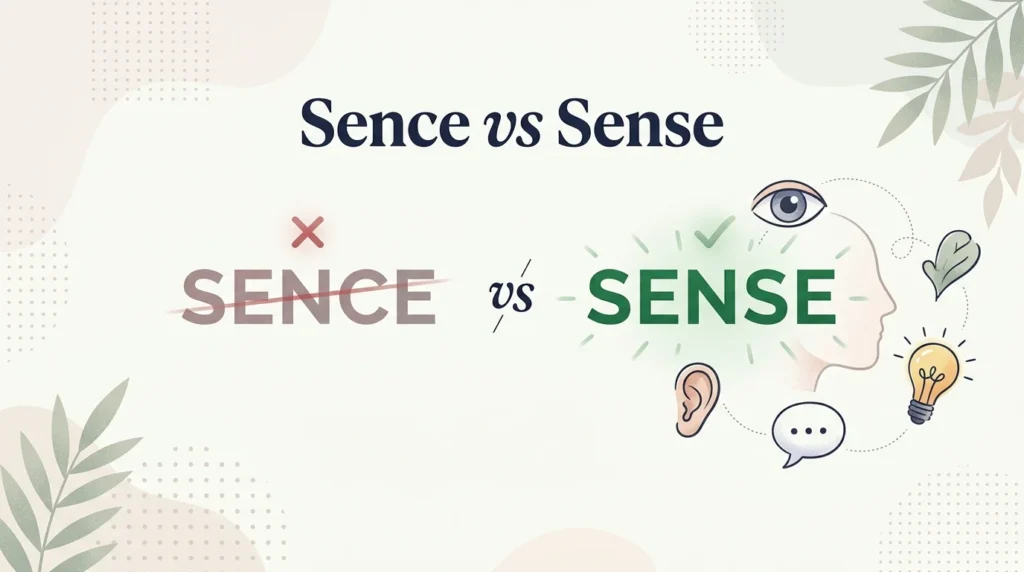

Sense is the correct spelling in standard modern English. Sence is normally an incorrect spelling when you mean the word related to meaning, perception, awareness, judgment, or detection. For example, write “That makes sense”, not “That makes sence.” The same spelling, sense, works as both a noun and a verb: “She has good sense” and “I can sense something is wrong.”
What Is the Difference Between Sence and Sense?
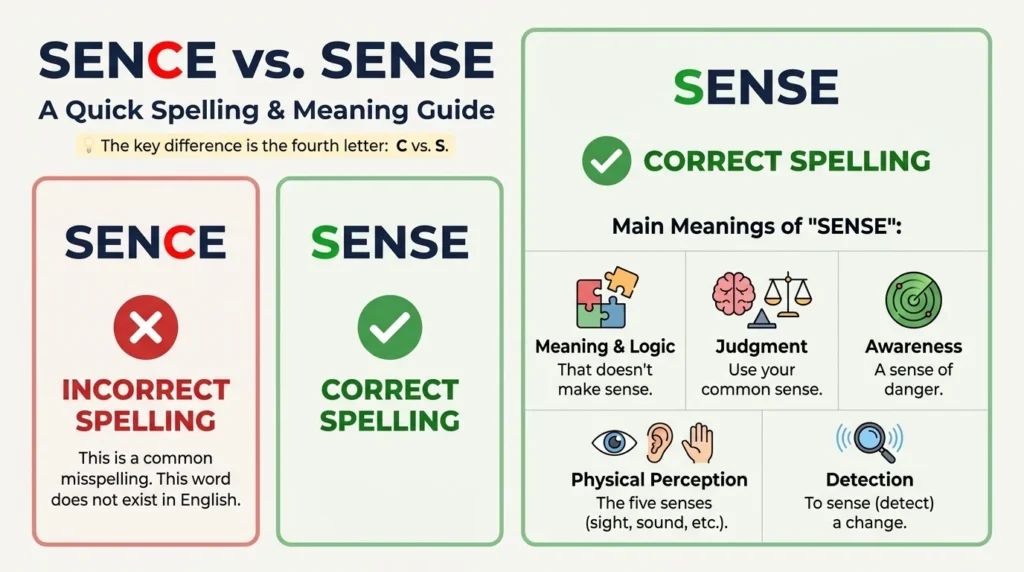
The difference is simple: sense is the standard English word, while sence is normally a spelling error.
There is no ordinary difference in meaning between the two forms because they are not two interchangeable English words.
If you write:
This explanation makes sense.
you are using the correct spelling.
If you write:
This explanation makes sence.
the reader will usually understand what you mean, but sence is misspelled.
The confusion is understandable because English spelling is not always predictable from pronunciation. The word sense is pronounced /sens/, and someone who is spelling mainly from sound may naturally try to write sence.
The important point is that the correct written form is:
S-E-N-S-E → sense
Not:
S-E-N-C-E → sence
Why Does Sense Matter?
The word sense appears in everyday conversation, education, business, technology, academic writing, and countless common expressions.
A spelling mistake may seem small, but repeated spelling errors can distract readers from your actual message.
Consider these situations:
- Email: “Your suggestion makes sense.”
- School: “The sentence has a different sense in this context.”
- Work: “We need to use common sense when reviewing the proposal.”
- Interview: “I could sense that the interviewer was interested.”
- Social media: “That really makes sense.”
- Academic writing: “The term is used in a different sense here.”
In every example, the spelling is sense.
Using sence does not normally create a new meaning. It simply introduces an unnecessary spelling error.
Read More: Summarize vs Summarise: Which Spelling Is Correct?
The Core Rule
Use “sense” whenever you mean meaning, understanding, judgment, awareness, perception, or detection. “Sence” is normally a misspelling and should not replace it.
A quick test is useful:
If you could replace the word with “meaning,” “awareness,” “judgment,” “perception,” or “detect,” you probably need sense.
Examples:
- That doesn’t make sense. → meaning or logic
- She has good sense. → judgment
- I lost my sense of smell. → physical perception
- I could sense his concern. → detect or perceive
- What is the sense of this expression? → meaning
How to Use Sense
Sense has several meanings, so learning its uses is more useful than memorizing the spelling alone.
Sense as a noun meaning “meaning”
Sense can refer to the meaning or interpretation of something.
What is the sense of this sentence?
Here, sense means the meaning that the sentence communicates.
You can also use it in phrases such as:
- in this sense
- in a broader sense
- in the usual sense
- in every sense
- in one sense
For example:
In this sense, the two arguments are similar.
Sense as a noun meaning “good judgment”
Sense can mean the ability to make reasonable or practical decisions.
You should have the sense to check the figures before submitting the report.
This is also the meaning behind common sense.
Use common sense before making a decision.
Here, sense is connected with practical judgment rather than physical perception.
Sense as a noun meaning “physical ability”
Sense can refer to one of the ways people perceive the world through their bodies.
The traditional five senses are:
- Sight
- Hearing
- Smell
- Taste
- Touch
Examples:
My sense of smell became weaker after the illness.
Dogs have an excellent sense of smell.
She has a strong sense of balance.
Sense as a noun meaning “awareness or feeling”
Sense can also describe an awareness, impression, or feeling about something.
I had a sense that something was wrong.
This does not necessarily mean the person had proof. It can describe an impression or awareness.
Other examples include:
There was a strong sense of excitement in the room.
He felt a sense of responsibility for the project.
Sense as a verb
Sense can also function as a verb.
As a verb, it means to perceive, notice, detect, or become aware of something.
I could sense that she was nervous.
The machine can sense movement.
He sensed that the conversation was becoming uncomfortable.
Notice the spelling again:
sense → sensed → sensing
Never change the spelling to sence when using the verb.
Correct Examples
Here are original examples showing how sense works in different situations.
Conversation
That doesn’t make sense to me.
The speaker means that something is unclear or illogical.
Your explanation makes much more sense now.
Here, sense refers to clarity or logic.
School
The word has a slightly different sense in this paragraph.
Here, sense means meaning.
Workplace
We need to use common sense before approving the purchase.
Here, sense means practical judgment.
Interview
I could sense that the interviewer wanted me to explain the idea further.
Here, sense is a verb meaning detect or perceive.
Social media
Finally, someone explained it in a way that makes sense.
The expression means that the explanation is understandable or logical.
Academic writing
The term is used in a narrower sense in this study.
Here, sense means a particular meaning or interpretation.
Technology
The device can sense changes in temperature.
Here, sense means detect.
Personal writing
She had a strange sense that she had forgotten something.
Here, sense describes an inner feeling or awareness.
Everyday English
He has a good sense of humor.
Here, sense refers to the ability to understand and appreciate humor.
Incorrect vs. Correct
| ❌ Incorrect | ✅ Correct | Why |
|---|---|---|
| That doesn’t make sence. | That doesn’t make sense. | The standard expression is make sense. |
| I can sence something strange. | I can sense something strange. | Sense is the verb meaning perceive or detect. |
| She has good common sence. | She has good common sense. | The fixed expression is common sense. |
| He has a strong sence of direction. | He has a strong sense of direction. | The noun is spelled sense. |
| I lost my sence of smell. | I lost my sense of smell. | Sense refers to a physical faculty. |
| It doesn’t sence logical. | It doesn’t make sense logically. | The correct expression is make sense. |
| I had a strange sence that she knew. | I had a strange sense that she knew. | Sense can mean an impression or awareness. |
| What sence does this word have? | What sense does this word have? | Sense can mean a particular meaning. |
| The sensor can sence movement. | The sensor can sense movement. | Sense is the correct verb. |
| In this sence, the ideas are similar. | In this sense, the ideas are similar. | The standard phrase uses sense. |
| She has a good sence of humor. | She has a good sense of humor. | Sense is the correct spelling. |
| The argument makes no sence. | The argument makes no sense. | Make no sense is the correct expression. |
Why Do People Make This Mistake?
The mistake is mainly a spelling problem, but several factors make sence look believable.
Phonetic similarity
Sense is pronounced /sens/. When people write quickly, they may try to reproduce the sound rather than remember the exact spelling.
This is particularly common for English learners because English spelling often contains patterns that cannot be predicted perfectly from pronunciation.
Familiar spelling patterns
English contains many words ending in -ence, including words such as:
- difference
- reference
- sentence
- experience
- presence
Because -ence is a familiar English spelling pattern, sence can look plausible even though it is not the standard spelling of sense.
Spelling by analogy
Writers sometimes unconsciously copy the spelling pattern of a different word.
For example, if a learner knows that some words use c before e, they may assume that the same pattern applies to sense.
English does not work that consistently.
Fast typing
A person may know the correct spelling perfectly well but type sence because the fingers follow a familiar pattern or the writer is concentrating on the meaning of the sentence rather than its spelling.
Autocomplete and spellcheck limits
Digital tools are useful, but they are not a substitute for knowing the word.
A writing tool may catch sence, but depending on the software and context, automated checking is not always perfect. Writers should still proofread important documents.
Translation interference
English learners may also transfer spelling patterns from another language. A word that sounds similar to sense may be written according to the spelling rules of the learner’s first language.
The safest solution is to memorize the English word as a complete unit:
sense
Common Mistakes Checklist
Writing “sence” because it sounds right
Problem: You spell the word according to its pronunciation.
Why it happens: English pronunciation does not always reveal the exact spelling.
How to avoid it: Memorize sense visually: S-E-N-S-E.
Writing “make sence”
Problem: You use the common phrase but spell its final word incorrectly.
Why it happens: The phrase is often learned through speech first.
How to avoid it: Remember the complete expression:
make sense
Assuming “sence” is British English
Problem: You treat the spelling as a regional alternative.
Why it happens: English genuinely has many American/British spelling differences.
How to avoid it: Remember that standard American and British English both use sense.
Confusing sense with since
Problem: You choose the wrong word because the forms look and sound similar.
How to avoid it: Check the meaning. Since usually relates to time or reason; sense relates to meaning, perception, judgment, or awareness.
Read More: Cancellation vs Cancelation: Which Spelling Is Correct?
Confusing sense with scents
Problem: You confuse a noun meaning perception or meaning with a plural noun meaning smells.
Example:
The flowers have beautiful scents.
But:
She has a strong sense of smell.
Trusting spellcheck without understanding the word
Problem: You rely completely on software.
How to avoid it: Learn the meaning and spelling together. That makes errors easier to recognize even when technology is unavailable.
Sence vs. Sense in Real English
Grammatically correct and natural: “sense”
Sense is completely natural in standard everyday English. Native and proficient speakers use it in ordinary expressions such as make sense, common sense, sense of humor, and sense of direction. It is also normal in professional, academic, technical, and formal writing. There is no need to replace it with another spelling depending on the situation. Sense is the standard form.
Grammatically possible but unnatural: “sence”
For ordinary modern English, sence should not be treated as a second spelling of sense. A reader may understand what the writer intended, but the spelling will normally be perceived as an error rather than as a legitimate alternative. Therefore, there is no useful context in standard contemporary writing where you should deliberately choose sence instead of sense.
Natural everyday English: “sense”
In everyday English, the most useful approach is to learn sense through complete expressions rather than as an isolated spelling. Phrases such as That makes sense, use your common sense, I can sense something is wrong, and a sense of humor reinforce the correct form naturally. Seeing the word repeatedly in these patterns makes it easier to remember that the middle spelling contains s, not c.
American vs. British English
There is no genuine American-versus-British spelling difference between sence and sense.
Both standard American English and British English use:
sense
Not:
sence
There are genuine regional differences in English, such as color/colour and humor/humour. But sense is not one of those cases.
For example:
American English: She has a good sense of humor.
British English: She has a good sense of humour.
Notice that sense remains unchanged.
Read More: Spicey vs Spicy: Correct Spelling & Usage.
Formal vs. Informal Usage
Sense works across virtually every level of English.
Informal
That makes sense.
This is completely natural in conversation and messaging.
Professional
The proposed change makes sense from a financial perspective.
This works well in business communication.
Academic
The term is used in a narrower sense in this context.
This is appropriate for academic writing.
Formal
The evidence should be considered in the broader sense of the term.
The word itself does not become more formal or informal through spelling.
Sence, however, should not be used as an informal alternative. A casual message may contain spelling mistakes, but that does not make sence an accepted informal spelling.
Comparison Table
| Feature | Sence | Sense |
|---|---|---|
| Standard spelling | ❌ No | ✅ Yes |
| Standard English word | ❌ Not normally | ✅ Yes |
| Common meaning | Usually a spelling error | Meaning, perception, judgment, awareness, detection |
| Can be a noun? | ❌ Not as the intended standard word | ✅ Yes |
| Can be a verb? | ❌ Not as the intended standard word | ✅ Yes |
| Used in “make ___”? | ❌ No | ✅ make sense |
| Used in “common ___”? | ❌ No | ✅ common sense |
| Used in “___ of smell”? | ❌ No | ✅ sense of smell |
| American English | ❌ | ✅ |
| British English | ❌ | ✅ |
| Academic writing | Avoid | Appropriate |
| Professional writing | Avoid | Appropriate |
| Everyday conversation | Avoid | Natural |
Memory Trick
Use this simple connection:
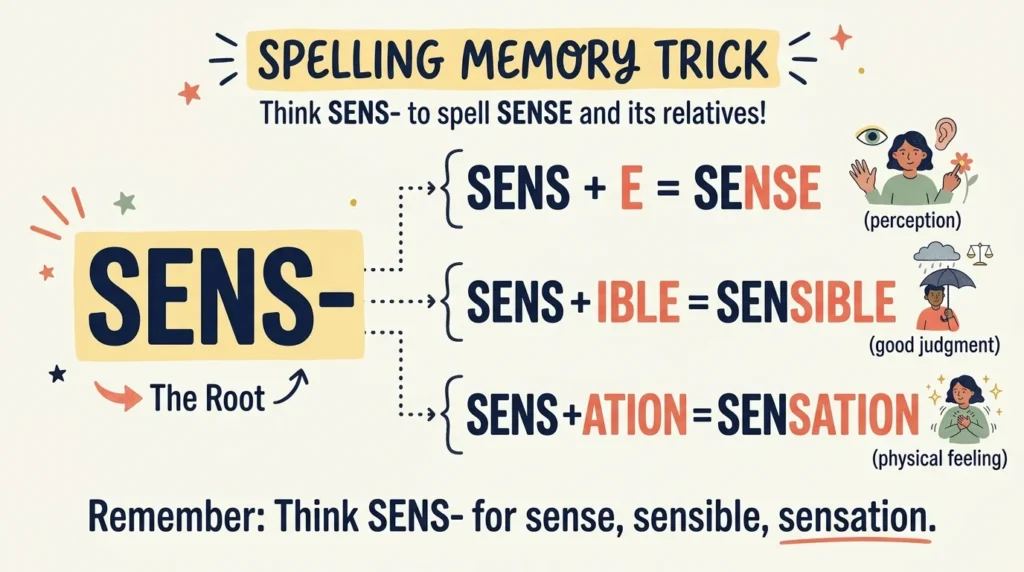
Sense → sensible → both start with “sens-.”
If you know how to spell sensible, you already have a useful reminder for sense.
Another quick visual trick is:
SENSE = S + EN + SE
The important letter to remember is the S before the final E.
So:
SEN-S-E → sense
Not:
SEN-C-E → sence
When in doubt, think of the phrase:
“That makes sense.”
The familiar expression can help bring the correct spelling back to mind.
Real-Life Situations
In an interview
You want to explain why you changed your strategy.
“The original approach stopped working, so changing the strategy made sense.”
Here, sense means logical or reasonable.
In a meeting
A colleague suggests a new process.
“That makes sense. Let’s test it next week.”
The phrase means that the idea seems logical.
In an email
You are asking for clarification.
“Could you explain this section? I can’t quite make sense of it.”
Here, make sense of means understand.
In a text message
A friend explains a confusing situation.
“Okay, that makes sense now.”
This is completely natural informal English.
In an exam
You are analyzing a word.
“The word is used in a different sense in the second paragraph.”
Here, sense means a particular meaning.
Mini Quiz
| # | Question | Answer | Explanation |
|---|---|---|---|
| 1 | Choose the correct spelling: “That doesn’t make ___.” | sense | The fixed expression is make sense. |
| 2 | Fill in the blank: “I could ___ that he was worried.” | sense | As a verb, sense means perceive or detect. |
| 3 | Which is correct: “common sence” or “common sense”? | common sense | Sense is the standard spelling. |
| 4 | Correct the sentence: “She has a good sence of humor.” | She has a good sense of humor. | The noun is spelled sense. |
| 5 | Choose the correct word: “I have a strange ___ that something will happen.” | sense | Here, sense means an impression or feeling. |
| 6 | Which spelling is standard: sence or sense? | sense | Sence is normally a misspelling. |
| 7 | Correct the sentence: “The machine can sence movement.” | The machine can sense movement. | Sense is the correct verb for detecting something. |
| 8 | Fill in the blank: “The argument makes no ___.” | sense | The standard phrase is makes no sense. |
| 9 | Choose the correct sentence. A) “In this sence, they agree.” B) “In this sense, they agree.” | B | Sense is the standard spelling. |
| 10 | Is “sence” an American spelling of “sense”? | No | Both American and British English use sense. |
Expert Tips
Learn the word in phrases
Instead of memorizing only:
sense
memorize:
make sense
common sense
sense of humor
sense of direction
sense of smell
sense of responsibility
Phrase-based learning gives you repeated exposure to the correct spelling.
Learn noun and verb uses together
Many learners remember sense as a noun but forget it can also be a verb.
Compare:
She has a strong sense of responsibility.
and:
I could sense that she was worried.
The spelling remains the same.
Watch for the “c” trap
The incorrect form looks believable because English contains many words ending in -ence.
Do not let the appearance of words such as difference or reference convince you that sence is correct.
Proofread high-stakes writing
A typo in a private text message may not matter much. A typo in a resume, business proposal, academic paper, or published article is more noticeable.
A final spelling check is worth the few seconds it takes.
Do not overthink the answer
This is one of those spelling questions where the answer is straightforward.
You do not need to decide between American and British spelling.
You do not need to decide between formal and informal spelling.
When you mean the standard word, write:
sense
FAQ
Is “sence” a correct English word?
Sence is not the standard spelling used for the common English word sense. If you mean meaning, perception, judgment, awareness, or detection, use sense.
Is sense or sence correct?
Sense is correct. Sence is normally a misspelling.
Why is sense spelled with an “s” instead of a “c”?
English spelling developed through several historical influences, so pronunciation does not always determine modern spelling. The standard form of this word is sense, and that spelling should simply be learned and used.
How do you spell sense correctly?
Spell it:
S-E-N-S-E
The fourth letter is S, not C.
Is sence a British spelling?
No. Sence is not the standard British spelling of sense. British English uses sense, just as American English does.
Is “make sence” correct?
No. The correct expression is make sense.
For example:
Your explanation makes sense.
What does sense mean?
Depending on context, sense can mean meaning, physical perception, good judgment, awareness, an impression, or the ability to detect something.
Can sense be a verb?
Yes. As a verb, sense means to perceive, detect, notice, or become aware of something.
I could sense that she was upset.
What is the difference between sense and since?
Sense relates to meaning, perception, judgment, or awareness.
Since generally refers to time or gives a reason.
Examples:
I have lived here since 2020.
That explanation makes sense.
What is the difference between sense and scents?
Sense has several meanings, including perception and understanding.
Scents is the plural of scent, meaning smells or odors.
Dogs have a strong sense of smell.
The flowers produced several pleasant scents.
Is “sence” ever acceptable?
You should not use sence as an alternative spelling of sense in ordinary modern English. If you encounter the form elsewhere, it may belong to a specialized, historical, or nonstandard context, but that does not make it the appropriate spelling for normal writing.
Quick Summary
Sense is the correct standard spelling; sence is normally a misspelling. Sense can be a noun meaning meaning, perception, awareness, or good judgment, and it can also be a verb meaning to perceive or detect something. The correct spelling remains sense in both American and British English. Common expressions include make sense, common sense, sense of smell, sense of humor, and sense of direction. The mistake often happens because sense is pronounced /sens/ and English spelling cannot always be predicted from sound. The easiest way to remember it is to connect sense with sensible: both begin with sens-. Whenever you mean the standard English word, choose sense, not sence.