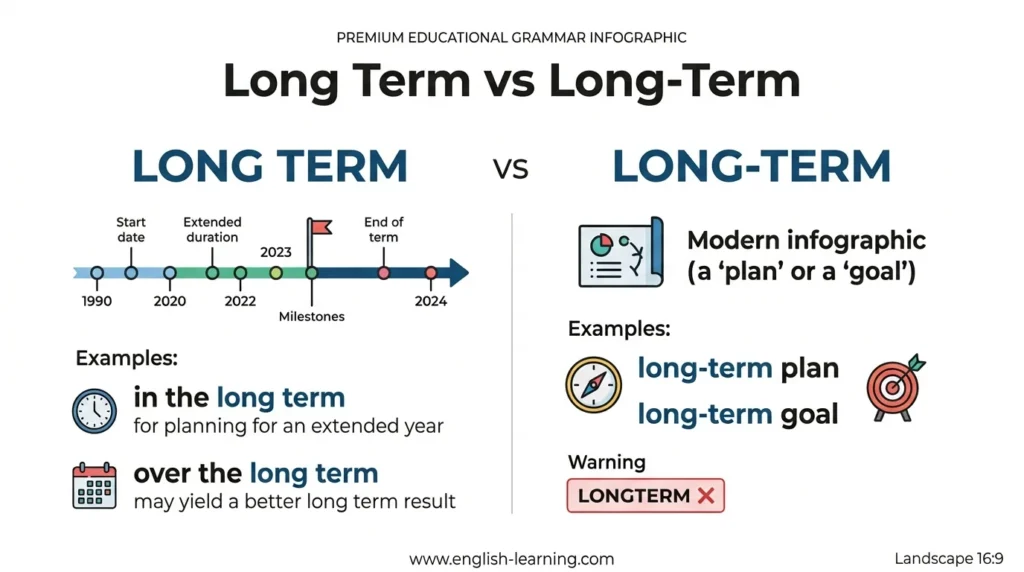

Both long term and long-term are correct, but they do different grammatical jobs. Use long-term when the two words work together as a compound modifier, usually before a noun: a long-term plan. Use long term when term is functioning as a noun phrase, especially in expressions such as in the long term or over the long term. The one-word form longterm is not standard English.
What Is the Difference Between Long Term and Long-Term?
The difference is mainly about grammatical function and the role of the hyphen.
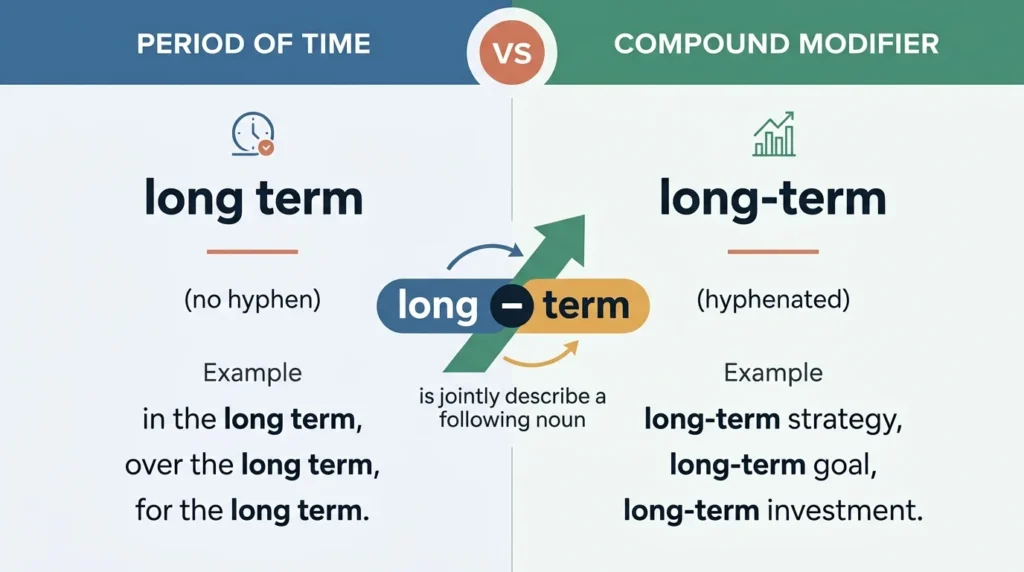
A hyphen joins words that work together as one unit. In long-term plan, the words long and term combine to describe the noun plan. That is why the hyphen is useful.
In in the long term, however, long describes the noun term. The phrase refers to an extended period of time, so the words remain separate.
Compare:
- a long-term strategy → long-term describes strategy
- in the long term → the long term refers to a period of time
The meaning is closely related, but the grammar is different.
Why It Matters
A missing or unnecessary hyphen may seem like a tiny writing issue, but it can make professional and academic writing look less polished.
You may encounter this distinction in:
- Business plans and reports
- Resumes and cover letters
- Academic essays
- Emails
- Financial documents
- Marketing copy
- School assignments
- News and formal writing
- Social media posts
- Everyday conversation
For example:
We need a long term strategy.
The intended meaning is clear, but in careful edited English, long-term strategy is the standard form because long-term acts as a compound modifier before strategy.
Now compare:
The strategy should benefit us in the long term.
Here, long term is correct because the phrase refers to the extended period itself.
The important lesson is not simply “use the hyphen before a noun.” The deeper rule is to identify what grammatical job the phrase is doing.
The Core Rule
Use long-term when the two words work together as a modifier. Use long term when you are referring to a long period of time as a noun phrase.
The easiest test
Look at the sentence and ask:
Am I describing something, or am I talking about a period of time?
If you are describing something:
long-term
If you are talking about the period itself:
long term
Examples:
- a long-term investment → describes investment
- a long-term problem → describes problem
- in the long term → refers to a period of time
- over the long term → refers to a period of time
- for the long term → refers to a period of time
And remember:
longterm is not the standard spelling.
How to Use Long-Term
Use long-term when the two words function together as a compound adjective or modifier.
A compound modifier contains two or more words that work together to describe another word.
Before a noun
This is the most common use.
- a long-term plan
- a long-term goal
- a long-term contract
- a long-term investment
- a long-term solution
- a long-term relationship
- a long-term strategy
- a long-term effect
- a long-term commitment
- a long-term project
The hyphen shows the reader that long and term belong together as one descriptive unit.
In professional writing
The hyphenated form is especially common in business, finance, education, healthcare, and other formal contexts.
Examples:
The company needs a long-term growth strategy.
We are looking for a long-term solution to the problem.
She accepted a long-term contract with the organization.
The report examines the long-term effects of the decision.
When another modifier comes before it
You may also see more complex combinations:
a carefully designed long-term strategy
Here, long-term still describes strategy. The adverb carefully modifies designed, not long-term.
Another example:
a highly effective long-term treatment
The hyphen remains because long-term functions as a unit describing treatment.
How to Use Long Term
Use long term when the phrase refers to an extended period of time rather than directly modifying a following noun.
The most common constructions include:
- in the long term
- over the long term
- for the long term
- the long term
- think about the long term
- plan for the long term
Examples:
The investment should pay off in the long term.
We need to consider the long term before making a decision.
Over the long term, the company expects costs to fall.
She is building her career for the long term.
They are focused on the long term.
In each sentence, the long term means an extended period of time.
“In the long term” is not “in the long-term”
One of the most common mistakes is adding a hyphen to the familiar expression:
❌ in the long-term
✅ in the long term
The correct expression is normally in the long term because the long term is functioning as a noun phrase.
The same pattern applies to:
❌ over the long-term
✅ over the long term
❌ for the long-term
✅ for the long term
Correct Examples
Here are examples from different types of everyday writing.
Conversation
I think this decision will help us in the long term.
We should consider the long-term impact before approving the proposal.
Workplace
The company needs a long-term strategy for customer retention.
Business
A long-term investment may require more patience.
School
The students discussed the long-term effects of climate change.
Academic writing
The study examines the long-term consequences of early intervention.
Social media
Building a real audience takes time and a long-term commitment.
Interview
My long-term career goal is to lead a creative team.
Financial writing
Investors should consider both short-term costs and long-term returns.
Personal planning
I am thinking about what will be best for me in the long term.
Everyday writing
We need a long-term solution rather than another temporary fix.
Planning
She is saving money with the long term in mind.
Notice that the correct form changes according to the grammatical role.
Incorrect vs. Correct
| ❌ Incorrect | ✅ Correct | Why |
|---|---|---|
| We need a long term plan. | We need a long-term plan. | Long-term works as one modifier before plan. |
| It will help in the long-term. | It will help in the long term. | The long term is a noun phrase. |
| They signed a long term contract. | They signed a long-term contract. | The compound modifier comes before contract. |
| We should think about the long-term. | We should think about the long term. | The phrase refers to the period itself. |
| She has a long term goal. | She has a long-term goal. | Long-term describes goal. |
| The change will matter over the long-term. | The change will matter over the long term. | Over the long term is the standard open expression. |
| He made a long term investment. | He made a long-term investment. | The two words jointly describe investment. |
| We need to plan for the long-term. | We need to plan for the long term. | The long term is functioning as a noun phrase. |
| The company needs long term thinking. | The company needs long-term thinking. | The compound modifies thinking. |
| They are preparing for long-term. | They are preparing for the long term. | The phrase needs the noun term in this construction. |
| This is a longterm strategy. | This is a long-term strategy. | Longterm is not the standard spelling. |
| The project should work in the long-term. | The project should work in the long term. | The period is being discussed as a noun. |
Why People Make This Mistake
The confusion is understandable because long term and long-term look almost identical and have closely related meanings.
The hyphen is easy to overlook
A hyphen is visually small. When reading quickly, many writers do not notice whether it is present.
People learn the phrase as one idea
Writers often remember the general concept of long term without remembering that English can represent that concept in different grammatical structures.
Similar phrases follow similar patterns
English contains many compounds that change form depending on their role:
- long-term plan / in the long term
- full-time employee / work full time
- high-speed connection / travel at high speed
- well-known author / widely known author
This can make the pattern feel inconsistent until you understand the grammar behind it.
Spellcheck does not explain grammar
A spellchecker may identify some spelling errors, but it cannot always explain why one form is appropriate in a particular sentence.
The difference between long term and long-term is often about sentence structure, not spelling alone.
Translation can cause interference
Learners whose first language expresses the idea with one fixed word may naturally expect English to have one fixed spelling too. English often uses different structures for related grammatical functions.
Common Mistakes Checklist
1. Writing “longterm”
Mistake:
We need a longterm solution.
Correct:
We need a long-term solution.
Why it happens: The phrase is treated as one word.
How to avoid it: Remember that standard English uses either long term or long-term, depending on the sentence. Do not normally combine the two into longterm.
2. Hyphenating “in the long term”
Mistake:
This will save money in the long-term.
Correct:
This will save money in the long term.
Why it happens: Writers remember that long-term is a common spelling and apply it everywhere.
How to avoid it: Learn the complete phrase in the long term.
3. Leaving out the hyphen before a noun
Mistake:
We need a long term strategy.
Correct:
We need a long-term strategy.
Why it happens: The writer sees long and term as two separate words.
How to avoid it: When they work together to describe a following noun, use the compound form long-term.
4. Hyphenating every occurrence
Mistake:
We should think long-term about the problem.
Preferred in this construction:
We should think long term about the problem.
Why it happens: The writer has learned the hyphenated form but not the underlying grammatical distinction.
How to avoid it: Do not treat long-term as a universal replacement for long term.
5. Assuming the hyphen changes the basic meaning
The hyphen does not create two unrelated meanings.
Both forms are connected to the idea of an extended period. The important difference is how the phrase functions in the sentence.
Long Term vs. Long-Term in Real English
Grammatically correct: “a long-term plan”
We need a long-term plan.
This is a straightforward and natural use. Long-term acts as a compound modifier before plan. The reader immediately understands that the plan is intended to operate over an extended period.
Grammatically correct: “in the long term”
The decision will benefit the company in the long term.
This is also completely natural. The long term refers to a period extending into the future. The words remain open because long modifies the noun term rather than forming a modifier for another noun.
Grammatically possible but context-dependent: “think long term”
We need to think long term.
This construction is common in everyday and professional English. Here, long term describes the time frame of the thinking rather than directly modifying a noun. It is therefore often written open.
You may also encounter think long-term, particularly where a writer treats the expression as a compound adverb. Usage varies, so the sentence structure and editorial style matter.
Natural everyday English: “over the long term”
The strategy should produce better results over the long term.
This is a highly natural construction when discussing future consequences, plans, investments, relationships, or outcomes.
The phrase clearly refers to an extended period rather than describing a noun that follows it.
Natural professional English: “long-term strategy”
The company needs a long-term strategy.
This is especially common in business and professional writing. The hyphen makes the relationship between long, term, and strategy immediately clear.
American vs. British English
There is no major American-versus-British difference in the basic distinction between long term and long-term.
Both varieties use:
- a long-term plan
- a long-term relationship
- in the long term
- over the long term
Dictionaries also record long-term as an adjective in both American and British English.
There can be some variation in less common adverbial uses, such as whether a writer chooses long term or long-term after a verb. In those cases, follow the conventions of the publication or style guide you are writing for.
For ordinary writing, the core distinction remains reliable:
long-term = compound modifier
long term = period of time
Read More: Unorganized vs Disorganized: What’s the Difference?
Formal vs. Informal Usage
The basic distinction applies in both formal and informal English.
In formal writing, however, consistency matters more because readers expect careful editing.
Formal
The report evaluates the long-term economic consequences.
The policy may prove beneficial in the long term.
Informal
I don’t know if it’ll work long term.
We’re thinking long term.
The informal examples are natural conversational constructions. In formal writing, you may prefer a more explicit structure:
We need to consider the long-term consequences.
or:
We need to consider the consequences in the long term.
The choice is not simply about being formal or informal. Grammar still determines the form.
Comparison Table
| Feature | Long term | Long-term |
|---|---|---|
| Basic form | Two separate words | Hyphenated compound |
| Main role | Noun phrase; also used adverbially | Compound adjective/modifier |
| Common position | After prepositions or in time expressions | Usually before a noun |
| Example | in the long term | a long-term plan |
| Meaning | An extended period | Existing, continuing, or intended for an extended period |
| Common expressions | in the long term, over the long term, for the long term | long-term goal, long-term strategy, long-term effect |
| Can it be correct? | Yes | Yes |
| One-word form | longterm is not standard | — |
Memory Trick
Use this simple memory trick:
If the phrase has a noun to describe, join it. If the phrase is the time period itself, leave it open.
Think:
long-term plan
The phrase describes plan → hyphen.
in the long term
The phrase names a period of time → no hyphen.
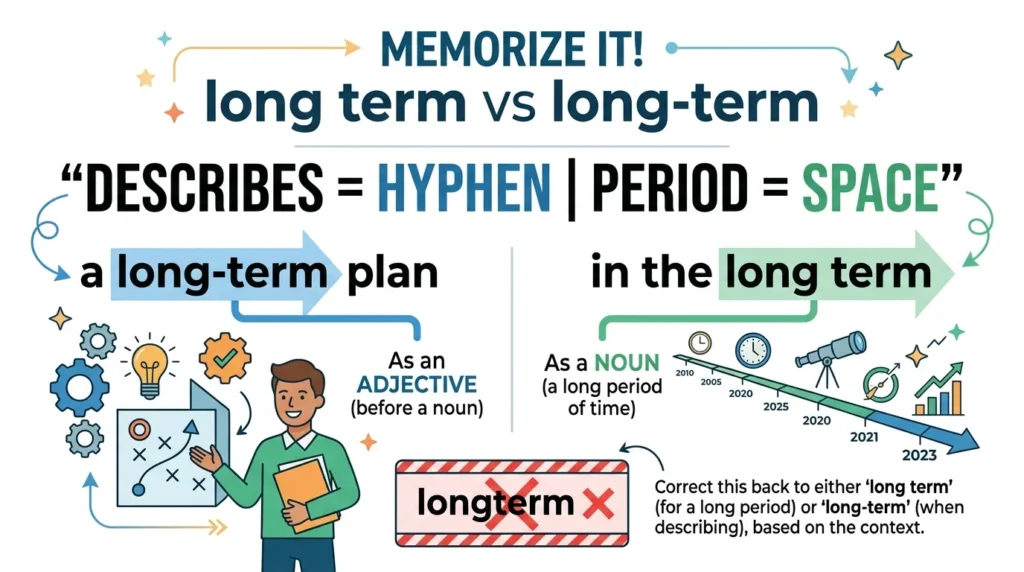
You can remember it as:
Describes = hyphen.
Period = space.
Real-Life Situations
Job interview
You are asked about your career goals.
My long-term goal is to become a senior manager.
Here, long-term describes goal.
Business meeting
You are discussing future results.
We need to consider how this decision will affect us in the long term.
Here, in the long term refers to a future period.
Read More: Loosing vs Losing: Meaning, Difference & Correct Use.
We are looking for a long-term partner who can support our expansion.
The phrase describes partner, so use long-term.
Text message
It might cost more now, but it’ll save money in the long term.
The phrase refers to a period of time, so use long term.
Academic assignment
Researchers examined the long-term effects of the treatment.
The compound modifier comes before effects, so long-term is appropriate.
Financial discussion
The investment may be difficult at first, but it could perform well over the long term.
The phrase refers to an extended period, so it remains open.
Social media
Real growth takes patience. Think long term.
Here, long term describes the time frame of the thinking.
Project planning
We need a long-term solution rather than a temporary fix.
The phrase modifies solution, so it is hyphenated.
Mini Quiz
| # | Question | Answer | Explanation |
|---|---|---|---|
| 1 | Choose: We need a ___ strategy. A) long term B) long-term | B) long-term | The compound modifies strategy. |
| 2 | Choose: This will matter in the ___. A) long term B) long-term | A) long term | The long term refers to a period of time. |
| 3 | Correct the sentence: “She has a long term goal.” | She has a long-term goal. | Long-term describes goal. |
| 4 | Choose: “The decision may help us ___.” A) in the long term B) in the long-term | A) in the long term | This is the standard open expression. |
| 5 | Is this correct? “They signed a long-term contract.” | Yes. | Long-term modifies contract. |
| 6 | Correct the sentence: “We should think long-term about this.” | We should think long term about this. | Here long term describes the time frame of the thinking. |
| 7 | Choose: “The company wants a ___ relationship.” A) long term B) long-term | B) long-term | The compound modifies relationship. |
| 8 | Is “longterm” standard English? | No. | Standard English uses long term or long-term, depending on function. |
| 9 | Fill in the blank: “Over the ___, the investment may grow.” | long term | Over the long term names an extended period. |
| 10 | Correct the sentence: “We need to plan for the long-term.” | We need to plan for the long term. | The long term is the noun phrase after for. |
Expert Tips
Do not memorize the hyphen by itself
Instead of memorizing dozens of individual examples, learn the grammatical pattern.
long-term + noun
long-term plan
long-term goal
long-term impact
preposition + the long term
in the long term
over the long term
for the long term
This makes new sentences much easier to handle.
Watch the word after the phrase
When you see:
long-term ______
ask what noun follows.
If long-term describes that noun, the hyphenated form is usually appropriate.
Do not confuse spelling with pronunciation
The spoken phrase may sound essentially the same whether it is written long term or long-term. The hyphen is a writing convention that shows grammatical connection.
Do not assume every hyphenated compound has the same rule
English hyphenation depends on the particular expression, its grammatical role, ambiguity, and editorial convention. The safest approach is to understand the structure of the sentence rather than applying one universal hyphen rule.
Remember the fixed expressions
If you frequently write business, academic, or professional English, these are worth learning as complete phrases:
- in the long term
- over the long term
- for the long term
- long-term plan
- long-term goal
- long-term strategy
- long-term effect
- long-term relationship
- long-term investment
- long-term solution
FAQ
Is “long term” correct?
Yes. Long term is correct when the phrase refers to an extended period of time, as in in the long term or over the long term.
Is “long-term” correct?
Yes. Long-term is correct when the two words work together as a compound modifier, such as a long-term plan or long-term effects.
Is “longterm” one word?
No. Longterm is not the standard spelling in ordinary English. Use long term or long-term, depending on the grammatical structure.
Should I write “in the long term” or “in the long-term”?
Write in the long term. The phrase refers to an extended period of time and is normally written without a hyphen.
Should it be “long term goal” or “long-term goal”?
Use long-term goal in careful edited writing. The compound modifier long-term describes the noun goal.
Is “over the long term” correct?
Yes. Over the long term is a standard expression meaning over an extended period of time.
Is “for the long term” correct?
Yes. For example: We are building the business for the long term. Here, the long term refers to the extended period ahead.
Can “long term” be used without “the”?
Yes, in some adverbial constructions. For example: The strategy should work long term. This use is common, especially in conversational and professional English.
Can “long-term” be used after a verb?
It can appear in some postpositive or adverbial constructions, and usage varies by context and editorial style. Do not apply a rigid rule that says every occurrence after a verb must be open or every occurrence must be hyphenated.
Is “long-term” more formal than “long term”?
Not necessarily. The two forms perform different grammatical functions. The choice should be based primarily on sentence structure, not simply on formality.
Does American English use “long-term” differently from British English?
There is no major difference in the basic distinction. Both varieties commonly use long-term as a modifier and long term in expressions such as in the long term.
Why does the hyphen matter?
The hyphen shows that long and term are working together as one compound modifier. In a long-term plan, the reader can immediately see that the two words jointly describe plan.
Quick Summary
Long term and long-term are both correct, but they are not interchangeable in every sentence. Use long-term when the two words work together as a compound modifier, especially before a noun: a long-term plan, a long-term goal, and long-term effects. Use long term when referring to an extended period of time: in the long term, over the long term, and for the long term. The most useful memory trick is simple: describes = hyphen; period = space. Avoid longterm, which is not the standard spelling. When you understand the grammatical function instead of memorizing isolated examples, the choice becomes much easier.