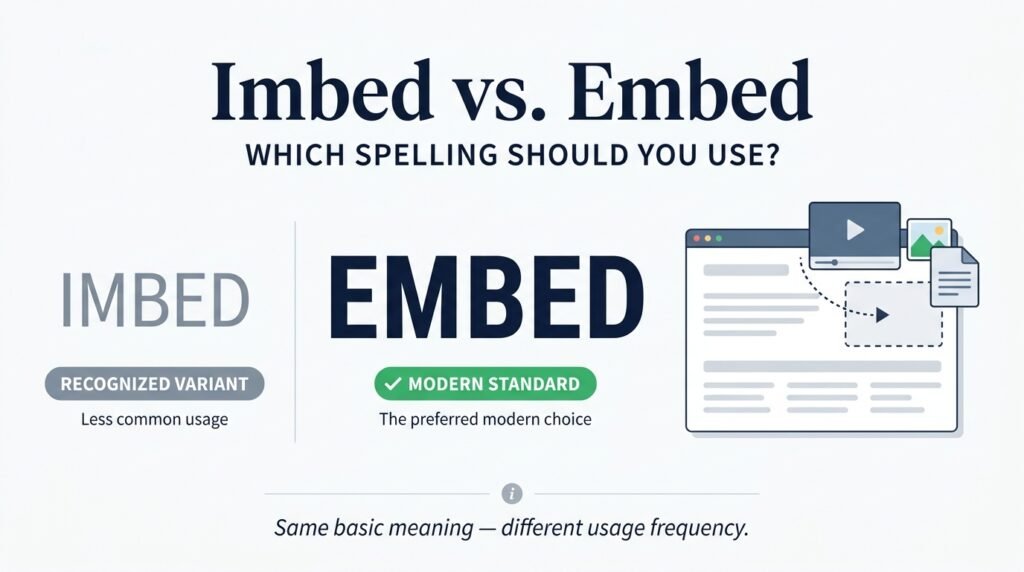

If you are choosing between imbed and embed, both spellings are recognized, but embed is the standard and much more common choice in modern English. Imbed is a variant spelling with the same basic meaning. For everyday, academic, business, and especially digital writing, embed is the form most readers expect.
What Is the Difference Between Imbed and Embed?
Imbed and embed are alternative spellings of the same verb. Both mean to put something firmly or deeply inside something else, either physically or figuratively.
The important difference is not meaning but usage and frequency.
- embed — the normal, widely used spelling
- imbed — a recognized but much less common variant
For example:
Please embed the video in the article.
You could also encounter:
Please imbed the video in the article.
The second sentence can be understood and the spelling is recognized, but embed is the natural modern choice.
This distinction becomes especially clear in technology. Expressions such as embedded video, embedded code, embedded software, embedded content, and embedded systems overwhelmingly use embed.
Why It Matters
Choosing between two recognized spellings may seem like a small issue, but familiar spelling makes writing easier to read.
If you write:
Please embed the image in the report.
Most readers will process the sentence without stopping.
If you write:
Please imbed the image in the report.
The meaning is still clear, but some readers may wonder whether imbed is a spelling mistake.
This matters particularly in:
- Business emails
- Academic assignments
- Professional reports
- Website content
- Technical documentation
- Presentations
- Marketing copy
- Software documentation
- Journalism
When two spellings have essentially the same meaning, the more familiar modern form is usually the practical choice.
The Core Rule
Use “embed” as your default spelling. “Imbed” is a recognized variant, but it is much less common.
There is no normal meaning-based rule that says embed means one thing while imbed means another.
Both can describe putting something inside something else:
The stone was embedded in the wall.
The stone was imbedded in the wall.
The first version is the one you should normally choose in contemporary writing.
How to Use Embed
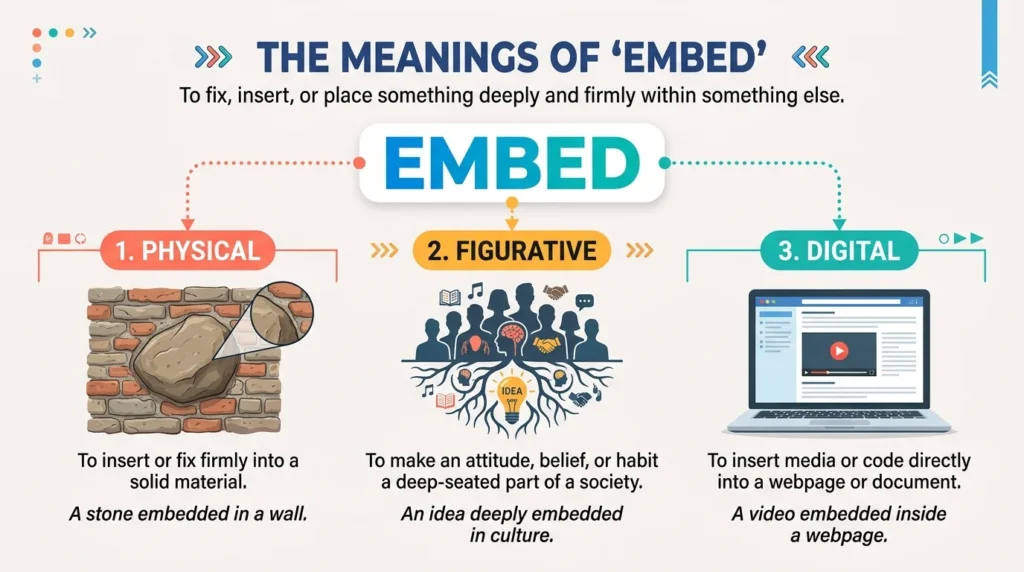
Embed can describe placing something physically inside another object, incorporating something into a larger structure, or making something deeply established in an abstract sense.
Physical use
Use embed when an object becomes firmly fixed within another material.
The jeweler embedded the stones in the ring.
A small piece of glass was embedded in the wood.
The roots are deeply embedded in the soil.
Here, embed describes a physical position inside something.
Figurative use
The word can also describe an idea, belief, habit, tradition, or principle that becomes deeply established.
The tradition is deeply embedded in the community.
The experience became embedded in her memory.
These values are embedded in the company’s culture.
The object does not have to be physically inside something. The word can describe something that has become firmly established.
Digital and technical use
Modern technology has made embed especially familiar.
You can:
- Embed a video
- Embed an image
- Embed a map
- Embed a social media post
- Embed code
- Embed a document
- Embed a chart
- Embed content on a webpage
For example:
You can embed the video directly into your blog post.
The developer embedded the map into the website.
The article contains an embedded image.
This digital usage is one reason embed is now so familiar to modern readers.
Correct Examples
Here are examples showing how embed works in different situations.
| Context | Correct Example |
|---|---|
| Conversation | Can you embed the photo in the message? |
| Please embed the chart before sending the report. | |
| Workplace | We should embed this process into our daily workflow. |
| School | The teacher asked us to embed evidence in our essays. |
| Academic writing | The study is deeply embedded in current research. |
| Website | You can embed the video on your homepage. |
| Social media | The platform lets users embed posts on external websites. |
| Technology | The device contains an embedded processor. |
| Business | Customer service is embedded in the company’s operating model. |
| Everyday writing | The memory is still deeply embedded in my mind. |
| Journalism | The reporter was embedded with the military unit. |
| Design | The buttons are embedded directly into the interface. |
Notice that embed is not restricted to one particular type of writing. It works across physical, figurative, technical, professional, and digital contexts.
Incorrect vs. Correct
Because imbed is a recognized variant, it is important not to describe every sentence containing imbed as grammatically impossible. In the examples below, the issue is mainly that embed is the more familiar and preferred modern form.
| ❌ Less preferred | ✅ Preferred | Why |
|---|---|---|
| Please imbed the video in the article. | Please embed the video in the article. | Embed is the normal modern form, especially for digital content. |
| The image was imbedded in the page. | The image was embedded in the page. | Embedded is the much more familiar form. |
| We are imbedding the map now. | We are embedding the map now. | Embedding is the standard modern form. |
| The data is imbedded in the system. | The data is embedded in the system. | Embedded is the expected spelling in technical writing. |
| The company wants to imbed the new process. | The company wants to embed the new process. | Embed is more natural in current professional English. |
| The stone was imbedded in the wall. | The stone was embedded in the wall. | Both can express the same idea, but embedded is far more familiar. |
| We need to imbed the chart in the report. | We need to embed the chart in the report. | Embed is standard for inserting digital material. |
| The idea became imbedded in the culture. | The idea became embedded in the culture. | Embedded is the established contemporary form. |
| She imbedded the image into the presentation. | She embedded the image into the presentation. | The second form matches normal modern usage. |
| The lesson was imbedded in the training program. | The lesson was embedded in the training program. | Embedded is the form most readers expect. |
The key point is simple: do not confuse “less common” with “meaningfully different.”
Why People Make This Mistake
The confusion between imbed and embed is understandable.
Phonetic similarity
The two words are pronounced alike or very similarly, so listening cannot reliably tell you which spelling a writer has used.
When someone says:
“Embed the file.”
you cannot hear whether the writer would spell it embed or imbed.
That makes this primarily a spelling-choice problem.
Spelling overlap
Both forms contain -bed, and both look plausible.
English has many words where spelling cannot be predicted perfectly from pronunciation. Learners therefore often assume that if one spelling looks logical, it must be the standard form.
Overgeneralisation
Some writers reason that imbed should be the correct form because something is being put in something else.
That logic is understandable, but spelling does not work that way.
The fact that embed describes placing something inside something does not mean writers should automatically change the first letter to i.
Autocomplete and spellcheck
Digital writing tools can add another layer of confusion.
A spellchecker may recognize imbed because dictionaries contain the variant, while another tool may prefer embed. A spelling tool’s response therefore does not necessarily tell you which form is most natural for your audience.
Read More: Licence vs License: British and American English.
Translation interference
Learners translating directly from another language may choose the spelling that appears to correspond more closely to their own language’s structure.
The safest approach is to learn the established English form rather than construct the spelling from the underlying idea.
Common Mistakes Checklist
1. Thinking “imbed” and “embed” have different meanings
They generally do not.
Both forms can describe placing or fixing something within something else.
Avoid the mistake: Treat them primarily as spelling variants, not as two unrelated words.
2. Assuming “imbed” is always completely wrong
That goes too far.
Imbed is recognized as a variant of embed.
Avoid the mistake: Remember that embed is the normal modern choice, while imbed exists as a less common alternative.
3. Using “embeded”
This is a genuine spelling error.
❌ The video is embeded in the page.
✅ The video is embedded in the page.
The correct form doubles the final d.
4. Writing “embeddding”
This adds too many letters.
❌ We are embeddding the video.
✅ We are embedding the video.
The correct spelling is:
embed → embedding
5. Choosing “imbed” in technical writing
Even though the variant exists, it is unusual in modern technology terminology.
Avoid the mistake: Use established expressions such as embedded software, embedded systems, and embedded content.
Imbed and Embed in Real English
Grammatically correct
Both embed and imbed can function as verbs with the same basic meaning. Dictionaries recognize imbed as a variant of embed. Cambridge, for example, directs its imbed entry to embed.
So a sentence such as “The object was imbedded in the wall” can communicate the intended meaning. It would be inaccurate to claim that the word imbed is simply nonexistent or universally ungrammatical.
Grammatically possible but less natural
A sentence using imbed can be grammatically understandable while still feeling unusual to a modern reader.
For example:
The developer imbedded the video in the webpage.
There is no special meaning created by choosing imbed. The reader understands the sentence, but embedded is much more familiar in contemporary digital English.
That difference between possible and preferred is important.
Natural everyday English
For most modern writing, choose embed.
The developer embedded the video in the webpage.
The image is embedded in the report.
The idea is deeply embedded in the culture.
These forms match the spelling readers encounter most often across ordinary, professional, academic, and technical contexts. The especially strong presence of embed in digital terminology reinforces that preference.
American vs. British English
There is no useful AmE-versus-BrE spelling distinction that requires you to switch between embed and imbed.
The important distinction is frequency and preference, not a simple American-versus-British rule.
Cambridge lists imbed as a variant and directs readers to embed, while usage references generally describe imbed as the less common spelling.
So if you are writing for an international audience, embed is the safest default.
Formal vs. Informal Usage
The recommendation is essentially the same in both registers.
Formal writing
Prefer embed in:
- Academic papers
- Business reports
- Professional emails
- Technical documentation
- Research writing
- Official documents
Example:
The findings are embedded within a broader theoretical framework.
Informal writing
Use embed in:
- Text messages
- Social media
- Casual emails
- Online discussions
- Personal blogs
Example:
I’ll embed the video in the post.
The difference is not that imbed belongs to informal English and embed belongs to formal English. Embed is simply the normal choice across both registers.
Imbed vs Embed: Comparison Table
| Feature | Embed | Imbed |
|---|---|---|
| Basic meaning | Put or fix something inside something else | Same basic meaning |
| Part of speech | Verb | Verb |
| Recognized English word | Yes | Yes |
| Standard modern choice | Yes | Less common variant |
| Digital content | Very common | Uncommon |
| Professional writing | Normal choice | Possible but unusual |
| Academic writing | Normal choice | Possible but less familiar |
| Embedded | Standard derived form | Imbedded is a variant |
| Embedding | Standard derived form | Imbedding is a variant |
| Best default for modern writing | Yes | No |
The distinction is therefore mainly about usage preference, not meaning.
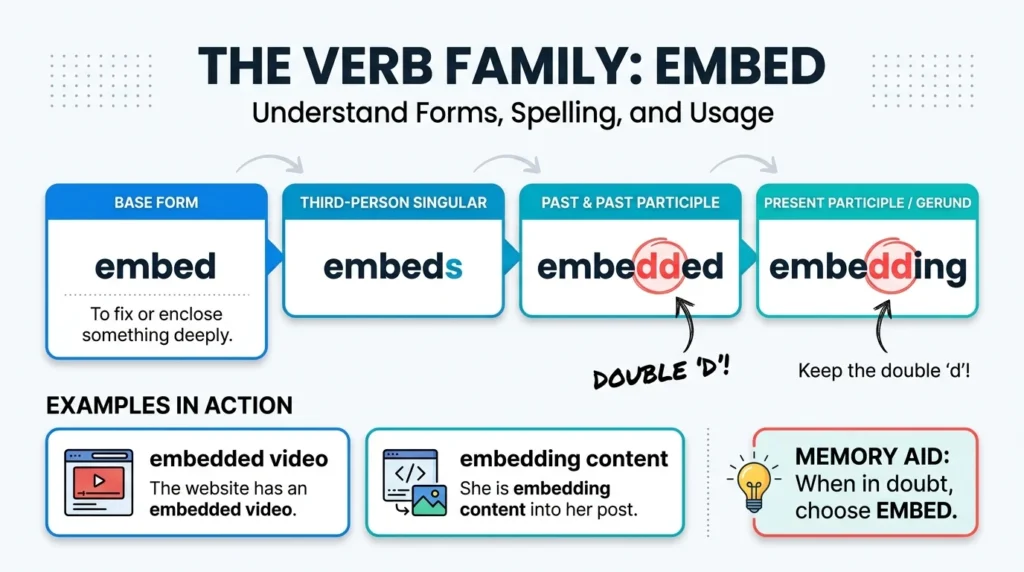
Embed, Embedded, and Embedding
Knowing the related forms helps prevent a second set of spelling mistakes.
Embed
This is the base form.
We will embed the video tomorrow.
Embeds
This is the third-person singular form.
The website automatically embeds the map.
Embedded
This is the past tense and past participle form.
The image is embedded in the document.
It is also commonly used as an adjective:
The report contains embedded charts.
Embedding
This is the -ing form.
We are embedding the video now.
The standard sequence is:
embed → embeds → embedded → embedding
The variant forms imbed, imbeds, imbedded, and imbedding can also be encountered, but embed and its related forms are the normal modern choices.
Is “Embedded” Correct?
Yes. Embedded is the standard spelling.
One of the most common errors is forgetting to double the final d:
❌ embeded
✅ embedded
Think of the spelling as:
embed + ed = embedded
Examples:
The video is embedded in the article.
A sensor is embedded inside the device.
The tradition is deeply embedded in the culture.
Is “Embedding” Correct?
Yes.
The correct form is:
embed + ing = embedding
Examples:
We are embedding the video into the page.
The software supports embedding external content.
Embedding the chart makes the report easier to understand.
Do not write embeddding.
Embed vs Insert
Embed and insert can overlap, but they are not always identical.
Insert generally emphasizes putting something into a particular place.
Insert the card into the machine.
Embed often suggests that something becomes incorporated into or fixed within a larger thing.
The designer embedded the sensor inside the device.
In digital writing, embed has a particularly specific established use. A video embedded in a webpage becomes part of the page’s presentation rather than simply being mentioned by name.
So:
Insert the video into the article.
may communicate the general idea, but:
Embed the video in the article.
is the established wording when referring to digital embedding.
Memory Trick
Use this simple reminder:
E = Embed = Electronic content
When you are talking about a video, image, map, code, webpage content, or other digital material, think:
E → Embed
For example:
- Embed a video.
- Embed an image.
- Embed a map.
- Embed code.
- Embedded content.
This is only a memory aid, not a grammar rule. It works because embed is particularly common in modern digital language.
Real-Life Situations
In an email
Your manager asks you to update a presentation.
“Please embed the latest sales chart in the final slide.”
In a meeting
A developer explains a website feature:
“We can embed the customer survey directly into the homepage.”
In a text message
A colleague asks for a video:
“I’ll embed it in the document and send it over.”
In an academic essay
A student explains a research idea:
“The theory is deeply embedded in the study’s methodology.”
In an interview
A candidate describes company culture:
“Those values are embedded in the way the team works.”
On social media
A creator explains how to share a video:
“You can embed the video on your website.”
In technical documentation
A developer writes:
“The application supports embedded media.”
Across these situations, embed remains the natural default.
Expert Tips
Tip 1: Do not confuse correctness with frequency
A word can be recognized without being the form most people normally choose.
That is exactly what makes imbed confusing.
Instead of asking only:
“Is imbed a real word?”
ask:
“Which spelling will modern readers expect?”
For most current writing, the answer is embed.
Tip 2: Learn the complete word family
Do not memorize only:
embed
Also remember:
embedded
embedding
This prevents common errors such as embeded.
Tip 3: Pay special attention to technology
If you are writing about websites, software, video, images, maps, code, or digital content, embed is overwhelmingly the useful form to remember.
Tip 4: Do not invent a meaning difference
There is no normal rule saying that embed means one thing and imbed means something else.
Changing the first letter does not create a new meaning.
Tip 5: Follow the terminology of your field
Technical language develops established expressions.
Embedded system is familiar technical terminology. Replacing embedded with imbedded may be understandable, but it does not match the form readers normally expect.
FAQ
Is “imbed” a real word?
Yes. Imbed is recognized as a variant spelling of embed. It has the same basic meaning but is much less common.
Is “embed” more common than “imbed”?
Yes. Embed is substantially more familiar in modern English, particularly in digital, technical, professional, and everyday writing.
Are imbed and embed pronounced differently?
They are generally pronounced the same or essentially the same, which is one reason the spelling can be confusing.
Does imbed mean something different from embed?
No. The two forms generally have the same basic meaning: to place, fix, or incorporate something within something else.
Should I use imbed in an essay?
You can encounter imbed as a recognized variant, but embed is the better default for modern academic writing because it is more familiar to readers.
Should I use embed for a YouTube video?
Yes. Embed a video is the standard modern expression.
Is “imbedded” correct?
Imbedded is a recognized variant form, but embedded is the standard and much more familiar modern spelling.
Is “embeded” correct?
No. The standard spelling is embedded, with two d letters after the e.
Is “imbedding” correct?
Imbedding can occur as the variant form of embedding, but embedding is the normal modern spelling.
Why does “imbed” appear in dictionaries?
Because it is a recognized spelling variant rather than simply a random misspelling. Some dictionaries list it directly or refer readers to embed.
Is embed always a verb?
Primarily, yes in the context discussed here. It functions as a verb meaning to place or fix something within something else. Embedded is also commonly used as an adjective.
What is the easiest way to remember imbed vs embed?
Remember:
Embed = the standard modern spelling.
If you are writing about a video, image, map, code, document, system, idea, or physical object, embed is the spelling to reach for first.
Mini Quiz
| # | Question | Answer | Explanation |
|---|---|---|---|
| 1 | Which spelling is the normal modern choice: imbed or embed? | Embed | Embed is the much more common modern form. |
| 2 | Fill in the blank: Please ___ the video in the article. | embed | Embed is the established term for placing digital content on a webpage. |
| 3 | Choose the correct form: The image was embeded / embedded in the report. | embedded | The standard past form doubles the final d. |
| 4 | Choose the correct form: We are embeddding / embedding the map. | embedding | The correct -ing form is embedding. |
| 5 | True or false: Imbed and embed normally have different meanings. | False | They are spelling variants with the same basic meaning. |
| 6 | Correct the sentence: “The developer imbedded the video in the page.” | The developer embedded the video in the page. | Imbed is recognized, but embed is the preferred modern form. |
| 7 | Which sounds more natural in technical writing: “embedded system” or “imbedded system”? | embedded system | Embedded is the established modern technical form. |
| 8 | Fill in the blank: The tradition is deeply ___ in the culture. | embedded | Embedded works naturally for something firmly established. |
| 9 | Is “imbed” completely nonexistent in English? | No | It is a recognized variant of embed. |
| 10 | Choose the best sentence: A) Please imbed the image. B) Please embed the image. | B | Both may communicate the meaning, but embed is the normal modern choice. |
Quick Summary
Embed and imbed are alternative spellings with the same basic meaning: to place, fix, or incorporate something within something else. The important difference is usage. Embed is the standard, much more common form in modern English and is especially dominant in technology, websites, professional writing, and digital content. Imbed is a recognized but less common variant, so it should not automatically be called an incorrect word. If you are unsure which spelling to use, choose embed. The same preference applies to related forms: embedded and embedding are the standard forms to use in contemporary writing. For most readers and situations, choosing embed gives you the clearest and most familiar wording.