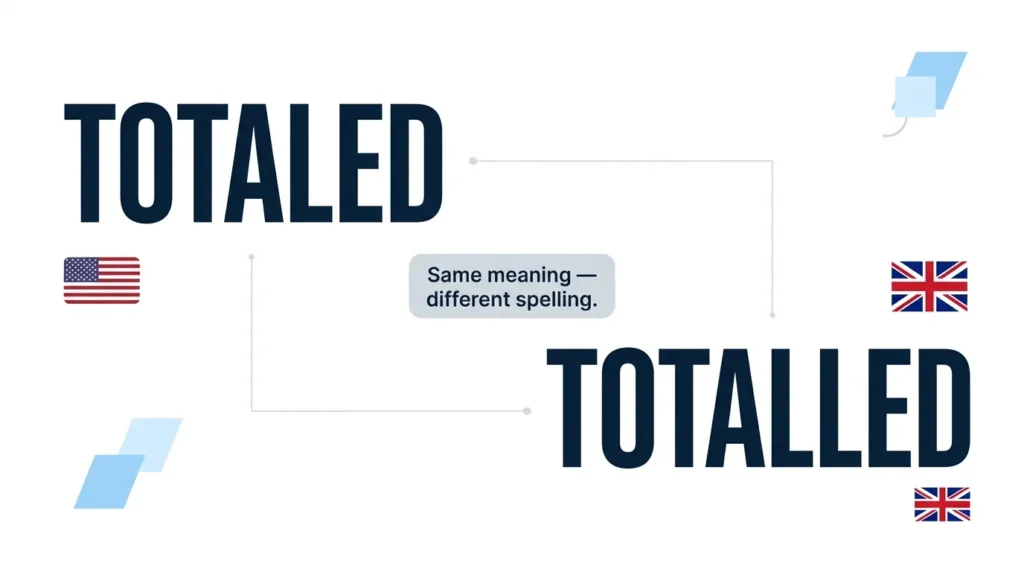

Totaled is the usual American English spelling, while totalled is the usual British English spelling. They mean the same thing when used as forms of the verb total. The verb can mean to add amounts together or, especially in American English, to damage a vehicle so badly that it cannot reasonably be repaired. Choose the spelling that matches the English variety you are using, and keep it consistent.
What Is the Difference Between Totaled and Totalled?
The difference between totaled and totalled is a spelling difference, not a difference in the basic grammatical function of the words.
Both are forms of the verb total:
- totaled — American English
- totalled — British English
Both can describe an action completed in the past:
The accountant totaled the expenses.
The accountant totalled the expenses.
The meaning is essentially the same: the accountant added the expenses together.
The same distinction appears when total is used to describe severe damage:
The crash totaled the car.
The crash totalled the car.
However, this second use has an important regional point. Cambridge marks the meaning “damage a vehicle so badly that it cannot be repaired” as mainly American English and gives write off as the UK equivalent.
So the spelling difference is real, but the meanings require a little more attention than simply saying “the words are interchangeable.”
Why It Matters
Using the wrong regional spelling is rarely a serious communication problem because readers can understand both forms. However, spelling consistency matters in professional and academic writing.
For example, imagine a British company report containing:
The project totalled £4 million.
That looks natural in British English.
But if the same report repeatedly switches between totalled, totaled, cancelled, and canceled, the document may look as though it combines different spelling systems.
The same applies to American writing. An American report would normally use:
The project totaled $4 million.
Choosing a spelling system and following it consistently makes your writing look deliberate rather than accidental.
This matters especially in:
- Business reports
- Academic papers
- Professional emails
- Journalism
- Website content
- Government documents
- Formal correspondence
- Educational materials
The issue is therefore not simply “Which spelling is right?” The better question is “Which spelling fits the English variety I am using?”
Read More: Skillset vs Skill Set: Which One Is Correct?
The Core Rule
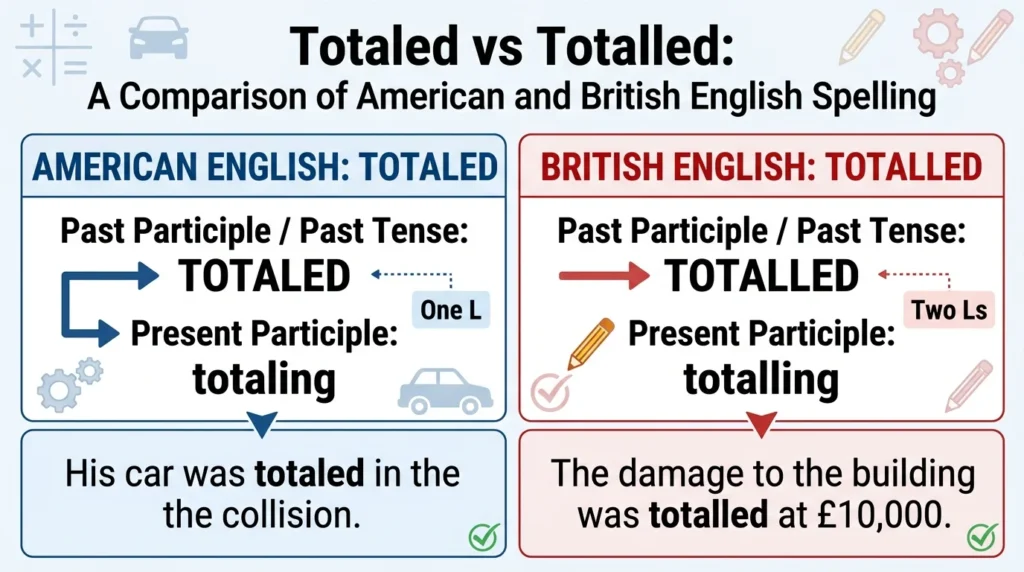
Use “totaled” in American English and “totalled” in British English. Both are correct regional spellings of the past tense and past participle of “total.”
The same regional difference appears in the present participle:
- American English: totaling
- British English: totalling
Cambridge explicitly identifies the forms as totalled/totalling in British English and totaled/totaling in American English.
A useful way to see the pattern is:
| American English | British English |
|---|---|
| totaled | totalled |
| totaling | totalling |
The important point is that you should not treat the extra l as a difference in meaning. It is part of the spelling convention.
How to Use Totaled
Use totaled when you are writing in American English.
It is the normal American spelling of the past tense and past participle of total.
The verb can mean added together to reach a total:
The accountant totaled the receipts.
It can also mean damaged a vehicle beyond repair, particularly in American usage:
The accident totaled the car.
The second meaning is especially common in American discussions of cars, insurance, and accidents. Cambridge labels this use as mainly US English.
Totaled for Adding Amounts
When total means “add up,” use totaled in American English.
Examples:
She totaled the sales figures for the quarter.
The expenses totaled $8,450.
We totaled all the receipts before submitting the report.
The donations totaled more than $50,000.
In these sentences, totaled describes either calculating a final amount or reaching a particular total.
Totaled for Severe Vehicle Damage
In American English, totaled can also describe a vehicle that has been damaged so severely that it is considered beyond economical repair.
For example:
The insurance company said the car was totaled.
This does not simply mean that the car was damaged. It describes a much more serious level of damage.
The adjective-like use is common in sentences such as:
Her totaled car was taken to the repair yard.
Cambridge gives this meaning as mainly American English.
How to Use Totalled
Use totalled when following British English spelling conventions.
It has the same basic grammatical role as totaled.
For example:
The accountant totalled the expenses.
The donations totalled £50,000.
The costs totalled more than expected.
Cambridge lists totalled as the past simple and past participle of total, with corpus examples involving amounts, losses, scores, and other quantities.
In British English, when talking about a vehicle that has been damaged beyond repair, write off is generally the more appropriate expression rather than using totalled in the American sense. Cambridge specifically contrasts the mainly US vehicle meaning of total with UK write off.
Correct Examples
Here are examples showing how the two spellings work in different situations.
- American English — workplace:
The finance team totaled the expenses before preparing the report. - British English — workplace:
The finance team totalled the expenses before preparing the report. - American English — email:
I totaled the figures twice to make sure the calculation was correct. - British English — email:
I totalled the figures twice to make sure the calculation was correct. - American English — business:
The company’s annual sales totaled $12 million. - British English — business:
The company’s annual sales totalled £9 million. - American English — accident:
The insurer declared the vehicle totaled after the crash. - British English — financial report:
The losses totalled nearly £2 million. - American English — school:
I totaled the points from all five sections of the test. - British English — academic writing:
The responses totalled 428 observations. - American English — social media:
The donations totaled more than we expected. - British English — everyday conversation:
The bill totalled almost £100.
Notice that the underlying action remains the same. The spelling changes according to the English variety.
Incorrect vs. Correct
The following examples focus on consistency and regional usage.
| ❌ Incorrect or inconsistent | ✅ Correct | Why |
|---|---|---|
| I totalled the figures. (in an otherwise US-style document) | I totaled the figures. | American English normally uses -l- here. |
| I totaled the figures. (in an otherwise British-style document) | I totalled the figures. | British English normally uses -ll- here. |
| The costs totalled $5 million. (in a consistent US document) | The costs totaled $5 million. | The spelling should match the document’s English variety. |
| The costs totaled £5 million. (in a consistent British document) | The costs totalled £5 million. | British English normally uses the double l. |
| The accountant totalled the figures in a US report. | The accountant totaled the figures in a US report. | The issue is regional spelling, not grammar. |
| The accountant totaled the figures in a British report. | The accountant totalled the figures in a British report. | British spelling uses totalled. |
| She is totalled the expenses. | She totalled the expenses. | Totalled is a past-tense/past-participle form; it cannot follow is this way. |
| She has totaled the expenses. (British-style document) | She has totalled the expenses. | The past participle should follow the chosen regional spelling. |
| The accident totaled the car. (describing a UK context where the intended term is write off) | The accident wrote off the car. | British English commonly uses write off for this vehicle meaning. |
| I am totalled the costs. | I am totalling the costs. | After am, use the present participle: totalling in British English. |
The key lesson is that not every apparent “mistake” is a grammar mistake. Some are simply inconsistencies between spelling systems.
Why People Make This Mistake
There are several reasons totaled and totalled cause confusion.
They Sound the Same
When spoken, the two spellings do not give you a useful pronunciation clue. You hear the same verb, regardless of whether the writer uses one l or two.
That means the distinction has to be learned visually.
English Uses Different Spelling Systems
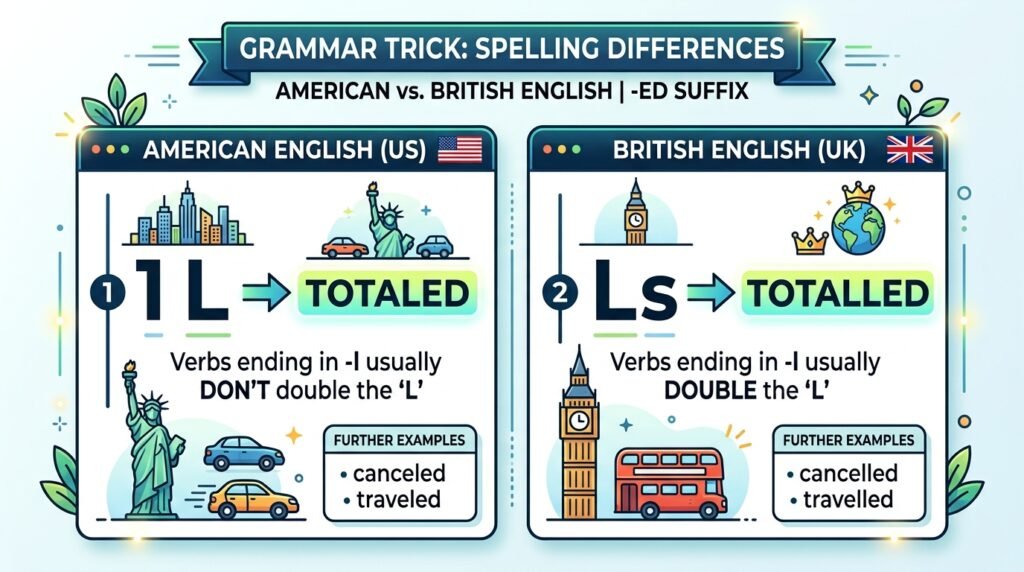
American and British English developed different conventions for certain spellings.
That is why writers encounter pairs such as:
- canceled / cancelled
- traveled / travelled
- labeled / labelled
- totaling / totalling
- totaled / totalled
Seeing both systems online can make a learner assume one version must be a spelling mistake.
It is not.
Spellcheck Settings Can Cause Confusion
A spellchecker configured for American English may flag totalled, while one configured for British English may prefer it.
The software is not necessarily telling you that the other form is universally wrong. It may simply be applying a different language setting.
People Learn From Mixed English Sources
A student might learn American English from one website, British English from a textbook, and Australian or international English from another source.
As a result, both forms can become familiar.
Translation Can Reinforce the Confusion
Learners who translate directly from another language may look for one “correct” spelling rather than recognizing that English has multiple standard varieties.
In this case, there is no single universal winner between the two forms.
Common Mistakes Checklist
1. Thinking “totalled” is always wrong
It is not. Totalled is a standard British English form. Cambridge lists it as the past simple and past participle of total.
2. Thinking “totaled” is always wrong
It is not. Totaled is the standard American spelling.
3. Treating the spellings as different words
They are not different verbs with different basic meanings. They are regional spelling variants.
4. Mixing spelling systems
A document can contain both forms if it is discussing different varieties, but ordinary writing should normally maintain a consistent style.
5. Assuming the extra L changes pronunciation
It does not create a different word or a different basic pronunciation.
6. Using “totaled” for every British vehicle context
British English commonly uses write off for a vehicle damaged beyond repair.
7. Forgetting the -ing form
If you choose American spelling, use totaling. If you choose British spelling, use totalling.
Totaled vs Totalled in Real English
Grammatically correct
Both totaled and totalled are grammatically correct when used as the past tense or past participle of total. The spelling depends on the variety of English. A sentence such as “The expenses totaled $5,000” is standard American English, while “The expenses totalled £5,000” is standard British English. Neither spelling becomes grammatically incorrect simply because another variety uses the alternative.
Grammatically possible but context-dependent
The vehicle-damage meaning needs more care. In American English, saying “The car was totaled” is a normal way to describe a vehicle damaged beyond repair. In British English, however, write off is generally the natural expression for this meaning. Therefore, translating the American usage directly into British English can produce wording that feels less natural even though the spelling itself is not the central issue.
Natural everyday English
For ordinary calculations, both regional forms are natural: “We totaled the expenses” in American English and “We totalled the expenses” in British English. In informal American conversation, totaled is also common when discussing a badly damaged car. In British everyday English, speakers are more likely to say that a car was written off. The natural choice therefore depends not only on spelling but also on the regional vocabulary surrounding the meaning.
American vs. British English
This is a genuine American–British spelling difference.
| Feature | American English | British English |
|---|---|---|
| Past tense | totaled | totalled |
| Past participle | totaled | totalled |
| Present participle | totaling | totalling |
| Meaning: add amounts | Yes | Yes |
| Vehicle severely damaged | totaled is common | write off is commonly used |
| Extra L | No | Yes |
Cambridge explicitly shows the spelling distinction as UK -ll- versus US -l-.
The important point is that American and British English are not competing for a single “correct” spelling. They are established varieties with their own conventions.
Formal vs. Informal Usage
The spelling difference itself is not a formal-versus-informal distinction.
Both totaled and totalled can appear in formal writing when the regional spelling is appropriate.
For example:
The project costs totalled £4.2 million.
That can be perfectly appropriate in a formal British report.
Likewise:
Project costs totaled $4.2 million.
is appropriate in formal American English.
The vehicle meaning is different. In American English, totaled can be relatively informal because it is common in everyday discussions of car accidents. In formal insurance or technical writing, a more precise phrase may be used depending on the context.
Comparison Table
| Feature | Totaled | Totalled |
|---|---|---|
| English variety | American English | British English |
| Spelling | One l | Two ls |
| Part of speech | Verb form | Verb form |
| Verb | total | total |
| Tense | Simple past | Simple past |
| Can be past participle? | Yes | Yes |
| Meaning: add amounts | Yes | Yes |
| Meaning: severely damage a vehicle | Common in US English | British English commonly uses write off |
| Present participle | totaling | totalling |
| Pronunciation | Same basic pronunciation | Same basic pronunciation |
| Formality | Neutral | Neutral |
| Main difference | Regional spelling | Regional spelling |
Memory Trick
Use this simple rule:
America = one L → totaled
Britain = two Ls → totalled
You can connect it to the broader pattern:
US: totaled, canceled, traveled
UK: totalled, cancelled, travelled
The mnemonic is not a grammatical rule by itself, but it is a useful way to remember the spelling pattern.
Real-Life Situations
Job Interview or Workplace
If you are writing for an American company:
The expenses totaled $18,500.
For a British company:
The expenses totalled £14,000.
The important thing is consistency with the company’s preferred English style.
Business Email
American:
I have totaled the figures and attached the revised report.
British:
I have totalled the figures and attached the revised report.
Academic Writing
American:
The responses totaled 1,250 observations.
British:
The responses totalled 1,250 observations.
Academic writing does not make one spelling universally correct. The required regional or institutional style determines the choice.
Text Message
American:
The bill totaled about $80.
British:
The bill totalled about £60.
In a casual message, readers will normally understand either form, but matching the variety you normally use is still good practice.
Car Accident
American:
The insurance company said my car was totaled.
British:
The insurance company said my car was a write-off.
The second example demonstrates an important point: sometimes regional English differs in vocabulary, not just spelling.
Expert Tips
Check the language setting before correcting the spelling
If your document is intended for an American audience, set your spelling checker to American English. If it is intended for a British audience, use British English.
This prevents software from making a regional difference look like an error.
Look at the whole document, not one word
Do not decide your English variety from totaled alone.
Look for other spellings:
- color or colour
- center or centre
- canceled or cancelled
- traveled or travelled
- organize or organise
A consistent pattern will tell you which spelling system the document is following.
Do not “correct” a regional spelling into your preferred variety
If you are editing British English, changing totalled to totaled does not improve the sentence. It changes the regional spelling.
Editors should preserve the intended English variety unless a style guide requires otherwise.
Pay attention to meaning when discussing damaged vehicles
If you are writing for an international audience, damaged beyond repair or written off may communicate more clearly than relying on the American use of totaled.
Remember the related form
If you learn totaled, also remember totaling.
If you learn totalled, also remember totalling.
This prevents you from learning the past-tense form in isolation.
FAQ
Is “totaled” correct English?
Yes. Totaled is the standard American English spelling of the past tense and past participle of total. It is correct when used according to American spelling conventions.
Is “totalled” correct English?
Yes. Totalled is the standard British English spelling of the past tense and past participle of total.
Is totaled or totalled more correct?
Neither is universally more correct. Totaled is standard in American English, while totalled is standard in British English.
Do totaled and totalled have different meanings?
Usually, no. They are regional spellings of the same verb form. However, the verb’s vehicle-damage meaning is especially associated with American English; British English commonly uses write off in that context.
Is “totalled” only used in the UK?
No. British-style spelling is used in the UK and can also appear in other varieties of English that follow British spelling conventions. The important distinction for a writer is the spelling standard being followed.
Is “totaled” only used in America?
It is the standard American spelling, but American spelling conventions are also used by writers and organizations outside the United States.
Should I write “totaled” or “totalled” in an international article?
Choose one spelling system and use it consistently. If your publication follows American English, use totaled. If it follows British English, use totalled.
What is the British word for a totaled car?
British English commonly uses written off or a write-off for a vehicle that is damaged beyond economical repair.
What is the American spelling of totalled?
The American spelling is totaled.
What is the British spelling of totaled?
The British spelling is totalled.
Is “totaling” or “totalling” correct?
Both are correct regional forms. Totaling is the American spelling, while totalling is the British spelling.
Can I use totaled and totalled in the same document?
You can if you are deliberately discussing different English varieties, but ordinary writing should normally use one regional spelling consistently.
Quick Summary
Totaled and totalled are both correct spellings of the past tense and past participle of total. The main difference is regional: totaled is standard American English, while totalled is standard British English. Both can mean that amounts were added together to reach a total. In American English, totaled can also mean that a vehicle was damaged so badly that it could not reasonably be repaired. British English commonly uses write off for this vehicle meaning. The related present-participle forms are totaling in American English and totalling in British English. For professional writing, choose the spelling that matches your audience or style guide and use it consistently.
Quiz
| # | Question | Answer | Explanation |
|---|---|---|---|
| 1 | Which spelling is standard in American English: totaled or totalled? | Totaled | American English normally uses one l. |
| 2 | Which spelling is standard in British English? | Totalled | British English normally uses two ls. |
| 3 | Fill in the blank: “The expenses ___ $25,000.” (American English) | totaled | The American past-tense spelling is totaled. |
| 4 | Fill in the blank: “The expenses ___ £25,000.” (British English) | totalled | The British spelling is totalled. |
| 5 | Correct this American English sentence: “The accountant totalled the receipts.” | The accountant totaled the receipts. | The American form uses one l. |
| 6 | Correct this British English sentence: “The accountant totaled the receipts.” | The accountant totalled the receipts. | The British form uses two ls. |
| 7 | Which is the American present participle: totaling or totalling? | Totaling | American English uses one l. |
| 8 | Which sentence follows British English? A) The costs totaled £4,000. B) The costs totalled £4,000. | B | Totalled follows the British spelling convention. |
| 9 | In British English, what expression is commonly used for a vehicle damaged beyond repair? | written off / a write-off | British English commonly uses write off for this meaning. |
| 10 | True or false: “Totaled” and “totalled” have different basic meanings. | False | They are regional spellings of the same verb form; the main distinction is spelling convention. |