
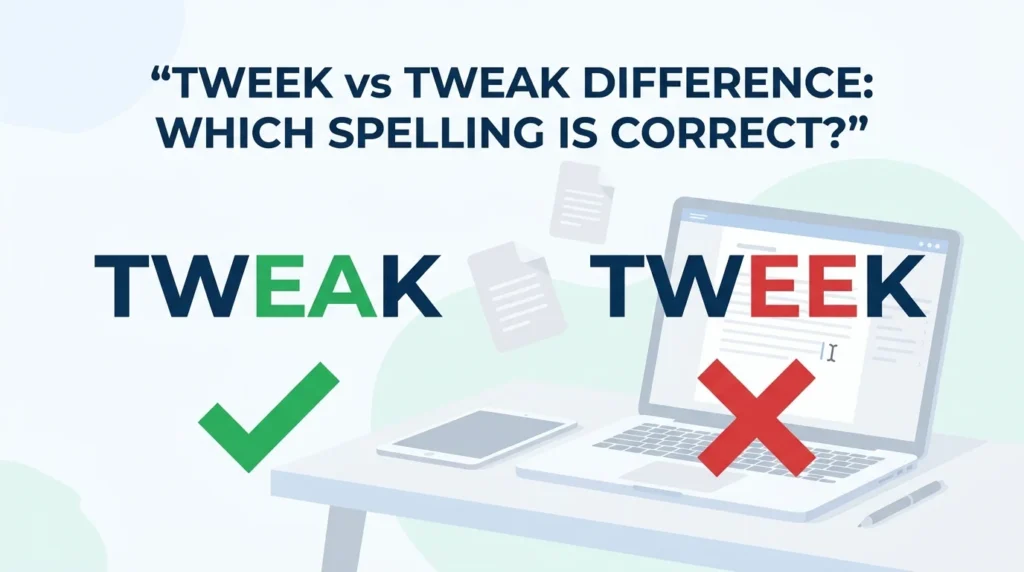

Tweak is the correct standard spelling when you mean “to make a small change, adjustment, or improvement.” Tweek is usually a misspelling of tweak. The confusion happens because tweak is pronounced /twiːk/, which sounds like “tweek.” Both British and American English use tweak for the ordinary meaning. However, tweek can appear in a few specialized or proper-name contexts, so it is not accurate to say that the letter combination can never occur.
What Is the Difference Between Tweek and Tweak?
The difference between tweek vs tweak is mainly one of spelling and standard usage.
Tweak is an established English word. It can function as both a verb and a noun.
As a verb, tweak means to make a small change or adjustment, often to improve something or make it work better.
I need to tweak the wording of this email.
As a noun, tweak means a small change or adjustment.
The website needs a few tweaks.
Tweek, when written with the intention of expressing this meaning, is generally a spelling error.
So, for normal English writing, remember:
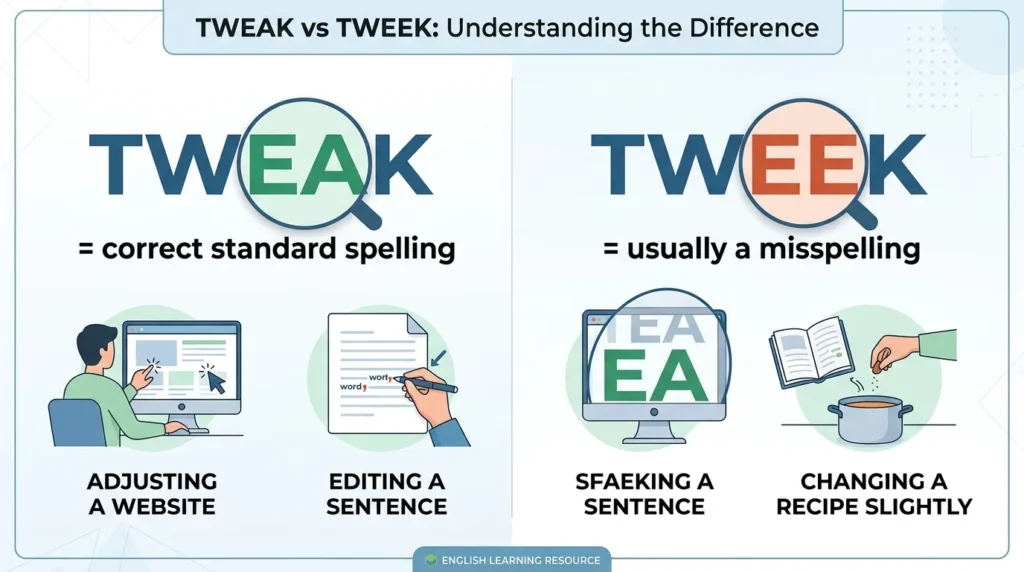
- tweak = correct standard spelling
- tweek = usually a misspelling of tweak
There is one important qualification: tweek does exist in some specialized contexts, including a rare technical noun referring to a type of radio interference. It can also appear as a name or other proper noun. These specialized uses do not make tweek an alternative spelling of the everyday word tweak.
Why Does It Matter?
A one-letter difference may seem unimportant, but spelling affects how clearly your writing communicates.
If you write:
I need to tweek the report.
most readers will understand what you mean. However, they are likely to interpret tweek as a spelling mistake because the standard word is tweak.
This matters especially in:
- Business emails
- Resumes and applications
- Academic assignments
- Reports
- Website content
- Professional presentations
- Instructions and documentation
- Published articles
A spelling error can distract the reader from your actual message. In professional writing, using the standard spelling also makes your work look more polished.
The Core Rule
Use TWEAK when you mean to make a small change, adjustment, or improvement.
The standard spelling is:
T-W-E-A-K
Not:
T-W-E-E-K
The key difference is the vowel combination:
tweak → EA
tweek → EE
The pronunciation does not make this distinction obvious because tweak is pronounced /twiːk/ in both British and American English.
How to Use “Tweak”
Tweak as a Verb
As a verb, tweak means to make a small adjustment.
You can tweak something without completely changing it.
For example:
I need to tweak the headline.
This suggests that the headline needs a small modification rather than a complete rewrite.
You can tweak:
- A sentence
- A paragraph
- A recipe
- A design
- A website
- Software settings
- A marketing strategy
- A schedule
- A presentation
- A business plan
The usual idea is small, deliberate modification.
Tweak as a Noun
Tweak can also be a noun.
In this form, it refers to the small change itself.
The designer made a tweak to the logo.
We made a few tweaks to the campaign.
One final tweak should improve the presentation.
The plural is tweaks.
Common Forms of Tweak
| Form | Example |
|---|---|
| tweak | I need to tweak the design. |
| tweaks | She makes small tweaks regularly. |
| tweaked | We tweaked the settings yesterday. |
| tweaking | They are tweaking the software. |
Notice that all these forms retain the ea spelling.
Correct:
tweaked
Not:
tweeked
Correct:
tweaking
Not:
tweeking
Correct Examples
Here are examples from different areas of everyday and professional English.
- Conversation:
“I just need to tweak a couple of things.” - Email:
“Could you tweak the final paragraph before sending the email?” - Workplace:
“We should tweak the proposal before presenting it to the client.” - School:
“I tweaked my introduction after reviewing the teacher’s comments.” - Academic writing:
“The researcher tweaked the wording of the question to improve clarity.” - Technology:
“Try tweaking the display settings.” - Marketing:
“The team tweaked the campaign after reviewing the first results.” - Design:
“The designer made a few tweaks to the homepage.” - Cooking:
“I tweaked the recipe by reducing the amount of sugar.” - Social media:
“I’m going to tweak the caption before posting it.” - Presentation:
“She tweaked the final slide to make the conclusion clearer.” - Everyday writing:
“The plan is good; it just needs a small tweak.”
In all these examples, tweak describes a relatively small adjustment rather than a complete transformation.
Incorrect vs. Correct
| ❌ Incorrect | ✅ Correct | Why |
|---|---|---|
| I need to tweek the design. | I need to tweak the design. | Tweak is the standard spelling. |
| Please tweek this sentence. | Please tweak this sentence. | The verb is spelled with ea. |
| We tweeked the settings. | We tweaked the settings. | The past tense keeps the spelling tweak. |
| She is tweeking the website. | She is tweaking the website. | The -ing form comes from tweak. |
| I made a small tweek. | I made a small tweak. | The noun is tweak. |
| They made several tweeks. | They made several tweaks. | The plural is formed from tweak. |
| Can you tweek the headline? | Can you tweak the headline? | Tweek is normally a misspelling here. |
| He tweeked the recipe. | He tweaked the recipe. | The correct past-tense spelling is tweaked. |
| We are tweeking the plan. | We are tweaking the plan. | Use tweak + ing. |
| The report needs one more tweek. | The report needs one more tweak. | The standard noun is tweak. |
The important point is that the mistake is not limited to the base form. Once you learn tweak, remember the same spelling when adding endings.
Why People Make This Mistake
1. Pronunciation Makes “Tweek” Look Logical
This is probably the biggest reason.
Tweak is pronounced /twiːk/. The vowel sound is the same long e sound heard in words such as week and seek. (Cambridge Dictionary)
So when someone hears:
tweak
they may naturally imagine:
tweek
English spelling, however, does not always provide a simple one-to-one match between sound and letters.
2. Familiar “EE” Words Influence Spelling
Learners already know many words containing ee:
- week
- seek
- keep
- sleep
- green
- feel
Because tweak has the same general long /iː/ vowel sound, tweek can feel visually natural.
But English also uses ea for the same sound:
- speak
- clean
- dream
- team
- mean
- weak
Tweak belongs to this second spelling pattern.
3. Fast Typing Creates Simple Errors
Sometimes there is no deeper explanation.
A person knows the word but types tweek quickly because the pronunciation is strongly associated with ee.
Once the error appears repeatedly in messages or documents, it can become a habit.
4. Autocomplete Is Not a Grammar Teacher
Spellcheckers and autocomplete tools can help, but they should not replace knowledge of standard spelling.
A word can appear frequently online without being the correct form for a particular context. Usernames, character names, product names, technical terminology, and intentional slang can all appear in search results.
That means seeing tweek online does not automatically prove that it is the standard spelling of tweak.
5. Translation Interference
Learners whose first language has a more predictable relationship between sounds and letters may expect pronunciation to determine spelling.
That strategy works for some English words but fails for others.
With tweak, hearing /twiːk/ does not tell you whether the middle should be ea or ee.
The spelling has to be learned.
Common Mistakes Checklist
Mistake 1: Writing “tweek” because it sounds right
Problem: The pronunciation suggests an ee spelling.
Solution: Memorize tweak = T-W-E-A-K.
Mistake 2: Writing “tweeked”
Problem: The writer changes the spelling before adding -ed.
Solution: Start with tweak, then add -ed:
tweak → tweaked
Mistake 3: Writing “tweeking”
Problem: The writer carries the imagined tweek spelling into the continuous form.
Solution:
tweak → tweaking
Mistake 4: Assuming it is a UK/US spelling difference
Problem: Some English words have different British and American spellings, so learners may assume this is another example.
Solution: It is not. Tweak is the standard spelling in both British and American English.
Mistake 5: Thinking every appearance of “tweek” is a spelling error
Problem: This goes too far in the opposite direction.
Solution: In ordinary writing about making a small adjustment, tweek is generally a misspelling. But specialized uses and proper names can exist.
Tweak in Real English
Everyday Conversation
Tweak is natural when someone wants to describe a small adjustment rather than a complete change.
“I like the design. I just want to tweak the colors.”
This sounds natural because the speaker is making a limited modification. Saying change the colors is also grammatical, but tweak gives the listener a stronger sense that the adjustment will be relatively minor. The word is especially useful when the original version is already close to what is wanted.
Workplace English
Tweak is common in workplace communication when discussing documents, plans, strategies, presentations, websites, or processes.
“We need to tweak the proposal before the meeting.”
The sentence suggests that the proposal does not need to be rebuilt from scratch. A few adjustments are expected. In a formal report, adjust or modify may sound more neutral, while tweak is perfectly natural in many professional conversations and emails.
Academic English
Tweak is grammatically correct in academic English, but the best choice depends on the level of formality.
For example:
“The researchers tweaked the experimental procedure.”
This is understandable and grammatical. In highly formal academic prose, modified, adjusted, or refined may sometimes be more precise. The issue is not correctness; it is register and the exact meaning the writer wants.
Technology and Design
Tweak is particularly natural when discussing small technical or visual adjustments.
“We tweaked the settings to improve performance.”
“The designer tweaked the layout.”
Here, tweak efficiently communicates the idea of fine adjustment. It does not normally imply rebuilding the entire system or design.
“Tweak” Does Not Always Mean “Improve”
A useful detail is that tweak often suggests improvement or optimization, but the word itself primarily describes a small adjustment.
For example:
“The company tweaked its pricing structure.”
The sentence tells us that the pricing structure was adjusted. It does not, by itself, prove that the result was better.
So avoid treating tweak as an exact synonym for improve in every situation.
American vs. British English
There is no standard American-versus-British spelling difference here.
Both varieties use:
tweak
and pronounce it /twiːk/.
So these are both correct:
British English: We need to tweak the schedule.
American English: We need to tweak the schedule.
This is different from genuine spelling differences such as colour/color or centre/center.
Do not write tweek simply because you are following British English.
Formal vs. Informal Usage
Tweak is not restricted to informal English. It can be used in everyday conversation, workplace communication, technical writing, and other contexts.
However, its tone can vary depending on the context.
| Context | Is “tweak” suitable? | Possible alternative |
|---|---|---|
| Casual conversation | Yes | adjust |
| Text message | Yes | change slightly |
| Business email | Yes | adjust / modify |
| Marketing | Yes | refine / optimize |
| Technical documentation | Yes | adjust / modify |
| Academic writing | Yes, depending on context | modify / refine |
| Legal writing | Sometimes | modify / amend |
| Very formal report | Sometimes | adjust / modify |
The key is precision. If you want to emphasize a small adjustment, tweak is often a good choice. If you need a more formal or technically precise term, another word may be better.
Tweak vs. Tweek: Comparison Table
| Feature | Tweak | Tweek |
|---|---|---|
| Standard spelling for a small adjustment | ✅ Yes | ❌ No |
| Common English verb | ✅ Yes | ❌ Not for this meaning |
| Common English noun | ✅ Yes | ❌ Not for this meaning |
| Means “make a small change” | ✅ Yes | ❌ No |
| Past tense | tweaked | Not tweeked |
| -ing form | tweaking | Not tweeking |
| British English | ✅ Yes | ❌ Not as an alternative spelling |
| American English | ✅ Yes | ❌ Not as an alternative spelling |
| Common in professional writing | ✅ Yes | ❌ Generally no |
| Can appear as a special name/term | — | ✅ In limited contexts |
The most useful rule is simple:
If you mean a small adjustment, use “tweak.”
Is “Tweek” Ever a Real Word?
This question deserves a more careful answer than simply saying “no.”
For normal writing, tweek should not be used as an alternative spelling of tweak.
However, tweek does appear in specialized contexts. Wiktionary records tweek as a noun for a type of atmospheric radio interference, and also records its use as a misspelling of tweak.
There can also be proper names containing Tweek. A name does not have to follow ordinary English spelling rules in the same way a common noun or verb does.
Therefore:
“I need to tweek the design.”
is normally a spelling error.
But:
“Tweek” as the name of a person, character, brand, or specialized term
may be intentional.
The context determines whether the spelling is an error.
Tweak vs. Change vs. Adjust vs. Modify
Tweak is related to several other verbs, but they are not always interchangeable.
Tweak
Usually suggests a small adjustment, often made to improve or fine-tune something.
We tweaked the headline.
Adjust
A broader and more neutral word for changing something to make it suitable or correct.
We adjusted the schedule.
Modify
Usually suggests changing something from its original form. It can describe small or substantial changes depending on context.
The engineer modified the system.
Change
The broadest term. It does not tell the reader how large or small the change was.
We changed the design.
Refine
Suggests improving something by making careful adjustments.
She refined the proposal.
This distinction is useful because tweak is not simply a fancy replacement for change. Its strongest feature is the idea of a relatively small adjustment.
Memory Trick
Here is an easy way to remember the spelling:
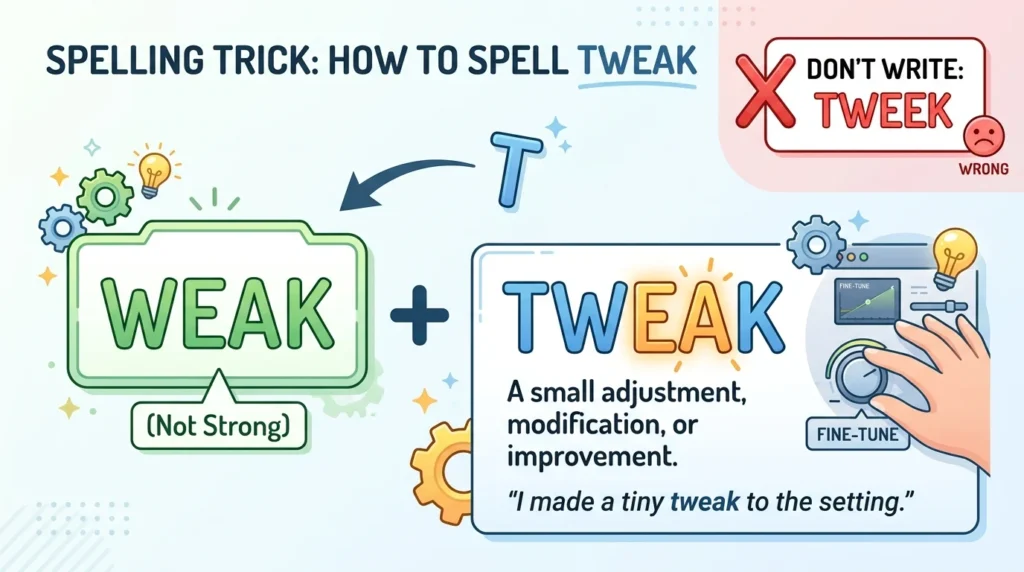
TWEAK has EA, like WEAK.
Break it visually:
T + WEAK = TWEAK
The spelling is:
T-W-E-A-K
Not:
T-W-E-E-K
Another memory sentence is:
Make a small TWEAK, not a big change.
Whenever you mean a small adjustment, picture the word TWEAK with EA in the middle.
Real-Life Situations
In an Interview
Interviewer: “Would you change anything about your previous project?”
Candidate: “I would probably tweak the onboarding process to make it easier for new users.”
Here, tweak communicates that the candidate would make a relatively small improvement rather than completely redesigning the process.
In a Team Meeting
“The strategy is solid, but we need to tweak the timeline.”
The speaker believes the overall strategy can remain. Only the timeline needs adjustment.
In an Email
“I’ve reviewed the document and made a few tweaks to the introduction.”
This is a natural professional use of the noun tweaks.
In a Text Message
“Give me five minutes. I just need to tweak the caption.”
The informal setting makes tweak feel natural and concise.
In an Exam
Question: Choose the correct spelling.
The teacher asked us to ___ our final paragraph.
Answer: tweak
The sentence means that the students should make a small adjustment to the paragraph.
Mini Quiz
| # | Question | Answer | Explanation |
|---|---|---|---|
| 1 | Choose the correct spelling: “I need to ___ the design.” A) tweek B) tweak | B) tweak | Tweak is the standard spelling for a small adjustment. |
| 2 | Fill in the blank: “She ___ the recipe yesterday.” | tweaked | The past tense of tweak is tweaked. |
| 3 | Which is correct? A) tweeking B) tweaking | B) tweaking | The -ing form is tweaking. |
| 4 | Correct the sentence: “We made a small tweek to the plan.” | We made a small tweak to the plan. | Tweak is the standard noun. |
| 5 | True or false: “Tweek” is the British spelling of “tweak.” | False | British and American English both use tweak. |
| 6 | Choose the best word: “The website is almost finished; we only need to ___ a few details.” A) tweak B) destroy | A) tweak | Tweak fits a small adjustment. |
| 7 | Fill in the blank: “The designer made three ___ to the layout.” | tweaks | The plural noun is tweaks. |
| 8 | Correct the sentence: “I am tweeking the settings.” | I am tweaking the settings. | The correct spelling is tweak + ing. |
| 9 | Which word normally suggests a small adjustment? A) tweak B) replace | A) tweak | Tweak normally describes a minor modification. |
| 10 | Choose the correct sentence: A) “Please tweek the report.” B) “Please tweak the report.” | B) Please tweak the report. | Tweak is the standard spelling. |
Expert Tips
1. Learn the Word Family, Not Just the Base Word
Do not memorize only:
tweak
Memorize the family:
tweak → tweaks → tweaked → tweaking
This makes it much harder to accidentally write tweeked or tweeking.
2. Connect Spelling to Meaning
When you think:
small adjustment
immediately connect it with:
TWEAK
That is more reliable than trying to remember the pronunciation.
3. Do Not Trust Sound Alone
English contains many words in which different letter combinations represent the same sound.
For example:
- weak
- week
- speak
- tweak
The sound can help with pronunciation, but it cannot always determine spelling.
4. Check the Scale of the Change
If you say:
“I tweaked the website.”
you normally suggest a relatively small adjustment.
If you mean the entire website was replaced or rebuilt, redesigned, rebuilt, or changed completely may communicate the idea more accurately.
5. Do Not Overcorrect “Tweek”
If you encounter tweek, first look at the context.
In an ordinary sentence about editing, adjusting, or improving something, it is almost certainly intended to be tweak.
But if Tweek is a person’s name, character name, brand, or specialized technical term, changing it may create a different error.
FAQ
Is “tweak” or “tweek” correct?
Tweak is correct when you mean to make a small change or adjustment. Tweek is normally a misspelling in this context.
Is “tweek” an alternative spelling of “tweak”?
No. It is not a standard British or American alternative spelling of tweak. Use tweak for the ordinary meaning.
Why is “tweak” spelled with EA?
English spelling uses several letter combinations for the long /iː/ sound. In tweak, the spelling is ea, as in weak and speak. The pronunciation alone does not reveal the spelling.
How do you spell “tweak” in the past tense?
The correct past tense is tweaked.
We tweaked the plan yesterday.
Not:
We tweeked the plan yesterday.
Is “tweaking” spelled with EA?
Yes.
The developer is tweaking the settings.
The spelling comes from tweak + ing.
Is “tweak” a noun or a verb?
It is both. As a verb, it means to make a small adjustment. As a noun, it means a small adjustment.
Verb: We tweaked the design.
Noun: We made a tweak to the design.
Can “tweak” mean something other than a small adjustment?
Yes. It can also refer to physically pulling or twisting something with a small, sudden movement. The modern adjustment meaning is extremely common, especially in technology, writing, design, and business.
Is “tweak” formal English?
Yes, tweak is standard English and can be used professionally. However, in highly formal or technical writing, words such as modify, adjust, or refine may sometimes be more precise.
Is “tweek” ever a real word?
In limited contexts, yes. It has been recorded as a specialized noun related to radio interference, and it can also appear as a proper name. That does not make it the standard spelling of the everyday verb tweak.
Is “tweak” the same in British and American English?
Yes. Tweak is the standard spelling in both varieties. There is no tweek versus tweak regional spelling rule.
What is the easiest way to remember “tweak”?
Think:
T + WEAK = TWEAK
The middle is EA, just like in weak.
Quick Summary
Tweak is the correct standard spelling when you mean to make a small change, adjustment, or improvement. Tweek is normally a misspelling caused by the pronunciation of tweak, which sounds like /twiːk/. The correct spelling uses EA, not EE. Tweak can be both a verb and a noun: you can tweak a design or make a small tweak to it. Its forms are tweaks, tweaked, and tweaking. British and American English use the same spelling. Although tweek can appear in rare specialized or proper-name contexts, use tweak whenever you mean an ordinary small adjustment.