

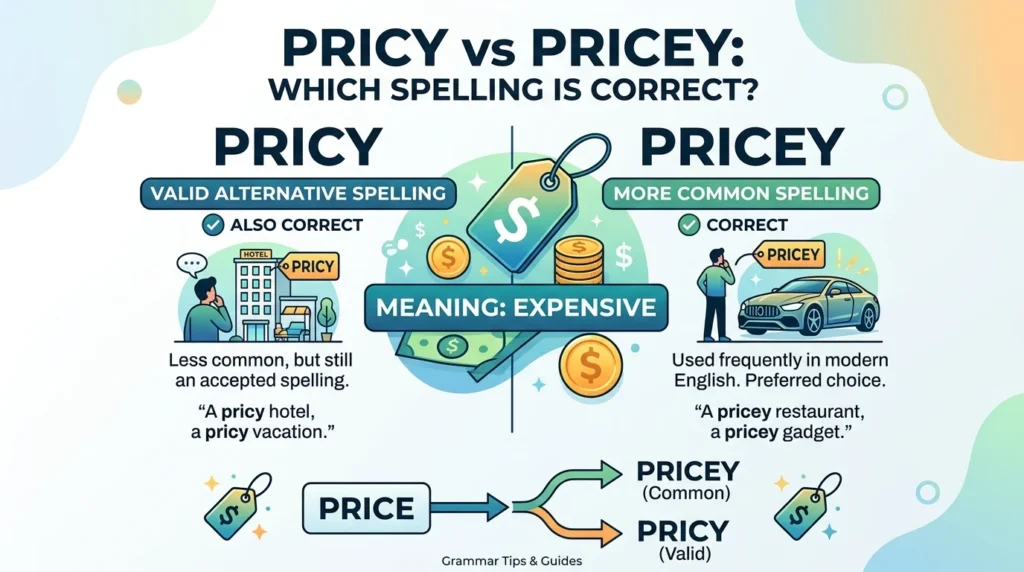
Both “pricy” and “pricey” are correct spellings. They mean the same thing: expensive or costing more money than expected. However, pricey is much more common and is generally the safer choice in everyday English, especially in American English. Pricy is a recognized alternative spelling, but many readers are more familiar with pricey.
What Is the Difference Between Pricy and Pricey?
Pricy and pricey are adjectives that mean expensive or relatively high in price.
The important point is that this is not a correct-vs-incorrect spelling problem. Unlike pairs such as writing and writting, both forms are legitimate English words.
The main difference is usage and frequency:
- pricey — the more common spelling
- pricy — a valid but less common spelling
- Both mean expensive
- Neither spelling changes the basic meaning
- Pricey is usually the better choice when you want the form most readers expect
For example:
That restaurant is quite pricey.
You could also write:
That restaurant is quite pricy.
Both sentences are grammatically correct.
Why It Matters
When two spellings are technically correct, choosing the more familiar one can make your writing easier to read.
This matters particularly in:
- Business emails
- Website copy
- Product descriptions
- School assignments
- Professional reports
- Social media posts
- Marketing materials
- Academic writing
If you write pricy, you are not necessarily making a spelling mistake. However, some readers may find pricey more familiar because it is the more widely used form.
If you simply want the safest everyday choice, use pricey.
The Core Rule
Rule: “Pricy” and “pricey” are both correct. “Pricey” is the more common and generally preferred spelling.
The word comes from price + -y, where the suffix -y creates an adjective meaning “having the quality of” or “characterized by.”
So:
price + y → pricey
The spelling pricy is also established in English, but it removes the extra e from price before adding -y.
Use “pricey” when you mean expensive
How to Use It
The hotel looks beautiful, but it is quite pricey.
I wanted to buy the jacket, but it was too pricey.
Their new software is more pricey than the older version.
Use “pricy” when you encounter or prefer that established variant
The apartment is comfortable but rather pricy.
That repair turned out to be surprisingly pricy.
There is no difference in meaning between these sentences and their versions using pricey.
Which one should you choose?
For most writers, the practical answer is simple:
Choose “pricey.”
It is the spelling most readers are likely to recognize immediately.
That does not mean that pricy is wrong. It simply means that pricey is usually the more familiar choice.
Correct Examples
Here are examples showing how pricey and pricy work naturally in different situations.
- Conversation:
“I like that restaurant, but the menu is a little pricey.” - Email:
“The hotel you suggested looks good, although the rooms seem quite pricey.” - Workplace:
“The proposed software solution is effective, but it may be too pricey for a small company.” - Shopping:
“These headphones are pricey, but they have excellent reviews.” - School:
“The textbook is useful, although it is rather pricey for students.” - Social media:
“Beautiful place, great food, but definitely pricey!” - Product review:
“The camera produces excellent images, but its accessories are quite pricey.” - Academic-style writing:
“The technology remains relatively pricey, limiting its adoption among smaller organizations.” - Using the alternative spelling:
“The repairs were more pricy than we originally expected.” - Everyday English:
“That coffee shop is good, but it can get pricey.” - Business discussion:
“The premium package is pricey, so we should compare it with other options.” - Travel:
“London can be pricey if you stay in the city center.”
Incorrect vs. Correct
Because both “pricy” and “pricey” are correct, the examples below focus on situations where writers may incorrectly assume that one spelling is always wrong or use the word in an unnatural way.
| ❌ Incorrect | ✅ Correct | Why |
|---|---|---|
| “Pricey is wrong; only pricy is correct.” | “Both pricey and pricy are correct.” | They are established spelling variants. |
| “Pricy is always a spelling mistake.” | “Pricy is a recognized variant of pricey.” | Pricy is not inherently incorrect. |
| “The car is price.” | “The car is pricey.” | An adjective is needed to describe the car’s high cost. |
| “The hotel was very price.” | “The hotel was very pricey.” | Pricey is the adjective meaning expensive. |
| “This phone is more expensive pricey.” | “This phone is pricey.” | Do not combine two adjectives expressing the same idea unnecessarily. |
| “The price is pricey.” | “The phone is pricey.” | Pricey normally describes something that costs a lot, not the abstract price itself. |
| “It is a pricey expensive restaurant.” | “It is a pricey restaurant.” | One adjective is enough. |
| “I bought it because it was very price.” | “I bought it because it was reasonably priced.” | Priced and pricey have different grammatical roles. |
| “The product is price.” | “The product is pricy.” | Pricy is a valid alternative adjective. |
| “Both words have different meanings.” | “Both words mean expensive.” | The spelling difference does not create a difference in meaning. |
Why People Make This Mistake
Phonetic similarity
When people hear pricey, they naturally think about the word price followed by an -y ending.
That can create uncertainty about whether the spelling should preserve the final e:
price + y → pricey
or remove it:
pric + y → pricy
English spelling does not always follow one perfectly predictable rule, so both forms have become established.
Spelling overlap
Writers may compare pricey with other words ending in -y and assume there must be one universal spelling pattern.
There isn’t.
English has many historical spelling patterns, and common usage often determines which forms survive.
Overgeneralisation
A learner may learn that some words drop a final e before a suffix and then apply that pattern automatically.
For example, English has many words where the spelling changes when a suffix is added. But that does not mean every word must follow the same pattern.
Read More: Tweek vs Tweak Difference: Which Spelling Is Correct?
Autocomplete and spellcheck
Modern spellcheckers can make the issue even more confusing.
One writing tool may accept pricy, while another may suggest pricey as the more common form. That does not necessarily mean the less familiar spelling is wrong.
Spellcheckers are useful, but they are not complete dictionaries of English usage.
Translation interference
Learners translating directly from another language may expect one fixed equivalent for “expensive.”
English, however, can have multiple legitimate forms for the same idea, including regional, historical, or frequency differences.
Common Mistakes Checklist
Mistake 1: Assuming “pricy” is always wrong
Why it happens: Pricey is much more familiar to many readers.
How to avoid it: Remember that pricy is a valid variant, even though it is less common.
Mistake 2: Assuming the two words have different meanings
Why it happens: Different spellings often signal different words in English.
How to avoid it: Here, the spelling difference does not create a meaningful difference. Both mean expensive.
Mistake 3: Treating “pricey” as a formal synonym for “expensive”
Why it happens: Learners sometimes assume that two synonyms have identical levels of formality.
How to avoid it: Pricey is generally conversational and informal-to-neutral. In highly formal writing, expensive, costly, or a more precise financial description may be better.
Mistake 4: Confusing “pricey” with “priced”
Why it happens: Both words relate to price.
How to avoid it:
- pricey = expensive
- priced = having a particular price
The laptop is pricey.
The laptop is priced at $2,000.
Mistake 5: Thinking a spellcheck suggestion proves a word is wrong
Why it happens: Writing software often prioritizes common forms.
How to avoid it: Check whether the word is an established English form before changing it.
Pricy vs. Pricey in Real English
“Pricey” — natural, common everyday English
Pricey is the form most readers will recognize immediately. It works naturally in conversations, reviews, shopping discussions, travel writing, product commentary, and informal business communication. It is especially useful when you want to say that something costs more than you would normally expect or want to pay.
“Pricy” — grammatically correct but less familiar
Pricy is also a legitimate adjective meaning expensive. It is not a spelling error simply because it is less common. However, because many readers are more accustomed to pricey, pricy can sometimes look unusual or unfamiliar. If your priority is maximum familiarity, pricey is the better default.
“Expensive” — the neutral choice
Expensive is the most straightforward and widely understood way to describe something that costs a lot. Unlike pricey, it does not carry the same conversational flavor. In formal, academic, or professional writing, expensive is often the safer choice when you simply need to communicate the cost clearly.
“Costly” — useful when emphasizing consequences
Costly can mean expensive, but it often has a slightly different emphasis. It can suggest that something requires a significant amount of money or produces a serious cost or consequence. For example, “a costly mistake” often means more than simply “an expensive mistake”; it can emphasize the consequences of the mistake.
American vs. British English
There is no major American-vs.-British meaning difference between pricy and pricey.
Both spellings can be found in English, and both mean expensive.
The more important distinction is frequency and familiarity, not national meaning.
If you are writing for an international audience, pricey is generally the more recognizable choice.
Formal vs. Informal Usage
Pricey is generally more conversational than expensive.
Compare:
That restaurant is pretty pricey.
with:
The restaurant is relatively expensive.
The first sounds natural in everyday conversation. The second is more neutral and may fit better in formal or analytical writing.
Pricy has the same basic register as pricey, but because it is less common, it may attract more attention from readers.
For highly formal writing, consider:
- expensive
- costly
- high-priced
- relatively high in cost
- financially demanding
Choose according to the exact meaning you want rather than simply replacing every occurrence of pricey.
Comparison Table
| Feature | Pricy | Pricey |
|---|---|---|
| Part of speech | Adjective | Adjective |
| Meaning | Expensive | Expensive |
| Correct spelling? | Yes | Yes |
| Common meaning | High in price | High in price |
| Commonness | Less common | More common |
| Everyday use | Correct | Very natural |
| Formal writing | Possible, but less common | Possible, but somewhat conversational |
| Safer default | Not usually | Yes |
| Different meaning? | No | No |
Pricey vs. Pricy vs. Expensive
These three words are closely related, but they are not equally useful in every situation.
| Word | Basic meaning | Typical feel | Example |
|---|---|---|---|
| pricey | Expensive | Conversational | “That hotel is pricey.” |
| pricy | Expensive | Less common variant | “That hotel is pricy.” |
| expensive | Costs a lot | Neutral | “That hotel is expensive.” |
| costly | Involves substantial cost | Neutral/formal | “The project became costly.” |
| high-priced | Having a high price | Neutral/descriptive | “They sell high-priced equipment.” |
Memory Trick
Think:
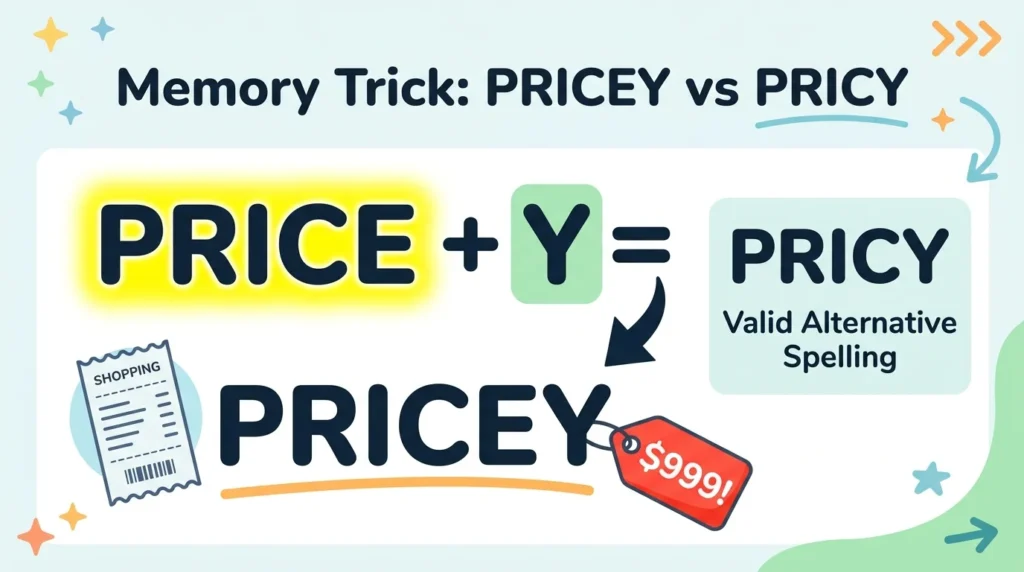
PRICE + Y = PRICEY
If you are unsure which spelling your reader will expect, keep the word price visible:
PRICE → PRICEY
Then remember:
Pricy is possible. Pricey is the safer default.
Real-Life Situations
In a shopping conversation
Ali: “Should we buy this laptop?”
Hamza: “It looks good, but it’s pretty pricey.”
Here, pricey sounds natural because the conversation is informal.
In a business meeting
“The premium software package is quite pricey, so let’s compare it with two alternatives.”
The word works in spoken business English, although a formal report might use expensive or high-cost instead.
In an email
“The hotel is excellent, but it may be too pricey for our current travel budget.”
This is perfectly understandable, though expensive would sound slightly more neutral.
In an exam
If the question asks for an adjective meaning “expensive,” pricey is correct.
Pricy can also be correct if the question concerns recognized spelling variants.
In academic writing
“The technology remains relatively expensive, which limits access among lower-income households.”
Here, expensive is usually a better choice than pricey because academic writing tends to favor neutral vocabulary.
In a text message
“The tickets are so pricey 😭”
This is a natural everyday use of the word.
Mini Quiz
| # | Question | Answer | Explanation |
|---|---|---|---|
| 1 | Which spelling is more common: pricy or pricey? | Pricey | Pricey is the more familiar and commonly used form. |
| 2 | Is pricy a valid English word? | Yes | Pricy is an established variant meaning expensive. |
| 3 | Fill in: “That restaurant is too ___ for my budget.” | pricey | Pricey means expensive and fits naturally here. |
| 4 | True or false: Pricy and pricey have different meanings. | False | Both mean expensive. |
| 5 | Which is more neutral in formal writing: pricey or expensive? | Expensive | Expensive is more neutral and broadly suitable for formal writing. |
| 6 | Correct the sentence: “The hotel is very price.” | “The hotel is very pricey.” | Pricey is the adjective meaning expensive. |
| 7 | Which sentence is correct? A) “The car is pricey.” B) “The car is price.” | A | Pricey functions as an adjective. |
| 8 | Fill in: “The repairs were surprisingly ___.” | pricy or pricey | Both spellings are correct. |
| 9 | Correct the sentence: “Pricey is the only correct spelling.” | “Pricey and pricy are both correct spellings.” | Pricy is a recognized alternative form. |
| 10 | Which word is usually the safest choice for a general international audience? | Pricey | It is the more familiar spelling for most readers. |
Expert Tips
1. Do not treat every spelling variation as an error
English contains many words with accepted spelling variants. A less common spelling is not automatically an incorrect spelling.
2. Choose the form your audience expects
If your goal is simple, familiar communication, pricey is the practical choice.
3. Know the difference between “pricey” and “priced”
This distinction is more important than the spelling difference between pricy and pricey.
The phone is pricey.
means:
The phone is expensive.
But:
The phone is priced at $800.
means:
Its listed price is $800.
4. Do not overuse “pricey”
Even though pricey is natural, repeating it throughout an article can make the writing monotonous.
Depending on context, alternatives include:
- expensive
- costly
- high-priced
- premium
- costly to maintain
- beyond my budget
Choose the alternative based on the precise meaning.
5. Remember that “pricey” is subjective
Calling something pricey does not necessarily mean that it has a high price by an objective standard.
“The coffee is pricey.”
usually means that the speaker considers the coffee expensive for what it is or compared with their expectations.
That makes pricey especially useful in reviews and everyday conversation.
FAQ
Is “pricy” a correct spelling?
Yes. Pricy is a recognized spelling variant of pricey and means expensive.
Is “pricey” or “pricy” more common?
Pricey is generally more common and more familiar to readers.
Does “pricy” mean something different from “pricey”?
No. Both words mean expensive or relatively high in price.
Should I use “pricy” in an essay?
You can, because it is a valid word. However, pricey is more familiar, while expensive may be a better choice if the essay is formal or academic.
Is “pricey” informal?
It is generally conversational and informal-to-neutral. It is common in everyday speech, reviews, shopping discussions, and casual business communication.
Is “pricy” a misspelling of “pricey”?
No. Although pricey is more common, pricy is an established alternative spelling.
Can I use “pricey” in professional writing?
Yes, especially in conversational professional writing, reviews, marketing, or customer-facing content. For highly formal documents, expensive, costly, or a more precise financial term may be preferable.
What is the opposite of “pricey”?
Depending on the context, possible opposites include cheap, inexpensive, affordable, and reasonably priced. The best choice depends on the intended meaning.
Is “pricey” the same as “expensive”?
They are close in meaning, but pricey often has a more conversational or subjective tone. Expensive is more neutral.
Can I say “very pricey”?
Yes. Very pricey is grammatically correct and natural.
“The new apartment is very pricey.”
Which should ESL learners remember: “pricy” or “pricey”?
A simple rule is: remember “pricey” first. It is the more familiar form. You should still recognize pricy as a valid spelling when you encounter it.
Quick Summary
Pricy and pricey are both correct English spellings. They are adjectives meaning expensive or relatively high in price, and there is no meaningful difference in their basic definition. The main difference is frequency: pricey is much more common and is generally the better default for everyday and general-purpose writing. Pricy is a legitimate alternative, but it may look less familiar to some readers. In formal or academic writing, expensive is often a more neutral choice. Do not confuse pricey with priced: pricey means expensive, while priced describes something assigned a particular price. When in doubt, choose pricey.