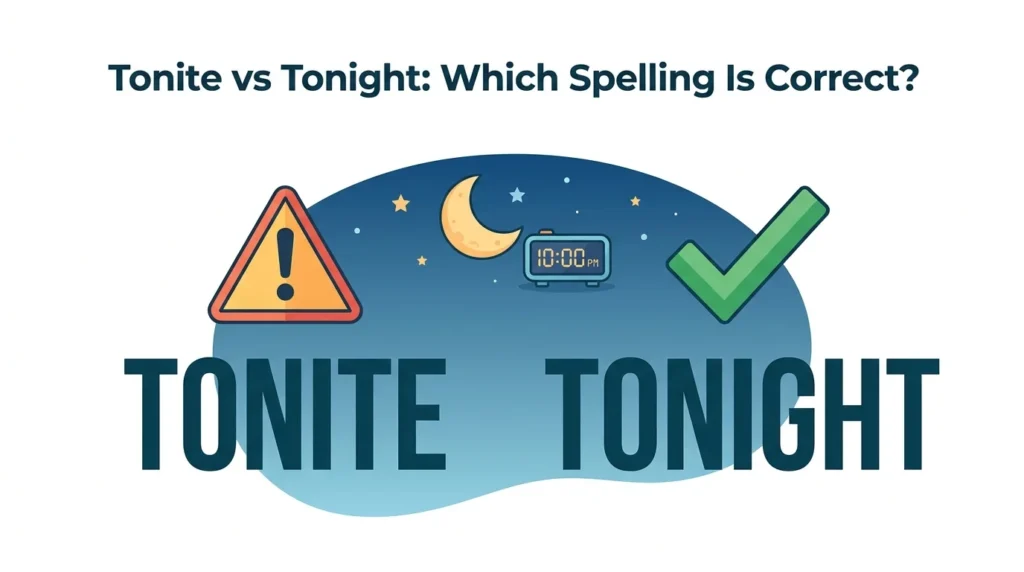

Tonight is the standard spelling for the evening or night of the current day. Tonite is an informal alternative spelling that appears mainly in advertising, entertainment, casual messages, and other deliberately informal contexts. For schoolwork, professional emails, business writing, academic work, and other standard English, use tonight. Both forms are normally pronounced the same when tonite means tonight.
What Is the Difference Between Tonite and Tonight?
The difference between tonite and tonight is mainly one of standard spelling and usage, not meaning.
Tonight is the normal English word meaning the evening or night of the present day. It can function as both an adverb and a noun.
For example:
- I will call you tonight.
- Are you free tonight?
- Tonight is the final performance.
- I am looking forward to tonight.
Tonite is an informal spelling variant of tonight. It represents the same pronunciation and is sometimes used to create a casual, shortened, or promotional style. It is particularly associated with entertainment and advertising in American English.
So, if you are writing a normal sentence, the safest choice is simple:
Use tonight.
The fact that you may see tonite on posters, social media, or advertisements does not mean it has become the preferred spelling for standard writing.
Why It Matters
A one-letter spelling difference may seem small, but spelling communicates more than pronunciation.
When you write an email to a client, submit an assignment, prepare a report, or publish professional content, readers expect standard English. Using tonight shows that you are following the conventional spelling.
Compare these:
I will send the report tonight.
and:
I will send the report tonite.
The second sentence is understandable, but it looks intentionally informal. In a professional context, there is no advantage to using tonite.
The difference becomes especially important when the same word appears in different situations:
- Academic writing: use tonight.
- Business email: use tonight.
- Job application: use tonight.
- Formal report: use tonight.
- Personal text: tonite may appear, but tonight is still completely natural.
- Advertising headline: tonite may be chosen deliberately for style.
- Event poster: tonite may be used as a design or promotional choice.
The important point is that informal does not mean that the spelling is the standard form.
The Core Rule
Rule: Use “tonight” in standard English. Use “tonite” only when you intentionally want an informal, promotional, or stylistic spelling.
If you are unsure which one to choose, choose tonight.
It works in both formal and informal English, so there is rarely a reason to replace it with tonite.
The simplest rule to remember
Tonight = standard spelling
Tonite = informal variant
This makes tonight the better choice for almost every ordinary piece of writing.
Read More: Cubical vs Cubicle: Which Word Is Correct?
How to Use Tonight
Tonight refers to the evening or night of the present day. Cambridge lists it as both an adverb and a noun.
As an adverb
An adverb can tell us when something happens.
- I am working tonight.
- We are meeting tonight.
- She will arrive tonight.
- The restaurant is open tonight.
- They are flying home tonight.
In these sentences, tonight tells us when the action happens.
As a noun
Tonight can also refer to the particular evening or night itself.
- Tonight will be unforgettable.
- I am looking forward to tonight.
- Tonight is the final night of the festival.
- We have been waiting for tonight.
This is one reason it is useful to learn the word as a complete English word rather than thinking of it simply as a shortened phrase.
The possessive form: tonight’s
You may also see tonight’s.
Examples:
- Tonight’s meeting starts at seven.
- Tonight’s dinner is already prepared.
- Tonight’s match was postponed.
- Tonight’s weather forecast looks clear.
The apostrophe belongs to the standard form tonight.
Avoid creating a possessive from the informal spelling when standard English is required.
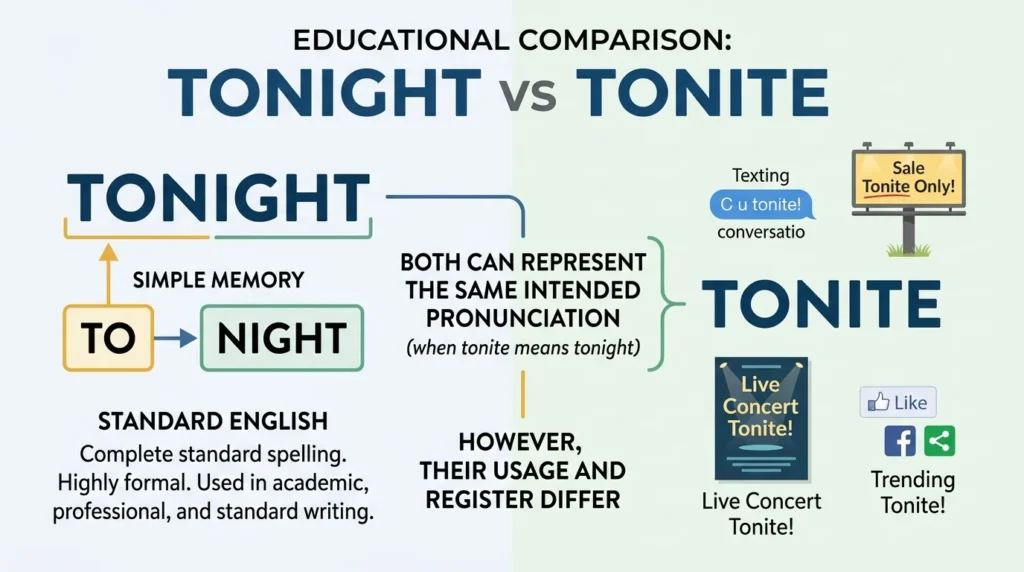
How to Use Tonite
Tonite is used as an informal spelling of tonight. It is not a different pronunciation or a different time period.
You might encounter it in:
- Event posters
- Entertainment advertising
- Social media captions
- Casual text messages
- Promotional slogans
- Song or creative titles
- Informal online writing
For example:
Party tonite!
Live music tonite!
See you tonite!
These examples are easy to understand because the intended meaning is clear.
However, there is an important distinction:
Something can be understandable and intentionally informal without being the standard spelling.
That is exactly what happens with tonite.
If you are writing a university assignment, business proposal, formal email, news article, or professional report, change it to tonight.
Correct Examples
Here are examples showing how tonight works naturally in different types of writing.
- Conversation:
“Are you free tonight?” - Text message:
“I’ll call you tonight.” - Email:
“I will send the revised document tonight.” - Workplace:
“The team will review the figures tonight.” - School:
“I need to finish my assignment tonight.” - Academic writing:
“The results will be discussed during tonight’s session.” - Social media:
“Looking forward to the concert tonight!” - Travel:
“Our flight leaves tonight at 11:30.” - News-style writing:
“The final match will take place tonight.” - Personal writing:
“Tonight feels different somehow.”
Notice that the spelling does not change simply because the context becomes casual. Tonight works perfectly well in a text message and in a formal report.
That is why it is the safest spelling.
Read More: Until vs Untill: Which Spelling Is Correct?
Incorrect vs. Correct
| ❌ Incorrect / Less Appropriate | ✅ Correct / Standard | Why |
|---|---|---|
| I will call you tonite. | I will call you tonight. | Tonight is the standard spelling. |
| The meeting is tonite. | The meeting is tonight. | Professional writing should use the standard form. |
| I have an exam tonite. | I have an exam tonight. | Academic writing calls for standard spelling. |
| We are leaving tonite. | We are leaving tonight. | Tonite is an informal variant. |
| Please send it tonite. | Please send it tonight. | Business communication should normally use tonight. |
| The show starts tonite. | The show starts tonight. | Tonite may appear in advertising, but tonight is standard. |
| I will study tonite. | I will study tonight. | Standard spelling is preferred in schoolwork. |
| Tonites meeting starts at 7. | Tonight’s meeting starts at 7. | The possessive form is tonight’s. |
| We need to finish it tonite. | We need to finish it tonight. | Tonight is the conventional form. |
| The event is happening tonite. | The event is happening tonight. | Use tonight unless the informal spelling is intentional. |
One important clarification: the left-hand forms are not always meaningless or impossible to understand. Tonite can be a deliberate informal spelling. The issue is that it is not the standard choice for ordinary formal writing.
Why Do People Make This Mistake?
Phonetic similarity
The strongest reason is pronunciation.
Tonight is pronounced approximately tə-NIGHT. The final sound is the same as the word night. Because English pronunciation and spelling do not always match perfectly, learners may naturally think that tonite is a logical spelling.
The spelling nite itself is also used informally for night, which makes tonite look even more plausible.
Spelling follows sound
English learners sometimes spell a word according to how they hear it.
This works with some words, but English has many historical spellings that cannot be predicted perfectly from pronunciation.
For example:
- night
- right
- light
- eight
- weight
The pronunciation of these words does not tell you their complete spelling.
Advertising encourages creative spelling
Tonite has a long association with promotional and entertainment language. Historical evidence records its use as a colloquial shortening of tonight, including advertising examples from the early twentieth century.
A poster saying:
LIVE MUSIC TONITE!
can look shorter and more visually casual than:
LIVE MUSIC TONIGHT!
The spelling may therefore be a stylistic choice, not a spelling mistake made accidentally.
Texting and social media
Digital communication has also made shortened and informal spellings more visible.
People may write:
- tonite
- nite
- thru
- pls
- msg
These forms can work in highly casual communication, but frequent exposure does not automatically turn them into standard spellings.
Autocomplete and spellcheck
Spellcheck can also create confusion.
A device may recognize tonite in some contexts or fail to flag it, especially because the form exists in dictionaries with meanings or usage labels.
That does not mean it is the preferred spelling for tonight in standard English.
Common Mistakes Checklist
1. Assuming both spellings are equally standard
They are not.
Tonight is the standard form for the ordinary meaning.
Tonite is an informal variant used in certain contexts.
2. Thinking “tonite” is always wrong
This is also too simple.
If an event organizer deliberately writes:
Movie Marathon Tonite!
the spelling can function as a stylistic choice.
So the better explanation is not “tonite never exists.”
The better explanation is:
Tonite exists as an informal variant, but tonight is the standard spelling.
3. Using tonite in professional writing
This is the most practical mistake to avoid.
If you are writing to:
- Your manager
- A customer
- A professor
- A client
- A hiring manager
- A business partner
use tonight.
4. Writing “tonites” instead of “tonight’s”
If you mean something happening during tonight, use the possessive-looking form:
Tonight’s meeting
not:
Tonites meeting
5. Assuming pronunciation determines spelling
Words that sound alike can have different spellings.
Pronunciation is a clue, but it is not a complete spelling rule.
Tonite vs. Tonight in Real English
Tonight in everyday English
Tonight is completely natural in everyday conversation and casual writing. You do not need tonite to sound relaxed or conversational. A native English speaker can naturally say, “See you tonight,” “What are you doing tonight?” or “I’ll text you tonight.” The standard spelling does not make the sentence formal by itself.
Tonite in informal writing
Tonite can be grammatically understandable but stylistically marked. Readers may interpret it as casual, playful, abbreviated, promotional, or intentionally eye-catching. It is especially associated with advertising and entertainment contexts. It should therefore be treated as a style choice rather than the normal spelling to use everywhere.
Tonite in professional writing
In professional writing, tonight is the natural and safer choice. There is normally no benefit to replacing it with tonite. If a business deliberately uses Tonite in an advertising headline, that is branding or copy style, not a general recommendation for professional spelling.
Tonite in academic writing
In academic writing, use tonight.
There is no academic advantage to using the informal variant. If the word appears in a quotation, title, or source name, however, you may need to preserve the original spelling.
American vs. British English
There is no major standard American-versus-British spelling difference here.
Tonight is the standard form in both American and British English.
Tonite is associated particularly with informal American entertainment and advertising usage, but it should not be treated as the standard American spelling, and it is not a standard British alternative to tonight.
So you do not need to choose between tonite and tonight based on whether you are writing American or British English.
Choose tonight for standard English.
Formal vs. Informal Usage
| Context | Recommended Form | Reason |
|---|---|---|
| Academic essay | tonight | Standard written English |
| Business email | tonight | Clear and professional |
| Job application | tonight | Standard spelling expected |
| School assignment | tonight | Conventional spelling |
| Formal report | tonight | Appropriate register |
| News writing | tonight | Standard spelling |
| Personal text | tonight | Natural and standard |
| Social media caption | tonight | Standard choice; tonite may be stylistic |
| Event poster | tonight or tonite | Tonite may be deliberately promotional |
| Entertainment advertising | tonight or tonite | Tonite can create an informal visual style |
The key idea is simple:
Tonight works everywhere. Tonite works only where the informal style is intentional and appropriate.
A Note About Another Meaning of “Tonite”
There is an unusual detail that is easy to miss.
Tonite has also been used as the name of an explosive compound, separate from its informal spelling use for tonight. Historical dictionary sources record this distinct noun meaning.
So the word can have two different interpretations depending on context:
- tonite = an informal spelling of tonight
- tonite = a historical name for an explosive compound
For ordinary modern writing about the evening or night of the current day, you should use tonight.
This second meaning is one reason it is inaccurate to say that tonite simply “does not exist.”
read More: Intention vs Intension: Which Is Correct?
Comparison Table
| Feature | Tonight | Tonite |
|---|---|---|
| Standard spelling | ✅ Yes | ❌ No |
| Meaning “this evening/night” | ✅ Yes | ✅ As an informal variant |
| Pronunciation | Usually /təˈnaɪt/ | Usually the same when meaning tonight |
| Formal writing | ✅ Recommended | ❌ Avoid |
| Academic writing | ✅ Recommended | ❌ Avoid |
| Business writing | ✅ Recommended | ❌ Avoid |
| Text messages | ✅ Natural | Possible |
| Social media | ✅ Natural | Possible |
| Advertising | ✅ Common | Sometimes used deliberately |
| Entertainment | ✅ Common | Sometimes used stylistically |
| Possessive form | tonight’s | Avoid in standard writing |
| Best choice when unsure | ✅ Tonight | ❌ Tonite |
Memory Trick
Use this simple trick:
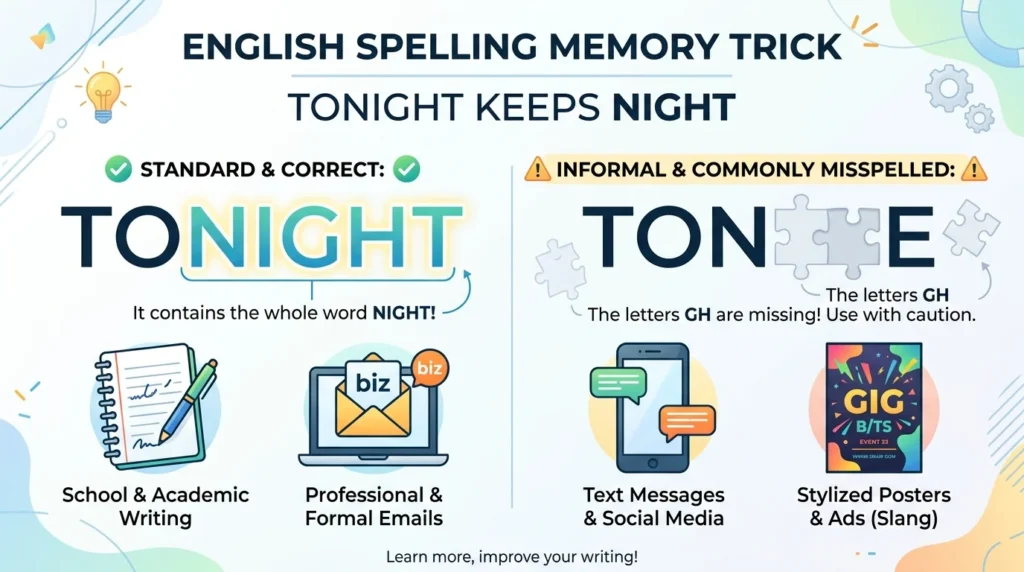
Keep the word NIGHT inside TONIGHT.
Think:
TO + NIGHT = TONIGHT
The standard spelling keeps the complete word night.
If you remember the phrase:
“Tonight keeps NIGHT.”
you will be much less likely to write tonite accidentally.
Another useful test is:
Would I use this spelling in a formal email?
If the answer is yes, choose tonight.
In fact, you can use tonight in almost every situation, so there is no need to overthink the choice.
Real-Life Situations
Situation 1: Texting a friend
You want to ask about plans.
Best:
Are you coming tonight?
You could see tonite in a very casual message, but tonight is still completely natural.
Situation 2: Writing to your manager
You need to explain when you will finish a report.
Use:
I will send the final report tonight.
Do not use tonite merely to sound casual.
Situation 3: Creating an event poster
A designer creates a deliberately informal entertainment headline:
LIVE MUSIC TONITE!
Here, tonite can be an intentional stylistic choice.
Situation 4: Writing an academic assignment
You write:
The students will complete the experiment tonight.
Use tonight.
Situation 5: Writing a social media caption
You post:
The big game is tonight!
Again, tonight is the normal spelling.
If a brand wants a deliberately playful advertising style, it may choose:
BIG GAME TONITE!
That is a branding decision, not a general spelling rule.
Mini Quiz
| # | Question | Answer | Explanation |
|---|---|---|---|
| 1 | Which spelling is standard? A) tonite B) tonight | B) tonight | Tonight is the standard spelling. |
| 2 | Fill in the blank: “I will see you ___.” | tonight | The sentence refers to the current evening/night. |
| 3 | Which is better in a business email? A) I will call you tonite. B) I will call you tonight. | B | Professional writing normally uses the standard form. |
| 4 | Correct the sentence: “Tonites meeting starts at 8.” | Tonight’s meeting starts at 8. | The possessive form is tonight’s. |
| 5 | Is tonite understandable in “Party tonite!”? | Yes | It is an informal variant and is often used stylistically in advertising. |
| 6 | Which is better for an academic essay? A) tonight B) tonite | A) tonight | Academic writing should use standard spelling. |
| 7 | True or false: Tonite and tonight always have different pronunciations. | False | When tonite means tonight, it normally represents the same pronunciation. |
| 8 | Complete the sentence: “Are you free ___?” | tonight | Tonight is the standard form used to refer to the current evening/night. |
| 9 | Is tonite automatically a spelling error in every possible context? | No | It can be an intentional informal or promotional spelling. |
| 10 | Choose the safest form when you are unsure: A) tonite B) tonight | B) tonight | Tonight is appropriate across formal and informal contexts. |
Expert Tips
1. Do not confuse “informal” with “incorrect”
Language contains many forms that are used informally.
The important question is not only:
“Can people understand this?”
Ask:
“Is this the appropriate form for my audience and purpose?”
That distinction is especially useful for English learners.
2. You never need tonite to sound natural
This is an important practical point.
Using tonight in a casual text does not sound overly formal:
See you tonight!
What are you doing tonight?
Are we still meeting tonight?
These are completely normal.
3. Treat advertising spellings differently
A company may intentionally use unusual spelling to create a visual identity.
For example:
SALE TONITE!
The unusual spelling may be part of the advertisement’s personality.
Do not copy that style automatically into your business emails or essays.
4. Check the audience before copying social media language
Online writing mixes standard English, slang, abbreviations, jokes, branding, and deliberate misspellings.
Seeing a form repeatedly does not necessarily mean it is the best form for formal writing.
5. Remember that dictionaries can record usage without recommending it for every context
A word or spelling appearing in a dictionary does not mean it has exactly the same status as every other entry.
Usage labels such as informal or nonstandard matter.
That is why the best answer is more precise than simply saying “tonite is not a word.”
FAQ
Is “tonite” a correct spelling?
Tonite is an informal spelling variant of tonight. It can be used deliberately in casual, entertainment, or advertising contexts, but tonight is the standard spelling for ordinary English writing.
Is “tonite” acceptable in a text message?
It can be understood and used as an informal spelling in a text message. However, you do not need it: tonight is also completely natural in casual texting.
Should I use “tonite” in a professional email?
No. Tonight is the better choice in professional email because it is the standard spelling.
Is “tonite” slang?
It can function as an informal or stylistically marked spelling, especially in casual and promotional contexts. Calling it simply “slang” can be less precise than describing it as an informal spelling variant.
Is “tonite” American English?
The informal use of tonite is particularly associated with American entertainment and advertising, but tonight is the standard spelling in both American and British English.
Can I use “tonite” in an essay?
It is best to use tonight in an essay. The informal spelling may make the writing look careless unless you are reproducing a quotation, title, name, or other original text where the spelling is intentional.
What is the possessive form of tonight?
The standard possessive form is tonight’s.
Example:
Tonight’s meeting has been postponed.
Does “tonite” have another meaning?
Yes. Tonite has also been recorded as the name of an explosive compound. This is a separate meaning from the informal spelling of tonight.
Is “tonite” shorter than “tonight”?
Yes, it removes the gh from the standard spelling. That visual shortening is one reason it can work in advertising and informal writing.
Which one should English learners memorize?
Memorize tonight.
It is the standard spelling and works in conversations, texts, schoolwork, professional communication, and academic writing.
Quick Summary
Tonight is the standard English spelling for the evening or night of the current day. Tonite is an informal spelling variant that may appear in casual communication, advertising, entertainment, and promotional writing. The two forms normally have the same pronunciation when tonite means tonight. For professional, academic, business, and school writing, always choose tonight. You do not need tonite even in casual messages because tonight sounds completely natural in everyday English. If you see tonite on a poster or social media post, it may be an intentional stylistic choice rather than an accidental spelling error. When in doubt, remember: TONIGHT keeps NIGHT.