

If you are wondering whether vender or vendor is correct, the answer is simple: vendor is the standard and overwhelmingly preferred spelling in modern English. However, vender is also a real English word and is recognized as a less common variant of vendor. Both refer to someone who sells something, but vendor is the form you should normally choose in business, professional, academic, and everyday writing.
What Is the Difference Between Vender and Vendor?
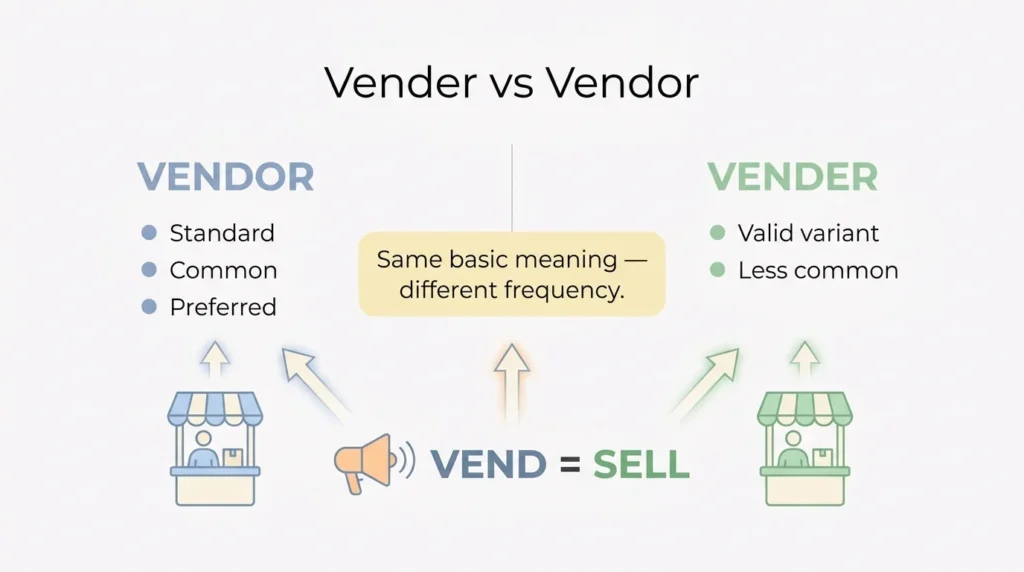
Vender and vendor have essentially the same basic meaning: a person or business that sells something.
The important difference is not meaning. It is standard usage and frequency.
| Word | Meaning | Modern usage | Best choice? |
|---|---|---|---|
| vendor | A person or company that sells goods or services | Standard and very common | Yes |
| vender | A person who sells something; variant of vendor | Much less common | Usually no |
Major dictionaries recognize vendor as the normal form. Merriam-Webster lists vender as a less common variant, while Cambridge directs its entry for vender to vendor.
So the safest rule is:
Use “vendor” in normal modern English. Treat “vender” as a legitimate but uncommon variant, not as the standard spelling.
This distinction matters because calling vender simply “wrong” is technically too strong.
Why It Matters
A spelling choice can affect how polished your writing appears.
Imagine these sentences:
- “Please contact the software vendor.”
- “Please contact the software vender.”
Most modern readers will immediately recognize the first as the expected spelling. The second is understandable, but its unusual spelling may make some readers wonder whether it is a typo.
This matters especially in:
- Business emails
- Contracts and agreements
- Procurement documents
- Websites
- Product descriptions
- Academic writing
- Resumes and professional profiles
- Reports and presentations
- Customer communications
The issue is usually not comprehension. A reader will probably understand vender. The issue is that vendor is the established form people expect to see.
In professional writing, choosing the conventional spelling removes unnecessary friction.
The Core Rule
Use “vendor” when you mean a person or company that sells goods or services.
Vender exists, but it is an uncommon variant.
If you are unsure which spelling to use, choose vendor.
The easiest rule to remember
Vendor = standard modern spelling
Vender = recognized but uncommon variant
That is enough for almost every writing situation.
How to Use Vendor
The noun vendor can describe different kinds of sellers.
A person selling goods
A person selling food, clothing, flowers, or other products can be called a vendor.
Example:
A street vendor was selling fresh fruit outside the station.
A company selling products or services
In business English, vendor frequently refers to a company that supplies or sells something.
Example:
We are evaluating three software vendors.
A technology provider
Technology companies often use vendor for an organization that supplies software, hardware, platforms, or other technical products.
Example:
The IT team contacted the vendor about the security issue.
A business supplier
In procurement and business operations, a vendor may be an organization from which a company purchases products or services.
Example:
We added a new packaging vendor to our approved supplier list.
A seller in a legal context
Vendor also has a specialized legal use. For example, in property transactions, a vendor can be the person selling a property. Oxford specifically identifies this legal meaning.
Example:
The vendor agreed to the terms of the property sale.
Correct Examples
Here are natural examples of vendor across different situations.
1. Everyday conversation
We bought fresh juice from a street vendor.
Here, vendor means a person selling something.
2. Business email
Please contact the vendor and confirm the delivery date.
The word refers to a business or seller.
3. Workplace communication
We need to compare the prices offered by each vendor.
This is a common business use.
4. Technology
The software vendor released a security update.
Here, vendor refers to a company providing software.
5. Retail
The store works with several clothing vendors.
The vendors are businesses supplying or selling clothing.
6. Event planning
We hired a local food vendor for the conference.
The vendor is providing food at an event.
7. Academic writing
Small vendors often face difficulties competing with large retailers.
The word works naturally in formal analytical writing.
8. Social media
We are looking for local vendors for our weekend market.
This is a natural promotional use.
9. Procurement
The purchasing department approved the new equipment vendor.
This is a standard professional use.
10. Property
The vendor accepted the buyer’s offer.
Here, vendor has a more specialized property-sale meaning.
Incorrect vs. Correct
Because vender is a legitimate variant, the examples below need an important qualification. The vender versions are not necessarily impossible English. They are simply uncommon and usually less suitable than vendor in contemporary standard writing.
| ❌ Less usual | ✅ Preferred | Why |
|---|---|---|
| The software vender sent an update. | The software vendor sent an update. | Vendor is the standard modern spelling. |
| We contacted the equipment vender. | We contacted the equipment vendor. | Business writing strongly favors vendor. |
| The food vender arrived early. | The food vendor arrived early. | Vendor is the expected everyday form. |
| Please ask the vender for an invoice. | Please ask the vendor for an invoice. | The conventional spelling is vendor. |
| Our company needs a new supplier vender. | Our company needs a new supplier vendor. | Vendor is the established business term. |
| The clothing vender offered a discount. | The clothing vendor offered a discount. | Vendor is much more familiar to modern readers. |
| We selected a local event vender. | We selected a local event vendor. | Vendor is the normal spelling for event sellers. |
| The hardware vender provided support. | The hardware vendor provided support. | Professional technology writing normally uses vendor. |
| The market vender sells handmade goods. | The market vendor sells handmade goods. | Vendor is the standard form. |
| The vender signed the agreement. | The vendor signed the agreement. | Vendor is the safer choice in formal documents. |
Why call the first versions “less usual” rather than simply “wrong”?
Because authoritative dictionaries do recognize vender.
Merriam-Webster lists vender as a less common variant of vendor, and Cambridge’s vender entry directs readers to vendor. (Merriam-Webster)
That means a good grammar guide should not tell learners that vender does not exist.
The more accurate advice is:
“Vender is valid but uncommon. Vendor is the standard choice.”
Why People Make This Mistake
The confusion between vender and vendor is understandable.
1. The words sound the same
In ordinary pronunciation, vender and vendor are essentially homophones for many speakers. Cambridge gives vendor as /ˈven.dər/ in UK English and /ˈven.dɚ/ in US English.
When two words sound alike, spelling becomes the only visible difference.
2. The spelling seems logical
The verb vend means to sell.
That makes this formation look logical:
vend + er → vender
And in fact, vender does exist.
But English vocabulary does not always use the most predictable spelling. The established form vendor became the normal noun.
3. The spelling difference is tiny
Only one letter changes:
vend + er → vender
vend + or → vendor
That makes the words easy to confuse when typing quickly.
4. Spellcheck may not help
A spellchecker may accept vender because it is a legitimate dictionary word.
That creates an important lesson:
A word being accepted by spellcheck does not necessarily mean it is the best word for your context.
Spellcheck can identify many misspellings, but it does not always tell you which valid word is most natural or conventional.
5. Translation can contribute to the confusion
English learners sometimes expect words to follow highly regular spelling patterns. If a learner knows vend means “sell,” vender may seem more obvious than vendor.
That reasoning is understandable, but modern usage still favors vendor.
Common Mistakes Checklist
Mistake 1: Assuming “vender” is completely wrong
Why it happens: Most people see vendor far more often.
How to avoid it: Remember that vender exists, but it is uncommon.
Mistake 2: Using “vender” in professional writing
Why it happens: The spelling follows naturally from vend.
How to avoid it: Use vendor in business, academic, workplace, and professional contexts.
Mistake 3: Thinking the two words have different meanings
Why it happens: Different spellings often suggest different words.
How to avoid it: In this case, the core meaning is essentially the same: someone who sells something.
Mistake 4: Trusting spellcheck completely
Why it happens: Your software may accept vender.
How to avoid it: Check whether the word is appropriate for the context, not merely whether it is recognized.
Mistake 5: Calling every occurrence of “vender” a spelling error
Why it happens: Vendor is much more familiar.
How to avoid it: Recognize vender as a legitimate but uncommon variant.
Mistake 6: Replacing the word when “vendor” is the established industry term
Why it happens: Writers may think either spelling is equally natural.
How to avoid it: Follow the conventional form used in your field: vendor.
Vender vs Vendor in Real English
Vendor: grammatically correct and naturally common
Vendor is the ordinary choice in contemporary English for a person or company that sells goods or services. It appears naturally in business, retail, technology, events, procurement, and everyday conversation. Expressions such as software vendor, food vendor, approved vendor, and street vendor are established and immediately familiar. If you want the normal modern form, vendor is the clear choice.
Vender: grammatically possible but much less natural
Vender is not simply a fabricated misspelling. It is recognized in dictionaries as a less common variant of vendor. However, its rarity means that many readers will perceive it as unusual or possibly mistaken. It can therefore be grammatically defensible while still being a poor practical choice for most modern writing. Unless you have a specific reason to reproduce the spelling, vendor is preferable.
Why “valid” does not mean “equally useful”
English contains many words and spellings that are technically recognized but rarely used.
This creates an important distinction:
- Possible: A dictionary recognizes the form.
- Standard: The form is widely accepted.
- Natural: Speakers and writers commonly choose it.
- Preferred: It is the form that best fits the context.
For vender vs vendor, the useful answer is:
Vender is possible. Vendor is standard and preferred.
Read More: Laid vs Layed: Which Spelling Is Correct?
American vs. British English
There is no major AmE/BrE spelling split in which Americans normally use vender while British speakers normally use vendor.
Instead, vendor is the standard and familiar form in both varieties.
There is, however, a useful dictionary detail. Cambridge labels vender as a US commerce term and directs it to vendor. (Cambridge Dictionary)
So if you are writing for an international audience, there is no reason to switch from vendor to vender.
Use vendor.
Formal vs. Informal Usage
Vendor works across a wide range of registers.
It is natural in:
- Everyday conversation
- Business emails
- Reports
- Contracts
- Academic writing
- Technical documentation
- Marketing
- News writing
- Professional communication
It can also be used in specialized legal contexts. Oxford lists vendor as a formal business term for a company selling a product and as a legal term for someone selling property.
Vender, by contrast, is not normally chosen simply because a situation is formal or informal. Its main issue is frequency.
The distinction is therefore not:
Formal = vendor, informal = vender
Instead:
Normal modern usage = vendor
Uncommon variant = vender
Comparison Table
| Feature | Vendor | Vender |
|---|---|---|
| Basic meaning | Person or company that sells something | Person who sells something |
| Part of speech | Noun | Noun |
| Standard modern form | Yes | No; variant |
| Recognized English word | Yes | Yes |
| Frequency | Very common | Much less common |
| Business writing | Preferred | Usually avoid |
| Academic writing | Preferred | Usually avoid |
| Everyday English | Natural | Unusual |
| Technology | Very common | Rare |
| Retail | Very common | Rare |
| American English | Standard | Recognized, uncommon |
| British English | Standard | Not the normal choice |
| Best choice for learners | Yes | No |
Vendor vs. Seller vs. Supplier
Another useful distinction is between vendor, seller, and supplier.
Vendor
A vendor is a person or organization that sells goods or services.
We are negotiating with a software vendor.
Seller
A seller is a broad everyday term for someone who sells something.
The seller accepted our offer.
Supplier
A supplier usually emphasizes providing goods, materials, or services to another business or organization.
We changed our packaging supplier.
These words can overlap, but they are not always interchangeable.
A company might be both a vendor and a supplier, depending on the business relationship and context.
Vendor Is a Noun, Not the Action
One common mistake is confusing the person or company with the action.
Sell is the action.
Vendor is the person or company.
Compare:
The company sells computers.
The company is a computer vendor.
You would not normally replace sells with vendor.
Likewise:
We need to sell the products.
Not:
We need to vendor the products.
The noun vendor identifies the seller; it does not function as the ordinary verb meaning “to sell.”
Memory Trick
Use this simple mnemonic:
VEND + OR = VENDOR
Think:
The VENDOR sells.
The important part is OR.
If you mean the common modern word for a seller or supplying business, remember:
VEND → VENDOR
Another quick memory sentence
“Our vendor sells.”
The sentence links the seller directly with the standard spelling.
Real-Life Situations
In a job interview
“I managed relationships with more than 20 vendors.”
Why: Business English normally uses vendor for companies or organizations providing products or services.
In a meeting
“Let’s ask the vendor for a revised quotation.”
Why: Vendor is the natural procurement term.
In an email
“The vendor confirmed that the order will ship tomorrow.”
Why: This is standard professional usage.
In a text message
“Did you hear back from the vendor?”
Why: Vendor is still natural in casual communication.
In an exam
“The company selected a new software vendor.”
Why: Vendor is the conventional spelling.
On a website
“Become a vendor at our annual marketplace.”
Why: This is a standard commercial use.
At a street market
“Several vendors were selling handmade crafts.”
Why: Vendor can refer to individual sellers.
Expert Tips
1. Don’t memorize “vender = wrong”
That shortcut is easy but technically inaccurate.
A better rule is:
Vender exists, but vendor is the normal modern spelling.
This gives you both accuracy and practical guidance.
2. Let frequency guide your writing
When two forms are technically recognized but one is overwhelmingly more common, the common form is usually the better choice for general writing.
3. Watch for false confidence from spellcheck
If your software accepts vender, that does not mean it is the preferred word.
Spellcheck answers:
“Is this word recognized?”
You still need to answer:
“Is this the best word for my audience and context?”
4. Use industry terminology consistently
If your company has documents using vendor, keep that spelling consistent throughout contracts, procedures, websites, and communications.
5. Don’t overcorrect historical or quoted material
If you are reproducing an original historical document, quotation, business name, or archival text containing vender, preserve the original spelling when accuracy requires it.
The goal is not to erase every occurrence of vender. The goal is to know when vendor is the appropriate modern choice.
Read More: Bailer vs Baler: Which Spelling Is Correct?
Mini Quiz
| # | Question | Answer | Explanation |
|---|---|---|---|
| 1 | Which spelling is preferred in modern English: vender or vendor? | Vendor | Vendor is the standard and much more common form. |
| 2 | Fill in the blank: “The software ___ released an update.” | vendor | A company selling software can be called a vendor. |
| 3 | True or false: “Vender” does not exist as an English word. | False | Vender is recognized as a less common variant of vendor. |
| 4 | Correct the sentence: “We contacted the equipment vender.” | We contacted the equipment vendor. | Vendor is the conventional spelling in professional writing. |
| 5 | Which word is more appropriate in a business report? vender / vendor | Vendor | It is the standard professional form. |
| 6 | Fill in the blank: “Several street ___ were selling food.” | vendors | Vendor commonly refers to people selling goods. |
| 7 | True or false: “Vendor” and “vender” normally have completely different meanings. | False | Their basic meanings are essentially the same. |
| 8 | Correct the sentence: “The vender sent us a new quotation.” | The vendor sent us a new quotation. | Vendor is the expected modern form. |
| 9 | Which is the safer choice for an international audience? | Vendor | It is the standard and widely recognized spelling. |
| 10 | Complete the memory trick: “VEND + ___ = VENDOR.” | OR | The mnemonic helps distinguish vendor from the uncommon vender. |
FAQ
Is “vender” a correct word?
Yes. Vender is a recognized English word, but it is much less common than vendor. Major dictionaries treat it as a variant of vendor rather than as a completely separate word.
Is “vender” a misspelling of “vendor”?
Not necessarily. In modern general writing, vender will often look like a spelling mistake because vendor is overwhelmingly more familiar. Technically, however, vender is a legitimate variant.
Should I use “vender” in a business email?
Usually, no. Vendor is the better choice because it is the established form in modern business English.
Does “vender” mean something different from “vendor”?
Generally, no. The two forms have essentially the same core meaning: someone who sells something. The major difference is usage frequency and conventional spelling.
Why does “vender” look correct?
Because it follows a logical spelling pattern from the verb vend, meaning “to sell.” The formation vend + er naturally suggests vender. English vocabulary, however, established vendor as the standard noun.
Is “vendor” used for companies?
Yes. In business English, vendor commonly refers to a company that sells goods or services. Cambridge gives examples involving companies selling goods and software vendors.
Can a person be called a vendor?
Yes. A person selling food, products, or other goods can be called a vendor. For example, street vendor is a common expression.
Is “vendor” used in legal English?
Yes. Vendor has a specialized legal meaning for someone selling property or another asset. Oxford lists this as a legal use.
Do British and American English spell it differently?
Not in the usual way. Vendor is the standard form in both. Cambridge specifically identifies vender as a US commerce variant, but that does not make vender the normal American spelling.
What is the easiest way to remember “vendor”?
Remember:
VEND + OR = VENDOR
If you are talking about the usual person or company that sells something, choose vendor.
Can I use “vender” if I find it in a dictionary?
Yes, but dictionary recognition does not mean equal frequency. If you are writing modern general English, vendor is normally the better choice.
Quick Summary
Vendor is the standard and preferred spelling for a person or company that sells goods or services. Vender is also a legitimate English word, but it is a much less common variant. That means calling vender simply “wrong” is not fully accurate. However, in business writing, academic work, emails, websites, technology, retail, and everyday modern English, vendor is the form you should normally use. The words have essentially the same basic meaning, so the main issue is not meaning but conventional usage. When in doubt, remember VEND + OR = VENDOR. Choosing vendor gives your writing the familiar spelling readers expect.