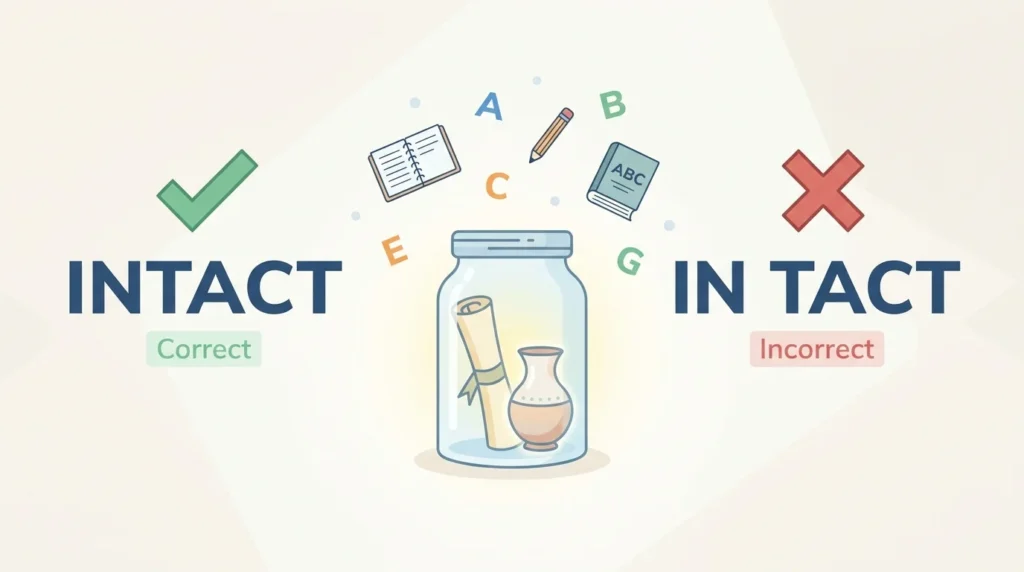

If you mean whole, complete, unbroken, or undamaged, the correct spelling is intact, one word.
In tact is not the standard spelling of this adjective. For example, write “The package arrived intact,” not “The package arrived in tact.” The confusion happens because intact sounds as though it could be divided into the familiar words in and tact. But intact is an established word with its own meaning and grammatical function.
What Is “Intact”?
Intact is an adjective that describes something that has remained complete or has not been damaged, broken, altered, or diminished.
In simple English, if something is intact, it is still in one piece or still in essentially the same condition.
You can use intact for physical things:
- The glass remained intact.
- The building survived the earthquake intact.
- The package arrived intact.
But intact is not limited to physical objects. It can also describe abstract things such as reputations, relationships, agreements, traditions, records, systems, and plans.
For example:
- Her reputation remained intact.
- Their friendship survived the disagreement intact.
- The original agreement is still intact.
Major dictionaries define intact in terms of being complete, original, untouched, or not damaged. Oxford traces the word to Latin intactus, from in- meaning “not” and tactus, related to “touch.”
Why It Matters
A one-letter spacing mistake can make otherwise polished writing look careless.
Consider these situations:
- Business email: “The original contract remains intact.”
- Academic writing: “The researchers preserved the sample intact.”
- News writing: “Several historic buildings remained intact.”
- Customer service: “Your package should arrive intact.”
- Social media: “Somehow, my phone survived the fall intact.”
Writing in tact in these sentences can distract the reader because it is not the standard form of the adjective.
This matters especially in professional and academic writing, where spelling accuracy contributes to credibility and readability.
The Core Rule
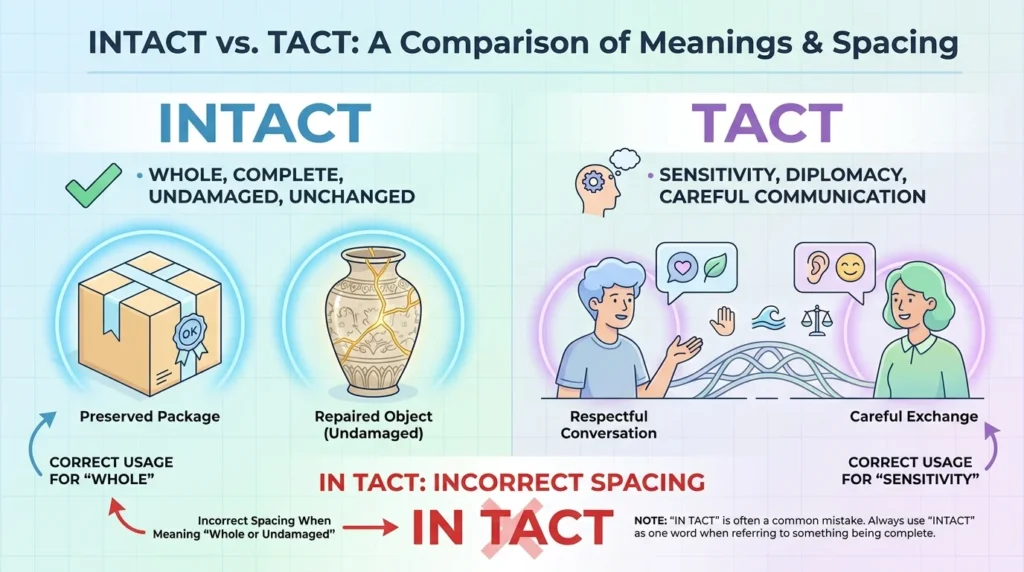
Use “intact” as one word when you mean whole, complete, unbroken, unchanged, or undamaged.
The easiest rule to remember
Whole = intact.
Sensitive communication = tact.
For example:
- The painting remained intact.
- She handled the complaint with tact.
The two words may look related because of their spelling, but they perform different jobs and have different meanings.
How to Use “Intact”
The most common pattern is:
remain/stay + intact
Examples:
- The original structure remained intact.
- Her confidence stayed intact.
- The evidence remains intact.
You can also use intact after verbs describing survival or preservation:
- The documents survived intact.
- The sculpture was recovered intact.
- The package arrived intact.
You can place intact directly before a noun when describing something that is complete and undamaged:
- an intact manuscript
- an intact building
- an intact ecosystem
- an intact fossil
- an intact document
Oxford specifically labels intact as an adjective and notes that it is not usually used before a noun in every context, although attributive uses such as “an intact fossil” are perfectly established.
Read More: Vender vs Vendor: Which Spelling Is Correct?
When “intact” describes abstract things
One useful point for learners is that intact does not require physical damage.
It can describe something that has survived a difficult event without losing its essential condition:
- The team’s lead remained intact.
- Her reputation remained intact.
- The agreement stayed intact.
- The tradition has survived intact.
- Their relationship emerged from the crisis intact.
This broader meaning is well established in contemporary English. Dictionary examples include reputations, records, friendships, and other nonphysical things remaining intact.
Correct Examples
Here are original examples across everyday, professional, academic, and online contexts.
- Conversation:
“I dropped my phone, but thankfully the screen is still intact.” - Email:
“Please make sure the original attachment remains intact when you forward the file.” - Workplace:
“The core terms of the agreement should remain intact during the negotiation.” - School:
“The teacher asked us to return the laboratory equipment intact.” - Academic writing:
“The researchers recovered an intact sample from the excavation site.” - Customer service:
“Your order was carefully packed so that every item would arrive intact.” - Social media:
“Three hours of traveling and somehow the birthday cake arrived intact!” - News-style writing:
“Several historic sections of the town remained intact after the storm.” - Personal writing:
“Despite everything that happened, her sense of humor remained intact.” - Business report:
“The company entered the merger with its existing management structure largely intact.”
Incorrect vs. Correct
| ❌ Incorrect | ✅ Correct | Why |
|---|---|---|
| The package arrived in tact. | The package arrived intact. | Intact is the adjective meaning undamaged or whole. |
| Her reputation remained in tact. | Her reputation remained intact. | A reputation can remain undamaged or unimpaired. |
| The vase was still in tact. | The vase was still intact. | The standard adjective is one word. |
| The original building is in tact. | The original building is intact. | Intact describes something preserved in its original condition. |
| The documents survived in tact. | The documents survived intact. | Intact can follow a verb such as survive. |
| Their friendship stayed in tact. | Their friendship stayed intact. | The word can describe an abstract relationship that remains whole. |
| The system remained in tact. | The system remained intact. | Intact can describe a system that remains complete or functioning as before. |
| The historical record is in tact. | The historical record is intact. | The spelling is not changed because the noun is abstract. |
| The artwork reached the museum in tact. | The artwork reached the museum intact. | The artwork arrived without damage. |
| The original plan remains in tact. | The original plan remains intact. | The plan has remained unchanged or preserved. |
Why People Make This Mistake
The mistake is understandable because intact looks as if it could be constructed from two familiar English words: in + tact.
But that visual interpretation is misleading.
Phonetic similarity
When people hear intact, especially in fast speech, they may mentally divide the sound into:
in + tact
That makes the incorrect two-word spelling feel logical.
Spelling overlap
Both in and tact are legitimate English words. Because writers already know both words independently, they may assume that putting them together as in tact is grammatically possible.
English does not work that way consistently. Many established words cannot be separated simply because their parts also exist as independent words.
Overgeneralisation
Learners sometimes apply a familiar pattern:
- in the house
- in good condition
- in order
- in shape
They may therefore assume that in tact follows the same structure.
But intact is not normally a preposition-plus-noun phrase meaning “in a good condition.” It is a single adjective.
Autocomplete and spellcheck
Spellcheck tools can catch many common spelling errors, but they do not understand every intended meaning.
A writing system may also fail to flag a spacing error if both resulting words are individually valid words.
That is why understanding the word is more reliable than depending entirely on automatic correction.
LanguageTool, for example, specifically lists “in tact” → “intact” as a possible typo.
Translation interference
Multilingual writers may also be influenced by how their first language expresses concepts such as “in good condition,” “whole,” or “undamaged.” If the equivalent construction uses separate words, splitting intact may feel natural.
The solution is not to memorize every English word as a special case. Instead, learn intact as a complete vocabulary item.
Common Mistakes Checklist
1. Writing “in tact” for “undamaged”
Mistake:
“The package arrived in tact.”
Fix:
“The package arrived intact.”
Remember: intact is the adjective.
2. Confusing “intact” with “tact”
Mistake: treating tact as though it means “whole.”
Correct distinction:
- intact = whole or undamaged
- tact = sensitivity and good judgment in dealing with people
Cambridge defines tact as the ability to say or do things without making people unhappy or angry.
3. Thinking “intact” only describes physical objects
It doesn’t.
You can have:
- an intact building
- an intact document
- an intact relationship
- an intact reputation
- an intact agreement
- an intact tradition
- an intact record
4. Assuming “in tact” is the British spelling
It isn’t.
There is no standard American/British spelling distinction here. Both varieties use intact.
5. Replacing “intact” with “tactful”
These words have completely different functions.
- “She responded with tact.”
- “She gave a tactful response.”
- “Her reputation remained intact.”
The first two describe sensitive behavior. The third describes preservation.
“Intact” in Real English
Grammatically correct
Intact is the normal adjective when you mean that something remains whole, undamaged, complete, or substantially unchanged. “The documents remained intact” and “Her reputation survived intact” are natural standard-English constructions. The word works with both physical and abstract nouns, so its use is much broader than simply describing objects that have not broken.
Grammatically possible but unnatural
A sequence containing the separate words in and tact can theoretically occur if the writer genuinely intends in as a preposition and tact as the noun. However, that is not the ordinary way English expresses the idea of acting sensitively. In modern writing, a phrase such as with tact or the adverb tactfully is normally clearer and more idiomatic.
Natural, everyday English
For everyday English, the practical choice is straightforward: use intact when something has survived without being broken, damaged, or substantially altered. Say “The phone is still intact,” “The agreement remains intact,” or “The package arrived intact.” If you mean sensitivity in communication, use tact, with tact, or tactfully instead.
Formal vs. Informal Usage
There is no spelling change between formal and informal English.
Intact works naturally in both:
- everyday conversation
- text messages
- emails
- business writing
- journalism
- academic writing
- technical writing
For example:
Informal:
“Luckily, my laptop is still intact.”
Formal:
“The original structure of the document remained intact.”
The word itself is not unusually formal. The surrounding vocabulary determines the overall register.
Comparison Table
| Feature | Intact | In tact | Tact |
|---|---|---|---|
| Standard word? | Yes | No, for this meaning | Yes |
| Spelling | One word | Two words | One word |
| Part of speech | Adjective | Not the standard form of intact | Noun |
| Main meaning | Whole, complete, undamaged | Usually a misspelling | Sensitivity in dealing with people |
| Example | “The vase remained intact.” | “The vase remained in tact.” ❌ | “She handled it with tact.” |
| Can describe an object? | Yes | No, in the intended meaning | No |
| Can describe a relationship? | Yes | No, in the intended meaning | No |
| Used in professional writing? | Yes | Avoid | Yes |
| Related adjective | — | — | tactful |
| Related adverb | — | — | tactfully |
Memory Trick
Use this:
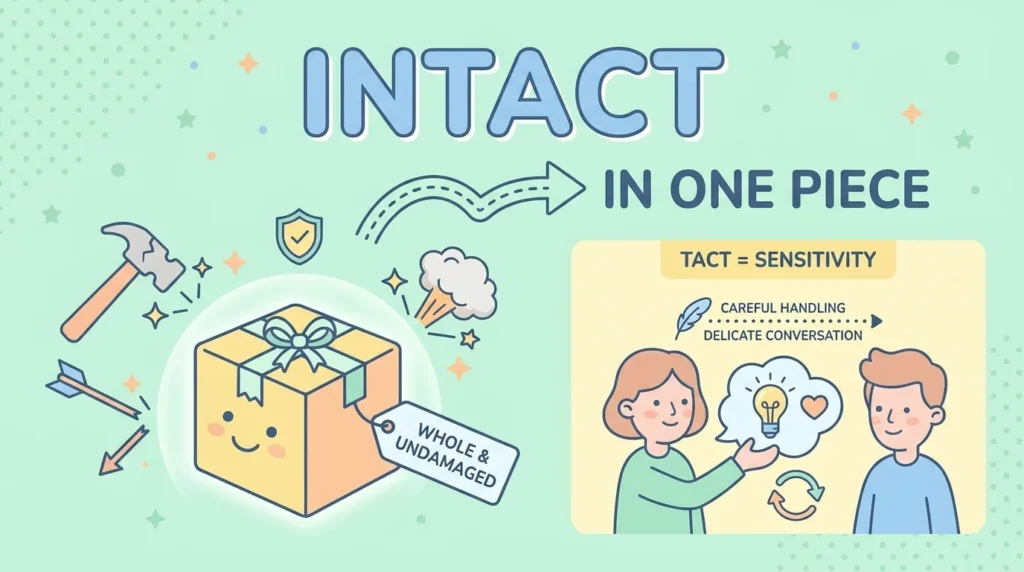
INTACT = IN ONE PIECE
Both ideas point to something that is still complete.
If the meaning is whole or undamaged, write:
INTACT
If the meaning involves sensitivity when dealing with people, think:
TACT
One-second test
Ask yourself:
“Am I talking about damage or diplomacy?”
- Damage/wholeness → intact
- Diplomacy/sensitivity → tact
Real-Life Situations
1. After an accident
You inspect your phone after dropping it.
Correct:
“My phone survived the fall intact.”
You are describing its condition.
2. In a business meeting
A team wants to change part of an agreement but preserve the original terms.
Correct:
“We need to keep the main agreement intact.”
3. In an interview
You are discussing how you handled a difficult colleague.
Correct:
“I tried to approach the conversation with tact.”
Here, tact means sensitivity.
4. In an email
You need to tell a colleague that the original document should not be changed.
Correct:
“Please return the document intact.”
5. In a text message
A friend asks whether your cake survived a long car ride.
Correct:
“Surprisingly, it arrived intact!”
6. In an exam
You are asked to choose between in tact and intact.
If the sentence means whole, complete, or undamaged, choose:
intact
Expert Tips
Think about meaning before spelling
Instead of memorizing only:
intact = correct
memorize:
intact = whole and undamaged
Meaning-based memory is stronger because it tells you why the word belongs in the sentence.
Learn “tact” separately
Do not treat tact as a piece that has been removed from intact.
Learn it as its own word:
tact → tactful → tactfully
For example:
- She showed tact.
- She was tactful.
- She responded tactfully.
Watch for “remain intact”
This is one of the most useful collocations to remember:
- remain intact
- stay intact
- keep intact
- leave intact
- survive intact
- arrive intact
Once you recognize these patterns, the spelling becomes easier.
Read More: Laid vs Layed: Which Spelling Is Correct?
Do not let the pronunciation decide the spelling
English contains many words whose sounds can be mentally divided in misleading ways.
If you hear:
in-TAKT
do not automatically write:
in tact
The established written word is:
intact
Remember that “intact” can be abstract
If something has not physically broken, intact is obvious.
But also remember:
reputation intact
relationship intact
agreement intact
tradition intact
confidence intact
record intact
That broader range makes the word easier to recognize in real writing.
Quick Summary
Intact is the correct one-word spelling when you mean whole, complete, unbroken, unchanged, or undamaged. For example, “The package arrived intact” means the package arrived without damage. In tact is not the standard spelling of this adjective. The confusion comes largely from the way intact sounds as though it could be divided into the familiar words in and tact. Remember the simple rule: whole or undamaged = intact; sensitivity in dealing with people = tact. The spelling is the same in standard American and British English, and intact is appropriate in both everyday and formal writing. (Cambridge Dictionary)
FAQ
Is “in tact” ever correct?
Not when you mean whole, complete, or undamaged. In that meaning, the standard spelling is intact. The separate words in and tact can theoretically occur together in a sentence if they have independent grammatical roles, but that is not the normal spelling or expression being asked about.
Is “intact” one word or two words?
Intact is one word. It is an adjective meaning whole, complete, original, or undamaged. (Cambridge Dictionary)
Is “in tact” a spelling mistake?
Yes, when it is being used as a separated version of intact. It is a common spacing error because the pronunciation makes the word appear to contain the separate words in and tact.
Can “intact” describe a person?
Yes, depending on the intended meaning. It can describe a person who emerges physically unharmed or a person’s condition remaining complete in a particular sense. It can also describe a person’s reputation, dignity, confidence, or other abstract qualities.
Can you say “my reputation remained intact”?
Yes. This is a natural and well-established use. Here, intact means that the reputation was not damaged or diminished.
Can “intact” describe a relationship?
Yes. For example:
“Their friendship remained intact after the disagreement.”
The relationship has not been broken or destroyed.
What is the difference between “intact” and “tact”?
Intact is an adjective meaning whole or undamaged.
Tact is a noun meaning sensitivity and good judgment when dealing with people.
Example:
- “The painting remained intact.”
- “She handled the criticism with tact.”
Is “intact” used in both American and British English?
Yes. There is no standard spelling difference between American and British English. Both use intact. Oxford lists the same spelling in its learner and American English dictionaries, and Cambridge gives the same form for both varieties.
What is the opposite of “intact”?
Depending on the context, useful opposites include:
- broken
- damaged
- incomplete
- altered
- impaired
- destroyed
The best opposite depends on exactly what has changed.
Is “intact” formal English?
It can be used in formal English, but it is not restricted to formal writing. It is completely normal in conversation as well as professional, academic, journalistic, and technical writing.
Mini Quiz
| # | Question | Answer | Explanation |
|---|---|---|---|
| 1 | Choose the correct form: “The vase remained ___ after the move.” A) in tact B) intact | B) intact | Intact means whole or undamaged. |
| 2 | Fill in the blank: “Her reputation remained ___ despite the controversy.” | intact | The reputation was not damaged. |
| 3 | Which sentence is correct? A) The documents arrived in tact. B) The documents arrived intact. | B | Intact is the standard adjective. |
| 4 | Fill in the blank: “She handled the sensitive discussion with ___.” | tact | Tact means sensitivity and good judgment. |
| 5 | Correct the sentence: “The original agreement stayed in tact.” | The original agreement stayed intact. | Intact is written as one word. |
| 6 | Which word means “sensitivity in dealing with people”? A) intact B) tact | B) tact | Tact is the noun for diplomatic sensitivity. |
| 7 | Fill in the blank: “Despite the earthquake, the historic building remained ___.” | intact | The building remained whole or undamaged. |
| 8 | Correct the sentence: “The package arrived in tact.” | The package arrived intact. | The intended meaning is “without damage.” |
| 9 | Choose the natural sentence: A) He responded with intact. B) He responded with tact. | B) He responded with tact. | Tact is the noun used for sensitive handling of a situation. |
| 10 | Fill in the blank: “The team entered the final round largely ___.” | intact | The team’s essential members or structure remained together. |
Final Takeaway
If you are choosing between in tact vs. intact, the answer is straightforward:
Use “intact.”
intact = whole, complete, unbroken, or undamaged
Use tact separately when you mean sensitivity or diplomacy.
Correct:
“The original document remained intact.”
Incorrect:
“The original document remained in tact.”
The important thing is not simply memorizing the spelling. Understand the meaning, and the spelling becomes much easier to remember.