
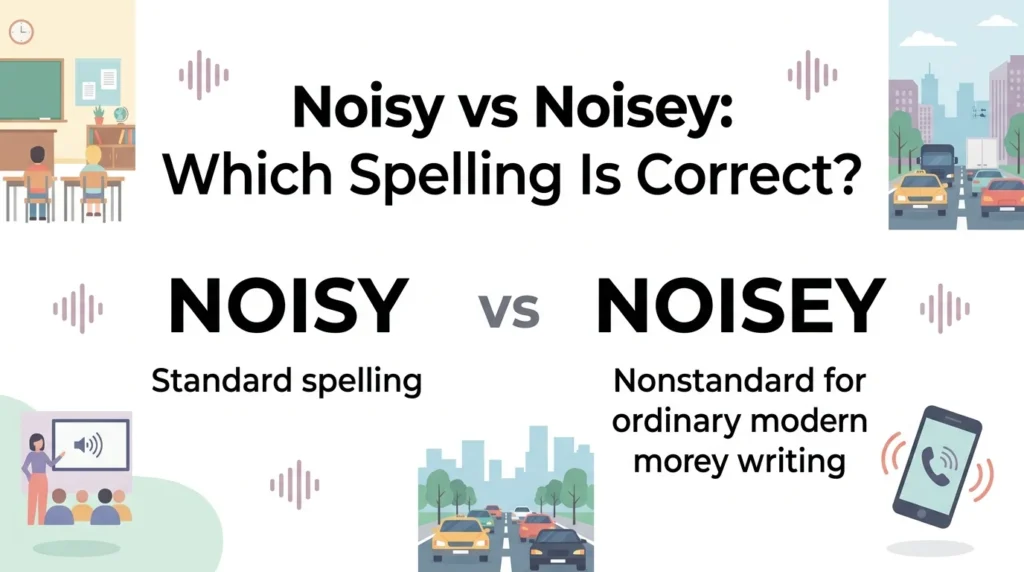

Noisy is the standard spelling in modern English. Noisey should not be used when you mean “making or full of noise.” The word noisy is an adjective formed from noise, and it means making a lot of sound or being full of noise. It is spelled N-O-I-S-Y, not N-O-I-S-E-Y. The same spelling is used in both American and British English.
What Is the Difference Between Noisy and Noisey?
The difference is mainly one of standard spelling:
- Noisy — the standard modern English spelling.
- Noisey — not the standard spelling you should use in ordinary modern writing.
For example:
The classroom became noisy after the teacher left.
Not:
The classroom became noisey after the teacher left.
Noisy is an adjective. It describes a person, place, thing, signal, or situation that produces a lot of sound or contains unwanted sound. Dictionaries also use noisy in specialized contexts, such as electronics and data, where a signal or dataset contains unwanted variation or information.
The important point is that noisy is the form you should choose in normal contemporary English.
Why It Matters
A one-letter spelling error can seem minor, but it can affect how polished your writing looks.
Imagine writing:
We moved offices because the old building was too noisey.
The meaning is still understandable. Most readers will know what you intended. But the spelling can make the sentence look careless, especially in a:
- Job application
- Business email
- School assignment
- Academic paper
- Website
- Report
- Professional presentation
- Formal complaint
Using noisy removes the problem immediately.
This is especially useful because noisy is a common word. You may need it when describing a street, classroom, machine, restaurant, office, neighborhood, crowd, recording, or electronic signal.
The Core Rule
Use “noisy,” not “noisey,” when you mean “making or full of noise.”
Think of the formation this way:
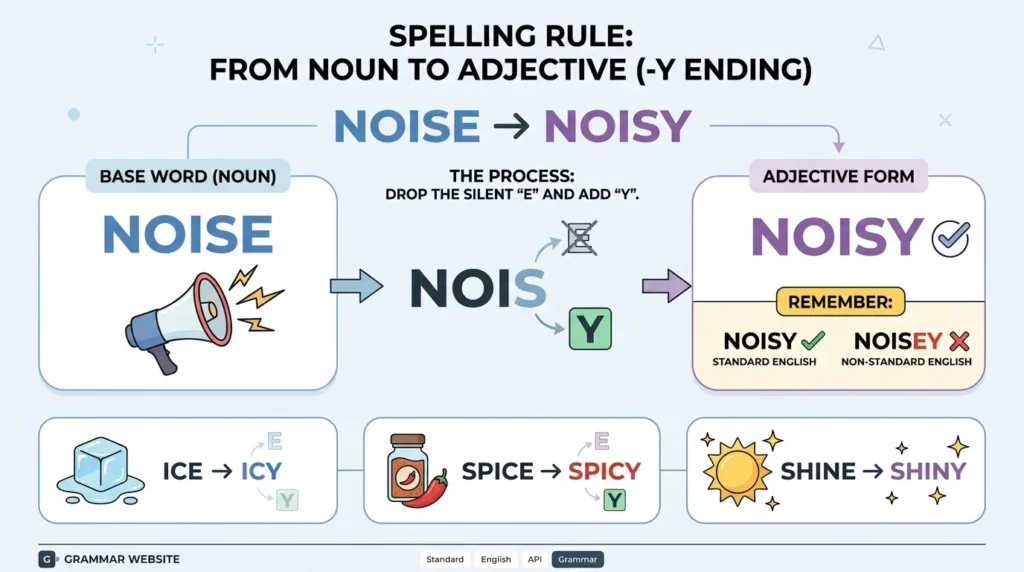
noise + y → noisy
The final e in noise is not retained before the -y ending.
Compare:
- noise → noisy
- ice → icy
- spice → spicy
- shine → shiny
- grease → greasy
- haze → hazy
- rose → rosy
The spelling pattern is useful, but it should not be treated as an absolute rule that explains every English adjective. English spelling contains many historical exceptions. For this particular word, however, the standard form is firmly noisy. Major dictionaries give noisy as the established adjective and its normal comparative and superlative forms as noisier and noisiest.
How to Use Noisy
Noisy normally comes before a noun as an adjective:
It was a noisy restaurant.
It can also appear after a linking verb:
The restaurant was noisy.
You can use it to describe both people and things:
The children were noisy.
The machine is noisy.
You can also use it with places and environments:
We live on a noisy street.
And it can describe sounds or technical information:
The recording contains a noisy background signal.
The researchers were working with noisy data.
Modern dictionaries recognize these broader technical uses as well as the ordinary meaning involving sound.
Comparative and Superlative Forms
The comparative form is:
noisy → noisier
The superlative form is:
noisy → noisiest
Examples:
The market is noisier on weekends.
This is the noisiest room in the building.
The spelling changes from y to i before -er and -est:
noisy → noisier → noisiest
This is another reason not to write noiseyer or noiseyest.
Correct Examples
Here are original examples showing how noisy works in different types of English.
Conversation
“Why is your house so noisy today?”
The adjective describes the amount of sound in the house.
The meeting room was too noisy for us to hear the presentation clearly.
Here, noisy describes the environment.
Workplace
We should move the customer-support team because the open office has become extremely noisy.
The word describes an environment that contains too much sound.
School
The students became noisy while they waited for the examination papers.
Noisy describes the students’ behavior.
Academic Writing
The researchers excluded several noisy measurements from the analysis.
Here, noisy has a technical meaning: the measurements contain unwanted variation.
Social Media
The café looked peaceful online, but it was surprisingly noisy in person.
The adjective describes the actual environment.
Text Message
Sorry, I can’t hear you. It’s really noisy here.
This is a natural everyday use.
Product Review
The fan works well, but it is noticeably noisy at its highest speed.
Here, noisy describes the sound produced by a device.
Travel Writing
The hotel is close to the station, but the area can be noisy at night.
The word describes the surrounding environment.
Technical Context
The microphone produced a noisy signal when it was connected to the faulty cable.
In electronics, noisy can describe unwanted changes or interference in a signal.
Incorrect vs. Correct
| ❌ Incorrect | ✅ Correct | Why |
|---|---|---|
| The classroom was noisey. | The classroom was noisy. | The standard adjective is noisy. |
| My neighbors are very noisey. | My neighbors are very noisy. | The final e from noise is not retained. |
| This machine is too noisey. | This machine is too noisy. | Noisy is the standard spelling for something producing a lot of sound. |
| The street becomes noisey at night. | The street becomes noisy at night. | Use noisy to describe a loud environment. |
| It was the noiseyest room. | It was the noisiest room. | The superlative of noisy is noisiest. |
| This room is noiseyer than the other one. | This room is noisier than the other one. | The comparative is noisier. |
| We work in a noisey office. | We work in a noisy office. | Noisy is the standard adjective. |
| The children were getting noisey. | The children were getting noisy. | The adjective ends in -y, not -ey. |
| The recording sounds noisey. | The recording sounds noisy. | Noisy also applies to unwanted background sound. |
| The data became noisey after the measurement error. | The data became noisy after the measurement error. | Noisy is used technically for data containing unwanted or unexplained variation. |
The error in these examples is primarily spelling, not meaning. A reader can usually understand noisey, but standard modern writing calls for noisy.
Why Do People Spell It “Noisey”?
The mistake is easy to understand.
The noun is:
noise
When people hear the adjective pronounced /ˈnɔɪzi/, they may instinctively connect it to the written form noise and add -y without changing anything:
noise + y → noisey
That looks visually plausible.
But English spelling does not always work by simply attaching a suffix to the complete written form of a word.
The accepted form is:
noise → noisy
The pronunciation does not provide enough information to determine the spelling. Noisy and noisey would be pronounced similarly, so listening alone cannot tell you which spelling is standard.
Phonetic Similarity
The spoken form can create the problem because both spellings suggest roughly the same pronunciation.
A learner may hear:
NOY-zee
and then have to decide whether the middle of the word is written -isy or -isey.
Pronunciation is therefore not a reliable spelling guide here.
Spelling Overlap
English contains many words in which an e appears before a final y, including words such as:
- honey
- money
- journey
- chimney
That can make noisey look more believable than it actually is.
The problem is that these words are not evidence that noise should become noisey. Word spellings develop through different historical patterns.
Overgeneralization
Learners sometimes create a rule such as:
“Keep the original word and just add y.”
That works for some words but not all.
English word formation often involves spelling changes. Noise → noisy is one example.
Read More: Vender vs Vendor: Which Spelling Is Correct?
Autocomplete and Spellcheck
A spellchecker may flag noisey, but different software can behave differently, especially with names, specialized terms, or unusual historical forms.
Typing tools can help, but they are not a substitute for knowing the standard form.
The safest approach is to remember the standard spelling:
noisy
Translation Interference
Learners of English may also transfer spelling patterns from another language. If the learner’s first language forms adjectives by attaching a suffix without changing the root spelling, noisey may seem logical.
The solution is not to memorize every English spelling rule. It is to learn common word families as complete patterns.
Common Mistakes Checklist
1. Adding the E
Mistake:
noisey
Better:
noisy
Why it happens: Writers see noise and assume the final e should remain.
How to avoid it: Remember noise → noisy.
2. Writing “Noiseyer”
Mistake:
This room is noiseyer.
Correct:
This room is noisier.
Why it happens: The writer treats noisy as though it were spelled noisey before adding the comparative ending.
How to avoid it: Learn the complete sequence:
noisy → noisier → noisiest
3. Writing “Noiseyest”
Mistake:
That was the noiseyest party.
Correct:
That was the noisiest party.
The superlative is noisiest.
4. Assuming It Is British English
Some learners encounter spelling differences such as:
- color / colour
- center / centre
- organize / organise
They may therefore assume noisey could be a British spelling.
It is not the standard British spelling. Noisy is used in both British and American English. Cambridge and Collins give the same basic spelling, although pronunciation notation may vary by variety.
5. Assuming “Noisey” Has a Different Meaning
It does not function as a separate standard modern adjective meaning something different from noisy.
If your intended meaning is “making a lot of noise,” use noisy.
Noisy in Real English
Standard and Natural
The restaurant is noisy.
This is both grammatically correct and completely natural. It is an ordinary way to describe a place where there is a lot of sound. Native and proficient English speakers routinely use noisy for restaurants, streets, classrooms, offices, vehicles, machines, and people. Dictionary examples and common collocations include expressions such as noisy crowd, noisy neighbors, noisy office, and noisy place.
Correct but More Context-Dependent
The data is noisy.
This is grammatical and natural in technical contexts, but it does not mean that the data literally makes a sound. Here, noisy is being used metaphorically or technically for information containing unwanted variation, errors, or irrelevant material. This use is established in technical English, including discussions of data and signals.
Correct but Not Always the Best Choice
The music was noisy.
This sentence is grammatically correct, but the intended meaning matters. If you simply mean that the music had a high volume, loud may be more precise. Noisy often carries an additional idea of unwanted, excessive, disruptive, or unpleasant sound. Compare:
The music was loud.
with:
The restaurant was noisy.
The first focuses on volume; the second naturally focuses on the environment and disturbance.
Natural Everyday English
Sorry, it’s too noisy here. Can I call you back?
This is highly natural conversational English. In everyday speech, noisy commonly describes an environment in which it is difficult to hear or concentrate.
Natural Professional English
The current workspace is too noisy for confidential client calls.
This is also natural. The word is not informal or childish. Noisy works in professional writing whenever the meaning requires it.
American vs. British English
There is no meaningful spelling difference here.
| English variety | Standard spelling | Example |
|---|---|---|
| American English | noisy | The neighbors are noisy. |
| British English | noisy | The neighbours are noisy. |
| Canadian English | noisy | The street is noisy. |
| Australian English | noisy | The restaurant is noisy. |
The spelling remains noisy.
There can be a difference in pronunciation notation between varieties, but that does not change the spelling. Cambridge lists noisy with UK and US pronunciation information, while Collins also provides British and American pronunciation entries for the same spelling.
One small difference you may notice is in related words such as neighbor/neighbour, not in noisy itself.
Formal vs. Informal Usage
Noisy works in both formal and informal English.
Informal
Your kids are getting noisy!
Neutral
The room became noisy during the break.
Professional
The open-plan office has become too noisy for extended telephone meetings.
Academic or Technical
The model performs less reliably when trained on noisy data.
There is no need to replace noisy with a more complicated word simply because you are writing formally.
Depending on context, alternatives such as loud, disruptive, clamorous, boisterous, or disturbing may be more precise. But noisy itself is perfectly acceptable in professional and academic writing.

Comparison Table
| Feature | Noisy | Noisey |
|---|---|---|
| Standard modern spelling | ✅ Yes | ❌ No |
| Means “making a lot of noise” | ✅ Yes | ❌ Not as a standard form |
| Used in American English | ✅ Yes | ❌ Not standard |
| Used in British English | ✅ Yes | ❌ Not standard |
| Suitable for academic writing | ✅ Yes | ❌ Avoid |
| Suitable for business writing | ✅ Yes | ❌ Avoid |
| Comparative | noisier | Not standard |
| Superlative | noisiest | Not standard |
| Adverb | noisily | Not standard |
| Noun | noisiness | Not standard |
| Technical use for signals/data | ✅ Yes | ❌ Not standard |
There is one important historical nuance: noisey is not simply an invented sequence of letters that has never existed in English. Historical and lexical records contain uncommon uses of noisey. However, that does not make it the spelling to choose in ordinary contemporary English. The practical rule for modern writing remains noisy.
Is “Noisey” Ever Correct?
For ordinary modern English, use noisy.
There is, however, a distinction between a standard modern spelling and the claim that a spelling has never appeared anywhere in English.
Historical records show noisey as an uncommon form. Wiktionary, for example, records historical examples of noisey and also lists it as an uncommon alternative form under noisy.
That historical fact does not mean that noisey is an acceptable alternative for everyday contemporary writing.
So if you are writing:
The classroom is very noisy.
use noisy.
Do not write:
The classroom is very noisey.
unless you have a specific reason to reproduce a historical spelling, quotation, title, or proper name.
Noisy Has More Than One Use
The most common meaning of noisy relates to sound:
The children were noisy.
It is a noisy street.
But the word can also be used in specialized contexts.
Noisy Signals
In electronics and signal processing, a noisy signal contains unwanted variation or interference.
The receiver produced a noisy signal.
Cambridge specifically identifies this specialized sense.
Noisy Data
In data analysis, machine learning, and scientific research, noisy data can contain errors, unexplained variation, irrelevant information, or other material that makes the underlying pattern harder to identify.
The model performed poorly because the training data was noisy.
This meaning has nothing to do with audible sound, but it is an established extension of the word.
Noisy as “Attention-Grabbing”
There is also a less literal use.
A person, group, or public debate can be described as noisy when it attracts attention through loud, forceful, or persistent expression.
For example:
The debate became increasingly noisy.
Collins also records a use of noisy for someone who is conspicuous or forceful in expressing views.
Memory Trick
Use this simple pattern:
NOISE loses E when it becomes NOISY.
Think:
NOISE → NOISY
Not:
NOISE → NOISEY
A second memory chain can reinforce it:
ice → icy
spice → spicy
noise → noisy
The goal is not to memorize a complicated spelling rule. Just remember the word family.
Real-Life Situations
Situation 1: A Classroom
You are writing about students talking during a lesson.
Correct:
The classroom became noisy after the teacher left.
Situation 2: A Hotel Review
You want to warn travelers about street traffic.
Correct:
The hotel is comfortable, but the street outside can be noisy at night.
Situation 3: A Work Email
You need a quieter place for a meeting.
Correct:
Could we use another meeting room? This one is too noisy for the client call.
Situation 4: A Text Message
Your friend calls while you are outside.
Correct:
It’s really noisy here. I’ll call you later.
Situation 5: An Exam
You need to describe a distracting environment.
Correct:
The examination hall became noisy when students started leaving.
Situation 6: A Product Review
You are reviewing a fan.
Correct:
The fan is powerful, but it becomes quite noisy at the highest setting.
Situation 7: Technical Writing
You are discussing a recording.
Correct:
The audio file contains considerable background noise and is therefore noisy.
Situation 8: Data Analysis
You are describing unreliable measurements.
Correct:
The measurements are noisy, so the underlying trend is difficult to identify.
Expert Tips
Tip 1: Learn the Word Family
Do not memorize only noisy. Learn its related forms:
- noise — noun
- noisy — adjective
- noisier — comparative adjective
- noisiest — superlative adjective
- noisily — adverb
- noisiness — noun
These forms make the spelling easier to remember.
Tip 2: Do Not Spell by Sound
English pronunciation does not always tell you how a word is written.
Noisy is pronounced with a sound that can make noisey look plausible. When pronunciation and spelling compete, rely on the established word form.
Tip 3: Distinguish “Loud” From “Noisy”
These words overlap, but they are not always interchangeable.
Loud usually focuses on volume.
Noisy often suggests a lot of sound, disturbance, or unwanted sound.
Compare:
The music is loud.
The restaurant is noisy.
Both can be true, but they emphasize different aspects.
Tip 4: Remember the Comparative
If you know the word is noisy, the comparative is noisier, not noiseyer.
This street is noisier than the next one.
The superlative is:
This is the noisiest street in the area.
Tip 5: Do Not Assume Every -E-Y Form Is Wrong
English has genuine words that contain -ey, and some words have spelling variants. The point is not that e + y is forbidden.
The point is simply that noisy is the established modern spelling for this word.
FAQ
Is “noisey” or “noisy” correct?
Noisy is the standard spelling in modern English. Use noisy when describing something that makes or contains a lot of noise.
Is “noisey” a word?
Historical and lexical records contain uncommon uses of noisey, so it is too absolute to say the spelling has never existed. However, it is not the standard modern spelling you should use in ordinary writing.
Is “noisey” British English?
No. Noisy is the standard spelling in both British and American English. The spelling does not change between the two varieties.
Why is “noisy” spelled without the E?
The standard form is noise + -y → noisy. The final e in noise is not retained in the established spelling of the adjective.
What is the plural of noisy?
Noisy is an adjective, so it does not have a plural form. The adjective remains noisy:
noisy children
noisy classrooms
noisy machines
What is the comparative of noisy?
The comparative is noisier.
The second room is noisier than the first.
What is the superlative of noisy?
The superlative is noisiest.
This is the noisiest restaurant on the street.
Is noisy a formal word?
Yes. Noisy is neutral and can be used in casual conversation, professional writing, academic writing, and technical contexts.
Can noisy describe data?
Yes. In technical English, noisy data can refer to data containing unwanted, unexplained, irrelevant, or variable information.
Can noisy describe a person?
Yes. It can describe someone who makes a lot of sound or talks loudly. Depending on context, calling a person noisy can sound critical.
What is the difference between noisy and loud?
Loud generally emphasizes the level or volume of sound. Noisy often emphasizes the presence of a lot of sound or unwanted/disruptive sound.
How can I remember noisy?
Remember:
NOISE → NOISY
The word is noisy, not noisey.
Mini Quiz
| # | Question | Answer | Explanation |
|---|---|---|---|
| 1 | Choose the correct spelling: noisy / noisey | Noisy | Noisy is the standard modern spelling. |
| 2 | Fill in the blank: “The restaurant was very ___.” | noisy | The adjective describes a place with a lot of sound. |
| 3 | Correct the sentence: “My neighbors are noisey.” | My neighbors are noisy. | Replace the nonstandard spelling with noisy. |
| 4 | What is the comparative form of noisy? | noisier | The y changes to i before -er. |
| 5 | What is the superlative form of noisy? | noisiest | The y changes to i before -est. |
| 6 | Choose the correct sentence: A) “The machine is noisey.” B) “The machine is noisy.” | B | Noisy is the standard spelling. |
| 7 | Fill in the blank: “This street is ___ than the main road.” | noisier | The sentence compares two streets. |
| 8 | Correct the sentence: “This was the noiseyest classroom.” | This was the noisiest classroom. | The superlative is noisiest. |
| 9 | Is this sentence correct? “The recording contains noisy background data.” | Yes | Noisy can have technical uses involving unwanted sound or information. |
| 10 | Choose the better spelling for professional writing: noisey / noisy | noisy | Noisy is the standard contemporary form. |
Quick Summary
Noisy is the correct standard spelling when you mean “making or full of noise.” Noisey should normally be avoided in contemporary English, although historical records contain uncommon uses of the spelling. The word noisy works in everyday, professional, academic, and technical English. It can describe people, places, machines, sounds, signals, and data. The spelling is the same in American and British English. Remember the word family as noise → noisy → noisier → noisiest. The easiest memory trick is simple: NOISE loses the E before becoming NOISY. If you are writing an email, assignment, report, website, or social media post, choose noisy.