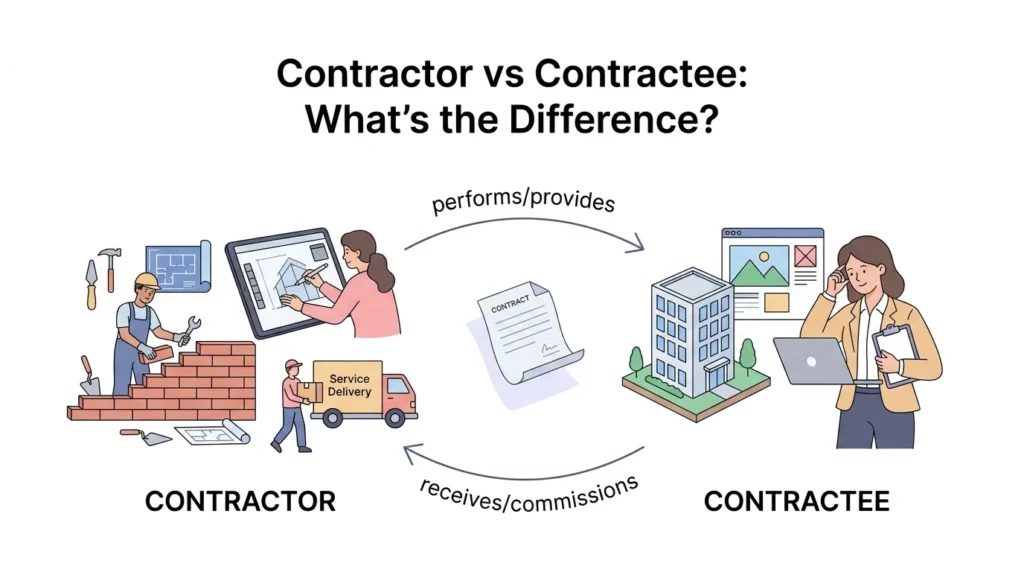

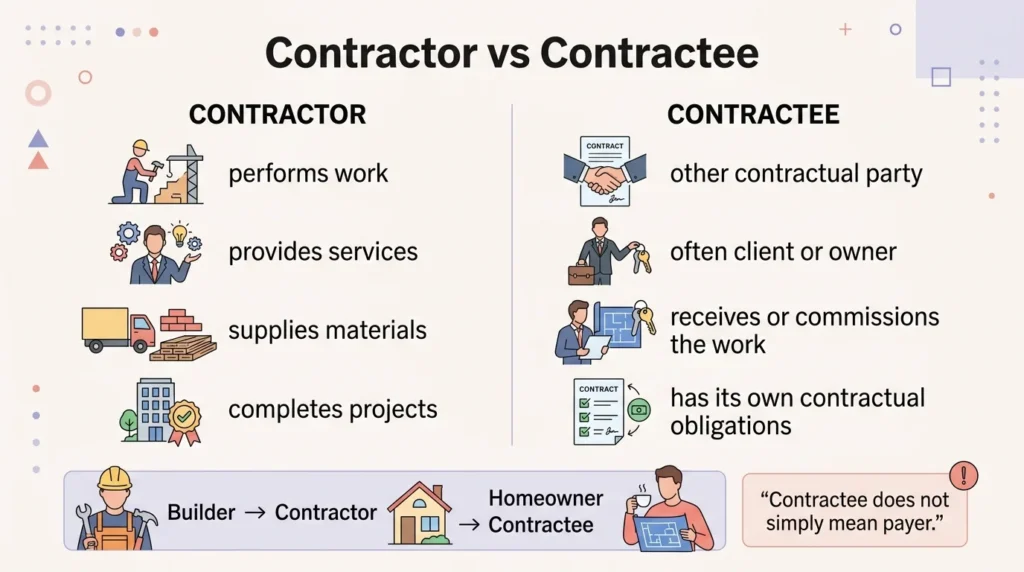
Contractor and contractee are both correct English nouns, but they describe different roles in a contractual relationship. A contractor is generally the person or company that agrees to perform work, provide services, or supply something under a contract. A contractee is generally the other party—the person or organization for whom the work is performed or with whom the contractor enters into the agreement. In construction, the contractee is often the owner or client.
The important point is that contractee does not simply mean “the person who pays.” Contract terminology can vary according to the type of agreement and the legal context.
What Is a Contractor?
A contractor is a person or company that agrees to perform work, provide services, supply materials, or complete a project under the terms of a contract.
The word is especially common in construction and business. A contractor might build a house, repair a roof, install electrical equipment, develop software, provide security services, or manage a specialized project.
Merriam-Webster defines contractor broadly as someone who contracts or is a party to a contract, including someone who contracts to perform work or provide supplies. Cambridge similarly describes a contractor as a person or company that signs a contract to supply materials or workers or perform a service or job.
For example:
The company hired a contractor to redesign its website.
Here, the website developer or development company is the contractor because it has agreed to perform the work.
A contractor can be an individual, a small business, a large company, or another organization.
Examples of Contractors
A contractor could be:
- A construction company building an office
- A plumber repairing a water system
- A freelance graphic designer creating a logo
- A software company developing an application
- An engineering firm designing a bridge
- A security company providing guards
- A consultant providing specialized advice
- A supplier providing materials under a contract
The exact duties depend on the agreement.
What Is a Contractee?
A contractee is a party to a contract, particularly the party on the other side of a contractor in an arrangement where the contractor performs work or provides services.
In construction usage, the term commonly refers to the party that is not the contractor and is frequently the owner. A legal discussion by the Oregon Supreme Court described contractee as a person with whom a contract is made and noted that the term is particularly associated with construction contracts and the recipient of a contractor’s services.
For example:
The homeowner hired a contractor to remodel the kitchen.
In this situation:
- The contractor is the builder or remodeling company.
- The contractee is the homeowner.
However, contractee is a context-dependent term. It is not always safe to replace it with client, customer, owner, or payer without checking what the contract actually says.
That distinction matters because contracts can involve several parties with different rights and responsibilities.
A Simple Example
Imagine that a restaurant hires a company to install a new kitchen.
The installation company agrees to perform the work.
The restaurant agrees to the contractual terms and receives the completed installation.
In the simplest description:
Restaurant → Contractee
Installation company → Contractor
The contractor performs the agreed work. The contractee is the party on the other side of that arrangement.
Why the Difference Matters
This distinction matters because contracts assign rights, duties, responsibilities, and obligations to specific parties.
If a document says that the contractor must complete a project by June 30, the person reading the document needs to know which party is the contractor.
Likewise, if the agreement gives the contractee the right to approve completed work, the parties need to know who the contractee is.
Confusing the two can make business communication unclear and can be especially problematic in legal or contractual documents.
The difference can affect questions such as:
- Who performs the work?
- Who receives the deliverables?
- Who must provide information or access?
- Who has approval responsibilities?
- Who submits invoices?
- Who is responsible for particular contractual obligations?
- Who has the right to request changes?
- Who accepts completed work?
The answers depend on the actual agreement, but identifying the parties correctly is the starting point.
The Core Rule
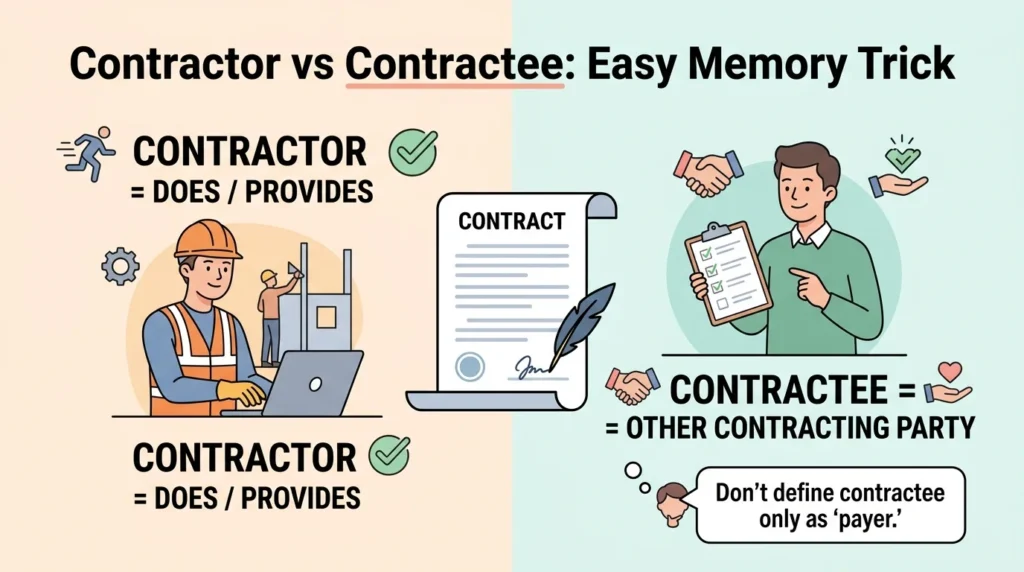
Contractor = the party contracted to perform work, provide services, or supply something.
Contractee = the other party to the contract, often the client, owner, or recipient of the contractor’s work.
Do not reduce the rule to:
“Contractor gets paid; contractee pays.”
That shortcut works in many ordinary service examples, but it is too absolute for contracts generally.
A contract can involve different payment arrangements, multiple parties, subcontractors, intermediaries, or obligations that do not fit that simple formula.
The safest question is:
Who is performing or supplying under the contract, and who is the other contracting party?
How to Use Contractor and Contractee
Use “contractor” for the party performing or supplying
Use contractor when referring to the person or organization hired or contracted to perform work, provide a service, or supply something.
Examples:
- The contractor will complete the renovation by Friday.
- We need to contact the contractor about the damaged flooring.
- The company hired an independent contractor to develop the software.
- The contractor must provide the required materials.
- The contractor submitted the project proposal yesterday.
Use “contractee” for the other contracting party when the term fits
Use contractee when the agreement or context specifically uses that term for the other party.
Examples:
- The contractee must approve the final design.
- The contractor submitted the plans to the contractee.
- The contractee accepted the completed construction.
- Both the contractor and contractee signed the agreement.
However, in everyday business English, client, customer, owner, employer, or simply the organization’s name may sound clearer.
Don’t automatically replace “client” with “contractee”
These words can overlap, but they are not always interchangeable.
Client is a broad everyday business term.
Contractee is a more specialized contractual term.
For example:
The client approved the website design.
sounds natural in ordinary business communication.
The contractee approved the website design.
is grammatically possible, but it sounds more formal and contractual.
Correct Examples
Here are examples showing how the two terms work in different situations.
- Conversation:
“The contractor said the repairs will take three days.” - Business email:
“Please send the revised proposal to the contractor before noon.” - Construction:
“The contractor completed the foundation ahead of schedule.” - Freelance work:
“The company hired a freelance contractor to write the product descriptions.” - Software development:
“The contractor will deliver the first version of the application next month.” - Legal writing:
“The contractor and contractee shall comply with the obligations stated in this agreement.” - Project management:
“The contractee must review the submitted plans within five business days.” - Academic writing:
“The agreement establishes specific obligations for both the contractor and the contractee.” - Workplace communication:
“The contractor is responsible for completing the installation.” - Social media:
“We hired a local contractor to renovate our office.” - Customer communication:
“The contractor will contact you to arrange a suitable installation date.” - Formal documentation:
“The contractor shall provide the completed report to the contractee.”
Notice that contractor is much more common in ordinary English. Contractee is most useful when you specifically need to identify the other party in a contractual relationship.
Read More: Laid vs Layed: Which Spelling Is Correct?
Incorrect vs. Correct
| ❌ Incorrect | ✅ Correct | Why |
|---|---|---|
| The contractor hired us to receive the service. | The contractor hired us to provide the service. | The contractor is generally the party providing or performing the contracted work. |
| The contractee will build the house for the owner. | The contractor will build the house for the owner. | The builder is the contractor in this example. |
| We sent the invoice to the contractor because he was our client. | We sent the invoice to the client. | “Client” is clearer when referring to the customer or hiring party. |
| The contractee completed the construction work. | The contractor completed the construction work. | The contractor is the party performing the construction. |
| Our contractor received the service from the company. | Our contractor provided the service to the company. | The roles have been reversed. |
| The contractor approved the work as the property owner. | The property owner approved the work. | Being the contractor does not automatically make someone the owner. |
| The contractee is always the person who pays. | The contractee is the other party to the contract, often the client or recipient. | Payment responsibilities depend on the agreement. |
| The contracter will repair the roof. | The contractor will repair the roof. | Contractor is the standard spelling. |
| We call the builder the contractee. | We call the builder the contractor. | The builder is performing the contracted construction work. |
| The contractor and client are always completely different legal roles. | A contractor and client commonly occupy different roles, but the exact legal relationship depends on the agreement. | Contract terminology can vary by context. |
Why People Make This Mistake
1. The words look almost identical
Contractor and contractee share the word contract.
That makes them easy to confuse, particularly when both appear in the same document.
The endings are different, but the beginning of the words is identical.
2. The endings suggest different roles
English uses endings such as -or and -ee in words that can describe different relationships.
For example:
- employer / employee
- interviewer / interviewee
- examiner / examinee
- trainer / trainee
Learners may therefore assume that every pair follows exactly the same pattern.
English does not always work that neatly.
3. Contract language is unfamiliar
Many people encounter contractee mainly in formal documents rather than ordinary conversation.
Because the word is relatively specialized, learners may know contractor but have little practical experience using contractee.
4. People overuse the “payer vs. paid” shortcut
A common explanation says:
Contractor gets paid. Contractee pays.
That can be useful as a basic memory aid in a simple service arrangement.
But it is not a complete definition of a contracting party.
The actual agreement determines payment obligations.
5. Translation can interfere
In some languages, one familiar word may cover several English contractual roles.
A direct translation can therefore make it tempting to use contractor, contractee, client, employer, or customer interchangeably.
When translating a contract, the safest approach is to identify the actual legal role rather than translate the word mechanically.
6. Spellcheck does not explain meaning
A spellchecker may recognize both words as correctly spelled.
That does not mean they are interchangeable.
Spellcheck can tell you that a word exists. It cannot necessarily tell you whether that word describes the correct party in your sentence.
Common Mistakes Checklist
Mistake 1: Using “contractee” for the person doing the work
Why it happens: The words are visually similar.
Fix: Ask, “Who is performing the contracted work?” That party is generally the contractor.
Mistake 2: Treating “contractee” as a synonym for “payer”
Why it happens: Many simple service contracts involve a client paying a contractor.
Fix: Think in terms of contractual roles, not just money.
Mistake 3: Assuming “contractee” always means “client”
Why it happens: In many service relationships, the two roles overlap.
Fix: Use client when you mean client. Use contractee when the contractual relationship itself is important.
Mistake 4: Writing “contracter”
Why it happens: Writers may associate the word with common -er nouns such as worker and teacher.
Fix: Remember the standard spelling: contractor.
Mistake 5: Thinking “contractee” is incorrect English
Why it happens: The word is uncommon in everyday conversation.
Fix: It is a legitimate noun, especially in legal and construction contexts. The issue is usually register and precision, not spelling validity.
Read More: Bailer vs Baler: Which Spelling Is Correct?
Contractor vs Contractee in Real English
Grammatically correct
Both contractor and contractee are grammatically correct nouns. You can use either word when it accurately describes a party’s role in a contract. Contractor is widely used in business, construction, employment-related contexts, and general communication. Contractee is also established English, particularly in contractual and construction contexts. The important issue is not whether the words are grammatical, but whether the selected word correctly identifies the party being discussed.
Grammatically possible but less natural
Contractee can be grammatically correct while still sounding unusually formal in an everyday conversation. For example, “The contractee called me this morning” is understandable, but many speakers would naturally say “The client called me” or “The customer called me.” The specialized term becomes more useful when the document needs to distinguish contractual parties precisely, particularly in formal agreements or construction contexts.
Natural everyday English
In ordinary business English, contractor is a very natural word. People commonly talk about hiring a contractor, contacting a contractor, paying a contractor, or asking a contractor to complete work. Contractee is much less common in everyday conversation. Depending on the situation, speakers often choose client, customer, owner, company, or the person’s name instead. Use contractee when the contractual role itself needs to be emphasized.
Formal vs. Informal Usage
The main difference here is register, not correctness.
| Context | More natural choice |
|---|---|
| Everyday conversation | client, customer, contractor |
| Business email | contractor, client, customer |
| Construction discussion | contractor, owner, client |
| Formal contract | contractor, contractee, named parties |
| Legal discussion | contractor, contractee, contracting party |
| Academic explanation | contractor and contractee |
| Casual social media | contractor, client, builder |
For example:
Everyday:
We hired a contractor to renovate the office.
More formal:
The contractor shall submit the completed work to the contractee.
The second sentence is not necessarily “better.” It is simply more formal and contractual.
Contractor vs Contractee Comparison Table
| Feature | Contractor | Contractee |
|---|---|---|
| Basic role | Performs work or provides services | Other party to the contract |
| Typical context | Construction, services, outsourcing | Contracts, construction, legal writing |
| Common example | Builder, developer, consultant | Owner, client, hiring organization |
| Provides contracted work | Usually yes | Usually no in the contractor relationship |
| Receives contractor’s work | Usually no | Often yes |
| Pays contractor | Often receives payment | Often pays or has payment obligations |
| Everyday frequency | Common | Relatively uncommon |
| Register | General and professional | Formal/specialized |
| Can be an individual? | Yes | Yes |
| Can be a company? | Yes | Yes |
| Best simple question | “Who performs the work?” | “Who is the other party receiving or commissioning it?” |
Contractor vs Client
One of the most useful distinctions is between contractee and client.
A client is the person or organization receiving professional services or engaging a professional.
A contractee is a contractual term identifying a party in relation to a contractor.
In many situations, the client is the contractee.
For example:
A company hires a marketing agency.
The marketing agency is the contractor.
The company may be described as the client and, in an appropriate contractual context, the contractee.
But the words emphasize different things:
- Client emphasizes the business relationship.
- Contractee emphasizes the contractual relationship.
That is why client often sounds more natural in everyday business communication.
Contractor vs Employee
A contractor should not automatically be treated as an employee.
A contractor may provide services to a company without being its employee. Cambridge specifically recognizes this common meaning of contractor: someone who works for a company for a limited period but is not an employee.
For example:
The company hired an independent contractor to redesign its website.
The person may be working for the company on a project, but that sentence does not make the person an employee.
The exact legal distinction between an independent contractor and an employee depends on the applicable law and the actual working relationship.
Contractor vs Contractee in Construction
Construction is one of the clearest areas in which the distinction appears.
Imagine that a homeowner wants to build an extension.
The homeowner hires a construction company.
The construction company may:
- Supply workers
- Arrange materials
- Perform construction
- Manage subcontractors
- Follow project specifications
- Complete the agreed work
The construction company is the contractor.
The homeowner may:
- Commission the project
- Provide access to the property
- Approve specified work
- Make payments according to the agreement
- Accept completed work
The homeowner is commonly described as the contractee in this contractual relationship.
Construction terminology is particularly important because the word contractee has a recognized association with the party on the non-contractor side of a construction contract.
Contractor vs Contractee in Business
The same basic distinction appears outside construction.
Website project
A company hires a web development agency.
Contractor: Web development agency
Contractee: Hiring company
Marketing project
A business hires an advertising agency.
Contractor: Advertising agency
Contractee: Business
Consulting project
A company hires an independent consultant.
Contractor: Consultant
Contractee: Company
Accounting services
A business engages an accounting firm.
Contractor: Accounting firm
Contractee: Business
Software development
A startup hires developers to build an application.
Contractor: Development company or contracted developer
Contractee: Startup
These examples show why the central distinction is about the contractual role, not the industry.
How to Remember Contractor vs Contractee
Use this simple mnemonic:
CONTRACTOR = the party that carries out the contract work.
CONTRACTEE = the other party receiving or commissioning that work.
Another quick test is:
Who is doing the contracted work? → Contractor.
Who is on the other side of that contractor relationship? → Contractee.
Do not rely only on the idea that one “pays” and the other “gets paid.” The actual contract determines the parties’ obligations.
Real-Life Situations
Job interview
Question: “Who was the contractor on the office renovation?”
Answer: “ABC Builders. They handled the construction.”
The builder is the contractor because it performed the contracted work.
Business meeting
“The contractor has completed the first phase, but the client still needs to approve the final design.”
Here, contractor identifies the service provider, while client is the more natural everyday term for the other party.
Formal contract
“The Contractor shall deliver the completed materials to the Contractee by December 15.”
Both terms are appropriate because the document is formally defining the contractual parties.
“Please ask the contractor to send the revised invoice.”
This is natural professional English.
Text message
“The contractor is coming tomorrow to fix the roof.”
This is natural everyday English.
Academic writing
“The agreement establishes separate responsibilities for the contractor and the contractee.”
This works when discussing contractual roles in a formal context.
Expert Tips
1. Use “client” when clarity matters more than legal terminology
If you are writing an ordinary business email, client may be clearer than contractee.
2. Use the exact terms defined in a contract
If a contract explicitly defines its parties as Contractor and Contractee, maintain those terms consistently throughout the document.
3. Don’t assume labels determine legal status
Calling someone a “contractor” does not by itself settle every legal question about whether that person is actually an independent contractor. The substance of the relationship and applicable law can matter.
4. Don’t assume every contractor is a freelancer
A contractor can be an individual, but it can also be a company or organization. Cambridge and Merriam-Webster both recognize company/business uses of the term.
5. Don’t assume every contractee is a homeowner
A homeowner is a common example, especially in construction, but a contractee can be a business, organization, or another party depending on the agreement.
6. Avoid unnecessary legal jargon
If your audience does not need the word contractee, consider using the more familiar term that accurately describes the party.
7. Define unusual terms in important documents
If your readers may not know what contractee means, define the term when the agreement begins.
For example:
“For purposes of this Agreement, ABC Ltd. shall be referred to as the Contractor, and XYZ Ltd. shall be referred to as the Contractee.”
That removes ambiguity.
FAQ
Is “contractee” a real English word?
Yes. Contractee is an established English noun. It is particularly associated with legal and construction contexts, although it is much less common in ordinary conversation than contractor.
What is the simplest difference between contractor and contractee?
A contractor is generally the party that performs the contracted work or provides the contracted service. A contractee is the other party to the agreement, often the client, owner, or recipient of that work.
Is a contractee always the person who pays?
No. That is an overly simple definition. A contractee may have payment obligations in a typical service arrangement, but the precise rights and duties of each party depend on the contract.
Is a contractee the same as a client?
Not always, although they can refer to the same party. Client describes a business relationship, while contractee emphasizes the party’s position in relation to a contractor and a contract.
Is “contractor” the correct spelling?
Yes. Contractor is the standard spelling. Contracter is not the standard spelling of the noun.
Is “contractee” formal?
Yes, it generally has a formal or specialized feel. It is more likely to appear in contracts, legal writing, and construction documentation than in casual conversation.
Can a company be a contractor?
Yes. A contractor can be an individual or a company. Construction firms, software companies, engineering firms, agencies, and other businesses can all act as contractors.
Can a company be a contractee?
Yes. A business or organization can be the other party to a contractor relationship and may be described as the contractee when that terminology fits the agreement.
Which word should I use in a normal business email?
Use contractor when referring to the party doing the contracted work. For the other party, client, customer, company, owner, or another specific term may sound more natural than contractee.
Is a contractor always an independent contractor?
No. Contractor has several meanings and contexts. An independent contractor is one specific type of contractor relationship. The legal classification depends on the applicable rules and the actual relationship.
Can both parties be contractors?
Yes, depending on the structure of the contracts. A business can be a contractor under one agreement and a client or contracting party under another. The label describes a particular contractual relationship rather than a permanent identity.
What is the plural of contractee?
The plural is contractees.
What is the plural of contractor?
The plural is contractors.
Quiz
| # | Question | Answer | Explanation |
|---|---|---|---|
| 1 | A company hires a builder to construct an office. Who is the contractor? | The builder | The builder is performing the contracted construction work. |
| 2 | Fill in the blank: “The company hired an independent ___ to develop its website.” | contractor | The person or business providing the service is the contractor. |
| 3 | Which is the standard spelling? A) contracter B) contractor C) contractar | B) contractor | Contractor is the standard English spelling. |
| 4 | Fill in the blank: “The ___ approved the completed construction.” | contractee | In this construction context, the contractee is the party on the receiving/owner side of the contractor relationship. |
| 5 | Which sentence is correct? A) The contractor built the house. B) The contractee built the house. | A | The contractor is the party performing the construction in this example. |
| 6 | True or false: A contractee always means “the person who pays.” | False | Payment obligations depend on the agreement. |
| 7 | Which sounds more natural in an everyday business email? A) The contractee called me. B) The client called me. | B | Client is usually more natural in ordinary business communication. |
| 8 | Correct the sentence: “The contracter will install the equipment.” | The contractor will install the equipment. | Contractor is the correct spelling. |
| 9 | A software company develops an application for a startup. Which party is the contractor? | The software company | It is providing the contracted development service. |
| 10 | Correct the sentence: “The contractee is always the person receiving payment.” | The contractee is the other party to the contract, often the client or recipient of the contractor’s work. | The term should not be reduced to a universal payment rule. |
Quick Summary
Contractor and contractee are both correct words, but they identify different sides of a contractual relationship. A contractor generally performs work, provides services, or supplies materials under a contract. A contractee is the other party to that contract and is often the client, owner, or recipient of the contractor’s work. The word contractee is valid but relatively formal and less common in everyday English. In ordinary business communication, words such as client, customer, or owner may sound more natural when they accurately describe the relationship. Remember: contractor = performs or provides; contractee = the other contractual party. Always check the actual agreement rather than assuming that contractee simply means “payer.”