
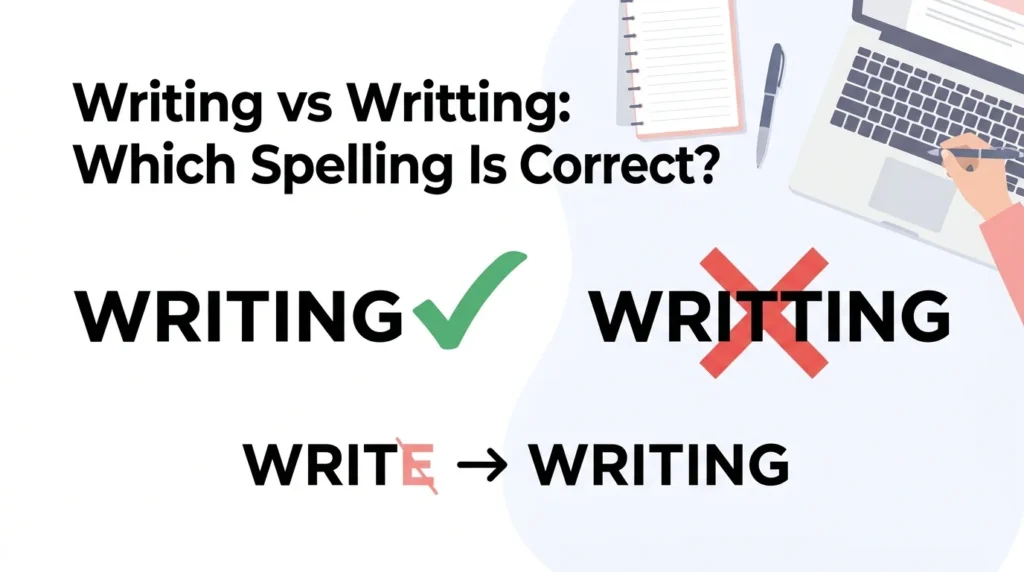

Writing is the correct spelling. Writting is a misspelling and should not be used in standard English. The word comes from the verb write. When -ing is added to write, the final silent e is removed: write + ing → writing. The t is not doubled. So whether you are writing an email, writing an essay, or writing a message, always use writing.
What Is Writing?
Writing is the -ing form of the verb write and can also function as a noun.
As a verb form, it describes the action of producing words, letters, sentences, or other written material:
- I am writing an email.
- She is writing a report.
- They are writing notes.
As a noun, writing can refer to the activity, skill, style, or product of putting ideas into written form:
- Writing takes practice.
- His writing is clear and professional.
- Academic writing requires careful organization.
The important spelling point is simple:
write → writing
Not:
write → writting
The form writting is simply a spelling error. It is not an alternative form of writing. Standard dictionaries list writing as the present participle of write.
Why Does the Difference Matter?
At first glance, the difference between writing and writting may seem like only one extra letter. But spelling errors can affect how professional, careful, or credible your writing appears.
The mistake can appear in many situations:
- A school assignment
- A university essay
- A job application
- A business email
- A website article
- A social media post
- A résumé or CV
- A professional report
- An examination
- A text message
In casual communication, readers will usually understand what writting means. However, understanding the correct spelling matters when accuracy and professionalism count.
For example:
❌ I am writting a report for my manager.
The reader can understand the sentence, but the spelling is incorrect.
✅ I am writing a report for my manager.
The second sentence follows standard English spelling.
The Core Rule
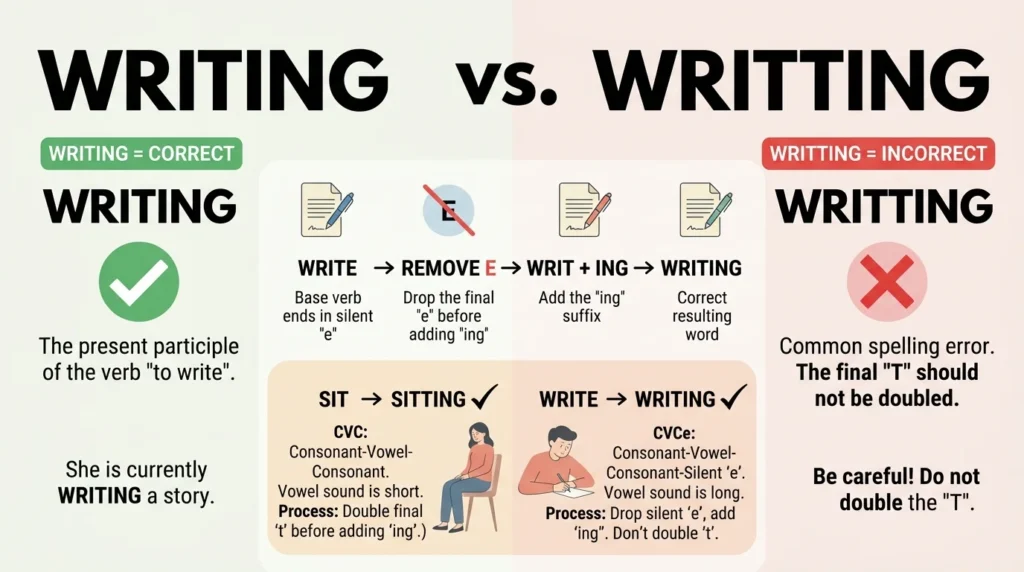
RULE: When you add -ing to write, drop the final silent e. Do not double the t.
write + -ing = writing
The process is:
WRITE → remove E → WRIT + ING → WRITING
This is an example of the silent-e rule. A silent e is a final e that is written but not pronounced in the base word. When a suffix such as -ing is added, that final e is usually removed. For example:
- make → making
- drive → driving
- hope → hoping
- smile → smiling
- use → using
- write → writing
English spelling rules are not completely mechanical, but the silent-e pattern is a useful and well-established spelling pattern.
Read More: Laid vs Layed: Which Spelling Is Correct?
How to Use Writing Correctly
The easiest way to use the word correctly is to remember its base form:
write → writing
Do not start with writting and try to correct it later. Build the word from write.
1. Use Writing for the Action Happening Now
When writing is part of the present progressive tense, it describes an action in progress.
- I am writing an email.
- She is writing a letter.
- He is writing his assignment.
- They are writing a new proposal.
2. Use Writing After Certain Verbs
Writing can also follow verbs that describe activities or preferences.
- I enjoy writing.
- She loves writing stories.
- He started writing professionally.
- They stopped writing when the meeting ended.
3. Use Writing as a Noun
The word can describe the activity or skill itself.
- Writing is an important communication skill.
- Good writing takes practice.
- Her writing has improved considerably.
4. Use Writing in Professional Contexts
Writing is completely natural in workplace English.
- I am writing the monthly report.
- He is writing a proposal for the client.
- We are writing new product descriptions.
- She is responsible for writing the newsletter.
5. Use Writing in Academic English
The word is equally common in education.
- Students are writing their final essays.
- Academic writing requires evidence.
- She is writing her research paper.
- The course focuses on professional writing.
Correct Examples
Here are examples from different areas of everyday English.
- Conversation:
“What are you writing in your notebook?” - Email:
“I am writing to confirm our meeting tomorrow.” - School:
“The students are writing their answers.” - University:
“She is writing her final research paper.” - Workplace:
“I am writing the report now.” - Social media:
“I’m writing a post about my experience.” - Text message:
“I’m writing this while I’m waiting for the bus.” - Academic writing:
“Clear writing makes complex ideas easier to understand.” - Creative work:
“He enjoys writing short stories.” - Professional communication:
“Thank you for writing to us about your order.” - Personal development:
“Daily writing can help you organize your thoughts.” - Business communication:
“She is writing a proposal for a potential client.”
Notice that none of these sentences needs writting.
Read More: Bailer vs Baler: Which Spelling Is Correct?
Incorrect vs. Correct
| ❌ Incorrect | ✅ Correct | Why |
|---|---|---|
| I am writting an email. | I am writing an email. | Write drops the final silent e before -ing. |
| She is writting a book. | She is writing a book. | The t is not doubled. |
| He enjoys writting stories. | He enjoys writing stories. | Writing is the correct -ing form of write. |
| They are writting notes. | They are writing notes. | The base verb is write, not writt. |
| I was writting yesterday. | I was writing yesterday. | Past progressive uses was/were + writing. |
| Stop writting and listen. | Stop writing and listen. | The spelling remains writing. |
| She loves writting poetry. | She loves writing poetry. | Writing is the correct noun/gerund form. |
| He is writting a report. | He is writing a report. | The final e is removed; the t remains single. |
| We are writting instructions. | We are writing instructions. | Write + ing produces writing. |
| I spend time writting every day. | I spend time writing every day. | Writing is the standard spelling. |
Why Do People Make This Mistake?
The main reason is that English has more than one spelling pattern for forming -ing words.
Consider:
- run → running
- sit → sitting
- swim → swimming
- stop → stopping
In these words, the final consonant is doubled.
A learner may therefore assume:
write → writting
But write follows a different pattern.
It ends in a silent e, so the e is removed:
write → writing
The short-vowel pattern causes confusion
Consonant doubling is associated with certain short-vowel patterns, particularly in words such as sit → sitting and run → running. Spelling resources describe consonant doubling and silent-e deletion as separate patterns.
Compare:
- sit → sitting
- run → running
- stop → stopping
with:
- write → writing
- make → making
- drive → driving
- hope → hoping
The patterns are different.
Visual similarity can also cause the error
Words such as written, writter, and writing can become confused because they all relate to the same word family.
The forms of write include:
| Form | Example |
|---|---|
| write | I write every day. |
| writes | She writes every day. |
| wrote | He wrote yesterday. |
| written | She has written three pages. |
| writing | They are writing now. |
The spelling of written contains two t’s, but that does not mean writing does.
Common Mistakes Checklist
Mistake 1: Doubling the T
❌ writting
✅ writing
Why it happens: Learners remember words such as sitting and running and apply the doubling pattern too broadly.
How to avoid it: Start with the base word write and remove the final e.
Mistake 2: Keeping the E
❌ writeing
✅ writing
Why it happens: The learner correctly identifies write but simply attaches -ing without changing the base word.
How to avoid it: Remember:
write − e + ing = writing
Mistake 3: Confusing Writing With Written
❌ “I am written an email.”
✅ “I am writing an email.”
Why it happens: Written and writing are both forms of write, but they perform different grammatical jobs.
Mistake 4: Assuming Every Verb Doubles Its Final Consonant
English does not double the final consonant in every verb before -ing.
Compare:
- run → running
- sit → sitting
- write → writing
- read → reading
- speak → speaking
The spelling pattern depends on the structure of the base word.
Mistake 5: Trusting Spellcheck Without Learning the Rule
Spellcheck can catch writting, but relying entirely on software does not explain why the spelling is wrong.
Understanding the pattern helps you spell related words correctly without waiting for software to correct you.
Writing in Real English
Grammatically correct and natural
Writing is completely normal in everyday English. It can describe the activity of putting words into written form, the action currently taking place, or the general skill of composing text. For example, “I am writing an email” and “I enjoy writing” are both natural constructions. The word works comfortably in conversation, education, business, digital communication, and formal writing.
Grammatically possible but not the best choice
Some sentences can technically contain writing but may need a different structure depending on the intended meaning. For example, “I am writing every day” is grammatical, but if the speaker is describing a regular habit rather than an action happening around now, “I write every day” may communicate the intended meaning more directly. The issue here is tense and meaning, not the spelling of writing.
Natural everyday English
Native and proficient English speakers routinely use writing in phrases such as “writing an email,” “writing a report,” “writing a book,” “writing notes,” and “writing about something.” There is no special American or British spelling of writing. The same spelling is used in standard English varieties. The important distinction is simply writing, not writting.
American vs. British English
There is no meaningful American-vs.-British spelling difference between writing and writting.
Both American English and British English use:
writing
The incorrect form remains:
writting
So you do not need to remember two regional spellings.
Whether you are writing for an American audience, a British audience, or an international audience, use writing.
Formal vs. Informal Usage
There is also no special formal or informal spelling.
Writing is appropriate in:
- Text messages
- Social media
- Emails
- School assignments
- University papers
- Business reports
- Professional documents
- Books
- Articles
- Official correspondence
The difference between formal and informal English comes from vocabulary, sentence structure, tone, and context—not from changing writing to another spelling.
Writing vs. Writting: Comparison Table
| Feature | Writing | Writting |
|---|---|---|
| Correct spelling | ✅ Yes | ❌ No |
| Base word | write | Incorrectly formed |
| Formation | write − e + ing | Incorrect doubling |
| Uses one t after the i | Yes | No |
| Can be used in formal English | Yes | No |
| Can be used in informal English | Yes | No |
| Standard dictionary form | Yes | No |
| Example | She is writing. | She is writting. |
| Meaning | Producing written words/text | No standard meaning |
| Should you use it? | Yes | No |
Writing vs. Written
One related confusion deserves special attention.
Writing and written are both forms of write, but they are not interchangeable.
Writing
Writing is the present participle and can also function as a gerund or noun.
- She is writing a letter.
- I enjoy writing.
- He is writing a report.
Written
Written is the past participle.
- She has written a letter.
- The report was written yesterday.
- He had written the instructions before the meeting.
A useful comparison is:
I am writing the report.
I have written the report.
The first emphasizes the activity in progress. The second describes a completed action in a perfect construction.
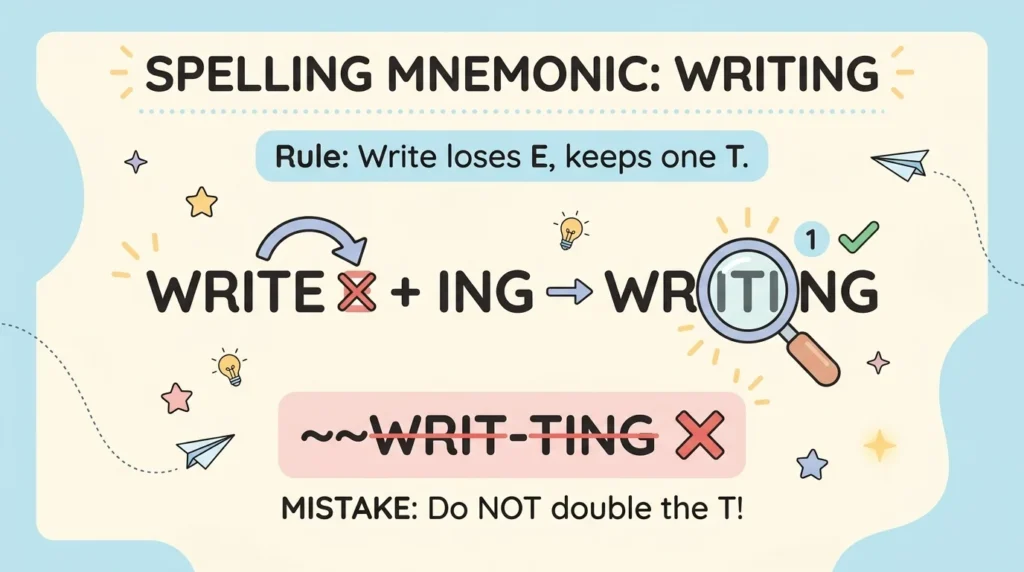
Memory Trick
Use this simple mnemonic:
“Write loses E before -ing, but keeps one T.”
Think of it visually:
WRITE → WRIT + ING → WRITING
Or remember:
One T, no E: WRITING.
If you see WRIT-TING, stop and return to the base word:
WRITE.
Then remove the E and add -ING.
Real-Life Situations
In an interview
Interviewer: “What are you working on?”
Candidate: “I’m writing a proposal for a new client.”
The correct form is writing.
In a workplace meeting
Manager: “Who is writing the meeting notes?”
This is a normal use of the present progressive.
In an email
“I am writing to follow up on our previous conversation.”
This is a standard professional expression.
In a text message
“I’m writing the message now. Give me a minute.”
Informal communication still uses the same spelling.
In an exam
“Students are writing their answers.”
Again, the correct form is writing.
In an academic paper
“Clear academic writing requires careful organization.”
Here, writing is a noun describing a skill or type of communication.
Mini Quiz
| # | Question | Answer | Explanation |
|---|---|---|---|
| 1 | Which is correct? A) writing B) writting | A) writing | Write drops its final silent e before -ing. |
| 2 | Complete: “I am ___ an email.” | writing | The correct -ing form of write is writing. |
| 3 | Correct the sentence: “She is writting a report.” | She is writing a report. | The t is not doubled. |
| 4 | Which is correct? A) writeing B) writing | B) writing | The silent e is removed before -ing. |
| 5 | Complete: “He enjoys ___ stories.” | writing | Writing functions as a gerund after enjoys. |
| 6 | True or false: “Writting” is an alternative British spelling. | False | British English also uses writing. |
| 7 | Correct the sentence: “They are writting their answers.” | They are writing their answers. | Write + ing becomes writing. |
| 8 | Which is correct? A) I have writing the report. B) I have written the report. | B) I have written the report. | Written is the past participle required after have. |
| 9 | Complete: “Good ___ takes practice.” | writing | Here writing is used as a noun. |
| 10 | Which spelling should you use in a business email? A) writing B) writting | A) writing | Writing is the standard spelling in all normal registers. |
Expert Tips
1. Learn the base word first
When you are unsure about an -ing form, identify the base verb.
For this word:
write → writing
This is more reliable than trying to memorize writing as an isolated spelling.
2. Do not apply consonant doubling automatically
The fact that running and sitting double their final consonants does not mean every verb does.
Compare:
sit → sitting
write → writing
Different spelling patterns are involved.
Read More: Ingage vs Engage: Which Spelling Is Correct?
3. Watch the final silent e
Words such as make, drive, hope, and write end in a silent e.
Before -ing, that e is normally removed:
- make → making
- drive → driving
- hope → hoping
- write → writing
This pattern is widely taught as the silent-e rule.
4. Do not let pronunciation dictate the spelling
English spelling is not always a direct representation of pronunciation.
The pronunciation of writing does not tell you whether the middle should contain one t or two. The spelling pattern does.
5. Remember the word family
Learning related forms together can make spelling easier:
- write
- writes
- wrote
- written
- writing
- writer
This helps prevent writing from being confused with written.
FAQ
Is “writting” a correct English word?
No. Writting is a misspelling of writing. Standard English uses writing for the -ing form of write.
Why is writing spelled with one t?
Because write ends in a silent e. Before adding -ing, the e is removed, producing writing. There is no rule requiring the t to be doubled.
Is it writeing or writing?
Writing is correct. The final silent e in write is removed before -ing is added.
Is writting ever acceptable in informal English?
No. Informal writing may contain deliberate abbreviations, slang, or unconventional spellings, but writting is still a misspelling when the intended word is writing.
Do Americans spell it “writing”?
Yes. Writing is the standard spelling in American English.
Do British people spell it “writing”?
Yes. British English also uses writing.
Why does “written” have two t’s but “writing” has one?
They are different forms of the verb write and are formed differently. Written contains two t’s, while writing is formed by removing the silent e and adding -ing.
Is “writing” a verb or a noun?
It can be both, depending on the sentence. In “She is writing,” it is part of a verb phrase. In “Writing is difficult,” it functions as a noun.
What is the easiest way to remember writing?
Remember:
WRITE − E + ING = WRITING
The final e disappears, but the t stays single.
Why do people write “writting”?
A common reason is overgeneralization. Learners see forms such as sitting and running, where a consonant is doubled, and apply that pattern incorrectly to write. The correct pattern for write is silent-e deletion.
Is “writing” the same as “written”?
No. Writing is the -ing form, while written is the past participle. For example: “She is writing” versus “She has written.”
Quick Summary
Writing is the only correct spelling when you mean the -ing form of write. Writting is a misspelling. The reason is simple: write ends in a silent e, and that e is normally removed before -ing is added. Therefore, write + ing = writing. The t is not doubled. This is different from words such as sit → sitting and run → running, which follow a consonant-doubling pattern. Writing can describe an action, such as “I am writing,” or function as a noun, as in “Writing takes practice.” The spelling is the same in American and British English and is suitable for both formal and informal contexts.