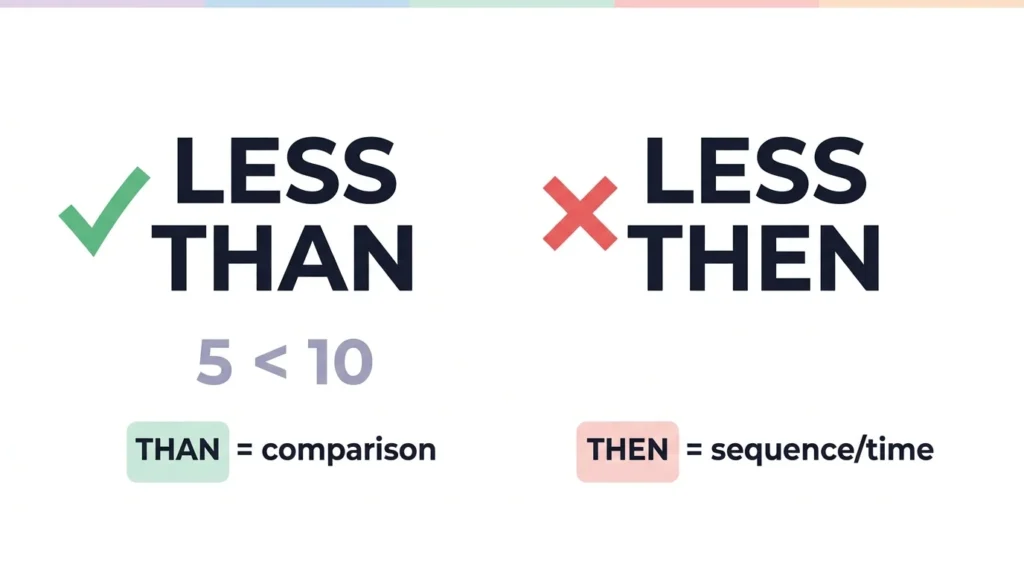

If you are comparing amounts, numbers, values, or degrees, the correct phrase is less than; not less then.
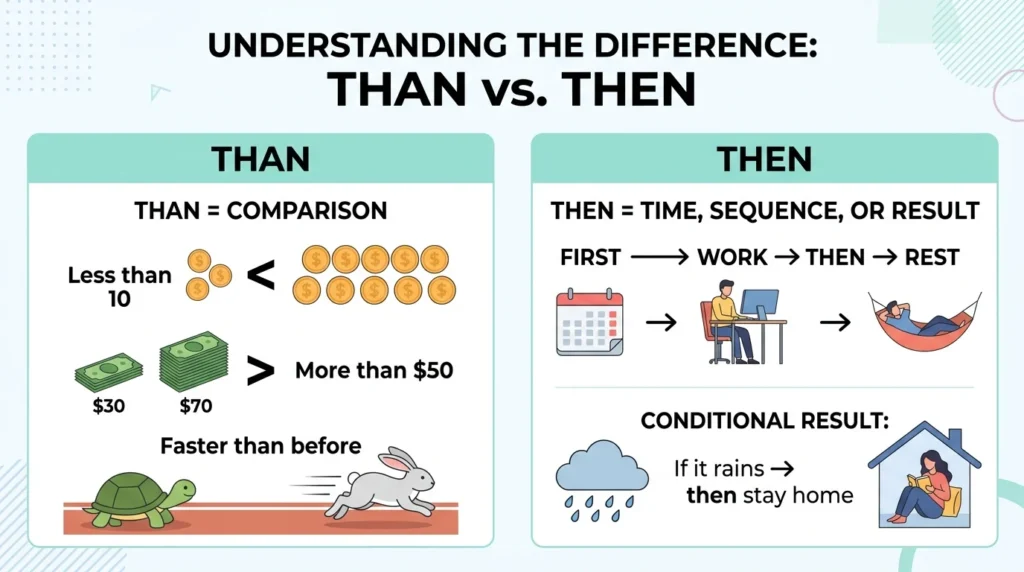
Than is used for comparisons: “less than 10,” “less than expected,” and “less expensive than before.” Then is mainly used for time, sequence, or result: “first this, then that” or “if it rains, then we will stay home.” The two words look and sound similar, but they have different grammatical jobs.
What Is “Less Than”?
Less than is a comparative expression used to show that one amount, number, degree, or value is smaller than another.
For example:
- 5 is less than 10.
- The jacket costs less than $50.
- The meeting lasted less than an hour.
- She is less experienced than her manager.
- The result was less impressive than expected.
The important word is than because the sentence compares one thing with another.
Cambridge defines less as referring to a smaller amount or a smaller degree and gives examples such as “less than I eat” and “less difficult than.”
The expression can also have a slightly different meaning in phrases such as less than honest or less than ideal. In these cases, it means that something does not fully have the quality being described.
What Does “Less Then” Mean?
Less then is not the standard form when you mean “a smaller amount or degree than something else.”
The mistake happens because than and then look almost identical and can sound similar in ordinary speech.
Compare:
- ❌ The project took less then two weeks.
- ✅ The project took less than two weeks.
Here, the writer is comparing the project duration with two weeks, so than is required.
Then has a different job. It commonly refers to a time, sequence, or consequence:
We finished the meeting, then we went to lunch.
So, when the meaning is comparison, choose than.
Why It Matters
A single letter can change the grammatical function of a word.
Using less then instead of less than can make otherwise clear writing look careless. This matters particularly in:
- school assignments
- university essays
- business emails
- reports
- résumés and cover letters
- professional websites
- social media posts
- formal documents
- technical writing
The error usually does not make the sentence impossible to understand. Most readers will understand what you meant. But spelling and grammar mistakes involving common words can distract readers from your actual message.
In professional writing, that distraction is easy to avoid: remember that comparisons take than.
The Core Rule
Use LESS THAN for comparisons. Use THEN for time, sequence, or consequence.
A simple test is to ask what the sentence is doing.
- Comparing something? → THAN
- Talking about what happens next or when something happened? → THEN
For example:
- This phone is cheaper than that one. → comparison
- We bought the phone, then we went home. → sequence
- The package weighs less than five kilograms. → comparison
- Finish your work, then send it to me. → sequence
Merriam-Webster specifically identifies than as the word used in comparisons and then as a word associated with time and sequence.
Read More: Partys vs Parties: Which Is Correct?
How to Use “Less Than”
Use “less than” with numbers
When one number is smaller than another, use less than.
- The answer is less than 20.
- The temperature dropped to less than 5°C.
- We received less than 100 applications.
- The package weighs less than 2 kg.
The mathematical symbol for “less than” is <.
So:
7 < 12
can be read as:
Seven is less than twelve.
Use “less than” with amounts
The expression is also used with money, time, distance, weight, and other measurable quantities.
- The repair cost less than $200.
- The journey takes less than three hours.
- The store is less than a mile away.
- The box weighs less than ten kilograms.
Using less than with periods of time and sums of money is standard because the measurement can be treated as one overall quantity.
Use “less than” with adjectives
Less than can compare degrees of a quality.
- The second option is less expensive than the first.
- This explanation is less confusing than the original.
- He is less confident than he appeared.
- The new design is less practical than the old one.
Here, the comparison is not about a physical quantity. It is about the degree of a characteristic.
Use “less than” with expectations
You can also use less than to compare a real result with what was expected.
- The response was less positive than we hoped.
- Sales were less strong than expected.
- The exam was less difficult than I thought.
- The meeting was less productive than usual.
Use “less than” in expressions such as “less than ideal”
This construction does not always mean a simple mathematical comparison.
For example:
The working conditions were less than ideal.
This means the conditions were not ideal or fell short of being ideal.
Similarly:
- The service was less than satisfactory.
- His explanation was less than convincing.
- The result was less than perfect.
This use is well established in English.
Correct Examples
Here are original examples showing how less than works in different real-life situations.
Conversation
“I’ll be there in less than ten minutes.”
The speaker is comparing the expected arrival time with ten minutes.
“We need less than two days to complete the first stage.”
The phrase compares the required time with two days.
Workplace
“Our new process uses less than half the paper we used before.”
The writer is comparing the amount of paper used.
School
“The final answer should be less than 50 words.”
The word count is being compared with a limit.
Academic writing
“The second group showed less improvement than the first group.”
The sentence compares the degree of improvement.
Social media
“You can make this recipe in less than 30 minutes.”
The preparation time is compared with 30 minutes.
Shopping
“This model costs less than the previous version.”
The prices are being compared.
Technology
“The application uses less than 100 MB of storage.”
The amount of storage is being compared with 100 MB.
Travel
“The airport is less than 20 kilometers from the city center.”
The distance is being compared with 20 kilometers.
Professional report
“The revised system produced less than 5% error.”
The measured error rate is compared with 5%.
Incorrect vs. Correct
| ❌ Incorrect | ✅ Correct | Why |
|---|---|---|
| The box weighs less then 10 kg. | The box weighs less than 10 kg. | The sentence compares the weight with 10 kg. |
| She arrived in less then an hour. | She arrived in less than an hour. | The time is being compared with one hour. |
| This costs less then $50. | This costs less than $50. | The price is being compared with $50. |
| The test took less then 30 minutes. | The test took less than 30 minutes. | The duration is being compared with 30 minutes. |
| He is less experienced then his colleague. | He is less experienced than his colleague. | The sentence compares two levels of experience. |
| We received less then 100 applications. | We received less than 100 applications. | The number of applications is being compared with 100. |
| The room is less then five meters wide. | The room is less than five meters wide. | The width is being compared with five meters. |
| The result was less impressive then expected. | The result was less impressive than expected. | The degree of impressiveness is being compared with an expectation. |
| This option is less expensive then the other one. | This option is less expensive than the other one. | Two prices are being compared. |
| The project required less then we planned. | The project required less than we planned. | The actual requirement is compared with the planned amount. |
Notice that then is not simply an “incorrect spelling” of than. It is a real English word. The problem is using the wrong word for the grammatical job.
Read More: Chriss vs Chris: Which Spelling Is Correct?
Why People Make This Mistake
Phonetic similarity
One major reason is pronunciation.
In many ordinary contexts, than and then are pronounced very similarly, and in rapid speech the distinction can be difficult to hear. Merriam-Webster notes that the words are frequently confused and are distinguished in spelling by only one letter.
That means a writer may know the correct expression but still type the wrong spelling.
Spelling overlap
The words differ by only one letter:
than
then
That tiny spelling difference makes them classic confusable words.
Overgeneralization
Some learners remember that then is a common word used throughout English but do not remember its specific function.
They may therefore choose the more familiar-looking word when writing quickly.
Autocomplete and spellcheck
Spellcheckers are useful, but they cannot always understand what you mean.
Both than and then are legitimate English words. A spelling checker may therefore fail to identify the problem if you type:
The price is less then $50.
The problem is not that then is misspelled. The problem is that the correct word in that context is than.
Translation interference
Learners whose first language uses one equivalent word or construction for comparison and sequence may find this distinction especially difficult.
The safest approach is not to translate word-for-word. Learn the English functions:
comparison → than
time/sequence/result → then
Common Mistakes Checklist
Mistake 1: Writing “less then” in comparisons
Problem: The writer uses then after less.
Why it happens: The two words look and sound similar.
Fix: Remember that comparative expressions use than.
Mistake 2: Choosing based on pronunciation
Problem: The writer hears the word and guesses the spelling.
Why it happens: The distinction may be weak in fast speech.
Fix: Decide based on meaning rather than sound.
Mistake 3: Trusting spellcheck completely
Problem: The software does not flag the sentence.
Why it happens: Then is correctly spelled even though it is wrong for the context.
Fix: Perform a meaning check.
Mistake 4: Thinking “then” means “than”
Problem: The two words are treated as interchangeable.
Why it happens: Both are extremely common function words.
Fix: Associate than with comparison and then with sequence/time.
Mistake 5: Correcting every “then”
Not every sentence containing then is wrong.
We finished the meeting, then we called the client.
Here, then is correct because it indicates what happened next.
“Less Than” in Real English
Grammatically correct and natural
Less than is completely natural when a writer compares an amount, number, degree, value, time, distance, or similar quantity with another point of reference. Sentences such as “It costs less than $20” and “She arrived in less than an hour” are ordinary English. There is no need to replace less than with another construction simply to sound more sophisticated.
Grammatically possible but potentially different in meaning
Less than can also appear in expressions such as “less than ideal” or “less than helpful.” Here, the phrase can mean that something falls short of the quality named. For example, “His explanation was less than clear” suggests that the explanation was not fully clear. This is different from a straightforward numerical comparison, but the word than remains correct.
Natural everyday English
In everyday speech and writing, less than is the normal choice for comparisons. Native English speakers do not normally substitute less then in this construction. If you are comparing two amounts or degrees, less than is the reliable form to use.
Where “then” naturally belongs
Then is natural when the sentence describes sequence or time:
First, check the settings. Then, restart the device.
It can also indicate a consequence:
If the file is missing, then contact support.
Merriam-Webster lists uses of then involving time, sequence, consequence, and “in that case.”
American vs. British English
There is no meaningful American-versus-British spelling difference between less than and less then.
Both major varieties of English use:
less than for comparisons.
For example:
- American English: “It costs less than $100.”
- British English: “It costs less than £100.”
The currency may change, but the comparative word remains than.
Formal vs. Informal Usage
There is no special formal version and informal version of less than.
The phrase is appropriate in both everyday and formal English:
- “It takes less than five minutes.” — everyday
- “The treatment lasted less than five minutes.” — professional
- “The sample contained less than 2% moisture.” — technical
- “The study involved less than 100 participants.” — academic
The important issue is choosing than, not changing the phrase according to formality.
Comparison Table
| Feature | Less than | Less then |
|---|---|---|
| Standard phrase for comparison? | ✅ Yes | ❌ No |
| Shows a smaller amount? | ✅ Yes | ❌ No |
| Used with numbers? | ✅ Yes | ❌ No |
| Used with prices? | ✅ Yes | ❌ No |
| Used with time measurements? | ✅ Yes | ❌ No |
| Used with comparative adjectives? | ✅ Yes | ❌ No |
| Refers to sequence? | ❌ No | ✅ Then can |
| Refers to time? | ❌ No | ✅ Then can |
| Refers to a consequence? | ❌ No | ✅ Then can |
| Correct after “less” in a comparison? | ✅ Yes | ❌ No |
Less Than vs. Then: The Bigger Difference
The easiest way to understand the pair is to stop treating them as spelling variants.
Than is primarily connected with comparison.
Then is primarily connected with time, sequence, or consequence.
Compare these sentences:
The new phone costs less than the old one.
This compares two prices.
I bought the new phone, then I transferred my data.
This describes two actions in sequence.
The spelling is similar, but the grammatical relationship is completely different.
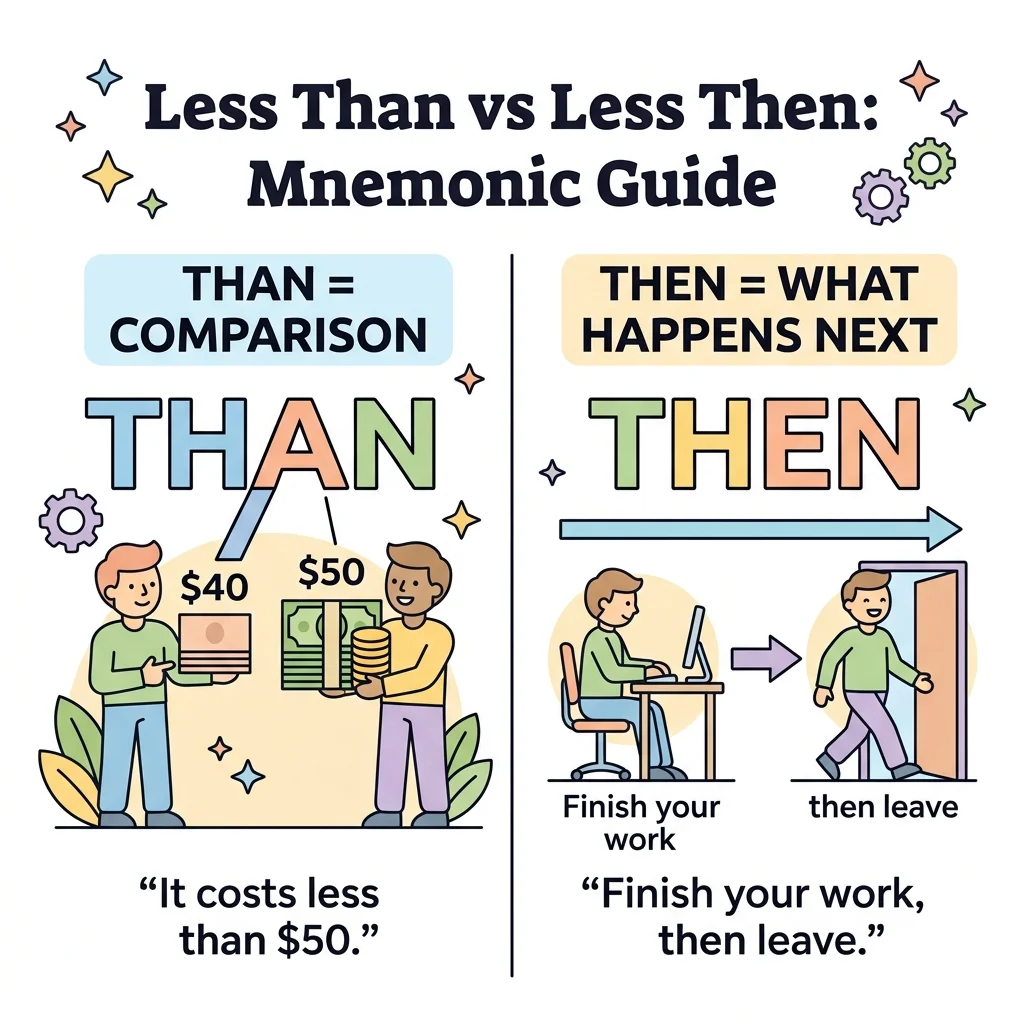
Memory Trick
Use this simple mnemonic:
THAN = comparison. THEN = what happens next.
Or remember:
ThAN → compArison
The A in than can remind you of comparison.
For then, think:
THEN = time comes next.
If you see words such as less, more, better, worse, smaller, larger, faster, cheaper, older, or easier, check whether you are making a comparison. If you are, than is usually the word you need.
Real-Life Situations
In an interview
Correct:
“I can complete the task in less than two hours.”
You are comparing the expected time with two hours.
In a business meeting
Correct:
“The new system costs less than the previous one.”
You are comparing two costs.
In an email
Correct:
“We expect the repair to take less than a day.”
You are comparing the repair time with one day.
In a text message
Correct:
“I’ll be there in less than 15 minutes.”
The arrival time is being compared with 15 minutes.
In an exam
Correct:
“Write an answer of less than 100 words.”
The required word count is being compared with 100 words.
In a presentation
Correct:
“The second option requires less investment than the first.”
The amount of investment is being compared.
In a sequence
Correct:
“Finish the form, then submit it.”
Here, then is correct because it tells the reader what happens next.
In a conditional sentence
Correct:
“If the payment fails, then try again.”
Here, then introduces the consequence of the condition.
Expert Tips
Tip 1: Look for the comparison
If the sentence answers a question such as:
“Less than what?”
you probably need than.
The project costs less than what?
→ The project costs less than $1,000.
Tip 2: Look for sequence
If the sentence answers:
“What happens next?”
you probably need then.
We finished the report, then what happened?
→ We sent it to the manager.
Tip 3: Watch for “less”
When than follows less, the combination is extremely common:
- less than
- less than expected
- less than usual
- less than half
- less than ever
- less than perfect
- less than ideal
Tip 4: Do not rely only on spellcheck
Both than and then are correctly spelled words.
Your software may not know that you chose the wrong one.
Read More: Infront vs In Front: Which Is Correct?
Tip 5: Read the sentence by meaning
Instead of asking:
“Which spelling looks right?”
ask:
“Am I comparing something, or am I describing what happens next?”
That question is much more reliable.
FAQ
Is “less than” always correct?
Less than is correct when you are making a comparison or indicating a smaller amount, number, degree, value, distance, or similar measurement. For example, “The bag weighs less than five kilograms.”
Is “less then” ever correct?
Not as the standard fixed phrase meaning “a smaller amount than.” If you write “less then” in that context, you should normally change then to than.
Why do people confuse than and then?
The words look very similar and are often pronounced similarly, especially in rapid speech. Their meanings and grammatical functions are different, however.
Should I write “less than” or “less then” in an essay?
Write less than when you are making a comparison. This applies to academic writing, professional writing, and everyday English.
What is the difference between than and then?
Than is used mainly for comparisons, while then commonly refers to time, sequence, or consequence.
Is “less than” used with time?
Yes. Expressions such as “less than an hour,” “less than three days,” and “less than a minute” are standard English.
Is “less than” used with money?
Yes. For example, “The service costs less than $50.” Less than can compare a price or monetary amount with another amount.
Can “less than” mean “not completely”?
Yes. In expressions such as less than ideal, it can mean that something falls short of the stated quality.
Does British English use “less then”?
No. British English uses less than for the same comparative meaning as American English.
Does “then” ever appear near “less”?
Yes, but that does not make less then a comparative phrase. For example, two separate ideas can occur next to each other: “I need less; then we can order.” Here, then belongs to the second part of the sentence and indicates sequence.
What is the easiest way to remember the difference?
Remember:
Than = comparison.
Then = time, sequence, or result.
Mini Quiz
| # | Question | Answer | Explanation |
|---|---|---|---|
| 1 | The package weighs less ___ 5 kg. | than | The sentence compares the weight with 5 kg. |
| 2 | We finished dinner and ___ went home. | then | Then shows the next action. |
| 3 | Choose the correct sentence: A) It costs less then $50. B) It costs less than $50. | B | The price is being compared with $50. |
| 4 | She arrived in less ___ an hour. | than | The arrival time is compared with one hour. |
| 5 | First save the document, ___ close the program. | then | Then indicates sequence. |
| 6 | Correct the sentence: “This option is cheaper then the other.” | This option is cheaper than the other. | Cheaper introduces a comparison, so use than. |
| 7 | The report contains less ___ 2,000 words. | than | The word count is compared with 2,000. |
| 8 | If you finish early, ___ you can leave. | then | Then introduces the result of the condition. |
| 9 | Correct the sentence: “The meeting lasted less then two hours.” | The meeting lasted less than two hours. | The duration is compared with two hours. |
| 10 | Which word belongs in a comparison: than or then? | than | Than is the standard comparative word. |
Quick Summary
Less than is the correct phrase when you are comparing an amount, number, degree, value, distance, time, price, or other measurable quantity. Less then is not the standard comparative expression. The key distinction is between than, which is used for comparison, and then, which commonly refers to time, sequence, or consequence. Write “less than $50,” “less than an hour,” and “less experienced than her colleague.” Use “then” in sentences such as “We finished the work, then we left.” A useful memory trick is simple: than = comparison; then = what happens next.