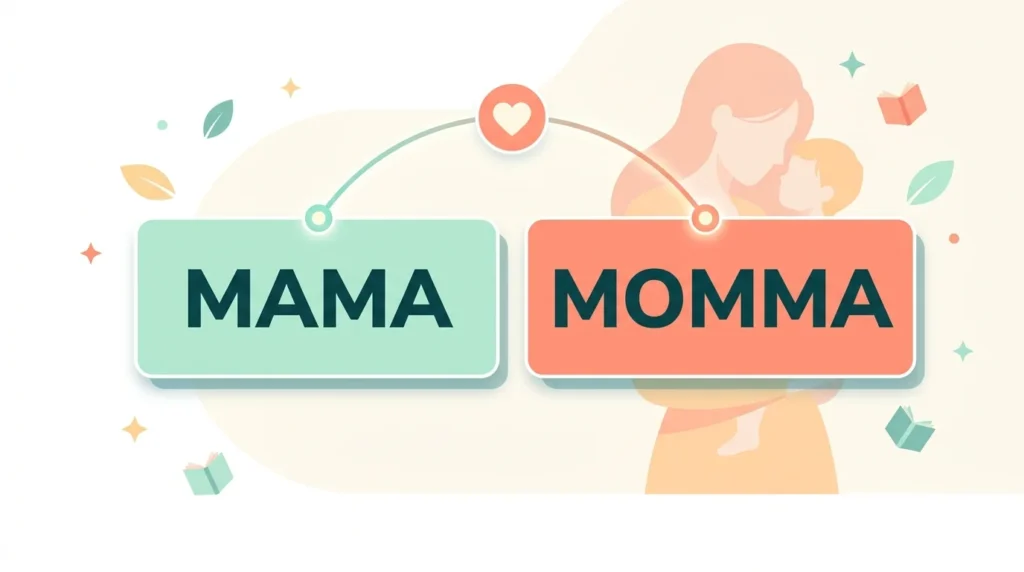

Mama and momma both mean “mother,” and neither spelling is inherently wrong. Mama is the more widely recognized and versatile form, while momma is especially associated with informal American English. If you are writing for a broad audience and have no particular reason to use the other form, mama is usually the safer choice. Neither word belongs in formal professional writing when mother is the appropriate formal term.
What Is the Difference Between Mama and Momma?
The difference is mainly spelling, usage, and register, not meaning.
Both mama and momma are nouns referring informally or affectionately to a mother. Major dictionaries recognize the relationship between the two forms. Merriam-Webster lists momma as a less common variant of mama, while Cambridge defines momma as an informal US word for mother and lists mama among its related terms.
So this is not a case where one word is grammatically correct and the other is a spelling mistake.
The more useful question is:
Which spelling sounds and looks natural for the person, region, audience, and situation?
For example:
- My mama taught me how to cook.
- My momma taught me how to cook.
Both sentences can be correct.
The spelling simply gives the sentence a slightly different stylistic or regional feel.
Why It Matters
At first glance, the difference between mama and momma may seem too small to matter. In everyday conversation, it often does not matter at all.
Writing is different.
A spelling choice can affect the voice of a sentence. Consider the difference between these:
My mama always told me to be kind.
and:
My momma always told me to be kind.
Both are understandable and grammatically acceptable. However, the writer may choose momma deliberately to preserve a family voice, regional flavor, or conversational tone.
This becomes particularly important in:
- Fictional dialogue
- Personal stories
- Memoirs
- Social media posts
- Songs and creative writing
- Children’s writing
- Family messages
- Cultural or regional writing
On the other hand, if you are writing a formal report, business email, academic paper, or professional document, mother is normally the better choice.
The important distinction is therefore not simply correct vs. incorrect.
It is correct vs. appropriate for the context.
The Core Rule
Rule: Both mama and momma are correct informal words for “mother.” Use mama as the more broadly versatile form; use momma when it fits the speaker’s family preference, regional voice, or informal style.
Neither spelling should automatically be treated as a mistake.
However, both are informal. If the situation calls for formal English, mother is usually the better choice.
Read More: Taught vs Tought: Which Spelling Is Correct?
How to Use Mama
Mama is an informal word for mother and can be used when talking about or addressing one’s mother.
It is especially common in family speech and can also appear in stories, children’s writing, songs, personal writing, and cultural expressions.
When “mama” works naturally
1. Talking about your mother
My mama lives in Texas.
2. Addressing your mother
Mama, can you help me with this?
3. Talking about childhood
When I was little, I always wanted to stay close to my mama.
4. Personal or emotional writing
I still remember my mama’s voice.
5. Creative writing
“Come inside, child,” Mama called from the porch.
The final example also introduces an important capitalization issue, which we will cover below.
How to Use Momma
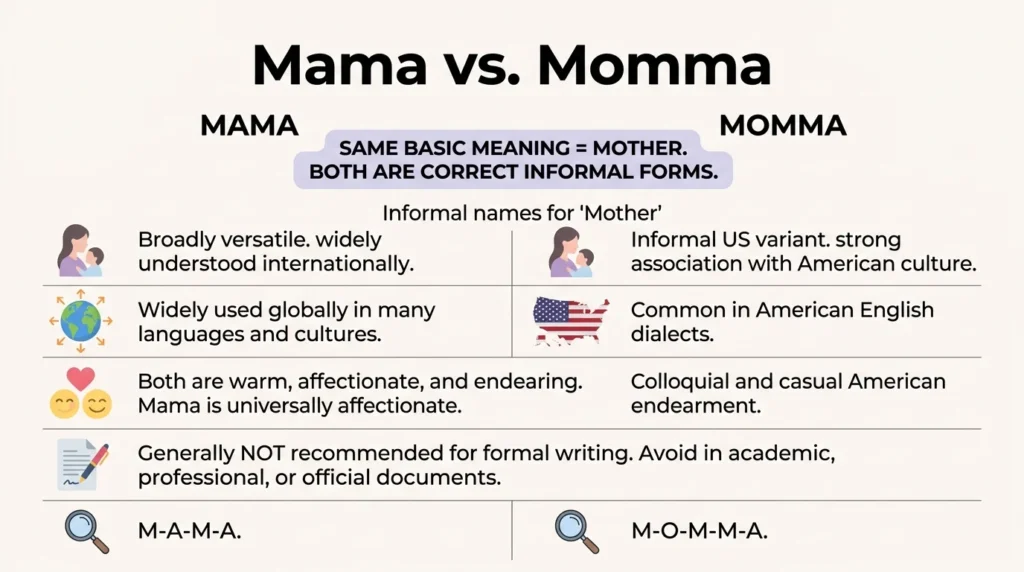
Momma has the same basic meaning as mama, but it is particularly associated with informal American English.
Cambridge labels momma as a US informal term for mother, while Merriam-Webster lists it as a less common variant of mama.
It can work especially well when the writer wants to preserve a conversational or personal voice.
Examples
My momma always believed in me.
I called my momma after the interview.
Momma said dinner was ready.
That was something my momma used to say.
I miss my momma every day.
The spelling can therefore be intentional rather than accidental.
Correct Examples
Here are examples showing how both forms work in different situations.
| Situation | Correct Example |
|---|---|
| Conversation | “My mama is waiting for me.” |
| Family message | “Love you, Momma!” |
| Childhood story | “I ran to Mama when I heard the noise.” |
| Personal writing | “My mama taught me to work hard.” |
| Fictional dialogue | “Momma, look what I found!” |
| Social media | “Happy birthday to my mama!” |
| Memoir | “My momma never gave up on us.” |
| Children’s story | “Mama Bear called her cubs home.” |
| Informal email | “I talked to my mama yesterday.” |
| Creative writing | “Mama stood quietly by the window.” |
| Song or poetic writing | “I still hear my mama’s voice.” |
| Family history | “My momma grew up on a small farm.” |
The key point is that the sentence does not become grammatically wrong merely because you replace mama with momma.
Read More: Shinning vs Shining: Which Is Correct?
Incorrect vs. Correct
The biggest mistakes with these words are usually not about choosing the “wrong” spelling. They are about treating an informal word as though it were a formal synonym for mother, assuming momma is always wrong, or using capitalization inconsistently.
| ❌ Incorrect | ✅ Correct | Why |
|---|---|---|
| My momma is my biological mother. | My mother is my biological mother. | Mother is more appropriate for formal or precise writing. |
| Please inform my mama about the policy. | Please inform my mother about the policy. | A formal instruction normally calls for mother, not an informal family term. |
| The patient was accompanied by her momma. | The patient was accompanied by her mother. | Professional and medical contexts normally favor mother. |
| My momma and I attended the academic conference. | My mother and I attended the academic conference. | Mother fits formal and academic prose better. |
| Mama is wrong because momma has two m’s. | Mama and momma are both recognized forms. | The extra m does not automatically make momma incorrect. |
| Momma is always a spelling error. | Momma is a recognized informal variant. | Major dictionaries recognize the form. |
| My Mama lives next door. | My mama lives next door. | When used as an ordinary noun, lowercase is generally appropriate. |
| I called my mama. | I called my mama. | Here mama is a common noun, not necessarily a name. |
| “mama, come here!” | “Mama, come here!” | A directly addressed name-like form is normally capitalized at the beginning of the sentence. |
| My mother told me, “Call Mama.” | My mother told me, “Call Mama.” | Mama is being used as a name-like form of address here. |
An important correction
Some online explanations say that mama is standard while momma is incorrect.
That is too strong.
Dictionary evidence does not support treating momma as simply an error. Cambridge explicitly defines it as an informal US term for mother, and Merriam-Webster lists it as a variant of mama.
The better rule is:
Mama is usually the more versatile choice, but momma is a legitimate informal variant.
Why People Make This Mistake
The confusion is easy to understand because the two words are extremely similar.
Phonetic similarity
When spoken, mama and momma can sound the same or very similar. Cambridge gives US pronunciations for both forms that are essentially alike in ordinary speech.
That means a learner may know the word from speech long before seeing it written.
Spelling overlap
The two spellings differ by only one letter:
mama
momma
When two forms look this similar, writers naturally wonder whether one is a typo.
Overgeneralization
English learners often learn a simple rule such as:
One spelling is correct; the other must be wrong.
That rule works for some common spelling pairs, but not all.
English contains many legitimate variants that differ because of region, history, pronunciation, style, or convention.
Autocomplete and spellcheck
Digital tools can make the confusion worse.
A spellchecker may recognize one form more readily than another depending on its dictionary, language setting, or context. A word being underlined does not automatically mean it is grammatically wrong.
Likewise, autocomplete is designed to predict what you are likely to type. It is not a complete grammar authority.
Translation interference
Learners who speak another language may also expect one fixed equivalent for “mother.” But English has several informal family terms, including mama, momma, mom, mum, mommy, mummy, and ma.
The most natural choice can depend on the variety of English and the speaker’s family.
Also Read: In Line vs Inline
Common Mistakes Checklist
Mistake 1: Assuming “momma” is misspelled
What happens: A writer sees the extra m and assumes it must be a typo.
Why: Mama is more familiar to many readers.
How to avoid it: Remember that momma is a recognized informal variant, especially in US English.
Mistake 2: Thinking “mama” is formal
What happens: A writer chooses mama instead of mother in a formal document.
Why: The word is standard-looking and appears in dictionaries.
How to avoid it: Dictionary recognition does not make an informal word formal. For professional or academic writing, use mother when that is the intended meaning.
Mistake 3: Treating the two spellings as completely interchangeable in tone
What happens: A writer assumes spelling has no stylistic effect.
Why: Both words have the same basic meaning.
How to avoid it: Meaning and tone are different things. Momma can feel more conversational or regionally marked, while mama is generally more versatile.
Mistake 4: Capitalizing every use of “Mama”
What happens: A writer writes:
My Mama lives in Florida.
Why: The writer treats every family term as a proper name.
How to avoid it: When the word functions as an ordinary noun, lowercase it:
My mama lives in Florida.
When it functions like a name or direct form of address, capitalization may be appropriate:
Mama, can you help me?
Mistake 5: Using either word in highly formal prose
What happens: A writer uses momma or mama in an academic or professional document.
Why: The writer wants to avoid repeating mother.
How to avoid it: Use mother in formal contexts unless the exact informal term is part of a quotation, name, title, cultural expression, or other deliberate stylistic choice.
Read More: Carrer vs Career: Which Spelling Is Correct?
Mama vs. Momma in Real English
“Mama” in everyday English
Mama is completely natural in many families and communities. It can sound affectionate, familiar, childlike, traditional, or simply personal depending on the speaker. It is also used in expressions and names that have become widely recognizable. The important point is that mama is not limited to children; adults can use it when referring to or addressing their mothers.
“Momma” in everyday English
Momma is also natural for speakers who use that form. It often has a stronger informal or conversational flavor in American English. A writer may choose it because that is the spelling used by their family or because they want dialogue to sound personal and authentic. It should not automatically be “corrected” to mama when the spelling is intentional.
“Mama” in formal English
Mama is grammatically possible in a formal sentence, but that does not make it formal vocabulary. If you are writing a report, academic paper, business document, legal document, or professional communication, mother is normally the more appropriate word. Use mama when the informal relationship or wording is itself relevant.
“Momma” in formal English
Momma is even less suitable for ordinary formal prose because dictionaries explicitly identify it as informal. It can still appear in formal publications when it is part of dialogue, a quotation, a title, a proper name, or a deliberately reproduced voice.
American vs. British English
There is a genuine regional distinction here, but it is easy to overstate it.
Momma is specifically labeled US informal by Cambridge. Mama has broader usage, but Cambridge labels it UK old-fashioned or US informal in its main English entry.
So the practical difference is:
- In American English, both mama and momma can occur.
- Momma has a distinctly informal US label in major dictionary sources.
- In British English, mama exists but is described as old-fashioned; mum is the much more familiar everyday term for many British speakers.
- Neither mama nor momma should be assumed to be the normal everyday choice for all English speakers.
This is why calling momma simply a “Southern spelling” is too narrow. It can have regional associations, but the reliable dictionary-level distinction is that it is an informal US form.
Also Read: Quantify vs Qualify
Formal vs. Informal Usage
| Context | Best Choice | Reason |
|---|---|---|
| Academic essay | mother | Formal register |
| Business email | mother | Professional register |
| Legal document | mother | Precise, formal vocabulary |
| Medical report | mother | Professional terminology |
| Everyday family conversation | mama / momma | Both can be natural |
| Personal message | mama / momma | Depends on family preference |
| Social media caption | mama / momma | Both can fit informal writing |
| Fictional dialogue | mama / momma | Depends on character and voice |
| Children’s story | mama or momma | Depends on style |
| Formal quotation | Original wording | Preserve the speaker’s wording |
The key lesson is that informal does not mean incorrect.
It means the word belongs to a different level of language.
Comparison Table
| Feature | Mama | Momma |
|---|---|---|
| Meaning | Mother | Mother |
| Part of speech | Noun | Noun |
| Basic status | Correct | Correct |
| Register | Informal | Informal |
| Dictionary recognition | Yes | Yes |
| US usage | Common | Informal variant |
| UK usage | Old-fashioned | Not the usual British form |
| Everyday family use | Yes | Yes |
| Formal business writing | Usually avoid | Usually avoid |
| Academic writing | Usually avoid | Usually avoid |
| Fictional dialogue | Yes | Yes |
| Regional/style effect | Relatively versatile | More conversational/US-marked |
| Spelling difference | One “m” after the first “a” | Double “m” |
| Meaning difference | None in the basic sense | None in the basic sense |
Merriam-Webster specifically lists momma as a less common variant of mama, while Cambridge identifies momma as an informal US term for mother.
Read More: Halfday vs Half Day: Which Is Correct?
What About Mamma?
There is a third spelling worth knowing:
mamma
This is not the same as saying that mama and momma are the only accepted forms.
Merriam-Webster lists mamma and momma as variants of mama, and Cambridge’s entry for mama also identifies mamma as a related form.
So if you encounter:
- mama
- mamma
- momma
you should not automatically assume that two of them are spelling errors.
Their distribution, pronunciation, regional associations, and stylistic uses can differ, but all can occur as forms referring to a mother.
Capitalization: Mama or mama?
Capitalization depends on how the word is being used.
Lowercase “mama”
Use lowercase when mama functions as a normal noun:
My mama lives nearby.
I called my mama last night.
Here, mama describes the person rather than functioning as her name.
Capitalized “Mama”
Capitalization is appropriate when Mama is used as a name-like form or direct address:
Mama, can you help me?
I asked Mama about the trip.
The second example treats Mama like a family name.
However, capitalization conventions can vary with house style and personal/family preference. The important point is not to assume that mama must always be capitalized simply because it refers to someone’s mother.
The same principle can apply to Mom, Dad, Grandma, and similar family terms when they are used as names.
Memory Trick
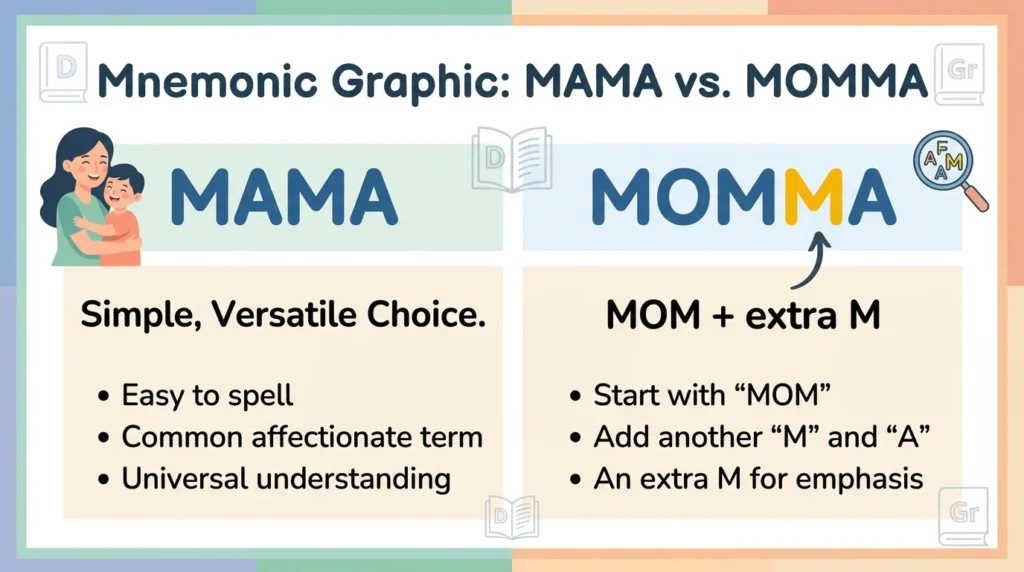
Use this simple mnemonic:
MAMA = the simple, versatile choice.
MOMMA = MOM with an extra M.
If you are unsure which one to choose in ordinary informal writing, mama is usually the safer default.
If momma reflects the speaker’s actual family language, regional voice, or intended style, keep momma.
And if the writing is formal?
Choose mother.
Real-Life Situations
1. A text message
You want to tell a friend that you spoke with your mother.
Natural:
I just talked to my mama.
Also natural for someone who uses the form:
I just talked to my momma.
2. A school essay
You are writing about your childhood.
Better:
My mother encouraged me to read every day.
You could use mama if the essay is personal and the word is part of the intended voice, but mother is the safer neutral choice.
3. Fictional dialogue
Your character grew up using “momma.”
“Momma, wait for me!”
Changing the word to mama just because it looks more standard could remove part of the character’s voice.
4. A formal report
The child’s mother attended the meeting.
This is better than:
The child’s momma attended the meeting.
The second sentence is understandable, but its informal register does not fit the professional context.
5. A social media caption
Happy Mother’s Day to my mama. ❤️
This is perfectly natural informal writing.
6. A memoir
My momma taught me that kindness costs nothing.
If momma reflects the author’s actual voice or background, the spelling can be a deliberate stylistic choice.
7. A direct address
Mama, I need to tell you something.
Here Mama functions as a name-like form of address.
8. A general reference
My mama needs a new phone.
Here mama is being used as an ordinary noun and is normally lowercase.
Expert Tips
Tip 1: Do not “correct” a legitimate variant
If someone writes momma, do not automatically change it to mama. First ask whether the spelling is intentional.
Tip 2: Think about voice, not just spelling
In creative writing, spelling can communicate character and background.
Changing momma to mama may technically preserve the meaning but alter the voice.
Tip 3: Separate correctness from register
A word can be correct but informal.
That is exactly what happens here.
Tip 4: Use “mother” when neutrality matters
If you are unsure whether an audience will consider mama or momma too casual, mother removes the problem.
Tip 5: Do not trust spellcheck blindly
A spellchecker may prefer one form, but dictionary recognition and contextual appropriateness are more important than an underline in a text editor.
Tip 6: Preserve quotations
If a person says “momma” in a quotation, do not silently change it to “mama.” The original wording may be part of the speaker’s identity or voice.
Tip 7: Remember that family vocabulary is personal
Different families use different terms: mama, momma, mom, mum, ma, mommy, mummy, and others.
There is no universal rule saying every English-speaking family must use the same word.
Also Read: Challenge vs Challange
Quick Summary
Mama and momma are both correct informal words for mother. The main difference is not meaning but usage, spelling, and register. Mama is the more broadly versatile form, while momma is recognized as an informal US variant and can carry a more conversational or personal feel. Neither should be treated as an automatic spelling error. In formal writing, however, mother is usually the better choice because both mama and momma are informal. Use mama when you want a widely recognizable option, and choose momma when it reflects a speaker’s family preference, regional usage, or deliberate writing style. The best choice is therefore determined by context rather than a simple right-versus-wrong rule.
Frequently Asked Questions
Is “mama” or “momma” correct?
Both are correct. Mama is the more widely recognized form, while momma is a recognized informal US variant. The two words have the same basic meaning: mother.
Is “momma” a misspelling of “mama”?
No. Momma is not automatically a misspelling. Major dictionaries recognize it as an informal variant or synonym of mama.
Is “mama” more correct than “momma”?
Not in the simple sense of one being correct and the other incorrect. Mama is generally the more versatile and widely recognized form, but momma is legitimate informal English.
Is “momma” only used in the Southern United States?
No. Momma can have regional associations, including Southern associations, but describing it as exclusively Southern is too restrictive. Cambridge identifies it more broadly as an informal US term for mother.
Can adults say “mama”?
Yes. Although mama can be a child’s word for mother, adults also use it to refer to or address their mothers, particularly in families where that is the normal term.
Is “mama” formal English?
No. Mama is generally informal. It may appear in formal publications for a specific reason, such as a quotation, title, name, or cultural expression, but mother is normally more appropriate in formal prose.
Is “momma” more emotional than “mama”?
It can feel more conversational or personal to some readers, but this is a stylistic tendency rather than a fixed grammatical rule. You should not assume that every English speaker hears exactly the same emotional difference.
Should “Mama” be capitalized?
Capitalize Mama when it is used as a name-like form or direct address. Use lowercase mama when it functions as an ordinary noun, such as “My mama called me.” Exact capitalization can depend on the publication’s style.
Which should I use in a formal essay?
Usually mother. Both mama and momma are informal terms, so mother is the safest neutral choice for academic and professional writing.
Which is better for a children’s story?
Either can work. Mama is a broadly recognizable choice, while momma can be appropriate when it matches the story’s character voice, setting, or family language.
Can I use “mama” and “momma” in the same article?
Yes, if there is a reason for the variation. For example, a narrator might use mama while a character consistently says momma. Randomly switching between them without a stylistic reason can make the writing look inconsistent.
What is the safest choice if I am unsure?
For informal writing, mama is usually the safest broadly recognizable choice. For formal writing, choose mother.
Mini Quiz
| # | Question | Answer | Explanation |
|---|---|---|---|
| 1 | Which spelling is correct: “mama” or “momma”? | Both | Both are recognized informal forms referring to a mother. |
| 2 | Fill in the blank: “My ___ taught me how to bake.” | mama or momma | Both work in an informal sentence. |
| 3 | Which is better in a formal report: “mother” or “momma”? | mother | “Mother” fits formal professional vocabulary better. |
| 4 | True or false: “Momma” is always a spelling mistake. | False | Dictionaries recognize “momma” as an informal US form. |
| 5 | Choose the more neutral option for a worldwide audience: “mama” or “momma.” | mama | “Mama” is generally the more broadly recognizable form. |
| 6 | Correct the sentence: “My Mama lives in London.” | My mama lives in London. | When used as an ordinary noun, “mama” is normally lowercase. |
| 7 | Correct the direct address: “mama, can you help me?” | Mama, can you help me? | A name-like form of direct address is capitalized at the beginning. |
| 8 | Which sentence is more appropriate for an academic paper? “My momma inspired my career.” / “My mother inspired my career.” | My mother inspired my career. | “Mother” is the more formal choice. |
| 9 | Fill in the blank: “___, I need your advice.” | Mama or Momma | Either can be used as a family form of direct address. |
| 10 | True or false: “Informal” means “grammatically incorrect.” | False | Informal words can be completely correct while being unsuitable for formal contexts. |
Also Read: Transferred vs Transfered