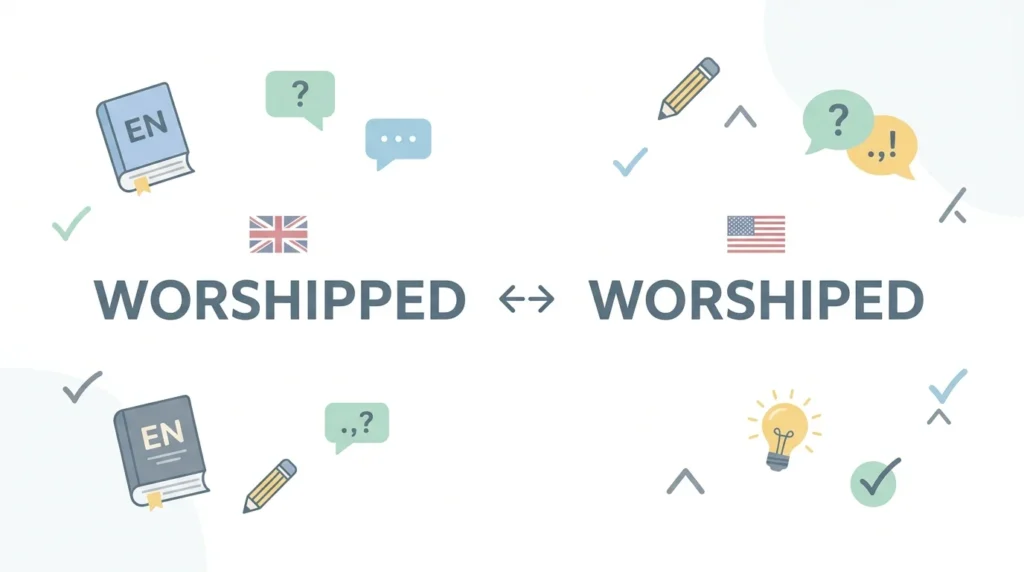

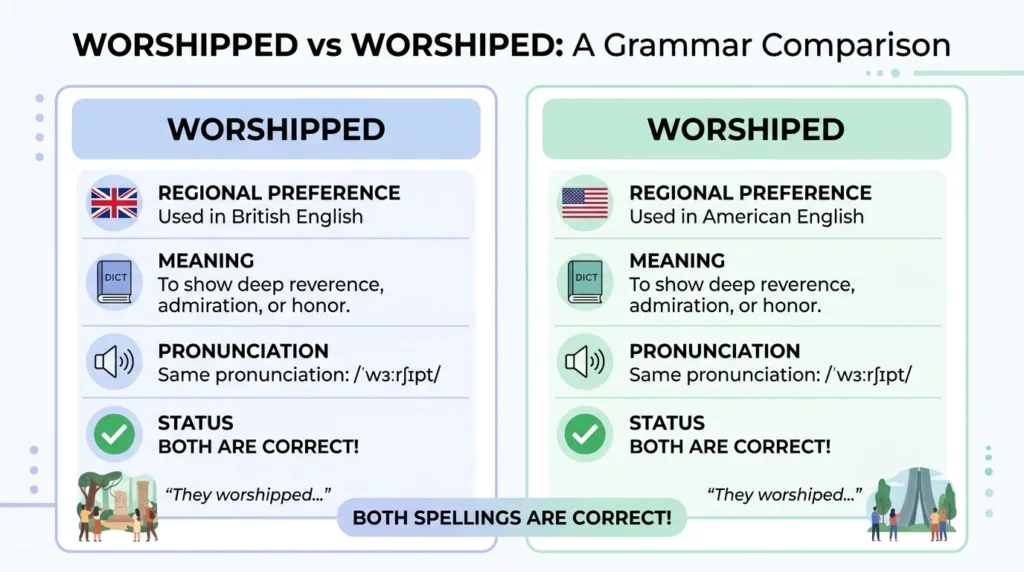
Both worshipped and worshiped are correct spellings of the past tense and past participle of worship. The main difference is regional spelling: worshipped is the standard form in British English, while worshiped is the standard form in American English. They have the same meaning and pronunciation. If you are writing for a British audience, use worshipped; for an American audience, use worshiped.
What Is Worshipped vs Worshiped?
Worshipped and worshiped are two spellings of the same verb form.
The base verb is worship. It means to show deep respect or reverence toward a god or other divine being. It can also mean to admire someone or something very strongly.
When you put the verb into the past tense, you can write:
- British English: worshipped
- American English: worshiped
For example:
British English: The people worshipped the ancient gods.
American English: The people worshiped the ancient gods.
The meaning does not change. The spelling changes according to the variety of English being used. Major dictionaries recognize both forms, with North American English favoring worshiped and British English favoring worshipped.
Why It Matters
At first glance, the extra p may look like a simple spelling mistake. It is not.
The important issue is English variety and consistency.
If you are writing an academic paper in British English, an editor may expect:
The ancient Egyptians worshipped several gods.
If you are following American English style, you would normally write:
The ancient Egyptians worshiped several gods.
Neither sentence is wrong simply because it uses a different spelling.
The real problem occurs when a writer chooses one regional spelling system but switches between forms without a reason.
For example:
The villagers worshipped at the temple, while their ancestors worshiped the same deity.
There is nothing grammatically wrong with the sentence, but if the document is intended to follow one consistent spelling convention, the variation may look careless.
Consistency matters in:
- Academic writing
- Professional reports
- Websites
- Books
- News writing
- Educational materials
- Formal correspondence
- Brand content
The goal is not to memorize which form is “right” in every situation. The goal is to know which form fits the English variety and style you are using.
The Core Rule
Rule: Use worshipped in standard British English and worshiped in standard American English. Both forms are correct and have the same meaning.
A useful comparison is:
| British English | American English |
|---|---|
| worshipped | worshiped |
| worshipping | worshiping |
| worshipper | worshiper |
The spelling difference extends beyond the past tense. British English commonly retains the doubled consonant in these forms, while American English commonly uses the single p. Oxford lists worshipped as the standard past form and identifies worshiped as the North American alternative.
Read More: Perfer vs Prefer: Which Spelling Is Correct?
How to Use It
Use Worshipped in British English
Choose worshipped when your writing follows British English conventions.
Examples:
- The ancient people worshipped the sun.
- She worshipped her grandfather.
- The community worshipped at the local church.
- The king was worshipped as a divine ruler.
British English dictionaries commonly give worshipped as the main past-tense form.
Use Worshiped in American English
Choose worshiped when your writing follows American English conventions.
Examples:
- The ancient people worshiped the sun.
- She worshiped her grandfather.
- The community worshiped at the local church.
- The king was worshiped as a divine ruler.
American English dictionaries commonly list worshiped as the past form.
Do Not Treat One as the “Wrong” Spelling
This is the most important point.
It is incorrect to teach:
❌ worshiped is wrong.
It is also incorrect to teach:
❌ worshipped is wrong.
Both are established English spellings.
The better explanation is:
worshipped = British English spelling
worshiped = American English spelling
There can be regional and editorial variation, so the distinction should not be treated as an absolute ban. Merriam-Webster, for example, lists both forms.
Correct Examples
Here are examples showing how the word works in different contexts.
Conversation
- “Did people really worshipped these gods?”
Corrected in natural conversation: “Did people really worship these gods?”
The past form is not used after did. - “They worshipped at the temple every Friday.”
In American English: “They worshiped at the temple every Friday.”
- “The report explains how ancient communities worshipped their gods.”
This is appropriate in British English. - “The report explains how ancient communities worshiped their gods.”
This is appropriate in American English.
School Writing
- “The Egyptians worshipped many different deities.”
British English spelling. - “The Egyptians worshiped many different deities.”
American English spelling.
Workplace
- “The historian explained that the community worshipped at the site for centuries.”
- “The historian explained that the community worshiped at the site for centuries.”
Social Media
- “Fans practically worshipped the singer after the concert.”
- “Fans practically worshiped the singer after the concert.”
The figurative use is also valid. Worship can describe extreme admiration, not only religious devotion.
Academic Writing
- “The study examines the way ancient societies worshipped natural forces.”
- “The study examines the way ancient societies worshiped natural forces.”
Both can be correct. Your choice depends on the spelling system used throughout the paper.
Incorrect vs. Correct
The following examples focus on genuine mistakes, not on pretending that one regional spelling is always wrong.
| ❌ Incorrect | ✅ Correct | Why |
|---|---|---|
| The people worshiped at the temple every Sunday. | The people worshiped at the temple every Sunday. | This sentence is already correct in American English. The single p is not a mistake. |
| The people worshipped at the temple every Sunday. | The people worshipped at the temple every Sunday. | This is also correct, particularly in British English. |
| Did they worshiped the same god? | Did they worship the same god? | After did, use the base form worship, not the past form. |
| They have worshipped the deity yesterday. | They worshipped the deity yesterday. | Yesterday normally requires a simple past construction, not present perfect. |
| They had worshiped the deity before the empire fell. | They had worshiped the deity before the empire fell. | The past participle follows had. The sentence is correct in American English. |
| They are worshiped the ancient god. | They are worshiping the ancient god. | After are, an ongoing action requires the present participle. |
| They worshipping the sun every morning. | They worship the sun every morning. | A simple present verb is needed for a regular habit. |
| She worshiped at the mosque every Friday in a British-English article that otherwise uses doubled forms. | She worshipped at the mosque every Friday. | The original form is not inherently wrong, but it may break the document’s chosen British spelling style. |
| He had worshipped God before the ceremony began. | He had worshipped God before the ceremony began. | This is correct in British English; the doubled form is not a spelling error. |
| The fans worshipped their favorite actor in an American-English style guide that requires American spelling. | The fans worshiped their favorite actor. | The issue is consistency with the chosen American style, not grammar. |
The key lesson is that worshiped and worshipped should not be placed into a simple “wrong versus right” category. The actual grammatical mistakes usually involve verb tense or verb form, while the spelling difference is mainly regional.
Why People Make This Mistake
Phonetic Similarity
The two forms are pronounced the same.
You do not normally hear an extra sound for the second p in worshipped. Both forms are pronounced essentially the same way. Oxford gives the same pronunciation for the North American worshiped and the British worshipped forms.
Because speech does not clearly reveal the spelling, learners have to remember the written convention.
Spelling Overlap
English contains many verbs whose past forms can appear with either one or two consonants depending on regional spelling.
That makes worshipped/worshiped look less predictable than learners expect.
Compare:
- worshipped / worshiped
- worshipping / worshiping
The pattern becomes easier once you recognize that the two spellings belong to different regional conventions.
Overgeneralization
A learner may learn that British English often doubles consonants and then assume every similar verb must follow the same pattern.
That does not work reliably across English.
Likewise, someone accustomed to American English may assume the shorter spelling is always preferable.
English spelling has exceptions, historical conventions, and regional preferences. It is better to learn established forms than to apply a single doubling rule mechanically.
Autocomplete and Spellcheck
Spellcheck can make the issue more confusing.
One writing program may accept worshiped while another accepts worshipped. That does not necessarily mean one program has identified an error.
The software may simply be using a different language setting.
If your document is set to American English, worshiped may be preferred. If it is set to British English, worshipped may be preferred.
Translation Interference
Learners who translate directly from another language may expect one universal English spelling.
But English is a global language with established regional varieties.
A spelling that is standard in one variety may look unusual in another without being incorrect.
Common Mistakes Checklist
Mistake 1: Calling Worshiped Incorrect
What happens: A writer sees worshipped and assumes worshiped has been misspelled.
Why it happens: British English is often taught internationally, so learners may encounter the doubled form first.
How to avoid it: Check the English variety being used before correcting the spelling.
Mistake 2: Calling Worshipped Incorrect
What happens: A writer assumes the shorter American form must be the only correct spelling.
Why it happens: American English is widely used online and in software.
How to avoid it: Remember that worshipped is a standard British English form.
Mistake 3: Using Worshiped After Did
Wrong: Did they worshiped the deity?
Correct: Did they worship the deity?
Why: The auxiliary verb did already carries the past tense. The main verb returns to its base form.
Mistake 4: Mixing Regional Spellings
A document can technically contain both forms, but switching between British and American spelling without a reason can make the writing look inconsistent.
Choose a style and stay with it.
Mistake 5: Assuming the Spelling Changes the Meaning
It does not.
Worshiped and worshipped refer to the same past action.
The difference is spelling, not meaning.
Mistake 6: Forgetting the -ing Forms
The same regional distinction appears in:
- British: worshipping
- American: worshiping
Major dictionaries recognize both patterns.
Worshipped vs Worshiped in Real English
Grammatically Correct
Both worshipped and worshiped are grammatically correct past-tense and past-participle forms of worship. The correct choice depends mainly on the English variety being followed. British English normally uses worshipped, while American English normally uses worshiped. Neither spelling changes the meaning, pronunciation, or grammatical function of the verb.
Grammatically Possible but Stylistically Inconsistent
A document may contain both worshipped and worshiped, and the individual sentences can still be grammatically correct. The problem is usually consistency rather than grammar. If a publication follows British English, randomly switching to the American spelling can make the text look poorly edited. The same applies in reverse when an American-English document unexpectedly adopts British spellings.
Natural, Everyday English
Native speakers do not normally choose between these forms based on meaning. They usually follow the spelling convention of the English variety they use. In everyday British writing, worshipped is natural; in American writing, worshiped is natural. The pronunciation does not provide a useful clue, so writers generally learn the spelling as part of their regional writing style.
American vs. British English
There is a genuine regional difference here.
| Feature | British English | American English |
|---|---|---|
| Base verb | worship | worship |
| Past tense | worshipped | worshiped |
| Past participle | worshipped | worshiped |
| Present participle | worshipping | worshiping |
| Meaning | Same | Same |
| Pronunciation | Essentially the same | Essentially the same |
| Recommended approach | Use consistently | Use consistently |
Oxford identifies worshipped as the main form and worshiped as a North American alternative. Its American English dictionary gives worshiped as the past form and notes worshipped as a Canadian variant.
This is why simply labeling worshipped as “British only” or worshiped as “American only” can be too rigid. Regional preferences are useful guidance, but actual English usage is broader than a two-box rule.
Formal vs. Informal Usage
There is no important formal-versus-informal distinction between worshipped and worshiped.
The difference is primarily regional.
You can use either form in:
- Academic writing
- Business writing
- Formal reports
- Journalism
- Everyday conversation
- Emails
- Social media
The important requirement is consistency with the chosen English variety and editorial style.
For example, a formal British-English report may say:
The population worshipped several deities.
A formal American-English report may say:
The population worshiped several deities.
Neither form is inherently more formal.
Comparison Table
| Feature | Worshipped | Worshiped |
|---|---|---|
| Base word | worship | worship |
| Word type | Verb | Verb |
| Tense | Past | Past |
| Can be a past participle? | Yes | Yes |
| Meaning | Showed worship, reverence, or intense admiration | Same |
| British English | Standard/common | Less typical |
| American English | Accepted but less typical | Standard/common |
| Pronunciation | Same | Same |
| Spelling | Double p | Single p |
| -ing equivalent | worshipping | worshiping |
| Is it correct? | Yes | Yes |
Memory Trick
Use this simple mnemonic:
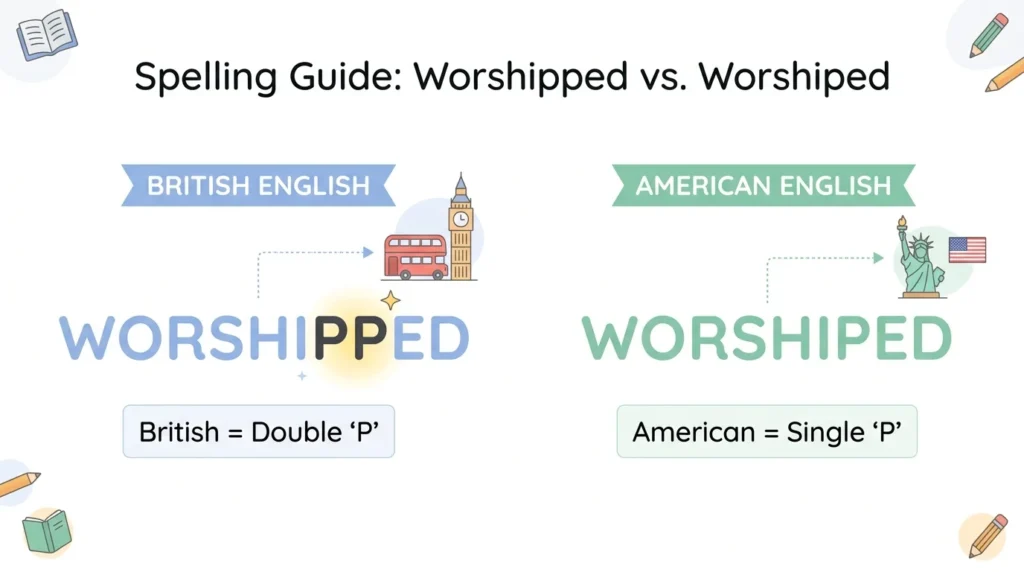
Britain brings back the extra P: worshipped.
America pares it down: worshiped.
Think:
UK → worshipped → PP
US → worshiped → P
If you remember British = doubled P, you can usually make the correct choice quickly.
Real-Life Situations
1. Job Interview
You are discussing historical research in a British-English interview:
“The society worshipped several gods.”
If the interview uses American English:
“The society worshiped several gods.”
2. University Assignment
British style:
“Ancient communities worshipped nature and celestial bodies.”
American style:
“Ancient communities worshiped nature and celestial bodies.”
3. Workplace Report
British English:
“The report states that the community worshipped at the site for generations.”
American English:
“The report states that the community worshiped at the site for generations.”
4. Text Message
“People in that civilization worshipped the sun.”
Or in American English:
“People in that civilization worshiped the sun.”
5. Academic Discussion
“The researchers concluded that the population worshiped the deity as a symbol of political power.”
Here, the American spelling is appropriate if the paper follows American English.
Mini Quiz
| # | Question | Answer | Explanation |
|---|---|---|---|
| 1 | Which is standard in British English? A) worshiped B) worshipped | B) worshipped | British English commonly uses the doubled p form. |
| 2 | Which is standard in American English? A) worshiped B) worshipped | A) worshiped | American English commonly uses the single p form. |
| 3 | Fill in the blank: The villagers had ___ at the temple for generations. | worshipped / worshiped | Both are correct; choose according to the English variety. |
| 4 | Correct the sentence: Did the people worshiped the sun? | Did the people worship the sun? | After did, use the base form worship. |
| 5 | True or false: Worshipped and worshiped have different meanings. | False | They have the same meaning. |
| 6 | Which fits American English? “The tribe ___ several gods.” | worshiped | This is the conventional American spelling. |
| 7 | Correct the sentence: They are worshipped the ancient deity. | They are worshipping the ancient deity. | The continuous form after are requires worshipping/worshiping. |
| 8 | Which spelling fits British English? “She ___ her grandmother.” | worshipped | British English commonly uses the doubled form. |
| 9 | True or false: The extra p changes the pronunciation. | False | The two forms are pronounced essentially the same. |
| 10 | Which is better in a document using American spelling throughout? A) worshipped B) worshiped | B) worshiped | Consistency with the document’s chosen spelling style is the goal. |
Expert Tips
1. Check the Language Setting Before Editing
If Word or another writing program marks worshipped as unusual, check whether the document is set to American English.
Likewise, if worshiped looks unusual in a British-English document, check the language setting before changing it.
2. Look at the Whole Document
Do not decide the spelling by looking at one word in isolation.
Look at related forms such as:
- worshipped / worshiped
- worshipping / worshiping
- worshipper / worshiper
Your preferred style should remain consistent across the document.
3. Do Not “Correct” a Regional Variant
If someone writes worshipped in British English, do not change it to worshiped simply because your own English is American.
Editing should respect the intended variety of English.
4. Remember the Verb After Did
This is a more important grammar issue than the spelling difference:
❌ Did they worshiped God?
✅ Did they worship God?
The word did already marks the past.
5. Use Context to Understand Worship
Worship is not limited to religious contexts.
It can describe intense admiration:
The young fans worshiped the actor.
It can also describe religious practice:
The community worshiped at the temple.
Both uses are established.
6. Don’t Trust Spellcheck Blindly
Spellcheck tells you what matches its language dictionary and settings. It does not necessarily tell you that another regional form is wrong.
7. Choose a House Style
For a website, newspaper, school, company, or book, establish a preferred English variety.
Then apply it consistently.
FAQ
Is worshipped or worshiped correct?
Both are correct. Worshipped is the standard form associated with British English, while worshiped is the standard American English form. Both are past tense and past participle forms of worship.
Is worshipped more correct than worshiped?
No. Neither is universally more correct. The preferred form depends on the variety of English being used. British English generally favors worshipped, while American English generally favors worshiped.
Is worshiped American English?
Yes. Worshiped is the conventional American English spelling of the past tense and past participle of worship.
Is worshipped British English?
Yes. Worshipped is the standard British English past-tense and past-participle form. North American English also recognizes the double-p spelling, so it should not be treated as exclusively British in every context.
Do worshiped and worshipped mean the same thing?
Yes. They have the same meaning. Both mean that someone showed worship, reverence, or very strong admiration.
Are worshiped and worshipped pronounced differently?
No significant pronunciation difference separates the two forms. The distinction is primarily written spelling rather than spoken pronunciation. Oxford gives the same pronunciation for the British and North American past forms.
What is the difference between worshiping and worshipping?
They follow the same regional spelling pattern. Worshipping is the common British form, while worshiping is the common American form. Both are present participles of worship.
Can I use worshipped in American English?
Yes. Worshipped is an established spelling and is recognized by major American dictionaries. However, worshiped is the more typical American form, so use it when following a consistent American-English style.
Can I use worshiped in British English?
You may encounter it, but worshipped is the standard British form. If your document follows British English, worshipped is the safer conventional choice.
Does worship always refer to religion?
No. Worship can also describe extreme admiration or devotion toward a person or thing. For example, someone can figuratively “worship” a famous actor or athlete.
What should I use in international English?
If your audience is international, the most important thing is consistency. Choose one spelling system and use it throughout the document. If your publication follows a specific style guide, follow that guide.
Quick Summary
Worshipped and worshiped are both correct spellings of the past tense and past participle of worship. The main difference is regional: worshipped is the standard British English form, while worshiped is the standard American English form. Both have the same meaning and are pronounced essentially the same way. The verb can refer to religious devotion or, in a figurative sense, very strong admiration. Do not mark either spelling as automatically wrong. Instead, choose the form that matches your English variety and keep it consistent. Also remember that after did, you must use the base verb: Did they worship?, not Did they worshiped?