

Copyright is the correct word when referring to the legal protection of creative work. Copywrite is not a standard English spelling of that word. However, copywriting is a real word that means writing persuasive or promotional content. A copyright protects original work, while copywriting involves creating written content for marketing, advertising, and communication.
What Is the Difference Between Copyright and Copywrite?
The difference between copyright and copywrite comes down to spelling and meaning.
Copyright is a legal term. It refers to the rights creators have over original works, such as books, music, photographs, films, and other creative content.
Copywrite is generally a misspelling of copyright or a mistaken form of copywriting. It is not the standard spelling for the legal concept or the professional activity of writing advertising content.
There is, however, an important related word: copywriting.
Copywriting means writing words designed to persuade, inform, or encourage an audience to take action. Businesses use copywriting for advertisements, websites, product descriptions, emails, landing pages, and social media campaigns.
Consider these examples:
- The photographer owns the copyright to her pictures.
- Our company hired a professional copywriter.
- Good copywriting can help a business increase sales.
The important distinction is that copyright concerns ownership and legal rights, whereas copywriting concerns the creation of written content.
Why Does the Difference Matter?
Confusing copyright and copywriting can create misunderstandings, especially in business, marketing, publishing, and professional communication.
These words describe two completely different concepts.
Imagine that you run a digital marketing agency. You want to hire someone to write persuasive website content. If you advertise for a copyright expert when you actually need a copywriter, you may attract professionals who specialize in intellectual property law rather than marketing content.
The same confusion can happen in the opposite direction. Someone searching for information about protecting their original photographs might mistakenly search for copywriting instead of copyright.
Getting the spelling right matters because:
- In business: It helps you hire the correct professional.
- In marketing: It distinguishes content creation from legal protection.
- In publishing: It prevents confusion about ownership and authorship.
- In education: It helps students use legal and professional terminology correctly.
- In communication: It makes your writing clearer and more credible.
The Core Rule: When Should You Use Copyright or Copywrite?
Correct for legal protection
COPYRIGHT
Use copyright when discussing legal ownership, protection, or rights relating to creative work.
Example: The author owns the copyright to the novel.
Correct professional term
COPYWRITING
Use copywriting when discussing the process of writing promotional or persuasive content.
Example: She has five years of experience in copywriting.
Avoid in standard writing
COPYWRITE
Do not use this as an alternative spelling of copyright. Although it is occasionally recorded as a rare verb meaning to write advertising copy, the normal professional expression is write copy or do copywriting.
Example: She writes advertising copy for international brands.
The easiest rule is:
- Legal protection = copyright.
- Promotional writing = copywriting.
- A person who writes promotional content = copywriter.
- A person who protects or manages intellectual property rights = copyright lawyer or copyright specialist, depending on their role.
An Important Exception: Is Copywrite Ever a Real Word?
There is a small linguistic detail worth knowing. Some dictionaries record copywrite as a rare verb formed from copywriter. In that uncommon sense, it means to write advertising or promotional text.
For example:
- Rare: She was hired to copywrite the company’s advertisements.
- Natural: She was hired to write copy for the company’s advertisements.
- Natural: She was hired to do the company’s copywriting.
This distinction matters because calling copywrite simply a nonexistent word would be too absolute. It has a rare recorded use, but it is not the normal choice in professional English.
For everyday writing, use write copy, copywriting, or copywriter.
How to Use Copyright and Copywriting Correctly
The two terms belong to different situations. Understanding their grammatical roles makes them much easier to use.
1. Using Copyright as a Noun
Copyright is most commonly used as a noun. It refers to the legal rights associated with an original creative work.
Examples:
- The copyright belongs to the photographer.
- The publisher purchased the copyright to the book.
- Copyright protects original creative expression.
- The company owns the copyright to its training videos.
- The artist transferred the copyright to the buyer.
You can also use it in compound expressions:
- Copyright law
- Copyright protection
- Copyright ownership
- Copyright infringement
- Copyright notice
- Copyright registration
2. Using Copyright as a Verb
Copyright can also function as a verb. It means to secure or claim copyright protection for a creative work.
Examples:
- The author wants to copyright her latest book.
- They plan to copyright the original illustrations.
- The company copyrighted its educational materials.
However, remember that copyright protection and registration are not necessarily the same thing. The legal requirements differ between countries. In many legal systems, protection can arise automatically when an eligible original work is created and fixed in a suitable form.
3. Using Copyrighted as an Adjective
Copyrighted describes something protected by copyright.
Examples:
- The video contains copyrighted music.
- Do not upload copyrighted photographs without permission.
- The publisher rejected the use of copyrighted illustrations.
- This is copyrighted material, so check the permission requirements before sharing it.
4. Using Copywriting as a Noun
Copywriting describes the activity or profession of writing persuasive content.
Examples:
- Copywriting is an important part of digital marketing.
- She enrolled in a professional copywriting course.
- Good copywriting can make a product easier to understand.
- The agency offers SEO and copywriting services.
- His copywriting improved the company’s advertising campaigns.
5. Using Copywriter as a Noun
A copywriter is a person who writes advertising, marketing, or promotional content.
Examples:
- We hired a freelance copywriter.
- The copywriter created a new landing page.
- Every copywriter needs to understand the target audience.
- She works as a senior copywriter at a marketing agency.
Correct Examples of Copyright vs Copywrite
Here are 12 original examples showing how these terms work in everyday and professional communication.
| Situation | Correct sentence |
|---|---|
| Everyday conversation | Who owns the copyright to this photograph? |
| Business email | Please confirm that we have permission to use the copyrighted material. |
| School assignment | Copyright protects the original expression of creative work. |
| University research | Researchers must respect copyright when reproducing published material. |
| Workplace | Our legal team reviewed the copyright agreement. |
| Digital marketing | Our agency provides professional copywriting services. |
| Social media | Strong copywriting makes social media advertisements more persuasive. |
| Freelancing | I work as a freelance copywriter for international clients. |
| Website development | We need original copywriting for the new website. |
| Publishing | The author retained the copyright to her manuscript. |
| Photography | The photographer owns the copyright to the original images. |
| Advertising | The copywriter developed a campaign for the new product. |
Notice that none of these sentences needs copywrite as a substitute for copyright or copywriting.
Incorrect vs. Correct: 12 Common Examples
The following examples show mistakes that can appear in emails, websites, assignments, advertisements, and professional documents.
| ❌ Incorrect | ✅ Correct | Why |
|---|---|---|
| I own the copywrite to this book. | I own the copyright to this book. | Copyright refers to legal ownership and protection. |
| The photograph is copywritten. | The photograph is copyrighted. | Copyrighted is the standard adjective. |
| We need to copywrite our website content. | We need to write copy for our website. | Write copy is the normal professional expression. |
| She works in copywrite. | She works in copywriting. | Copywriting is the standard name of the profession or activity. |
| He is a professional copywrite. | He is a professional copywriter. | Copywriter is the noun for the person. |
| This music has no copywrite. | This music has no copyright protection. | Copyright is the legal term. |
| I am learning copywrite. | I am learning copywriting. | Copywriting is the correct name of the skill. |
| The company owns the copywrite. | The company owns the copyright. | Copyright describes the relevant legal rights. |
| We hired someone for copywrite services. | We hired someone for copywriting services. | Copywriting is the standard professional term. |
| Please check the copywrite notice. | Please check the copyright notice. | Copyright is the correct spelling in this expression. |
| The article is copywritten. | The article is copyrighted. | Copyrighted is the standard past participle and adjective. |
| Our new copywrite is ready. | Our new advertising copy is ready. | Advertising copy refers to the written material itself. |
A useful distinction: The sentence “She copywrites advertisements” may be understood as a rare use of the verb copywrite. However, “She writes advertising copy” is more natural and widely accepted in professional communication.
Why Do People Confuse Copyright and Copywrite?
There are several reasons these terms are frequently mixed up.
1. They Sound Almost Identical
Copyright and copywrite are homophones in common English pronunciation. Homophones are words that sound the same but have different spellings or meanings.
When people hear the words in conversation, they may not recognize which spelling is appropriate.
For example, someone might hear:
“Please check the copyright.”
If they are unfamiliar with the spelling, they may write “copywrite” because it looks like two familiar words: copy and write.
2. The Words Share Similar Parts
Both terms contain the word copy.
The difference becomes clearer when you understand their construction:
- Copyright: A legal term relating to rights over creative work.
- Copywriting: Writing persuasive or promotional material.
- Copywriter: A person who writes promotional material.
The shared word creates confusion, but their meanings are different.
3. People Confuse Copywriting with Copyright
Marketing professionals work with written content, while copyright law also protects written content.
For example, a copywriter may create a sales page for a business. That page may qualify for copyright protection if it meets the applicable legal requirements.
One term describes the creation of the text. The other describes legal protection for eligible creative expression.
4. Spellcheck Does Not Always Understand Context
Autocorrect and spellcheck tools can identify many spelling errors, but they do not always understand what a sentence means.
A rare word, a valid word used incorrectly, and a misspelling can create different problems.
For example, a spellchecker may not explain why “copywrite services” is unsuitable in a professional marketing proposal. The writer must understand the intended meaning.
5. Translation Can Cause Confusion
People learning English may translate both concepts using a similar word in their first language.
This can lead them to assume that copyright and copywriting are interchangeable.
The best solution is to learn each word through a complete sentence rather than memorizing its spelling alone.
Common Mistakes Checklist
Use this checklist to avoid the most frequent errors.
- Writing copywrite instead of copyright: Use copyright when referring to legal rights or protection.
- Using copywritten instead of copyrighted: Write copyrighted when describing protected material.
- Using copywrite instead of copywriting: Use copywriting when discussing the marketing profession or activity.
- Calling a copywriter a copywrite: A copywriter is the person who creates advertising or promotional content.
- Confusing copyright with ownership of an idea: Copyright generally protects eligible creative expression, not ideas alone.
- Assuming all online material is free to use: Content being publicly accessible does not automatically mean it is free of copyright restrictions.
- Confusing copyright with a trademark: Copyright protects eligible creative works, while trademarks identify and distinguish goods or services.
- Assuming registration and protection mean the same thing: Registration requirements and the benefits of registration depend on the applicable country’s law.
Read More: Gray vs Grey: Which Spelling Is Correct?
Copyright vs Copywrite in Real English
Grammatically Correct
“Copyright” is the standard noun and verb used in legal and publishing contexts. “Copywriting” is the standard noun for promotional writing, and “copywriter” identifies the person doing that work. “Copyrighted” is the normal adjective describing protected material. These forms are grammatically correct and appropriate for professional communication, educational writing, business documents, and everyday English.
Grammatically Possible but Unnatural
“Copywrite” can be found as a rare verb meaning to write advertising copy. However, it is not the usual choice in modern professional marketing communication. Sentences such as “I copywrite for businesses” may be understood, but “I write copy for businesses” sounds more straightforward and familiar. Similarly, “copywrote” and “copywritten” are uncommon forms that are best avoided in standard professional writing.
Natural, Everyday English
In everyday English, people normally say “write copy,” “work in copywriting,” or “hire a copywriter.” When discussing legal protection, they use “copyright,” “copyrighted material,” and “copyright ownership.” For example, a marketing agency might say, “We write advertising copy for our clients,” while a publisher might say, “We own the copyright to this book.” These expressions are clear and natural.
American vs. British English
There is no meaningful American-versus-British spelling difference between copyright and copywriting.
Both varieties use the same standard spellings:
| Meaning | American English | British English |
|---|---|---|
| Legal protection | Copyright | Copyright |
| Promotional writing | Copywriting | Copywriting |
| Promotional writer | Copywriter | Copywriter |
| Protected material | Copyrighted | Copyrighted |
| Legal violation | Copyright infringement | Copyright infringement |
The pronunciation of copywriter can vary slightly between American and British English, but the spelling remains the same.
You do not need separate spelling rules for these words when writing for American or British audiences.
Formal vs. Informal Usage
Both copyright and copywriting are suitable for formal and informal communication. The important difference is the context in which you use them.
| Context | Recommended expression |
|---|---|
| Legal documents | Copyright ownership |
| Academic writing | Copyright protection |
| Business contracts | Copyright assignment |
| Marketing proposals | Copywriting services |
| Everyday conversation | Writing advertising copy |
| Professional job title | Copywriter |
| Website content | Copyright notice |
| Freelance portfolio | Copywriting experience |
In formal legal documents, use precise terms such as copyright owner, copyright holder, and copyright infringement.
In everyday business communication, expressions such as “write copy for our website” and “hire a copywriter” are perfectly appropriate.
Copyright vs Copywrite: Comparison Table
This table summarizes the most important differences between the related terms.
| Feature | Copyright | Copywriting |
|---|---|---|
| Meaning | Legal protection for creative work | Writing promotional content |
| Word type | Noun and verb | Noun |
| Main purpose | Protect eligible creative expression | Persuade and communicate |
| Common field | Law and publishing | Marketing and advertising |
| Related person | Copyright owner | Copywriter |
| Related adjective | Copyrighted | Promotional |
| Example | Copyright protection | Professional copywriting |
| Common phrase | Copyright infringement | Copywriting services |
| Main concern | Legal rights | Effective communication |
| Correct spelling | Copyright | Copywriting |
Remember: A copywriter creates content, while copyright protects eligible creative work. A copywriter’s work may itself receive copyright protection.
Memory Trick: How to Remember the Difference
Use this simple memory trick:
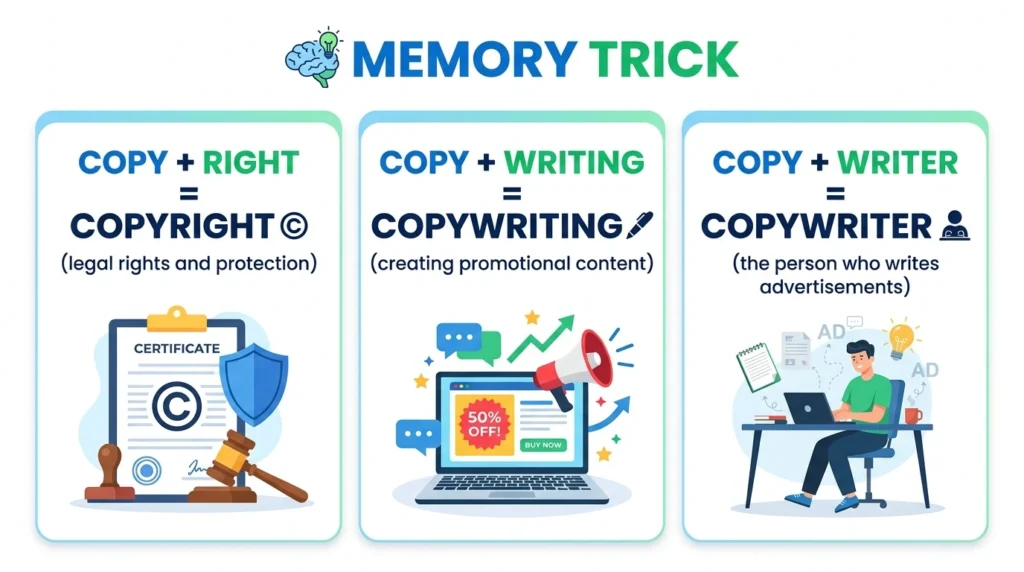
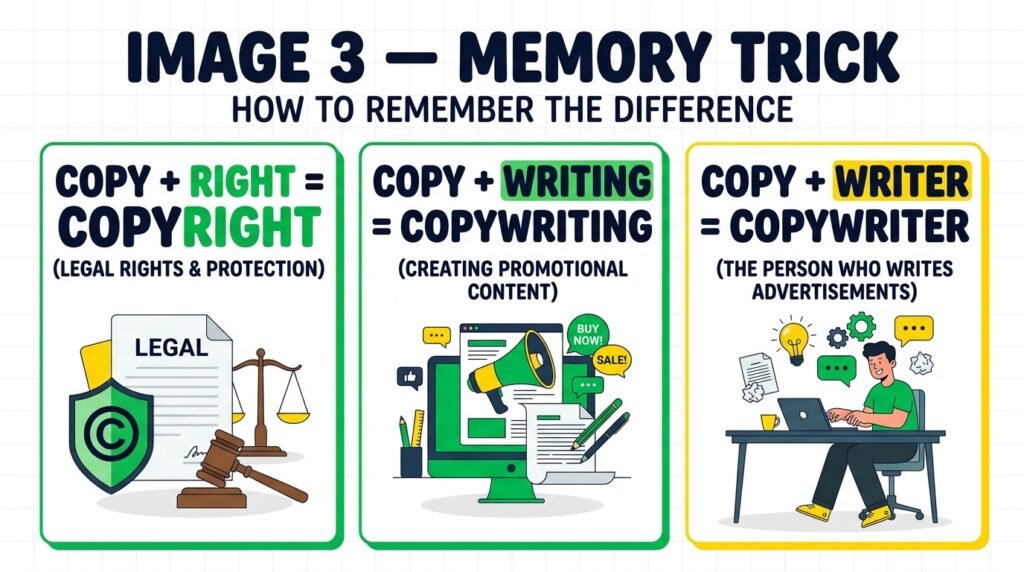
COPY + RIGHT = COPYRIGHT
Think of the legal right to control how eligible creative work is used.
COPY + WRITING = COPYWRITING
Think of writing words that sell, persuade, or promote something.
COPY + WRITER = COPYWRITER
Think of the person who writes advertising and marketing content.
An even easier way to remember:
Rights belong to copyright. Writing belongs to copywriting.
If you remember this one sentence, you will rarely confuse the terms again.
Real-Life Situations: Copyright vs Copywrite
Let’s look at how these words appear in practical situations.
1. During a Job Interview
Interviewer: What is your professional experience?
Candidate: I have three years of experience in copywriting. I create website content, advertisements, and email campaigns for businesses.
Here, copywriting is correct because the candidate is describing a professional skill.
2. During a Business Meeting
Manager: Can we use these photographs in our new advertising campaign?
Marketing Executive: We should first confirm who owns the copyright and whether we have permission to use them.
Here, copyright is correct because the discussion concerns legal rights.
3. In a Client Email
Client: We need someone to write persuasive content for our new product.
Agency: We can assign an experienced copywriter to develop the campaign.
Here, copywriter is the correct word for the professional.
4. In a School Examination
Question: Which term describes legal protection for an original creative work?
Answer: Copyright.
Using copywrite would be incorrect for this meaning.
5. In a Freelance Proposal
Freelancer: I offer professional copywriting services, including website copy, email marketing, landing pages, and product descriptions.
Here, copywriting correctly describes the service.
6. On a Website
Website notice: © 2026 Digital Wings. All rights reserved.
This is a copyright notice. It communicates a claim of copyright ownership or protection; the precise legal effect depends on the applicable law.
Read More: Propose vs Purpose: Meaning, Differences & 20+ Examples.
Expert Tips: What Writers Should Know
These practical distinctions can help you avoid mistakes that ordinary spelling lessons often overlook.
1. Copyright Does Not Mean Owning an Idea
Copyright generally protects the original expression of an idea, not the underlying idea itself.
For example, two writers can independently write books about entrepreneurship. The general topic is not owned by either writer, although their original written expression may be protected.
2. Copyright and Copywriting Can Exist Together
A copywriter creates marketing content, and that original content may qualify for copyright protection.
For example, a copywriter develops a unique advertising campaign for a clothing brand. The resulting written material may receive copyright protection under the applicable law.
The two concepts are different, but they are not mutually exclusive.
3. A Copyright Symbol Is Not the Same as a Trademark Symbol
These symbols have different purposes:
- © indicates copyright.
- ™ indicates a claimed trademark.
- ® indicates a registered trademark.
Do not use them interchangeably.
4. Copyright Protection and Registration Are Different
In many countries, copyright protection arises automatically when qualifying original work is created and fixed in an appropriate form. Registration may provide additional legal benefits or evidence, depending on the jurisdiction.
Do not assume that every country follows exactly the same registration rules.
5. Learn the Word Through Its Professional Context
If you work in digital marketing, remember these expressions:
- Copywriting services
- Professional copywriter
- Advertising copy
- Website copy
- Sales copy
- Copyright protection
- Copyright ownership
- Copyright infringement
Learning these phrases as complete expressions will help you use the words naturally.
Read More: Its Called vs. It Called: Which Is Correct?
Frequently Asked Questions (FAQ)
Is copywrite a correct English word?
Copywrite is recorded in some dictionaries as a rare verb meaning to write advertising copy. However, it is not the standard spelling of copyright, and professional writers generally prefer “write copy” or “do copywriting.” Use copyright when referring to legal protection.
Is copyright one word or two words?
Copyright is written as one word. Writing it as “copy right” or “copy-write” is not standard when referring to legal protection for creative work.
What is the difference between copyright and copywriting?
Copyright refers to legal protection for eligible creative work. Copywriting refers to writing persuasive or promotional content. One concerns legal rights, while the other concerns creating written material for marketing and communication.
Is a copywriter the same as a copyright lawyer?
No. A copywriter creates advertising and promotional content. A copyright lawyer provides legal advice and assistance relating to copyright law and intellectual property rights. These are different professions.
What is the correct spelling: copywritten or copyrighted?
Copyrighted is the standard spelling when describing material protected by copyright. Copywritten is a nonstandard form commonly confused with copyrighted. For professional and academic writing, use copyrighted.
Can I say that I copyright my work?
Yes. Copyright can function as a verb meaning to secure or claim copyright protection for creative work. However, the legal process and requirements vary by country, and protection may arise automatically without registration.
Does copywriting have anything to do with copyright?
They are related through the content they concern, but they have different meanings. Copywriting is the process of creating promotional content. Copyright is the legal protection that may apply to original written content, including qualifying advertising material.
What is the difference between a copywriter and a content writer?
A copywriter generally creates persuasive content intended to encourage an action, such as purchasing a product or signing up for a service. A content writer often focuses on informing, educating, or entertaining readers through articles, guides, and other material. Their responsibilities can overlap.
Is copywriting a single word or two words?
Copywriting is one word. It should not be written as “copy writing” when referring to the established professional term for the activity of writing advertising or promotional content.
How do I remember copyright vs copywrite?
Remember that copyright contains the word “right” because it concerns legal rights. Copywriting contains “writing” because it describes the activity of creating promotional content. A copywriter is the person who does that work.
Quick Summary
Copyright vs copywrite is a common spelling confusion, but the difference is important. Copyright is the correct standard term for legal protection relating to original creative work. Copywriting means creating persuasive or promotional content, while a copywriter is the person who writes it. Copywrite is occasionally recorded as a rare verb, but “write copy” is the more natural professional expression. Similarly, copyrighted is the standard form when describing protected material. Remember this simple rule: copyright concerns legal rights, while copywriting concerns writing. Both terms are useful in business, publishing, education, and digital marketing, but they should never be treated as interchangeable.
Mini Quiz: Test Your Understanding
Choose the correct word or expression in each question. The explanations will help you understand why each answer is correct.
| No. | Question | Correct answer | Explanation |
|---|---|---|---|
| 1 | The author owns the (copyright / copywrite) to her novel. | Copyright | Copyright refers to legal rights over eligible creative work. |
| 2 | She works as a professional (copywriter / copywrite). | Copywriter | A copywriter is a person who creates advertising or promotional content. |
| 3 | Our agency offers SEO and (copywriting / copyrighting) services. | Copywriting | Copywriting is the professional activity of writing promotional content. |
| 4 | The photographer’s images are (copyrighted / copywritten). | Copyrighted | Copyrighted is the standard adjective for protected material. |
| 5 | Fill in the blank: We need to _____ for our new landing page. | Write copy | This is the natural professional expression for creating marketing text. |
| 6 | Identify the correct sentence: A. I own the copywrite. B. I own the copyright. | B | Copyright is the correct term for legal protection and rights. |
| 7 | Correct this sentence: He is learning copywrite. | He is learning copywriting. | Copywriting is the standard name for the skill. |
| 8 | Which word describes legal protection: copyright or copywriting? | Copyright | Copyright concerns legal protection of eligible original expression. |
| 9 | Correct this sentence: We hired a copywrite for our advertising campaign. | We hired a copywriter for our advertising campaign. | Copywriter identifies the person hired to create advertising content. |
| 10 | Fill in the blank: The company must respect the _____ of the original photograph. | Copyright | Copyright refers to the legal rights associated with the photograph. |