

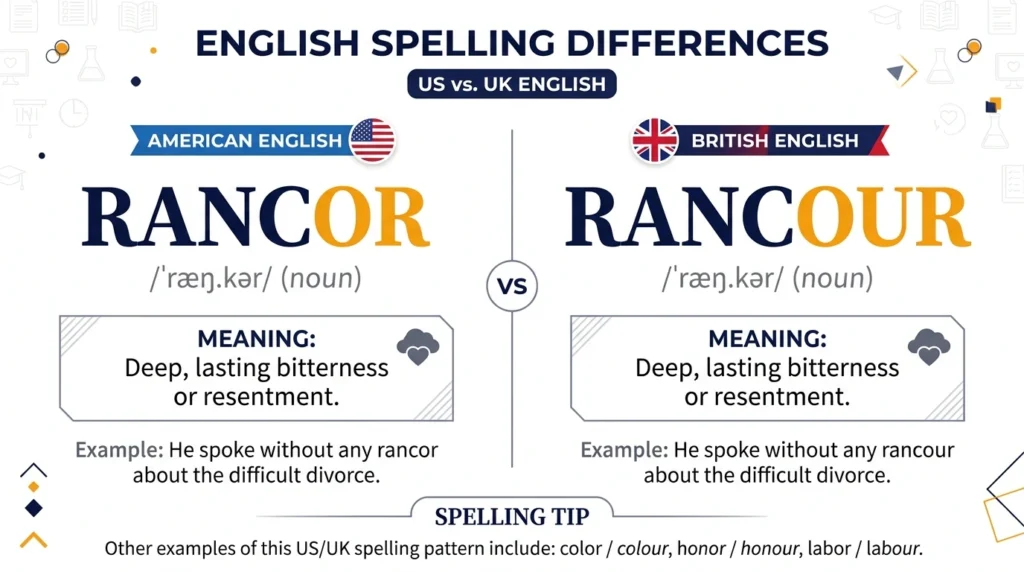
Both rancor and rancour are correct spellings of the same English word. The difference is regional: rancor is the standard American English spelling, while rancour is the standard British English spelling. Both describe deep, lasting bitterness, resentment, or hostility toward someone, often because of a past disagreement or unfair treatment. Neither spelling is more correct than the other; choose according to your audience.
What Is the Difference Between Rancor and Rancour?
The difference between rancor and rancour is spelling, not meaning. Both words are nouns that describe a strong feeling of bitterness or continuing anger.
The distinction follows a familiar American and British spelling pattern. American English generally uses the shorter -or ending in certain words, while British English retains the -our ending.
Consider these examples:
- American English: The two former business partners separated without rancor.
- British English: The two former business partners separated without rancour.
Both sentences communicate exactly the same idea.
The spelling you choose depends on the English variety you are following, not on the intensity of the emotion or the situation in which you use the word.
Why Does the Difference Matter?
Although rancor and rancour have the same meaning, choosing the appropriate spelling matters when writing for a particular audience.
For example, if you are preparing an American business report, using rancor will match the spelling conventions your readers expect. If you are writing for a British newspaper, academic institution, or UK-based organisation, rancour is generally the better choice.
Inconsistent spelling can make otherwise professional writing look poorly edited.
This matters especially in:
- Academic writing: Follow the spelling convention required by your university or publication.
- Business communication: Use the spelling preferred by your company’s house style.
- Professional editing: Maintain consistency throughout reports, proposals, and presentations.
- International publishing: Choose the spelling that matches your intended readership.
- Examinations: Follow the English variant specified by the examination board.
Remember that the spelling difference does not create a difference in meaning. Both forms describe the same emotion.
The Core Rule: Rancor vs Rancour
Rancor
American English
The standard US spelling.
Example: The argument ended without rancor.
Rancour
British English
The standard UK spelling.
Example: The argument ended without rancour.
One meaning: Deep, continuing bitterness, resentment, or ill will.
The easiest rule to remember is:
- Writing in American English? Use rancor.
- Writing in British English? Use rancour.
- Writing for an international audience? Choose one spelling convention and use it consistently.
What Does Rancor or Rancour Mean?
Rancor (American spelling) and rancour (British spelling) mean a deep feeling of bitterness, resentment, or hostility that continues over time.
It is stronger and more enduring than ordinary anger. Someone may become angry because of a frustrating event, but rancor usually suggests that the negative feeling remains long after the original incident.
For example:
- A customer becomes angry when a company delivers the wrong product.
- The customer develops resentment when the company refuses to correct the problem.
- If that bitterness continues for years, it may be described as rancor.
The word often appears in situations involving personal disputes, broken relationships, political disagreements, family conflicts, and professional rivalries.
It is a relatively formal word, so it is particularly useful when describing serious or lasting hostility rather than a temporary disagreement.
Understanding the Meaning Through Examples
Consider the following sentences:
- She spoke about her former employer without rancor.
- Years of political disagreements created considerable rancor between the two groups.
- Despite their difficult divorce, the couple managed to avoid rancor.
- The negotiations ended peacefully, without bitterness or rancour.
- His criticism contained more disappointment than rancor.
In each example, the word communicates a negative feeling that goes beyond ordinary irritation.
How to Use Rancor and Rancour Correctly
Both spellings function as nouns. They are generally used to describe an emotional condition rather than a specific action.
Here are the most useful constructions.
1. Without Rancor or Rancour
This is a common expression meaning without bitterness, resentment, or hostility.
Examples:
- They ended their partnership without rancor.
- She accepted the decision without rancour.
- The former rivals finally spoke without rancor.
- He remembered his previous manager without rancour.
This construction is especially useful when describing a disagreement that ends peacefully.
2. With Rancor or Rancour
Use this construction when someone expresses or experiences bitterness.
Examples:
- He spoke with considerable rancor.
- The former colleagues discussed the issue with rancour.
- She responded to the accusation with no rancor.
- The debate was conducted with unnecessary rancour.
3. Rancor or Rancour Between People
The word can describe hostility between two individuals, organisations, communities, or political groups.
Examples:
- There was considerable rancor between the two families.
- The election increased rancour between political parties.
- Old disagreements created lasting rancor among the partners.
- The conflict left years of rancour between neighbouring communities.
4. Rancor or Rancour Toward Someone
The word can also describe bitterness directed at a particular person or group.
Examples:
- She felt no rancor toward her former colleague.
- He continued to harbour rancour against his former business partner.
- The manager showed no rancor toward the employee who resigned.
- They held considerable rancor against the organisation.
Both toward and towards can appear in English. Their preference varies by regional style, but neither changes the meaning of rancor or rancour.
5. A Great Deal of Rancor or Rancour
Because the word is normally an uncountable noun, expressions such as much rancor, considerable rancor, and a great deal of rancor are appropriate.
Examples:
- The disagreement generated a great deal of rancor.
- There was considerable rancour after the announcement.
- The negotiations were complicated by years of resentment and rancor.
Read More: Gray vs Grey: Which Spelling Is Correct?
Correct Examples of Rancor vs Rancour
The following examples show how both spellings work in everyday and professional contexts. The sentences are original examples illustrating the same meaning in different situations.
| Situation | American English | British English |
|---|---|---|
| Conversation | I have no rancor toward him. | I have no rancour towards him. |
| Business | The partnership ended without rancor. | The partnership ended without rancour. |
| I hope we can resolve this without rancor. | I hope we can resolve this without rancour. | |
| School | The disagreement created rancor among students. | The disagreement created rancour among students. |
| Workplace | There was no rancor between the former managers. | There was no rancour between the former managers. |
| Politics | The election campaign was full of rancor. | The election campaign was full of rancour. |
| Family | Years of conflict left rancor within the family. | Years of conflict left rancour within the family. |
| Academic writing | The dispute generated considerable rancor. | The dispute generated considerable rancour. |
| Social media | The discussion quickly turned into rancor. | The discussion quickly turned into rancour. |
| Journalism | The agreement was reached without rancor. | The agreement was reached without rancour. |
| Relationships | She spoke about the breakup without rancor. | She spoke about the breakup without rancour. |
| Negotiations | Both sides wanted to avoid further rancor. | Both sides wanted to avoid further rancour. |
Notice that the sentence structure and meaning remain unchanged. Only the spelling differs.
Incorrect vs Correct: Common Rancor and Rancour Mistakes
The following table explains mistakes that learners may make when using these words.
| ❌ Incorrect | ✅ Correct | Why |
|---|---|---|
| I feel many rancors toward him. | I feel a great deal of rancor toward him. | Rancor is normally uncountable. |
| She showed a rancour against her boss. | She showed rancour toward her boss. | Use the noun without an unnecessary article in this construction. |
| His rancor are growing. | His rancor is growing. | Rancor is an uncountable singular noun. |
| There were several rancours between them. | There was considerable rancour between them. | The uncountable noun does not normally take a plural ending. |
| I am rancor with him. | I feel rancor toward him. | Rancor is a noun, not an adjective. |
| They ended the meeting in no rancor. | They ended the meeting without rancor. | Without rancor is the natural construction. |
| He has a rancor feeling. | He has feelings of rancor. | The noun should not be used as an ordinary adjective here. |
| The argument caused many rancor. | The argument caused considerable rancor. | Use an appropriate uncountable quantity expression. |
| She spoke rancor to the manager. | She spoke with rancor to the manager. | The noun needs an appropriate preposition in this construction. |
| The disagreement was rancor. | The disagreement was marked by rancor. | Rancor describes the bitterness surrounding a disagreement, not the disagreement itself. |
Important: These examples concern grammatical construction and natural expression. They do not mean that the American spelling is incorrect in British English or that the British spelling is incorrect in American English in every international context. The regional preference is the main spelling distinction.
Why Do People Confuse Rancor and Rancour?
There are several reasons why English learners and even experienced writers hesitate between these spellings.
1. American and British Spelling Differences
One of the biggest reasons is the familiar difference between American words ending in -or and British words ending in -our.
For example:
- Color / Colour
- Honor / Honour
- Favor / Favour
- Labor / Labour
- Rancor / Rancour
When learners understand this pattern, the spelling of rancor becomes easier to remember.
2. Both Spellings Are Correct
Many spelling questions involve one correct word and one misspelling. This is not the case here.
Both rancor and rancour are recognised English spellings. A spellchecker may accept one and flag the other depending on its selected language settings.
For example, an American English dictionary may prefer rancor, while a British English dictionary may prefer rancour.
3. Pronunciation Does Not Help Much
The two spellings are pronounced essentially the same way within their respective English varieties.
The additional letter u in rancour does not create a separate meaning or a different pronunciation rule.
Consequently, listening to someone say the word will not usually tell you which spelling they would choose.
4. Translation Interference
Some learners translate English words directly from their first language. They may understand the meaning of bitterness or resentment but remain unfamiliar with the regional spelling conventions.
The solution is to learn the meaning and spelling together rather than memorising the word as an isolated translation.
5. Autocorrect and Spellcheck Limitations
Digital writing tools do not always understand your intended English variant.
If your document uses American English, a British spelling may be flagged. If your settings are British English, the reverse may happen.
A spelling warning does not automatically mean the word is incorrect. Check your language settings before changing a recognised regional spelling.
Common Mistakes Checklist
Before using rancor or rancour, check the following:
- Mixing American and British spelling: Choose rancor for American English and rancour for British English.
- Assuming one spelling is universally correct: Both are standard forms in their respective varieties.
- Changing the meaning: Neither spelling describes a different type or level of anger.
- Using it as a countable noun: Avoid expressions such as three rancors when you mean several incidents of bitterness.
- Confusing it with ordinary anger: Rancor usually describes deeper, longer-lasting resentment.
- Using it as an adjective: Use rancorous when you need the adjective.
- Ignoring language settings: Check your spellcheck settings before accepting automatic corrections.
- Changing spelling halfway through a document: Keep the same regional convention throughout your writing.
Rancor and Rancour in Real English
Understanding what dictionaries accept is only part of learning English. You should also know how these words function in actual sentences.
Grammatically Correct
Both spellings are grammatically correct when used according to their regional conventions. For example, The negotiations ended without rancor is standard American English, while The negotiations ended without rancour is standard British English. Both use the noun naturally and correctly. The expression without rancor or without rancour is particularly useful when describing a disagreement that does not leave lasting bitterness.
Grammatically Possible but Unnatural
A sentence such as He has much rancor feelings toward his colleague is not a natural construction. The problem is not the regional spelling; it is the way the noun has been combined with another noun. A more natural sentence would be He has strong feelings of rancor toward his colleague. Similarly, avoid forcing rancor into expressions where anger, resentment, or bitterness would communicate the intended idea more clearly.
Natural, Everyday English
Rancor and rancour are established words, but they belong more naturally to formal discussions, journalism, literature, and serious descriptions of conflict than to casual everyday conversation. People are more likely to say I’m still upset about what happened than I still feel rancor. However, without rancor is a familiar and useful expression in formal conversation and writing. Choose the word when you specifically mean deep, continuing bitterness rather than temporary irritation.
American vs British English: Rancor or Rancour?
This is a genuine American and British English spelling difference.
| Feature | American English | British English |
|---|---|---|
| Preferred spelling | Rancor | Rancour |
| Meaning | Deep bitterness or resentment | Deep bitterness or resentment |
| Part of speech | Noun | Noun |
| Pronunciation | /ˈræŋ.kɚ/ | /ˈræŋ.kə(r)/ |
| Example | He spoke without rancor. | He spoke without rancour. |
| Standard usage | US publications | UK publications |
American English: Rancor
In American English, rancor is the standard spelling. It is used in newspapers, business reports, academic writing, political discussions, and everyday communication.
Examples:
- The disagreement ended without rancor.
- His comments revealed considerable rancor.
- The two organisations put aside their rancor and reached an agreement.
- The political debate became increasingly bitter and full of rancor.
British English: Rancour
In British English, rancour is the standard spelling. It appears in British journalism, literature, professional correspondence, and academic publications.
Examples:
- The disagreement ended without rancour.
- His comments revealed considerable rancour.
- The two organisations put aside their rancour and reached an agreement.
- The political debate became increasingly bitter and full of rancour.
What About International English?
International English does not require a separate third spelling.
If you write for readers in different countries, either form can be understood. However, choose one consistent spelling convention for the entire document.
For example, a Pakistani writer preparing a report for an American client would normally use rancor. A writer preparing a report for a British publisher would normally use rancour.
Formal vs Informal Usage
Rancor and rancour are relatively formal words. Their meaning is associated with serious, lasting bitterness rather than a temporary emotional reaction.
| Context | Is it appropriate? | Example |
|---|---|---|
| Academic writing | Yes | The dispute generated considerable rancor. |
| Business reports | Yes | The negotiations ended without rancor. |
| Journalism | Yes | Political rancour continued after the election. |
| Professional emails | Yes, when relevant | I hope we can resolve this matter without rancor. |
| Formal conversations | Yes | There was no rancour between the former partners. |
| Casual conversations | Less common | I’m still upset about what happened. |
| Text messages | Usually uncommon | I don’t hold a grudge against you. |
When Should You Use Rancor or Rancour?
Use these words when you want to describe:
- Deep resentment following unfair treatment.
- Long-lasting bitterness between former friends.
- Hostility between political groups.
- Personal animosity after a serious disagreement.
- Negative feelings that remain after a relationship ends.
Avoid using them when you simply mean temporary annoyance, mild frustration, or ordinary disappointment.
Read More: Propose vs Purpose: Meaning, Differences & 20+ Examples.
Comparison Table: Rancor vs Rancour and Similar Words
Understanding the difference between regional spellings is easy. Understanding how rancor relates to similar words helps you use it more precisely.
| Word | Meaning | Main distinction |
|---|---|---|
| Rancor | Deep, lasting bitterness | Often involves brooding over a past wrong |
| Rancour | Same as rancor | British spelling |
| Anger | A strong feeling of displeasure | Can be temporary |
| Resentment | Bitter displeasure about unfair treatment | Often involves a sense of injustice |
| Bitterness | A lasting negative emotional feeling | Broader than rancor |
| Hatred | Intense dislike or hostility | Can be directed at a person or thing |
| Animosity | Strong hostility between people or groups | Often involves mutual opposition |
| Grudge | Continuing resentment about a past incident | Commonly associated with a particular wrong |
| Hostility | Unfriendly or aggressive feelings or behaviour | Can be expressed through actions as well as feelings |
| Acrimony | Bitterness expressed through angry or harsh words | Often describes hostile discussions |
Rancor vs Resentment
Rancor and resentment are closely related, but they are not always interchangeable.
Resentment is a feeling of displeasure or bitterness, often because someone believes they have been treated unfairly. Rancor usually suggests a deeper or more persistent form of bitterness.
Example:
- Resentment: She felt resentment after being overlooked for promotion.
- Rancor: Years after the incident, she still spoke about her former manager with rancor.
Rancor vs Grudge
A grudge is continuing resentment against someone because of something they did in the past. Rancor describes the deeper bitterness or hostility associated with such resentment.
Example:
- He held a grudge against his former business partner.
- Years of disagreement created deep rancor between them.
Rancor vs Acrimony
Acrimony often describes bitterness expressed through harsh or angry language, particularly during arguments and disputes.
Rancor can exist even when someone remains outwardly calm.
Example:
- The meeting ended with considerable acrimony as both sides exchanged insults.
- Despite years of rancor, the former partners remained polite during the meeting.
Memory Trick: How to Remember Rancor vs Rancour
The easiest way to remember the difference is to connect rancor and rancour with other familiar American and British spelling pairs.
Remember the spelling pattern
American English
- Color
- Honor
- Favor
- Rancor
British English
- Colour
- Honour
- Favour
- Rancour
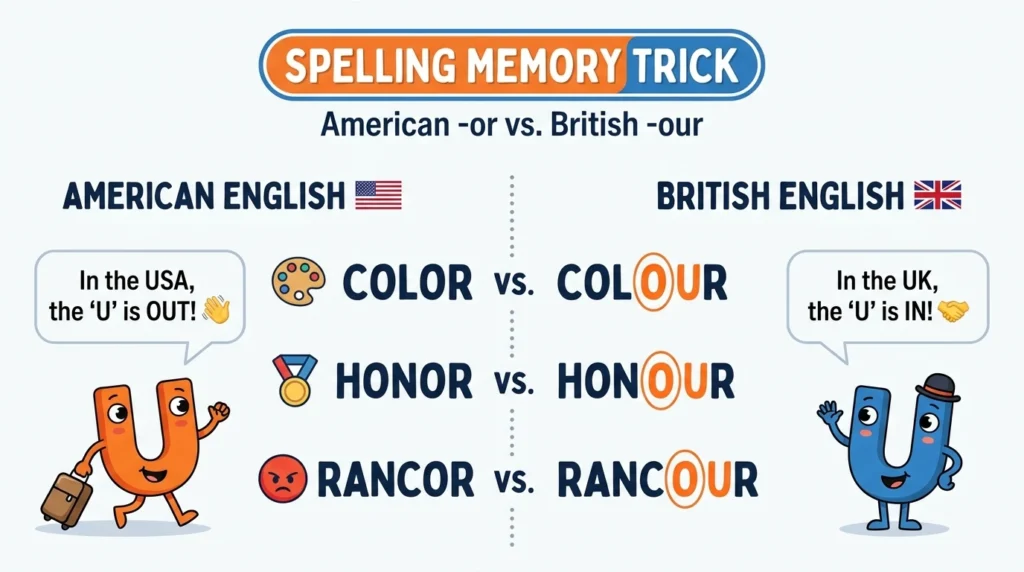
The memory rule: American English generally prefers -or, while British English generally prefers -our in this spelling family.
Think of the u in rancour as a reminder of the British spelling pattern.
If you remember colour and color, you can remember rancour and rancor.
Rancor vs Rancour in Real-Life Situations
The following situations demonstrate how to use the words naturally in different settings.
1. During a Job Interview
An interviewer asks a candidate why they left their previous company.
Candidate: “I had some professional disagreements with the management, but I left without any rancor. I appreciate the experience I gained there.”
Here, rancor communicates that the candidate does not carry lasting bitterness toward the former employer.
2. During a Business Meeting
Two business partners decide to end their partnership after several disagreements.
Partner A: “We have different visions for the company’s future.”
Partner B: “I agree. Let’s close this chapter professionally and without rancor.”
The expression shows a desire to end the relationship without personal hostility.
3. In a Professional Email
A manager wants to address a disagreement with an employee.
Example:
“I understand that we have had different opinions about this project. However, I hope we can resolve the matter without rancor and continue working together professionally.”
The word adds a formal tone to the message.
4. In a Family Discussion
Two siblings disagree about an inheritance.
“Although the disagreement was difficult, they eventually settled the matter without rancor.”
This describes a situation in which the family members resolve their dispute without continuing bitterness.
5. In Academic Writing
A researcher discusses the effects of a historical political conflict.
“The political rivalry created deep rancor between the two opposing groups, making future cooperation difficult.”
The word is appropriate because it describes lasting hostility rather than a short-lived disagreement.
6. In a Text Message
Someone wants to reassure an old friend after an argument.
“I know things didn’t end well between us, but I don’t hold any bitterness toward you.”
This is more natural in casual messaging than using the relatively formal word rancor.
Expert Tips: Using Rancor and Rancour More Effectively
1. Learn the Difference Between Anger and Rancor
Do not use rancor whenever you want to describe anger.
Anger can arise suddenly and disappear quickly. Rancor usually involves bitterness that remains over time.
For example, a person may become angry after receiving an unfair decision. If they continue to feel bitter about that decision years later, rancor may be an appropriate description.
2. Remember That Rancor Is Usually Uncountable
Rancor is generally an uncountable noun. This means it does not normally use a or an directly and does not usually take a plural form.
Prefer:
- Considerable rancor
- Deep rancor
- Much rancor
- A great deal of rancor
- Feelings of rancor
Avoid:
- A rancor
- Many rancors
- Several rancors
You can, however, say a feeling of rancor because the countable noun is feeling, not rancor.
Read More: Its Called vs. It Called: Which Is Correct?
3. Learn the Expression Without Rancor
This is one of the most useful constructions to remember.
Examples:
- They parted without rancor.
- She accepted his decision without rancor.
- The discussion ended without rancour.
It communicates that people have avoided bitterness despite a disagreement.
4. Do Not Confuse Rancor With Rancorous
Rancor and rancorous are related but have different grammatical functions.
- Rancor: Noun. The feeling of deep bitterness.
- Rancorous: Adjective. Describes something that expresses or involves deep bitterness.
Examples:
- Noun: The debate was full of rancor.
- Adjective: It was a rancorous debate.
The adjective rancorous has the same spelling in standard American and British English.
5. Use Rancor When Precision Matters
In professional and academic writing, choosing a precise word makes your communication stronger.
Instead of writing:
“The two groups were angry with each other for years.”
You could write:
“The two groups maintained deep rancor for years.”
The second sentence communicates a more persistent and serious form of hostility.
Quick Summary
Rancor and rancour are two correct spellings of the same English word. Rancor is the standard American English spelling, while rancour is the standard British English spelling. Both are nouns describing deep, lasting bitterness, resentment, or hostility, often resulting from a past disagreement or unfair treatment. Neither spelling changes the meaning or pronunciation. Use rancor when writing for an American audience and rancour when writing for a British audience. Both words are relatively formal and commonly appear in journalism, academic writing, professional communication, and discussions about serious conflicts. Remember the familiar spelling pattern: color/colour, honor/honour, and rancor/rancour. Most importantly, maintain consistency throughout your writing.
Read More: Envolved vs. Involved: Which Spelling Is Correct?
Frequently Asked Questions (FAQ)
1. Is rancor or rancour correct?
Both are correct. Rancor is the standard American English spelling, while rancour is the standard British English spelling. They have exactly the same core meaning.
2. Is rancour British or American?
Rancour is the standard British English spelling. American English generally uses rancor instead.
3. Does rancor mean hatred?
Rancor means deep, continuing bitterness, resentment, or ill will. It can involve hatred, but it does not always mean complete hatred. It often describes resentment that remains after a past disagreement or injustice.
4. Is rancor a noun or an adjective?
Rancor is a noun. Its related adjective is rancorous, which describes someone, something, or a situation involving deep bitterness or hostility.
Example: The discussion became rancorous.
5. Is rancor a countable or uncountable noun?
Rancor is generally an uncountable noun. You would normally write considerable rancor or a great deal of rancor, rather than many rancors.
6. Can I use rancor in formal writing?
Yes. Rancor is particularly suitable for formal writing, journalism, academic discussions, political analysis, and professional communication. It may sound overly formal in ordinary casual conversation.
7. What is the plural of rancor?
Rancor is normally uncountable, so it does not usually have a plural form. Use expressions such as feelings of rancor or instances of resentment when referring to different experiences.
8. What is the difference between rancor and resentment?
Resentment is bitterness or displeasure, often caused by perceived unfair treatment. Rancor generally suggests deeper, more persistent bitterness or hostility. The words overlap, but rancor often carries a stronger sense of lasting ill will.
9. Is rancorous spelled the same in American and British English?
Yes. Rancorous is the standard spelling of the adjective in both American and British English. It means expressing or involving deep bitterness, hatred, or continuing anger.
10. Can I use rancor and rancour in the same document?
You should generally avoid switching between them in the same document. Choose American or British English according to your audience or publication requirements, then maintain that spelling consistently.
Mini Quiz: Test Your Understanding of Rancor vs Rancour
Test what you have learned with these 10 questions. The quiz includes multiple-choice questions, fill-in-the-blanks, and sentence corrections.
| No. | Question | Answer | Explanation |
|---|---|---|---|
| 1 | Which spelling is standard in American English? A) Rancour B) Rancor C) Both equally preferred | B) Rancor | American English generally uses the -or ending. |
| 2 | Which spelling is standard in British English? A) Rancor B) Rancour C) Rancorr | B) Rancour | British English generally retains the -our ending. |
| 3 | Fill in the blank: The former partners separated without _____. (American English) | Rancor | Rancor is the American spelling. |
| 4 | Fill in the blank: Years of disagreement created considerable _____. (British English) | Rancour | Rancour is the British spelling. |
| 5 | What does rancor mean? A) Happiness B) Temporary excitement C) Deep and continuing bitterness D) Confusion | C) Deep and continuing bitterness | Rancor describes lasting resentment or ill will. |
| 6 | Correct the sentence: She has many rancors against her former employer. | She has considerable rancor toward her former employer. | Rancor is generally an uncountable noun. |
| 7 | Is rancorous a noun or an adjective? | Adjective | Rancorous describes something involving deep bitterness or hostility. |
| 8 | Choose the correct American English sentence: A) The debate ended without rancour. B) The debate ended without rancor. | B) The debate ended without rancor. | Rancor is the standard American spelling. |
| 9 | Correct the sentence: His comments were full of rancor anger. | His comments were full of rancor. | The extra word anger is unnecessary because rancor already expresses bitterness or hostility. |
| 10 | Are rancor and rancour different in meaning? | No. | They are regional spelling variants with the same core meaning. |