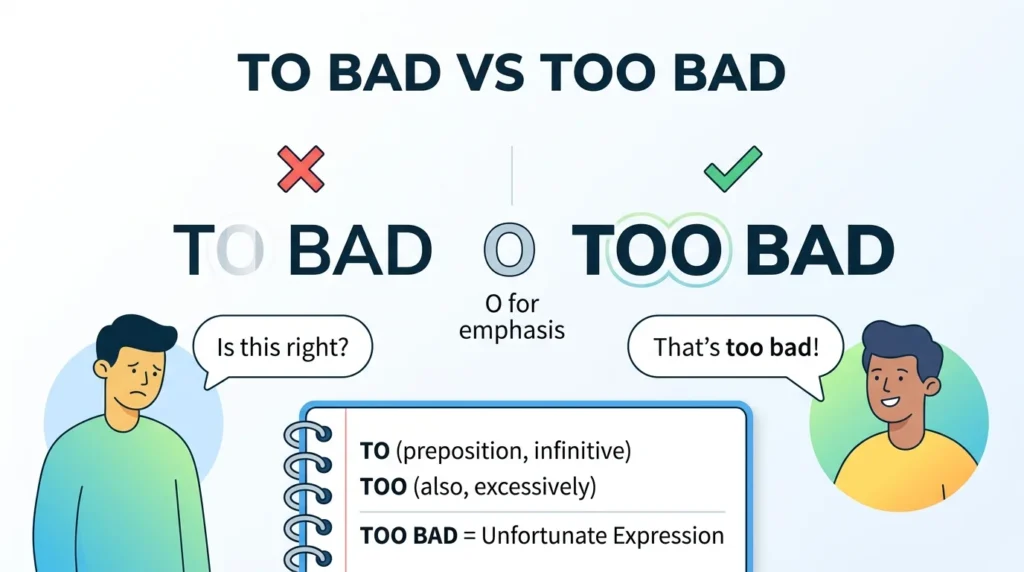

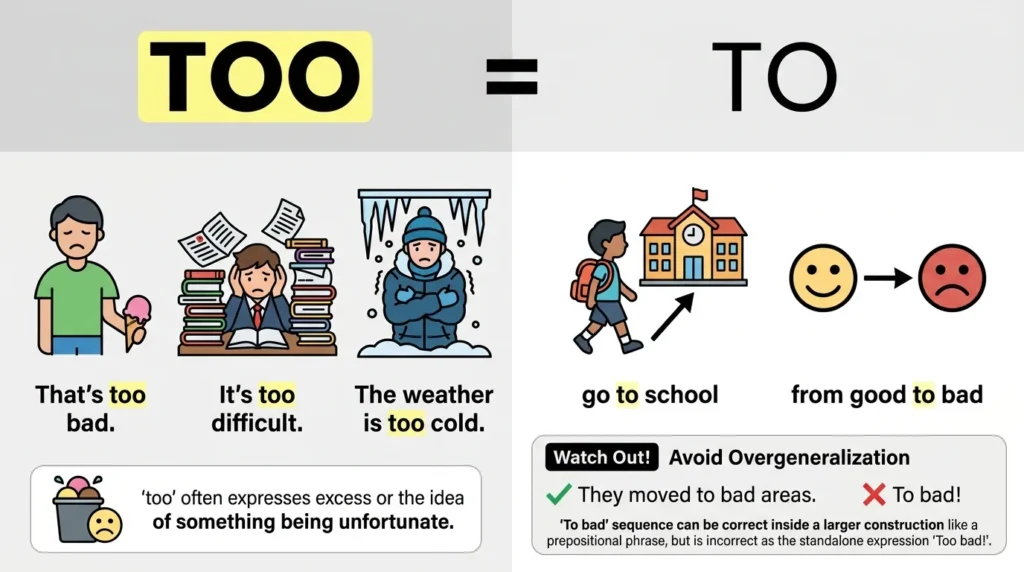
Use too bad when you mean that something is unfortunate, disappointing, regrettable, or excessively bad. For example, “That’s too bad” means “That’s unfortunate” or “That’s a shame.” To bad is incorrect when used as a replacement for too bad. However, to and bad can appear next to each other legitimately when to belongs to a larger structure, such as “from good to bad.”
What Is “Too Bad”?
Too bad is a common English expression with two closely related uses.
First, it can express sympathy, disappointment, regret, or the idea that something is unfortunate:
- It’s too bad you couldn’t come.
- That’s too bad about your flight.
- Too bad we missed the last train.
In this use, too bad is an informal expression. The meaning is often close to “that’s unfortunate,” “what a shame,” or “I’m sorry to hear that.” The exact emotional tone depends on the situation and the speaker’s delivery.
Second, too can have its ordinary meaning of “more than is desirable, suitable, or acceptable.” In that case, too bad literally means that something is excessively bad:
- The weather was too bad for the match.
- The damage was too bad to repair.
- The road conditions were too bad for driving.
So too bad is not limited to one meaning. Context tells you whether it expresses a reaction to unfortunate news or describes an excessive degree of badness.
Read More: Requester vs Requestor: Which Spelling Is Correct?
Why “Too Bad” Is Correct
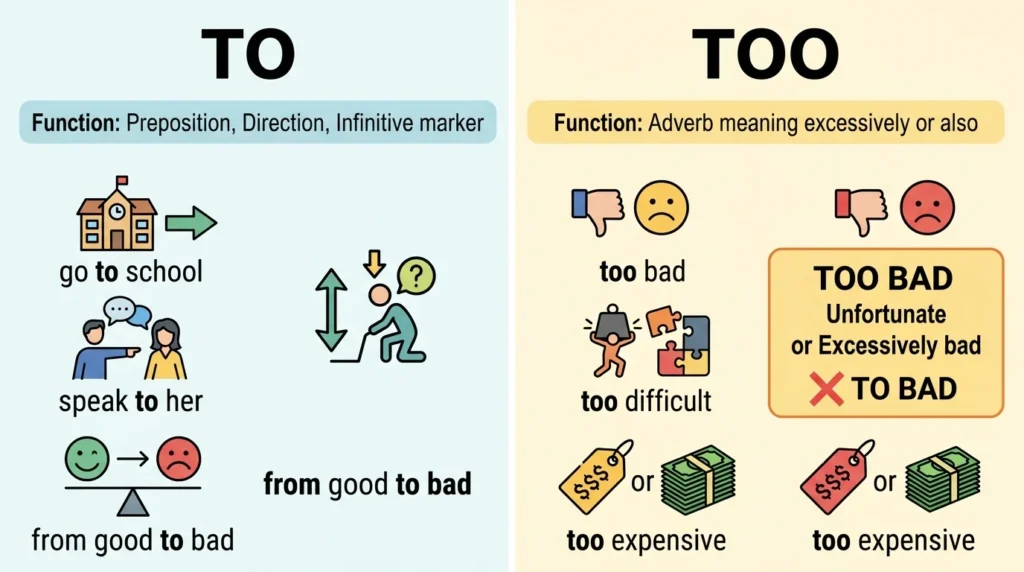
The easiest way to understand the difference is to look at the grammatical jobs of to and too.
Too is an adverb. One of its important functions is to show an excessive degree:
- too expensive
- too difficult
- too cold
- too noisy
- too serious
- too bad
In too bad, too works with the adjective bad.
By contrast, to is commonly used as a preposition or as part of the to-infinitive. It can show direction, destination, relationship, or introduce a verb:
- go to school
- speak to your teacher
- drive to work
- want to leave
- need to study
That grammatical role does not create the expression to bad when you mean “unfortunate.”
The Core Rule
Use “too bad” when you mean “unfortunate,” “a shame,” or “excessively bad.”
Do not write “to bad” as a substitute for “too bad.”
There is one important qualification: do not assume that every occurrence of the two words to bad is automatically an error. If to belongs to another grammatical construction, the sequence can be correct.
For example:
The situation changed from good to bad.
Here, to shows a change from one state to another. It is not modifying bad. This is completely different from:
It’s too bad we missed the train.
How to Use “Too Bad”
There are several common patterns worth learning.
1. “That’s too bad” for unfortunate news
This is one of the most common uses.
- “I can’t attend the wedding.”
“That’s too bad.” - “The store was closed when we arrived.”
“That’s too bad.”
The phrase can show genuine sympathy, disappointment, or simply recognition that something unfortunate happened.
2. “It’s too bad…” before a situation
You can use it’s too bad followed by a clause.
- It’s too bad you missed the interview.
- It’s too bad we cannot stay longer.
- It’s too bad the event was canceled.
- It’s too bad she had to leave early.
This structure is especially useful when you want to express regret about a particular situation.
3. “Too bad…” as a shorter reaction
In conversation, speakers often shorten the expression:
- Too bad we missed the bus.
- Too bad you couldn’t join us.
- Too bad the restaurant was closed.
This is natural in casual conversation and informal writing.
4. “Too bad” meaning excessively bad
Here, the expression has a more literal grammatical meaning.
- The weather is too bad for a picnic.
- The injury was too bad to ignore.
- The traffic was too bad to reach the airport on time.
In these sentences, too means that the degree of badness is beyond what is acceptable or manageable.
5. “Too bad to…”
A particularly useful structure is:
too + adjective + to + verb
For example:
- The damage was too bad to repair.
- The weather was too bad to continue.
- The road was too bad to drive on safely.
Notice that this pattern can contain both too and to.
In:
The weather was too bad to continue.
- too bad = excessively bad
- to continue = infinitive
This is a useful example because it shows that to and too are not interchangeable, even when they appear close together.
Correct Examples of “Too Bad”
Here are examples from different real-life settings.
| Situation | Correct sentence |
|---|---|
| Conversation | “That’s too bad. I hope things get better.” |
| Text message | Too bad you couldn’t make it tonight. |
| It’s too bad that the meeting had to be canceled. | |
| School | It’s too bad Maria missed the final presentation. |
| Workplace | It’s too bad the client could not attend the meeting. |
| Social media | Too bad we missed the sunset! |
| Academic writing | It would be too bad to overlook this important distinction. |
| Travel | It’s too bad our flight was delayed. |
| Customer service | It’s too bad the product arrived damaged. |
| Everyday speech | That’s too bad. I know you were looking forward to it. |
| Weather | The weather was too bad for outdoor activities. |
| Construction | The road was too bad to use safely. |
Incorrect vs. Correct
The most common mistake is writing to bad when the intended expression is too bad.
| ❌ Incorrect | ✅ Correct | Why |
|---|---|---|
| That’s to bad. | That’s too bad. | The expression for an unfortunate situation is too bad. |
| It’s to bad you missed the show. | It’s too bad you missed the show. | Too expresses the idea of something being unfortunate. |
| To bad we arrived late. | Too bad we arrived late. | The shortened reaction is too bad, not to bad. |
| It’s to bad that she left. | It’s too bad that she left. | Too bad expresses regret or disappointment here. |
| The weather is to bad for a picnic. | The weather is too bad for a picnic. | Too modifies the adjective bad and shows excessive degree. |
| The damage was to bad to repair. | The damage was too bad to repair. | Too means the damage was excessively severe. |
| That is to bad news. | That is too bad. | The intended expression is the idiom too bad. |
| I’m sorry. That’s to bad. | I’m sorry. That’s too bad. | The sympathetic expression uses too. |
| It was to bad to continue. | It was too bad to continue. | Too indicates an excessive degree; to continue separately uses to. |
| To bad we couldn’t stay longer. | Too bad we couldn’t stay longer. | The phrase at the beginning is an expression of disappointment. |
One Important Exception
Consider this sentence:
The situation went from good to bad.
You should not change it to:
The situation went from good too bad.
Here, to is correct because it forms the pattern from X to Y.
The same distinction appears in:
- The relationship went from good to bad.
- His mood changed from calm to bad.
- The conversation moved from good to bad.
- The situation went from manageable to bad.
These are not examples of the expression too bad.
Why People Make This Mistake
1. “To” and “too” sound alike
The main reason is pronunciation. In many contexts, to and too are pronounced the same or very similarly. This makes the distinction difficult to hear.
When people learn a phrase through conversation before seeing it written, they may know the sound but not remember which spelling belongs to it.
2. The words are visually similar
The difference is only one extra o:
- to
- too
Because both forms are familiar English words, the eye can easily overlook the missing letter during fast typing.
3. People spell by sound
If someone hears:
“That’s too bad.”
they may mentally reproduce the sound as:
“That’s to bad.”
The problem is not pronunciation. It is choosing the wrong written form for the grammatical meaning.
4. Autocomplete does not understand every intention
Spellcheck and autocomplete can catch many spelling errors, but they do not always understand what you mean.
Because to is a legitimate English word, software may not treat it as an obvious spelling error.
For example, to bad can occur legitimately inside a larger construction such as:
from good to bad
That makes the distinction partly grammatical and contextual, not simply a spelling issue.
5. Translation interference
Learners whose first language expresses these ideas differently may mentally translate the entire expression rather than learning too bad as an English pattern.
A useful solution is to learn common chunks rather than individual words:
- That’s too bad.
- It’s too bad that…
- Too bad you missed…
- too bad to…
Learning these patterns makes the correct spelling easier to recall.
Common Mistakes Checklist
Mistake 1: Writing “to bad” for “that’s unfortunate”
Problem:
“That’s to bad.”
Fix:
“That’s too bad.”
Remember that the expression meaning “unfortunate” uses too.
Mistake 2: Assuming “too” always means “very”
Problem:
Some learners think too bad simply means “very bad.”
Fix:
Look at the context. Too bad can mean “unfortunate” or “a shame,” but it can also literally describe an excessive degree of badness.
Mistake 3: Correcting every “to bad” automatically
Problem:
A writer sees the sequence to bad and changes it to too bad.
Fix:
Read the whole sentence.
In “The situation went from good to bad,” to is correct.
Mistake 4: Confusing pronunciation with spelling
Problem:
The writer chooses the spelling based only on sound.
Fix:
Ask what grammatical job the word is doing.
Mistake 5: Using “too bad” without considering tone
Problem:
“Too bad” can sometimes sound dismissive.
Fix:
When showing genuine sympathy, add context:
“That’s too bad. I’m sorry you had to miss it.”
“Too Bad” in Real English
Grammatically correct and natural
“That’s too bad.” is completely natural in everyday English when someone tells you about an unfortunate situation. It is common in conversation, text messages, and informal communication. Depending on tone, it can express sympathy or simple acknowledgment. For a warmer response, speakers often add a second sentence, such as “I’m sorry to hear that” or “I hope everything works out.”
Grammatically possible but different
“From good to bad” is grammatical, but it is not another spelling of “too bad.” In this construction, to marks movement or change from one condition to another. The sentence “Things went from good to bad” means that circumstances changed from a positive state to a negative one. The two words happen to occur together, but they perform completely different grammatical jobs.
Natural but potentially dismissive
A short response such as “Too bad.” is natural, but its tone depends heavily on context. If a friend says they missed an important appointment, “Too bad” may express sympathy. If someone loses an opportunity after ignoring advice, the same words may sound cold or sarcastic. In sensitive situations, a fuller response such as “That’s too bad. I’m sorry” makes your intention clearer.
Read More: Programming vs Programing: Which Spelling Is Correct?
American vs. British English
There is no important spelling difference between American and British English for this expression.
Both varieties use:
too bad
The expression is also understood in both varieties of English.
The main point is usage and tone rather than regional spelling. You do not need to change too bad to another form simply because you are writing for American or British readers.
Formal vs. Informal Usage
Too bad is especially common in conversational and informal English.
It works naturally in:
- everyday conversation
- text messages
- casual emails
- social media
- informal workplace communication
For more formal writing, alternatives such as unfortunately, regrettably, or it is unfortunate that may be more appropriate.
Compare:
Informal:
“It’s too bad we couldn’t attend.”
More formal:
“Unfortunately, we were unable to attend.”
Neither is inherently grammatically superior. The choice depends on the situation, audience, and tone.
Comparison Table
| Feature | Too bad | To bad |
|---|---|---|
| Main use | Expression of disappointment, sympathy, or excessive degree | Not a replacement for too bad |
| Part of speech | Too is an adverb | To is usually a preposition or infinitive marker |
| Meaning “unfortunate” | Yes | No |
| Meaning “excessively bad” | Yes | No |
| Common expression | Yes | No |
| Example | That’s too bad. | ❌ That’s to bad. |
| Can the words appear together legitimately? | Yes | Yes, in certain larger structures |
| Example of legitimate “to bad” | — | from good to bad |
| Suitable for formal writing | Grammatically correct, but often informal | Depends on the larger sentence |
| Main memory point | Too = excessive/unfortunate | To = direction, relationship, or infinitive |
Memory Trick
Use this simple rule:
If you mean “a shame” or “more than acceptable,” choose TOO with two O’s.
Think of the extra O as “one extra”:
too = extra
So:
Too bad = unfortunate / excessively bad
For example:
- Too bad you missed the bus.
- The weather is too bad to travel.
But:
to = direction or connection
- Go to school.
- Speak to your teacher.
- Change from good to bad.
The mnemonic is not a grammar rule by itself, but it gives you a fast spelling check.
Real-Life Situations
In an interview
Interviewer: “Unfortunately, the position has already been filled.”
Candidate: “That’s too bad. Thank you for letting me know.”
Here, too bad expresses disappointment politely.
In a meeting
Manager: “Sarah cannot attend today’s meeting.”
Colleague: “That’s too bad. We needed her input.”
The expression acknowledges an unfortunate situation.
In an email
Original:
“It’s to bad that the deadline has passed.”
Corrected:
“It’s too bad that the deadline has passed.”
The second version uses the standard expression.
In a text message
Friend: “I can’t come tonight.”
Reply: “Too bad! We were hoping you could join us.”
This is casual and conversational.
In an exam
If the question asks which sentence is correct:
A. That’s to bad.
B. That’s too bad.
Choose B.
In a report
Instead of:
“It’s too bad that the project was delayed.”
a formal report might say:
“Unfortunately, the project was delayed.”
The first sentence is grammatical, but the second is often more suitable for formal professional writing.
Mini Quiz
| # | Question | Answer | Explanation |
|---|---|---|---|
| 1 | Choose the correct form: “That’s ___ bad.” A) to B) too | B) too | Too bad is the expression used to show disappointment or sympathy. |
| 2 | Fill in the blank: “It’s ___ bad we missed the train.” | too | The sentence expresses regret, so the correct phrase is too bad. |
| 3 | Correct the sentence: “To bad you couldn’t come.” | Too bad you couldn’t come. | The expression meaning “what a shame” uses too. |
| 4 | Which is correct? A) The weather is to bad to travel. B) The weather is too bad to travel. | B | Too shows that the weather is excessively bad; to travel is the infinitive. |
| 5 | Is this sentence correct? “Things changed from good to bad.” | Yes | Here to shows a change from one condition to another. |
| 6 | Choose the correct sentence: A) That’s to bad about your car. B) That’s too bad about your car. | B | The phrase expressing sympathy is too bad. |
| 7 | Fill in the blank: “The damage was ___ bad to ignore.” | too | Too bad to ignore means the damage was excessively serious to overlook. |
| 8 | Correct the sentence: “Too bad we arrived too late”? | Correct as written. | The first too forms too bad; the second too modifies late to show excess. |
| 9 | Which sentence correctly uses to bad? A) That’s to bad. B) The situation changed from good to bad. | B | In B, to correctly marks the change from one state to another. |
| 10 | Complete the sentence: “I’m sorry you missed the concert. That’s ___ bad.” | too | That’s too bad is a natural expression of sympathy or disappointment. |
Expert Tips
Learn the phrase, not just the individual words
Instead of memorizing only the rule to vs. too, memorize useful expressions:
- That’s too bad.
- It’s too bad that…
- Too bad you missed…
- too bad to…
- far too bad…
Recognizing the entire pattern reduces hesitation.
Look at the word after “too”
When too comes before an adjective, it often shows an excessive degree:
- too expensive
- too difficult
- too loud
- too cold
- too bad
That gives you a useful grammatical clue.
Do not rely only on sound
If you are writing rather than speaking, pronunciation cannot tell you whether to use to or too. Look at the meaning and grammatical function instead.
Remember that “too bad” has more than one meaning
Compare:
“That’s too bad.”
= That’s unfortunate.
“The weather is too bad for hiking.”
= The weather is excessively bad for hiking.
The words are identical, but the context changes the meaning.
Do not overcorrect legitimate “to bad” sequences
The goal is not to replace every occurrence of to bad with too bad.
Look at the complete sentence:
“The relationship changed from good to bad.”
Here, to is correct.
The real question is:
Is “too” supposed to modify “bad,” or is “to” performing another grammatical job?
That question is more reliable than memorizing “too always goes before bad.”
FAQ
Is “to bad” ever correct?
Yes, but not as an alternative spelling of too bad. The words to bad can appear together when to belongs to another grammatical structure. For example, “The situation changed from good to bad” is correct. Here, to shows a change from one state to another.
Is “too bad” grammatically correct?
Yes. Too bad is grammatically correct and is commonly used to express disappointment, sympathy, regret, or an unfortunate situation. It can also literally mean that something is excessively bad, as in “The weather was too bad for travel.”
Does “too bad” mean “very bad”?
Sometimes, but not always. In “The damage was too bad to repair,” too indicates an excessive degree. But in “That’s too bad,” the expression usually means something like “That’s unfortunate” or “That’s a shame.”
Can I say “too bad” by itself?
Yes. “Too bad.” is a common short response in informal conversation. However, tone matters. Depending on context and delivery, it can sound sympathetic, neutral, sarcastic, or dismissive.
Is “too bad” formal or informal?
The idiomatic expression too bad is generally associated with informal English. It is perfectly grammatical, but in a formal report or official communication, unfortunately, regrettably, or it is unfortunate that may fit the register better.
Why do “to” and “too” cause so many mistakes?
They are easily confused because they can sound alike in speech, while both are extremely common English words. Writers may remember the sound of a phrase without remembering its spelling or grammatical function.
Is “too bad you missed it” correct?
Yes. “Too bad you missed it” is a natural informal sentence. It means that it is unfortunate that the person missed the event or opportunity.
Is “it’s too bad” correct English?
Yes. “It’s too bad” is a standard expression. Depending on context, it can mean that something is unfortunate or disappointing. For example: “It’s too bad you cannot stay longer.”
Can “too bad” be used in professional emails?
Yes, especially in less formal workplace communication. However, if the message is formal or sensitive, a phrase such as “Unfortunately, we were unable to…” may sound more appropriate.
What is the easiest way to remember “too bad”?
Remember two O’s = too when you mean “a shame” or “more than acceptable.” For example, “That’s too bad.” Use to when it has another grammatical job, such as showing direction or forming a construction like “from good to bad.”
Should I always change “to bad” to “too bad”?
No. Check the whole sentence first. If someone wrote “That’s to bad,” the correction is “That’s too bad.” But “The situation went from good to bad” is already correct. The words to bad are not automatically an error.
Quick Summary
Too bad is the correct expression when you mean that something is unfortunate, disappointing, regrettable, or excessively bad. For example, “That’s too bad” expresses sympathy or disappointment, while “The weather is too bad for travel” shows an excessive degree. To bad is incorrect when it is used as a replacement for too bad. However, the words to bad can appear correctly when to has a different grammatical function, as in “The situation changed from good to bad.” The easiest way to remember the difference is to associate too with excess or “a shame,” while to commonly shows direction, connection, or an infinitive.