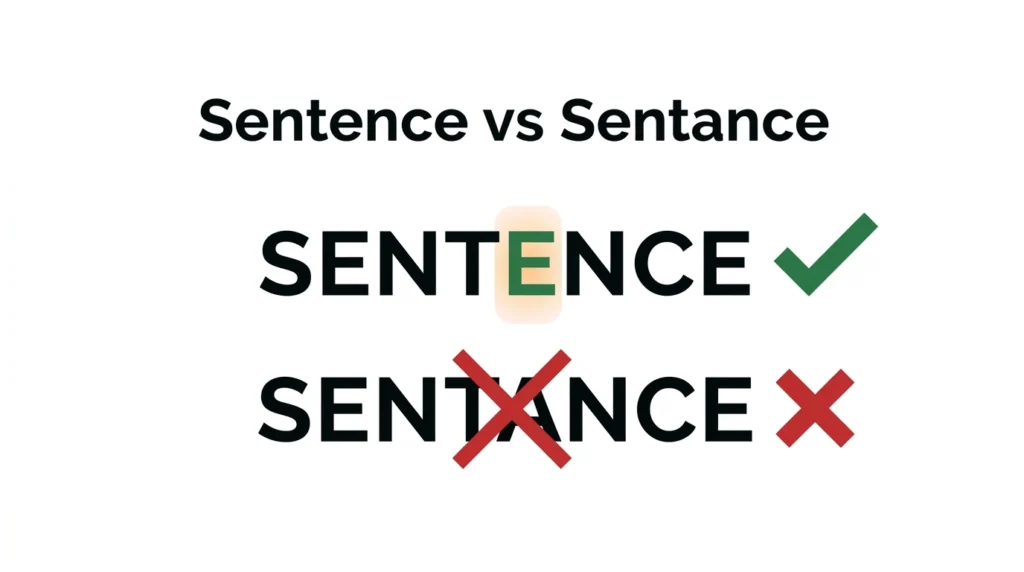

Sentence is the correct spelling. Sentance is a common misspelling and is not the standard spelling of the word. Use sentence whether you are talking about a group of words that expresses an idea, a question, or an instruction, or about a punishment ordered by a court. The spelling does not change between American and British English.
What Is the Difference Between Sentence and Sentance?
The difference is simple: sentence is the correct English word, while sentance is a spelling error.
The two forms are easy to confuse because they look almost identical and are pronounced very similarly. The problem is the vowel in the middle of the word. In normal speech, that vowel is weak, so it does not clearly tell you whether to write e or a.
There is no different meaning attached to sentance. It is not a second word that can be used in a different situation.
| Spelling | Correct? | Meaning |
|---|---|---|
| sentence | ✅ Yes | A grammatical unit of words; also a legal punishment |
| sentance | ❌ No | Common misspelling of sentence |
So if you are asking, “Should I write sentence or sentance?” the answer is always sentence in standard English.
What Does Sentence Mean?
The word sentence has more than one meaning, so understanding its uses helps you recognize the correct spelling.
Sentence in grammar
In grammar, a sentence is a unit of language that expresses a statement, question, instruction, or exclamation. In writing, it normally begins with a capital letter and ends with appropriate punctuation.
For example:
- The children are playing outside.
- Where did you put my keys?
- Please close the window.
- What a beautiful morning!
A sentence can be short:
She smiled.
Or much longer:
After the meeting ended, the team stayed behind to discuss the new project.
The length does not determine whether something is a sentence. What matters is its grammatical structure and whether it functions as a complete sentence.
Read More: Affend vs Offend: Which Spelling Is Correct?
Sentence in law
Sentence also has an important legal meaning. It can refer to the punishment given by a court after someone has been found guilty of an offense.
For example:
The judge gave him a five-year sentence.
Here, sentence does not mean a group of words. It means a court-ordered punishment.
Sentence as a verb
Sentence can also be a verb. In legal contexts, to sentence someone means to officially give that person a punishment.
For example:
The judge sentenced him to three years in prison.
The spelling remains sentence.
Its common forms include:
- sentence
- sentences
- sentenced
- sentencing
The form sentance is not the correct base spelling for any of these uses.
Why It Matters
A one-letter spelling mistake may seem minor, but sentence is such a common word that the error can be noticeable.
You may use the word in:
- school assignments
- university essays
- workplace emails
- reports
- applications
- websites
- social media posts
- presentations
- grammar exercises
- legal writing
Consider this sentence:
Please correct the second sentance in the report.
The meaning is still understandable, but the spelling error can make the writing look less carefully edited.
The correct version is:
Please correct the second sentence in the report.
This is especially important because sentence is not a rare technical word. It is an everyday word used across many types of English.
The Core Rule
Always spell the word as SENTENCE: S-E-N-T-E-N-C-E.
Do not use SENTANCE when you mean the standard English word.
There is no special situation in normal English where you need to choose sentance instead of sentence.
The confusion is about spelling, not meaning.
How to Use Sentence Correctly
The easiest way to use the word correctly is to remember that the standard spelling is always sentence.
When talking about writing
Use sentence when referring to a grammatical unit.
I wrote a short sentence.
The final sentence needs revision.
Can you explain this sentence?
When talking about grammar
Use sentence when discussing sentence structure, punctuation, or writing.
This sentence has a subject and a verb.
The paragraph contains six sentences.
The sentence is too long and difficult to follow.
When talking about a court punishment
Use sentence as a noun.
The court announced the sentence.
He received a ten-year prison sentence.
When talking about giving a legal punishment
Use sentence as a verb.
The judge sentenced the defendant to two years in prison.
She was sentenced to community service.
When writing informally
The spelling does not change.
Can you read this sentence?
You should not write:
Can you read this sentance?
Informal communication may tolerate many shortcuts, but sentance is still a misspelling.
Correct Examples
Here are examples from different real-life settings.
| Situation | Correct Example |
|---|---|
| Conversation | Can you repeat that sentence? |
| Text message | I don’t understand the last sentence. |
| School | Write one sentence about your favorite book. |
| University | The opening sentence introduces the main argument. |
| Workplace email | Please revise the second sentence of the email. |
| Report | The final sentence summarizes the finding. |
| Social media | That one sentence completely changed my perspective. |
| Presentation | Let me repeat the last sentence for clarity. |
| Academic writing | The topic sentence introduces the paragraph’s main idea. |
| Legal context | The judge announced the sentence after the hearing. |
| Editing | I removed the unnecessary sentence. |
| Everyday writing | This sentence sounds more natural. |
Notice that the spelling sentence remains exactly the same in every situation.
Read More: Whose vs Whos: Which Is Correct? Easy Grammar Guide.
Incorrect vs. Correct
The mistake is usually simple to fix. The important part is recognizing why the incorrect form is wrong rather than simply memorizing a correction.
| ❌ Incorrect | ✅ Correct | Why |
|---|---|---|
| Please write one sentance. | Please write one sentence. | The standard spelling ends in -ence. |
| I forgot the last sentance. | I forgot the last sentence. | Sentance is a misspelling. |
| This sentance is too long. | This sentence is too long. | The grammatical term is sentence. |
| Check the first sentance. | Check the first sentence. | The correct word uses e, not a, in the middle. |
| She wrote a good sentance. | She wrote a good sentence. | There is no standard word sentance. |
| The final sentance needs editing. | The final sentence needs editing. | Use sentence for a grammatical unit. |
| The judge announced the sentance. | The judge announced the sentence. | The legal noun is also spelled sentence. |
| He received a five-year sentance. | He received a five-year sentence. | The legal meaning uses the same spelling. |
| The teacher corrected my sentance. | The teacher corrected my sentence. | The spelling does not change in education. |
| That sentance sounds unclear. | That sentence sounds unclear. | The correct form is sentence. |
Why People Make This Mistake
The mistake is understandable because English spelling and pronunciation do not always match perfectly.
Phonetic similarity
The most obvious reason is pronunciation.
The word sentence is commonly pronounced approximately SEN-tuhns. The middle vowel is weak or unstressed in normal speech. Cambridge gives the UK and US pronunciation as /ˈsen.təns/.
That means the spoken word does not strongly announce:
“Use the letter E here.”
Someone who spells mainly from sound may therefore write sentance.
The influence of -ance words
English contains many familiar words ending in -ance, including:
- distance
- importance
- performance
- attendance
- appearance
English also contains many words ending in -ence, including:
- presence
- difference
- confidence
- patience
- silence
- sentence
Because both patterns are common, a writer cannot always predict the correct spelling simply from the sound.
Spelling by pronunciation
Some learners develop the useful habit of sounding out unfamiliar words. However, pronunciation alone cannot reliably determine every English spelling.
For sentence, the unstressed vowel makes the method particularly unreliable.
Autocomplete and spell-check
Digital tools can catch many spelling mistakes, but they should not become a substitute for knowing common words.
A spell-checker may underline sentance, but the better long-term solution is to remember the correct spelling.
Technology can correct a typo.
Understanding the spelling prevents you from making it repeatedly.
Translation interference
English learners may also transfer spelling patterns from another language into English.
If a learner’s first language has a spelling system where vowel sounds map more directly to letters, English words with weak or reduced vowels can be particularly confusing.
The problem is not a lack of intelligence or grammar ability. It is simply a mismatch between the sound a learner hears and the spelling English conventionally uses.
Common Mistakes Checklist
Writing “sentance” because it sounds right
What happens: You hear the weak middle vowel and choose a.
Why it happens: The pronunciation does not clearly distinguish the spelling.
How to avoid it: Memorize the written form sentence rather than trying to reconstruct it from sound.
Assuming -ance and -ence are interchangeable
What happens: You treat the two endings as if either one could work.
Why it happens: Both endings are common in English.
How to avoid it: Learn individual spellings instead of relying on a universal ending rule.
Writing “sentanced”
The correct form is:
sentenced
Not:
sentanced
The correct base word is sentence, so the past form is sentenced.
Writing “sentenceing”
The correct form is:
sentencing
Not:
sentenceing
The final silent e is removed before the -ing ending.
Read More: To Bad vs Too Bad: Which Is Correct?
Assuming British English uses “sentance”
It does not.
British and American English both use sentence. The spelling is not a regional variation.
Sentence in Real English
Grammatically correct and natural
Sentence is an ordinary, natural word in everyday English. People use it constantly when talking about writing, grammar, communication, and law.
For example:
Can you read that sentence again?
I don’t like the first sentence of this paragraph.
These are completely natural uses.
Grammatically possible but context-dependent
Some uses of sentence depend heavily on context.
For example:
The sentence was heavy.
This can be grammatically possible, but without context it may sound unclear because sentence can mean either a grammatical unit or a legal punishment. If you mean a court punishment, a clearer phrase might be:
The court imposed a heavy sentence.
The issue here is not spelling. It is meaning and context.
Natural everyday English
In everyday conversation, people commonly use phrases such as:
a complete sentence
the first sentence
the last sentence
a short sentence
a long sentence
sentence structure
sentence by sentence
in a sentence
The spelling stays sentence in all of them.
American vs. British English
There is no spelling difference between American and British English for this word.
| English variety | Correct spelling |
|---|---|
| American English | sentence |
| British English | sentence |
| International English | sentence |
The pronunciation is also represented similarly in standard dictionary entries for both varieties.
This is worth emphasizing because English has genuine regional spelling differences, such as color/colour and center/centre. Sentence/sentance is not one of them.
If you see sentance, do not assume it is British English, American English, or another regional spelling. In ordinary English writing, it is simply a misspelling.
Formal vs. Informal Usage
Sentence works in both formal and informal English.
Formal examples
The final sentence of the report requires clarification.
The defendant received a five-year sentence.
Please revise the concluding sentence.
Informal examples
That was a weird sentence.
Can you read this sentence?
I forgot what the last sentence said.
The spelling does not change according to formality.
Sentance is not an informal alternative. You should not use it simply because you are texting or writing casually.
Comparison Table
| Feature | Sentence | Sentance |
|---|---|---|
| Standard English spelling | ✅ Yes | ❌ No |
| Correct noun | ✅ Yes | ❌ No |
| Correct verb | ✅ Yes | ❌ No |
| Grammar meaning | ✅ Yes | ❌ No |
| Legal meaning | ✅ Yes | ❌ No |
| Used in American English | ✅ Yes | ❌ No |
| Used in British English | ✅ Yes | ❌ No |
| Suitable for formal writing | ✅ Yes | ❌ No |
| Suitable for informal writing | ✅ Yes | ❌ No |
| Common spelling mistake | No | Yes |
This is not a case where two correct words have different meanings. There is only one standard spelling: sentence.
Memory Trick
A useful way to remember the spelling is:
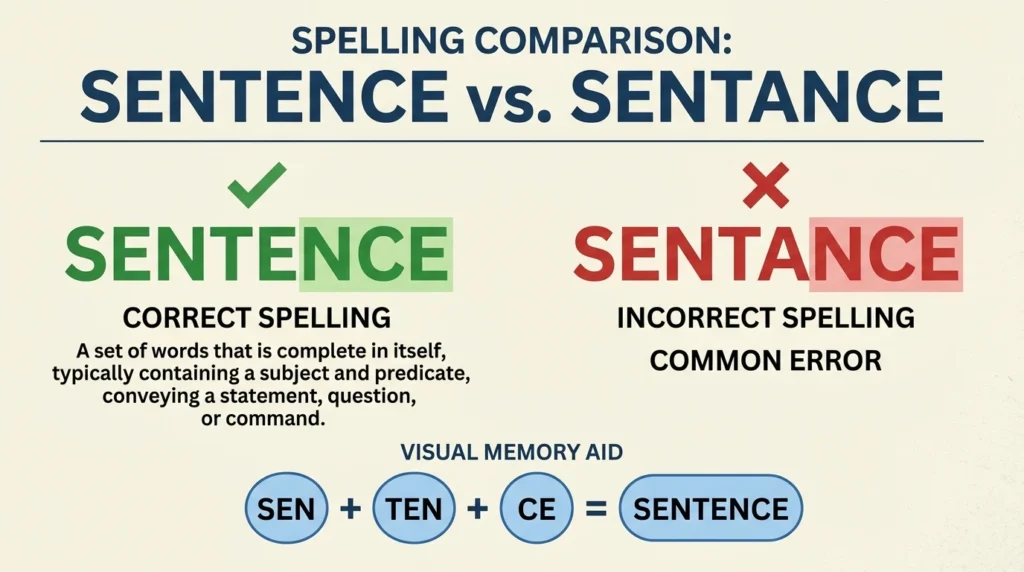
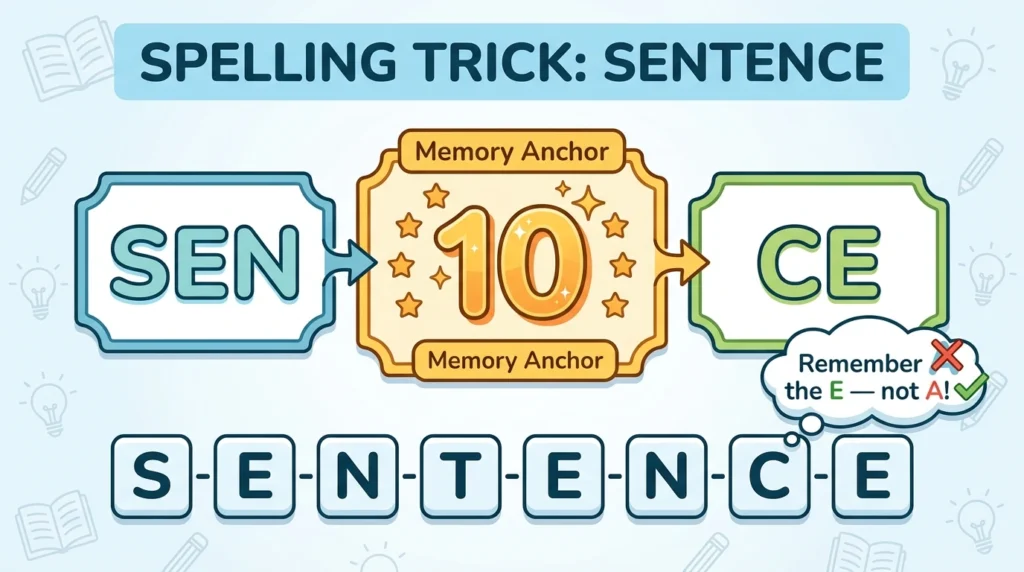
SEN + TEN + CE = SENTENCE
The word sentence contains the sequence TEN:
SEN-TEN-CE
When you are unsure, break it into these three parts:
sen — ten — ce
That gives you:
S E N T E N C E
Another visual trick is to remember that sentence has three e’s:
sentence
If you see sentance, the a should immediately look suspicious.
The important thing is not to create a complicated spelling rule. Just connect the visual form sentence with the word you already know.
Read More: To Bad vs Too Bad: Which Is Correct?
Real-Life Situations
In an interview
An interviewer asks:
“Can you describe your experience in one sentence?”
You could answer:
“I help businesses improve their digital marketing and customer growth.”
The correct word is sentence.
In a workplace meeting
A colleague says:
“The second sentence in the proposal is unclear.”
They are referring to a grammatical unit of the proposal.
In an email
You might write:
“Could you please shorten the final sentence?”
This is a normal professional use.
In a text message
A friend might say:
“Your last sentence confused me.”
The spelling remains exactly the same in casual communication.
In an exam
A teacher may ask:
“Write a sentence using the word ‘confidence.’”
Again, the correct spelling is sentence.
In a legal report
A report might say:
“The court imposed a five-year sentence.”
Here, sentence has its legal meaning rather than its grammar meaning.
Expert Tips
Learn the word visually
Because pronunciation can make the spelling unclear, visual recognition is useful.
Look at:
sentence
Then look at:
sentance
The second form should become recognizable as the mistake.
Read More: Requester vs Requestor: Which Spelling Is Correct?
Learn related forms together
Instead of memorizing only one word, learn the family:
- sentence
- sentences
- sentenced
- sentencing
This helps prevent new versions such as sentanced and sentenceing.
Do not invent a spelling rule
It may be tempting to say that words ending in -ence always have one particular meaning or that -ance follows one universal grammar rule.
English spelling is not that predictable.
For this word, it is safer and more accurate to remember the established spelling:
sentence
Read the complete word
When proofreading, do not only listen to the sentence in your head.
Look at the letters.
This matters because your brain can sometimes recognize a familiar word even when one letter is wrong.
Check the base word first
If you are unsure about sentenced or sentencing, return to the base form:
sentence
Then build the correct form from it.
This is much safer than trying to remember each spelling independently.
FAQ
Is sentence or sentance correct?
Sentence is correct. Sentance is a misspelling. Use sentence when referring to a grammatical unit, a court-imposed punishment, or the related verb meaning to impose a legal punishment.
Is sentance a real English word?
Not as the standard spelling of the ordinary English word sentence. If you mean the grammatical or legal word, use sentence.
A particular name, username, or other proper name could theoretically contain unusual spelling, but that would not make sentance the standard spelling of the English vocabulary word.
Why is sentence spelled with an e instead of an a?
The spelling reflects the established form of the English word and its historical development. The pronunciation does not make the middle vowel especially clear, which is one reason people may choose the wrong letter. The word ultimately traces through Old French to Latin sententia. (Oxford Learner’s Dictionaries)
How do you spell sentence?
Spell it:
S-E-N-T-E-N-C-E
A useful memory aid is:
SEN + TEN + CE
Is sentance a British spelling?
No. Sentence is used in both British and American English. Sentance is not a standard British alternative.
Can sentence be a verb?
Yes. As a verb, sentence means to officially impose a legal punishment.
Example:
The judge sentenced him to two years in prison.
The past form is sentenced, and the -ing form is sentencing. (Oxford Learner’s Dictionaries)
What is the plural of sentence?
The plural is sentences.
Example:
The paragraph contains five sentences.
Is it sentenced or sentanced?
The correct form is sentenced.
Correct: The judge sentenced him to three years.
Incorrect: The judge sentanced him to three years.
The spelling comes from the base word sentence.
Is it sentencing or sentenceing?
The correct form is sentencing.
The court is sentencing the defendant today.
The final silent e is removed before -ing.
Does every sentence need a subject and a verb?
Most ordinary sentences contain a subject and a verb, but it is better not to treat that as an absolute rule for every sentence type. For example, an imperative such as “Close the door.” has an understood subject: you.
The more useful idea is that a sentence is a grammatical unit capable of functioning as a complete statement, question, command, or exclamation.
Can sentence mean a punishment?
Yes. In legal English, a sentence is a punishment ordered by a court.
For example:
The court imposed a five-year sentence.
This is completely different in meaning from:
The first sentence of the article is too long.
The spelling is identical in both cases.
Why do I keep writing sentance?
You may be relying on pronunciation. The middle vowel in sentence is weak in ordinary speech, so the word can sound as though it might contain a rather than e.
The best solution is to memorize the visual spelling sentence and practice it in real phrases.
Mini Quiz
| # | Question | Answer | Explanation |
|---|---|---|---|
| 1 | Choose the correct spelling: sentence / sentance | sentence | Sentence is the standard spelling. |
| 2 | Fill in the blank: “Please write one complete ______.” | sentence | A grammatical unit is a sentence. |
| 3 | Correct the sentence: “This sentance is too long.” | This sentence is too long. | Replace sentance with sentence. |
| 4 | Which is correct: “The judge announced the sentence” or “The judge announced the sentance”? | The judge announced the sentence. | The legal noun is also spelled sentence. |
| 5 | Choose the correct past form: sentenced / sentanced | sentenced | The past form comes from sentence. |
| 6 | Choose the correct -ing form: sentencing / sentenceing | sentencing | The final silent e is dropped before -ing. |
| 7 | True or false: Sentance is the British spelling of sentence. | False | British English also uses sentence. |
| 8 | Fill in the blank: “The paragraph has six ______.” | sentences | Sentences is the plural of sentence. |
| 9 | Correct the sentence: “The judge sentanced him to prison.” | The judge sentenced him to prison. | The correct verb form is sentenced. |
| 10 | Which spelling should you use in a professional email? sentence / sentance | sentence | Sentence is the standard spelling in both formal and informal writing. |
Quick Summary
Sentence is the correct spelling, while sentance is a misspelling. Use sentence when you mean a grammatical unit of words or a punishment ordered by a court. The same spelling is used in American and British English, so sentance is not a regional variation. The confusion mainly comes from pronunciation: the middle vowel in sentence is weak in normal speech, which can make the spelling difficult to hear. Remember the word as SEN-TEN-CE or simply memorize S-E-N-T-E-N-C-E. Related forms include sentences, sentenced, and sentencing. Whenever you are unsure between sentence and sentance, choose sentence.