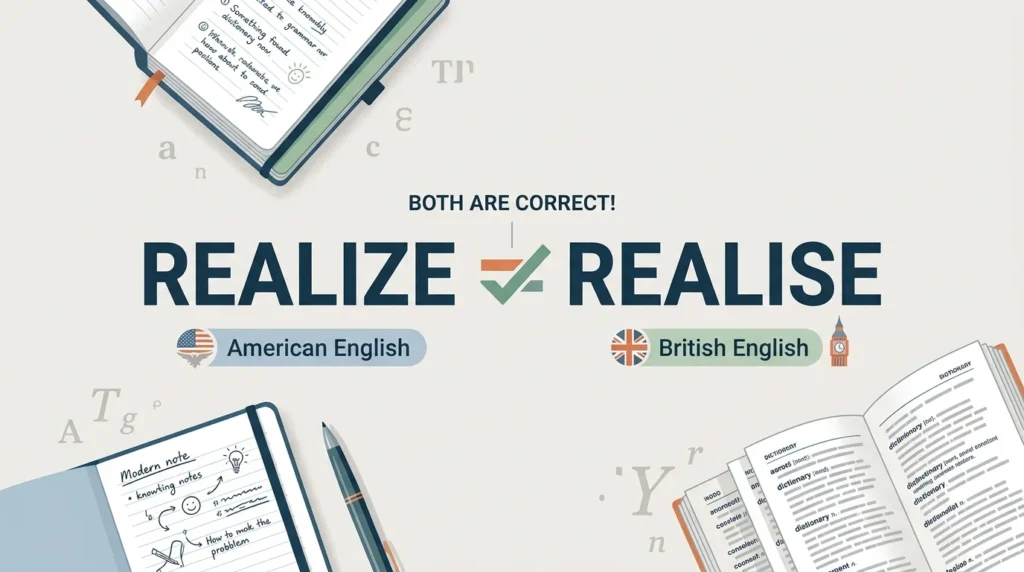

Realize and realise mean the same thing: to become aware of something, understand something, or make something real. Realize is the usual American English spelling, while realise is commonly used in British English. The choice is therefore not about grammar or meaning. It is mainly about which English spelling system you are following. The important rule is to choose one variety and remain consistent.
What Is the Difference Between Realize and Realise?
Realize and realise are two spellings of the same verb.
The verb can mean to become aware of something or understand something, as in:
I didn’t realize that the meeting had already started.
It can also mean to achieve or make something real, as in:
She worked hard to realize her dream.
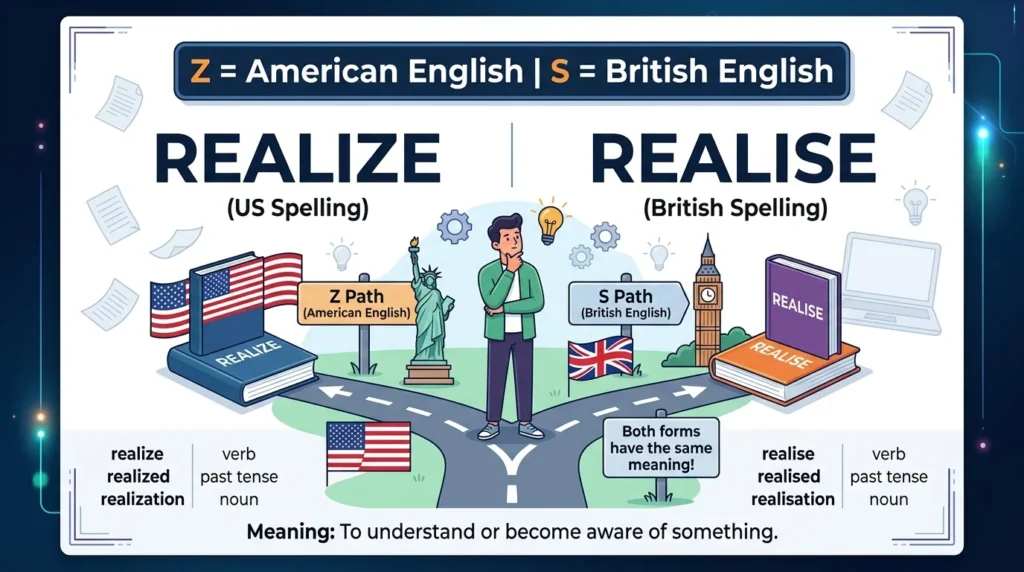
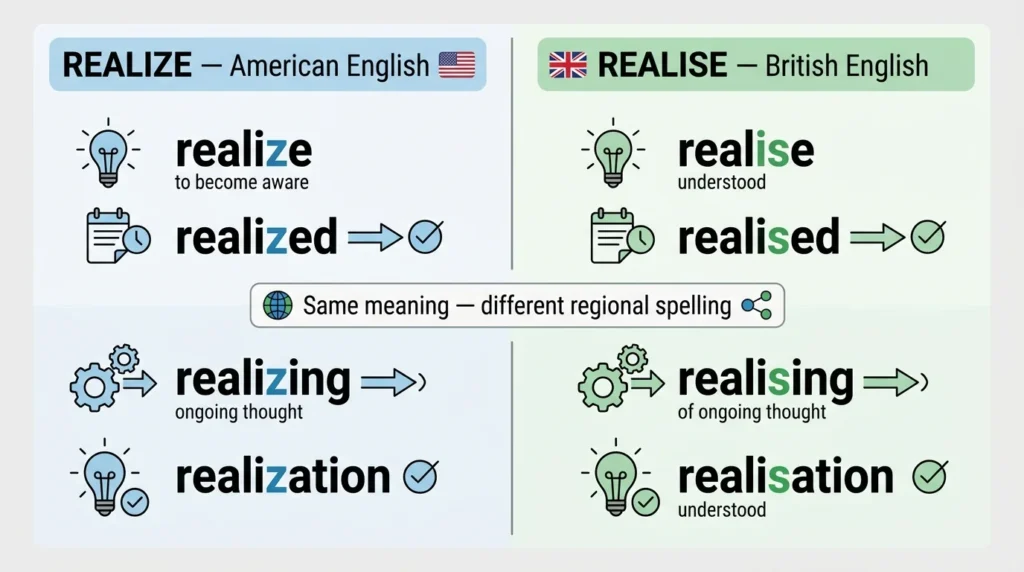
In these meanings, realize and realise function in the same way. The difference is the spelling of the final syllable:
- realize → z
- realise → s
The pronunciation is essentially the same, and changing the s to z does not create a different word or meaning. Major learner dictionaries identify realise as the usual British form of realize.
For example:
- American English: I didn’t realize my mistake.
- British English: I didn’t realise my mistake.
Both sentences communicate exactly the same idea.
Why It Matters
This spelling difference matters when you are writing for a particular audience.
Imagine that you are preparing:
- a university assignment
- a business report
- a professional email
- a website
- a résumé or CV
- an academic paper
- a book
- a social media post
Using realize in an American English document is normal. Using realise in a British English document is also normal.
The problem usually appears when a writer mixes spelling systems unnecessarily.
For example:
I realized the company was changing its colour.
Here, realized follows the -ize spelling, while colour follows the British -our spelling.
This combination is not automatically grammatically wrong, but it may make the document’s chosen English variety less consistent.
Consistency is especially useful in professional, academic, and published writing.
Read More: Smoky vs Smokey: Which Spelling Is Correct?
The Core Rule
Use “realize” for American English and “realise” for British English when following the usual regional spelling conventions. Both forms have the same meaning.
A simple way to decide:
- Writing in American English? Use realize.
- Writing in British English? Use realise.
- Following a specific style guide? Follow that guide consistently.
- Writing for an international audience? Choose a spelling standard and use it consistently.
There is no difference in meaning between the two spellings.
How to Use Realize and Realise
Use “realize” in American English
Examples:
- I didn’t realize how late it was.
- She finally realized that she had made a mistake.
- We realize the importance of good communication.
- He hopes to realize his ambition of becoming a doctor.
Use “realise” in British English
Examples:
- I didn’t realise how late it was.
- She finally realised that she had made a mistake.
- We realise the importance of good communication.
- He hopes to realise his ambition of becoming a doctor.
The grammatical structure remains the same. Only the spelling changes.
The verb can commonly be followed by that, a question word, or a noun phrase:
- I realized that I was wrong.
- She realised how difficult the task would be.
- They realized the importance of preparation.
Dictionary examples also show realize used for becoming aware, achieving ambitions, and making something real.
Related forms
The same spelling pattern continues in other forms of the word:
| Form | American English | British English |
|---|---|---|
| Base verb | realize | realise |
| Past tense | realized | realised |
| -ing form | realizing | realising |
| Noun | realization | realisation |
For example:
- She realized the truth.
- She realised the truth.
- He is realizing his potential.
- He is realising his potential.
- The realization came suddenly.
- The realisation came suddenly.
The regional spelling distinction therefore does not disappear when the verb changes form.
Correct Examples
Here are examples across different types of everyday and professional writing.
| Situation | Correct Example |
|---|---|
| Conversation | I didn’t realize you were waiting for me. |
| I realize that this may have caused some confusion. | |
| Workplace | We realized that the report contained an error. |
| School | She realised that she had forgotten her notebook. |
| University | The researchers realized that the results required further analysis. |
| Social media | I didn’t realise how quickly the year had passed. |
| Interview | I realized that communication was one of my strongest skills. |
| Business | The company realised the importance of improving customer service. |
| Personal writing | He slowly realized what had happened. |
| Academic writing | The study helped researchers realise the wider implications of the findings. |
The exact spelling in these examples should be adjusted according to the English variety being used.
Incorrect vs. Correct
The following table focuses on situations where writers incorrectly treat the two spellings as different words or mix spelling conventions without a clear reason.
| ❌ Incorrect | ✅ Correct | Why |
|---|---|---|
| I did not realise in American English. | I did not realize in American English. | American English normally uses -ize. |
| I didn’t realize in British English when following an -ise house style. | I didn’t realise. | A British -ise style should be applied consistently. |
| She realisied the problem. | She realised the problem. | The past form is realised, not realisied. |
| He is realiseing the problem. | He is realising the problem. | The final e is dropped before -ing. |
| She realizated the problem. | She realized the problem. | The verb’s past form is realized. |
| They realisation the danger. | They realised the danger. | Realisation is a noun, not the past tense of the verb. |
| I realized that how difficult it was. | I realized how difficult it was. | Do not normally combine that and the question-word construction here. |
| I realised about the mistake. | I realised the mistake. | Realise does not normally require about in this construction. |
| She realized to leave early. | She realized that she needed to leave early. | The verb requires a suitable complement; realized to leave is not natural standard usage. |
| He finally realise what happened. | He finally realised what happened. | The past-time context requires the past form. |
The important point is that realize and realise themselves are not competing grammatical forms. They are spelling variants. Errors usually occur when writers change the spelling incorrectly or use the wrong grammatical form.
Why People Make This Mistake
Phonetic similarity
When you hear realize and realise, you generally cannot determine from pronunciation whether the writer uses s or z.
That means listening alone cannot tell you which spelling to type.
Spelling overlap
English contains many words with -ise and -ize variations. This can make learners wonder whether the difference changes meaning.
In this case, it does not.
Overgeneralisation
A learner may learn:
British English = -ise
and then assume every British word ending in this sound must use -ise.
That is too simple. British spelling conventions are more complicated than one universal rule, and some British publishers and style systems use -ize spellings. Oxford’s style, for example, uses -ize in relevant words.
Autocomplete and spellcheck
Your software may accept one form and flag another depending on the language setting.
A document set to English (United States) may prefer realize.
A document set to English (United Kingdom) may prefer realise.
That does not necessarily mean the other spelling is universally wrong. It may simply indicate a different language setting.
Translation interference
Learners who move between English varieties may see one spelling in textbooks and another online. This can make the two forms appear to have different meanings.
They do not.
Common Mistakes Checklist
Mistake 1: Thinking one spelling is always correct
Why it happens: Learners often learn one spelling first.
How to avoid it: Remember that English has regional spelling standards.
Mistake 2: Mixing forms in one document
Why it happens: Writers may copy words from different sources.
How to avoid it: Set your document’s English language preference before proofreading.
Mistake 3: Writing “realisied”
Why it happens: Writers may try to apply a familiar spelling-change pattern incorrectly.
How to avoid it: Memorize the correct pair:
realize → realized
realise → realised
Mistake 4: Writing “realiseing”
Why it happens: The writer adds -ing without applying the normal spelling change.
How to avoid it:
realize → realizing
realise → realising
Mistake 5: Assuming the “z” version sounds different
Why it happens: The letters s and z look different.
How to avoid it: Treat the two as regional spelling variants, not separate vocabulary items.
Read More: Treet vs Treat: Which Spelling Is Correct?
Realize vs Realise in Real English
Grammatically correct: “I realized the problem.”
This is completely standard English. In American English, realized is the normal spelling. The sentence means that the speaker became aware of or understood the problem.
In British English, the equivalent is “I realised the problem.” The difference is spelling, not grammar or meaning. Dictionary definitions support the same core meaning for both forms.
Grammatically correct: “I realised that I was wrong.”
This is natural British English. The structure realise + that-clause is a normal way to express becoming aware of a fact.
The American equivalent is:
I realized that I was wrong.
Neither sentence is more grammatically correct. The spelling reflects the English variety being followed.
Grammatically possible but less natural: “I realized about the problem.”
This construction is generally not the natural way to express the idea.
A writer would normally say:
I realized the problem.
or, depending on the intended meaning:
I realized that there was a problem.
The issue here is not realize vs realise. It is the construction used after the verb.
Natural everyday English: “I didn’t realize.”
This is extremely common conversational English when someone says they were unaware of something.
For example:
“You were supposed to bring your passport.”
“Oh, I didn’t realize.”
The British spelling would be:
“Oh, I didn’t realise.”
The underlying expression is the same.
American vs. British English
There is a genuine regional spelling difference.
| English variety | Usual spelling | Example |
|---|---|---|
| American English | realize | I didn’t realize what happened. |
| British English | realise | I didn’t realise what happened. |
Cambridge identifies realise as the usual UK form, while Oxford lists realise as the British form alongside realize. (Cambridge Dictionary)
An important detail is that British English is not simply a system where every relevant verb must use -ise. Some British writing standards use -ize. Oxford style is a well-known example.
So the most accurate rule is:
American English normally uses “realize.” British English commonly uses “realise,” but “realize” also occurs in British English under some spelling conventions.
This is more accurate than saying that realise is always the only correct British spelling.
Formal vs. Informal Usage
The choice between realize and realise is not primarily a formal-versus-informal distinction.
Both can be used in:
- casual conversation
- emails
- business writing
- academic writing
- journalism
- professional documents
- formal reports
The important question is usually which English spelling standard you are following, not how formal the sentence is.
For example, both of these can appear in formal writing:
The researchers realized that the initial assumption was incorrect.
The researchers realised that the initial assumption was incorrect.
The spelling changes with the chosen English variety or style convention.
Read More: Their vs Thier: Which Spelling Is Correct?
Comparison Table
| Feature | Realize | Realise |
|---|---|---|
| Part of speech | Verb | Verb |
| Meaning | Become aware; understand; make real; achieve | Same |
| Main spelling | -ize | -ise |
| Common US form | Yes | No |
| Common UK form | Less common but used in some styles | Yes |
| Pronunciation | Same | Same |
| Meaning difference | None | None |
| Formality | Neutral | Neutral |
| Past tense | realized | realised |
| -ing form | realizing | realising |
| Noun | realization | realisation |
Memory Trick
Think:
Z = American “realize”
S = British “realise”
Then remember the bigger pattern:
realize → American
realise → British
You do not need to memorize a new meaning for each spelling.
Just ask:
“Which English am I writing?”
Then choose the spelling that matches your chosen standard.
Real-Life Situations
Job interview
American English:
“I realized that my strongest skill was solving problems under pressure.”
British English:
“I realised that my strongest skill was solving problems under pressure.”
Business meeting
American English:
“We realized that the deadline needed to be changed.”
British English:
“We realised that the deadline needed to be changed.”
American English:
“I realize there was some confusion about the schedule.”
British English:
“I realise there was some confusion about the schedule.”
Text message
“I didn’t realize you were already there.”
or:
“I didn’t realise you were already there.”
Both communicate the same idea.
Exam
If your school or examination system follows British English, use the spelling expected by that system. If it follows American English, use realize.
The important thing is not to switch randomly between regional conventions.
Mini Quiz
| # | Question | Answer | Explanation |
|---|---|---|---|
| 1 | Which spelling is standard in American English: realize or realise? | Realize | American English normally uses -ize. |
| 2 | Which spelling is commonly used in British English? | Realise | British English commonly uses the -ise form. |
| 3 | Fill in: “I didn’t ___ that you had already left.” | realize / realise | Both are correct; choose according to your English variety. |
| 4 | Correct the sentence: “She realisied her mistake.” | She realised her mistake. | The correct past form is realised. |
| 5 | Correct the sentence: “He is realiseing the importance of practice.” | He is realising the importance of practice. | The e is dropped before -ing. |
| 6 | True or false: Realize and realise have different meanings. | False | They are spelling variants of the same verb. |
| 7 | Choose the American English sentence: A) I realised the truth. B) I realized the truth. | B | American English normally uses realized. |
| 8 | Choose the British English sentence: A) She realized her mistake. B) She realised her mistake. | B | Realised is the common British spelling. |
| 9 | Correct the sentence: “I realized about the problem.” | I realized the problem. / I realized that there was a problem. | The original construction is not the natural standard construction. |
| 10 | Correct this sentence in American English: “The team realised the importance of consistency.” | The team realized the importance of consistency. | Change -ise to -ize when following American spelling. |
Expert Tips
1. Decide your English variety before proofreading
If you are writing a long document, decide whether it will follow American or British English first.
This prevents small spelling differences from appearing throughout the document.
Read More: Pricy vs Pricey: Which Spelling Is Correct?
2. Change the whole word family
Do not change only realize.
If you choose the British spelling, remember:
- realise
- realised
- realising
- realisation
If you choose the American spelling:
- realize
- realized
- realizing
- realization
3. Do not confuse spelling with grammar
The difference between realize and realise is mainly orthographic—meaning it concerns how the word is written.
It does not create two different grammatical verbs.
4. Check your software language setting
If your spellchecker repeatedly flags your preferred spelling, check whether your document is set to US, UK, or another English variety.
The software may be enforcing a different regional dictionary.
5. Follow the required style guide
For academic, professional, or publishing work, your institution or publisher may specify a spelling system.
Follow that requirement rather than changing spellings based on personal preference.
6. Do not “correct” British spelling into American spelling automatically
If someone writes:
I didn’t realise what had happened.
that is not automatically a spelling mistake.
It may simply be British English.
7. Consistency matters more than switching back and forth
If your document uses British English, realise fits that system. If it uses American English, realize fits it.
The goal is a coherent document, not a mixture of regional spellings.
FAQ
Is “realize” or “realise” correct?
Both are correct spellings. Realize is the usual American English spelling, while realise is commonly used in British English.
Is “realise” wrong in American English?
In standard American English, realize is the expected spelling. American dictionaries and usage generally use the -ize form.
Is “realize” wrong in British English?
Not necessarily. Realise is common in British English, but realize is also used in Britain, including in some established spelling styles.
Do realize and realise mean the same thing?
Yes. They can mean to become aware of something, understand something, achieve something, or make something real, depending on context.
Are realize and realise pronounced differently?
No meaningful pronunciation difference is created by the spelling. The two forms represent the same verb.
Which should I use in an American essay?
Use realize if your essay follows standard American English.
Which should I use in a British essay?
Realise is the common British choice, unless your institution, publisher, or style guide specifically uses -ize spellings.
Is “realized” American and “realised” British?
Generally, yes. Realized is the American spelling, while realised is the common British spelling.
What is the noun form of realize?
The noun is realization in American English and commonly realisation in British English.
Is “realising” correct?
Yes. Realising is the British spelling of the -ing form. The American spelling is realizing.
Is realize a verb?
Yes. Realize/realise is a verb. It can describe becoming aware of something or achieving/making something real.
Quick Summary
Realize and realise are two spellings of the same English verb. They have the same meaning, pronunciation, and grammatical function. Realize is the standard spelling normally used in American English, while realise is commonly used in British English. The difference is therefore mainly regional spelling, not grammar or meaning. British English can also use realize in some spelling conventions, so it is too strong to say that realise is always the only British form. The same pattern appears in related forms: realized/realised, realizing/realising, and realization/realisation. When writing, choose the spelling that matches your intended English variety, required style guide, or publication standard—and use it consistently throughout the document.