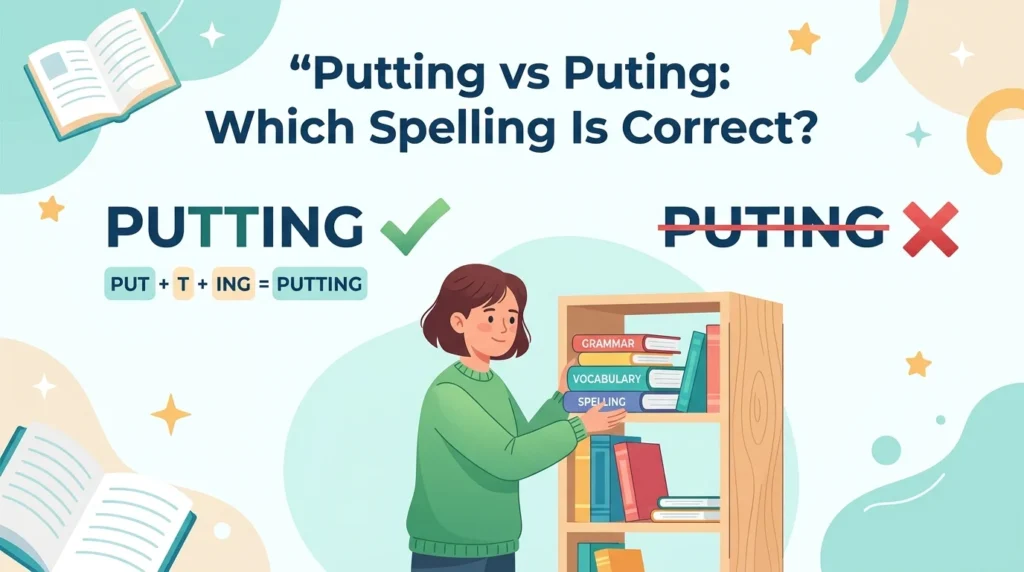

Putting is the correct spelling. Puting is a misspelling and is not the standard English form. The word putting is the -ing form of the verb “put” and can function as a present participle or a gerund. The spelling contains two t’s: put + t + ing = putting. Use putting in everyday conversation, emails, academic writing, business communication, and formal documents.
What Is Putting?
Putting is the -ing form of the verb “put.” The verb put generally means to place, move, position, or cause something to be in a particular place or condition.
For example:
- I am putting the books on the shelf.
- She is putting her phone away.
- They are putting the plan into action.
In grammar, putting can have two important functions.
Putting as a Present Participle
A present participle is the -ing form of a verb. It is commonly used with forms of be to create continuous tenses.
For example:
She is putting the files in order.
Here, is putting describes an action that is happening around the present time.
Other examples include:
- He is putting the dishes away.
- We were putting together the presentation.
- They are putting new procedures in place.
Putting as a Gerund
A gerund is an -ing form that functions as a noun.
For example:
Putting things off can create unnecessary stress.
Here, putting things off is the subject of the sentence. It names an activity rather than describing an action being performed by a particular subject.
More examples:
- Putting money aside requires discipline.
- Putting customers first can strengthen a business.
- Putting your ideas into writing makes them easier to evaluate.
So, putting is a normal and versatile English word. The problem is not its meaning. The problem is remembering to spell it with two t’s.
Why It Matters
A missing t may look like a small spelling mistake, but spelling errors can affect how your writing is perceived.
Consider these situations:
- Email: “I am puting together the report.”
- School: “She is puting her answer on the board.”
- Business: “We are puting a new system in place.”
- Social media: “Just puting this out there.”
- Academic writing: “The study is puting forward a different explanation.”
In every example, puting distracts the reader because the standard spelling is putting.
The correct spelling is especially important when your writing represents you professionally. A simple spelling error can make an otherwise polished email, report, application, or article look less carefully edited.
The Core Rule
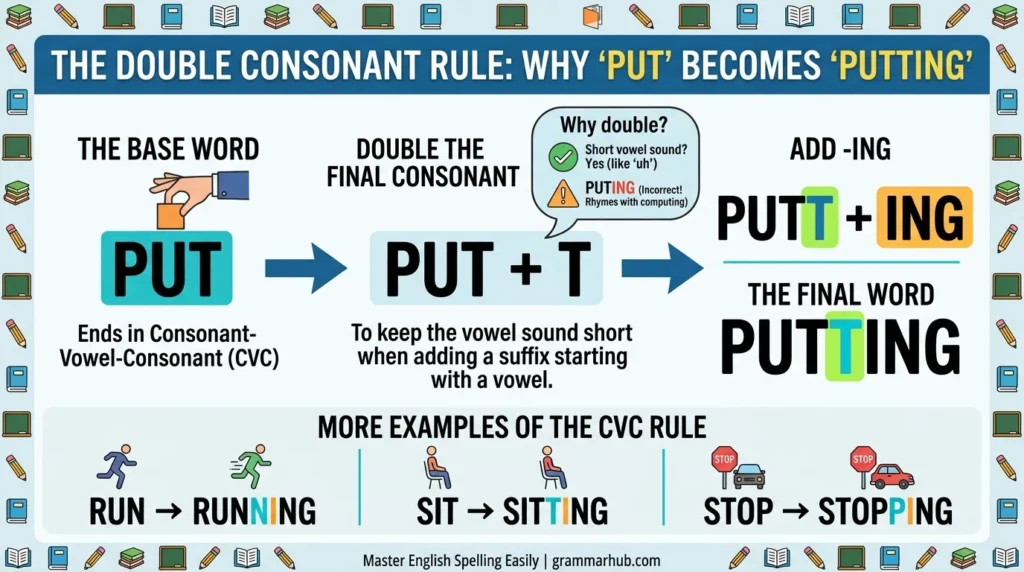
When the verb “put” takes the -ing ending, its final “t” is doubled: put → putting.
The spelling is:
put + t + ing = putting
Not:
put + ing = puting ❌
The word put is a short, one-syllable verb ending in a consonant after a single vowel. It belongs to a group of verbs in which the final consonant is doubled when certain suffixes, including -ing, are added. Similar patterns occur in words such as run → running, sit → sitting, and stop → stopping.
A Simple Way to See It
Look at the base word:
P — U — T
- P = consonant
- U = vowel
- T = consonant
Add -ing:
PUT + ING
Double the final T:
PUTT + ING
Result:
PUTTING
This is why the correct spelling has two t’s.
How to Use Putting
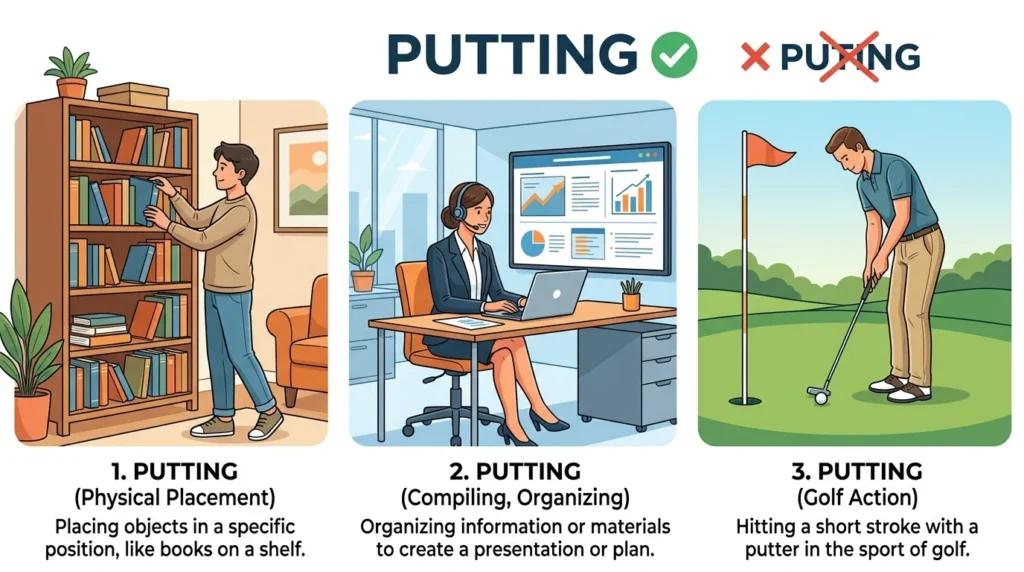
The most common use of putting is to describe the action of placing, positioning, or moving something.
Putting Something Somewhere
I am putting the keys on the table.
Putting Something Away
She is putting her clothes away.
Putting Something Together
We are putting together a new presentation.
Putting Something Into Practice
The team is putting the new strategy into practice.
Putting Something Into Words
He had difficulty putting his feelings into words.
Putting Effort Into Something
She is putting a lot of effort into her studies.
Putting Something Off
Putting off means delaying something.
I keep putting off my doctor’s appointment.
Putting Something Forward
Putting forward means presenting an idea, proposal, argument, or suggestion for consideration.
The researcher is putting forward a new explanation.
Putting in Place
This expression means establishing or implementing something.
The company is putting new safety measures in place.
Putting in Golf
Putting also has a specific meaning in golf. It refers to using a putter to hit the ball along the green toward the hole.
His putting has improved considerably this season.
The spelling remains putting.
Correct Examples
Here are examples from different real-world situations.
| Situation | Correct Example |
|---|---|
| Conversation | “I’m putting the kettle on.” |
| Home | “She is putting the dishes away.” |
| “I’m putting together the information you requested.” | |
| Workplace | “We are putting a new process in place.” |
| School | “The teacher is putting the students into groups.” |
| University | “The researcher is putting forward a new argument.” |
| Social media | “Just putting this out there.” |
| Business | “The company is putting more resources into customer service.” |
| Personal writing | “I am putting my thoughts into words.” |
| Golf | “His putting was excellent today.” |
| Planning | “We are putting together a detailed schedule.” |
| Everyday life | “He is putting his shoes by the door.” |
Notice that the spelling does not change according to the situation. Whether you are writing a text message, a university paper, or a business report, the correct form is putting.
Incorrect vs. Correct
| ❌ Incorrect | ✅ Correct | Why |
|---|---|---|
| I am puting the books away. | I am putting the books away. | The final t must be doubled before -ing. |
| She is puting the files on my desk. | She is putting the files on my desk. | Put becomes putting, not puting. |
| They are puting together a proposal. | They are putting together a proposal. | The standard spelling has two t’s. |
| He is puting his phone away. | He is putting his phone away. | One t is missing in the incorrect form. |
| We were puting the chairs outside. | We were putting the chairs outside. | The final consonant is doubled. |
| She enjoys puting things in order. | She enjoys putting things in order. | The gerund form is also spelled putting. |
| I am puting more effort into my work. | I am putting more effort into my work. | Putting is the correct -ing form. |
| The company is puting a new system in place. | The company is putting a new system in place. | The second t is required. |
| He is puting his ideas into words. | He is putting his ideas into words. | Put + ing produces putting. |
| She is puting for the final hole. | She is putting for the final hole. | The golf term is also spelled putting. |
| They are puting the plan into action. | They are putting the plan into action. | Puting is a spelling error. |
| I keep puting the task off. | I keep putting the task off. | The phrasal verb still uses putting. |
Why People Make This Mistake
The mistake puting is understandable because English spelling does not always behave consistently.
1. The Base Word Looks Very Short
The word put is only three letters long. When learners add -ing, they may simply attach the ending mechanically:
put + ing → puting
That looks logical at first glance.
The problem is that English spelling rules require the final consonant to be doubled in this pattern.
2. Learners Overgeneralise
Some verbs simply take -ing without changing their spelling:
- read → reading
- work → working
- play → playing
- help → helping
A learner may therefore assume:
put + ing = puting
But English has different spelling patterns depending on the ending of the base verb.
3. Pronunciation Does Not Help Much
The two spellings do not sound dramatically different when spoken quickly.
Because the extra t is not usually perceived as a separate, strong sound, learners may not notice that the written word needs two t’s.
4. Typing Quickly
Puting can simply be a typing error. When people type quickly, repeated letters are easy to omit.
5. Spellcheck Is Not a Grammar Teacher
Spellcheck can catch many errors, but it should not replace knowledge of spelling patterns. Depending on the software and context, an incorrect form may not always be immediately flagged.
6. Translation Interference
Learners whose first language does not use English-style consonant doubling may naturally find puting more logical than putting.
The solution is not to memorise the spelling as an isolated exception. Learn the pattern:
put → putting
and connect it with similar examples such as:
sit → sitting
run → running
stop → stopping
Common Mistakes Checklist
Mistake 1: Writing “puting”
Problem: The second t is missing.
Fix: Remember:
put → putting
Mistake 2: Assuming Every Verb Behaves the Same Way
Problem: Learners may add -ing without considering the spelling pattern.
Fix: Look at the ending of the base verb before adding the suffix.
Mistake 3: Confusing “Put” and “Putting”
These forms are not interchangeable.
I put the book on the desk yesterday.
But:
I am putting the book on the desk now.
Mistake 4: Forgetting the Second T in Phrases
The spelling remains the same in expressions such as:
- putting together
- putting away
- putting off
- putting forward
- putting into practice
- putting in place
Mistake 5: Thinking “Puting” Is an Alternative Spelling
It is not a standard alternative spelling of putting. In standard English, use putting.
Putting in Real English
Natural and Everyday
Putting is completely natural in everyday English when it describes placing or positioning something.
“I’m putting the groceries away.”
This is ordinary conversational English. Native speakers do not normally replace putting with another form simply because the situation is casual.
Grammatically Correct but More Context-Dependent
Some expressions with putting are grammatically correct but depend heavily on context.
“Putting everything together took three hours.”
This is perfectly natural when discussing an activity or process. However, the exact meaning of putting depends on what follows it. English speakers commonly use putting with particles and prepositions such as away, together, off, forward, and into.
Natural in Formal English
Putting is not an informal word. It works naturally in professional and academic writing when the meaning requires it.
“The researchers are putting forward an alternative explanation.”
“The organisation is putting new safety procedures in place.”
There is no need to replace putting with a more complicated word simply to make writing sound formal.
Natural in Informal English
It is equally normal in casual speech:
“I’m putting my phone away.”
“Just putting this out there.”
The word itself does not determine whether the sentence is formal or informal. The surrounding expression and context do.
American vs. British English
There is no spelling difference between American and British English for this word.
| English Variant | Correct Spelling |
|---|---|
| American English | putting |
| British English | putting |
| Canadian English | putting |
| Australian English | putting |
| International English | putting |
Puting is not a standard regional alternative.
So you do not need to remember two versions. Whether your audience uses American or British English, write putting.
Formal vs. Informal Usage
Putting is suitable in both formal and informal English.
Formal
The organisation is putting new policies into effect.
The researchers are putting forward a possible explanation.
Informal
I’m putting my shoes on.
Just putting this out there.
The spelling does not change between the two registers.
The difference comes from the surrounding vocabulary and sentence structure, not from the word putting itself.
Putting vs. Puting: Comparison Table
| Feature | Putting | Puting |
|---|---|---|
| Spelling | ✅ Correct | ❌ Incorrect |
| Base verb | Put | Intended to be put |
| Form | -ing form of put | Misspelling |
| Standard English | Yes | No |
| Formal writing | Correct | Avoid |
| Informal writing | Correct | Still incorrect |
| American English | Correct | Incorrect |
| British English | Correct | Incorrect |
| Meaning | Placing, positioning, etc. | No standard meaning |
| Example | “She is putting the book away.” | “She is puting the book away.” ❌ |
Putting vs. Put: Do Not Confuse the Forms
Another common issue is confusing put with putting.
| Form | Example | Function |
|---|---|---|
| put | I put the keys here every morning. | Base/present form |
| put | I put the keys here yesterday. | Past form |
| put | I have put the keys here. | Past participle |
| putting | I am putting the keys here now. | -ing form |
The verb put is unusual because its base form, past form, and past participle are all put.
But when you add -ing, the form becomes:
put → putting
Not puting.
Memory Trick
Use this simple mnemonic:
“Two T’s keep things Putting in place.”
Think of the two t’s as two hands helping to put something in position.
Another quick visual:
PUT + T + ING = PUTTING
If you remember “put needs two T’s when it is putting,” the spelling becomes much easier to recall.
Real-Life Situations
Interview
An interviewer asks about your current responsibilities.
“I’m putting together a new customer-service process for the company.”
Workplace Meeting
A manager explains a new plan.
“We are putting the new system in place next month.”
You need more time to finish a report.
“I’m putting together the final section and will send it shortly.”
Text Message
A friend asks what you are doing.
“I’m putting dinner together. I’ll call you later.”
School Exam
A student describes an activity.
“The teacher is putting the students into groups.”
Academic Writing
A researcher presents an argument.
“The study is putting forward an alternative interpretation.”
Social Media
Someone shares an opinion:
“Just putting this out there: consistency matters more than motivation.”
Golf
A player describes their performance:
“My putting was much better today.”
Mini Quiz
| # | Question | Answer | Explanation |
|---|---|---|---|
| 1 | Which is correct? A) puting B) putting | B) putting | The correct -ing form of put is putting. |
| 2 | Fill in the blank: “She is ___ the books away.” | putting | The sentence needs the -ing form of put. |
| 3 | Correct the sentence: “I am puting my phone away.” | I am putting my phone away. | Putting has two t’s. |
| 4 | Which spelling is correct? A) putting B) puting | A) putting | Puting is a misspelling. |
| 5 | Fill in the blank: “They are ___ together a proposal.” | putting | The phrase is putting together. |
| 6 | Is this correct? “We are puting a new policy in place.” | No. | It should be “We are putting a new policy in place.” |
| 7 | Choose the correct sentence: A) He is puting his shoes on. B) He is putting his shoes on. | B | The correct spelling is putting. |
| 8 | Complete the word: PUT + T + ING = ? | PUTTING | The final t is doubled before -ing. |
| 9 | Correct this sentence: “She enjoys puting things in order.” | She enjoys putting things in order. | Here putting is a gerund functioning as a noun. |
| 10 | True or false: British English uses “puting” while American English uses “putting.” | False | Both varieties use putting. |
Expert Tips
1. Learn the Word as a Complete Unit
Do not repeatedly construct the word letter by letter.
Learn:
putting
as one complete spelling.
2. Connect It to Similar Words
Build a small mental group:
- run → running
- sit → sitting
- get → getting
- stop → stopping
- put → putting
Seeing the pattern makes the spelling easier to remember.
3. Watch for “-ing” After Short Verbs
When adding -ing to a short verb, do not automatically assume that nothing changes.
Check whether the final consonant needs doubling.
4. Remember That “Putting” Is Not Informal
You do not need a more formal substitute for putting.
It is perfectly acceptable in:
- academic writing
- professional reports
- business emails
- formal presentations
- everyday conversation
5. Proofread Repeated Letters
When editing your writing, specifically look for words where a repeated consonant may have been accidentally omitted.
Examples include:
- putting
- running
- sitting
- planning
- stopping
6. Do Not Let Pronunciation Decide the Spelling
English spelling cannot always be reconstructed from pronunciation alone.
When in doubt, remember the written form:
PUTTING
FAQ
Is “puting” a word?
Puting is not the standard spelling of the -ing form of put. In standard English, the correct form is putting.
Is it “putting” or “puting”?
It is putting with two t’s.
✅ putting
❌ puting
Why does “put” become “putting”?
The final consonant is doubled before the -ing ending in this spelling pattern.
put → putting
Does “putting” have two t’s?
Yes. The correct spelling is p-u-t-t-i-n-g.
Is “puting” ever correct?
Not as the standard -ing form of the English verb put. If you mean the action described by put, use putting.
Is “putting” a verb?
Yes. Putting is the present participle of put and is used in continuous verb forms.
“She is putting the books away.”
It can also function as a gerund:
“Putting things away keeps the room tidy.”
What is the past tense of “put”?
The past tense is put.
Present: I put the book here.
Past: I put the book there yesterday.
The -ing form is different:
I am putting the book here.
Is “putting” correct in American English?
Yes. Putting is the standard spelling in American English.
Is “putting” correct in British English?
Yes. British English also uses putting.
Can I use “putting” in formal writing?
Yes. Putting is completely acceptable in formal writing when it expresses the intended meaning.
What is the easiest way to remember “putting”?
Remember:
PUT + T + ING = PUTTING
Or use the mnemonic:
Two T’s keep things putting in place.
Quick Summary
Putting is the correct spelling, while puting is a misspelling. Putting is the -ing form of the verb put and can function as a present participle or a gerund. The key spelling pattern is put → putting, with the final t doubled before -ing. This same type of consonant doubling appears in words such as running, sitting, getting, and stopping. Putting is correct in American and British English and works naturally in both formal and informal writing. If you are unsure, remember the simple formula: PUT + T + ING = PUTTING. Once you learn the pattern rather than memorising only the individual word, the spelling becomes much easier to use correctly.