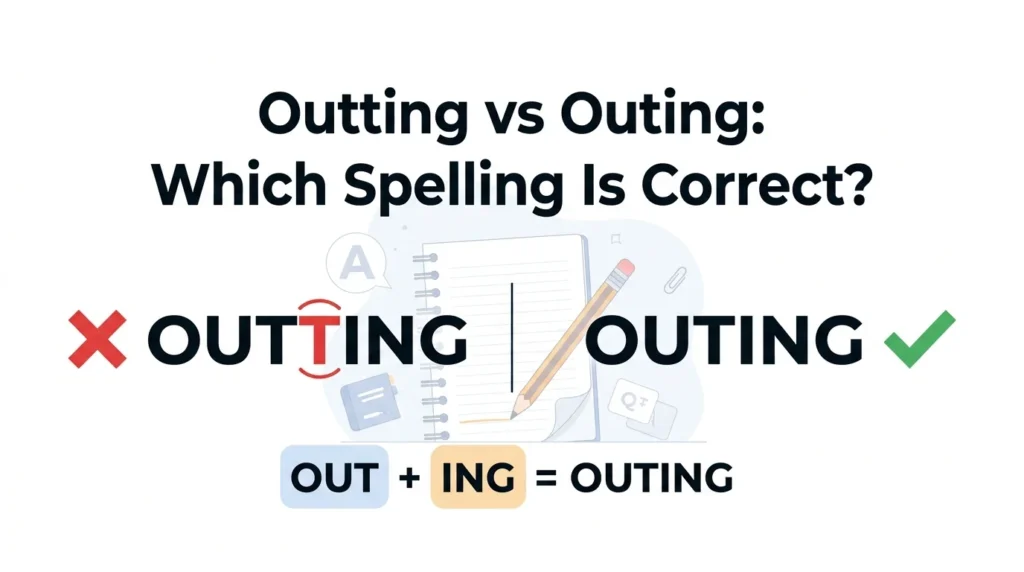

Outing is the correct spelling in standard modern English. Outting is a misspelling and should not be used in normal English writing. An outing can mean a short trip, excursion, or social activity, such as a family outing or school outing. The word can also refer to publicly revealing someone’s private identity or information. The correct form is simply out + ing = outing.
What Is the Difference Between Outting and Outing?
The difference is simple:
- Outing — correct
- Outting — incorrect in standard modern English
Outing is a real English word. It is commonly used as a noun for a short trip or activity away from home, school, or work.
For example:
We went on a family outing to the beach.
The school organized an outing for the students.
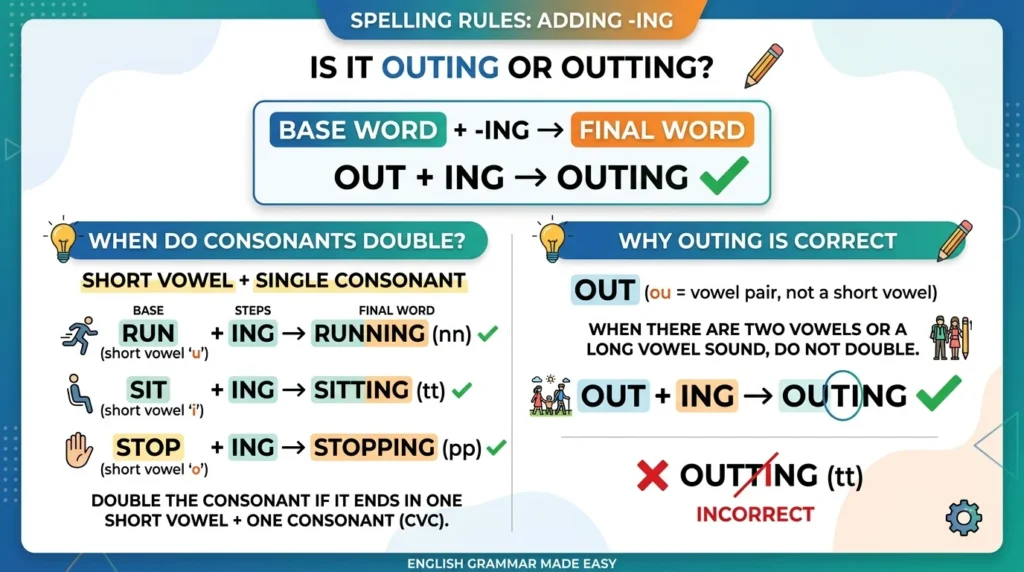
The spelling outting looks believable because English sometimes doubles a final consonant before adding -ing. Words such as running, sitting, and stopping follow specific spelling patterns. But out does not follow that pattern.
So the correct formation is:
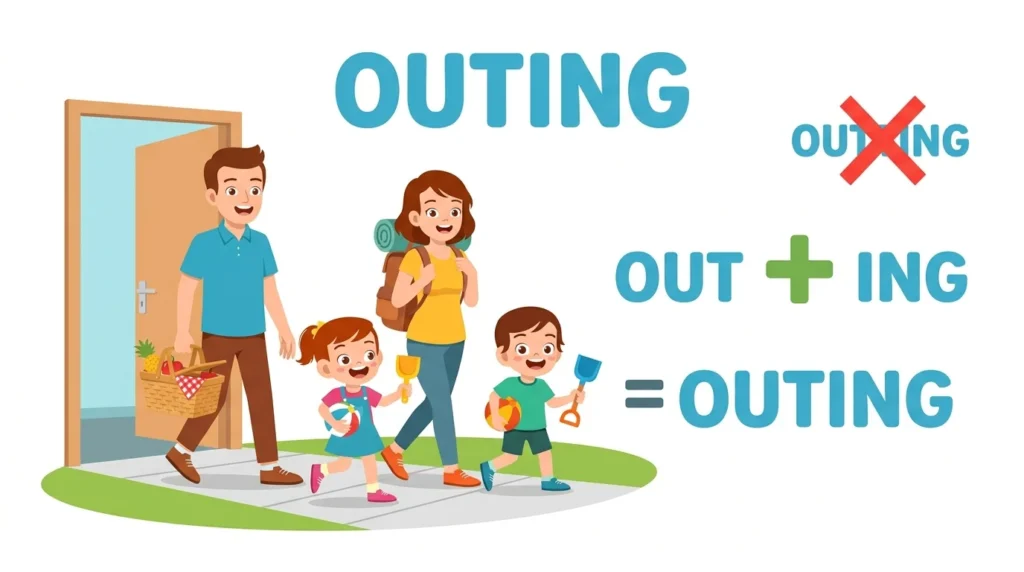
OUT + ING = OUTING
Not:
OUT + TING = OUTTING
Standard English dictionaries list outing as the established word. Cambridge defines it as a short trip made by a group of people, usually for pleasure or education, while Oxford also records meanings connected with sports and publicly revealing someone’s private identity.
Why It Matters
A spelling mistake such as outting may seem small, but it can affect how polished your writing looks.
You might use this word in:
- A school assignment
- A business email
- A company announcement
- A social media caption
- A travel blog
- A family message
- A workplace notice
- An academic paper
For example:
❌ We are planning a company outting next month.
The reader will probably understand what you mean, but the spelling is incorrect.
A better version is:
✅ We are planning a company outing next month.
In professional or academic writing, choosing the standard spelling helps your writing look accurate and carefully edited.
The Core Rule
RULE: The correct spelling is “outing,” with only one “t.”
out + ing = outing
Do not write outting when you mean the normal English word outing.
The important point is that adding -ing does not automatically mean doubling the final consonant. Consonant doubling depends on the spelling and pronunciation pattern of the base word.
Words such as:
- run → running
- sit → sitting
- stop → stopping
follow a consonant-doubling pattern.
But:
- out → outing
does not.
The word out ends with the diphthong /aʊ/ followed by /t/, rather than the short-vowel pattern that triggers consonant doubling in words such as run and sit.
How to Use “Outing”
1. Outing as a Short Trip
The most common meaning of outing is a short trip or excursion, usually for pleasure, education, or social activity.
Examples include:
- a family outing
- a school outing
- a company outing
- a weekend outing
- a picnic outing
- an outing to the museum
For example:
We are going on a family outing this Sunday.
The students went on an outing to the science museum.
This meaning is recorded in major English dictionaries.
2. Outing as a Social Activity
An outing does not always have to be a formal trip. It can simply describe spending time outside the normal home or work environment.
Our team had a relaxing outing after the project ended.
We planned a weekend outing with our friends.
The emphasis is usually on the activity or occasion rather than on long-distance travel.
3. Outing in Sports
In sports writing, particularly in British English and sports reporting, outing can describe an occasion when a player competes in a match or competition.
For example:
The young striker impressed in his first outing for the club.
This use is different from a family trip, but the spelling remains exactly the same: outing. Oxford and Collins both record this sporting sense.
4. Outing as Public Revelation
The word outing can also refer to the act of publicly revealing private information about someone’s sexual orientation or identity, particularly when that person did not want the information made public.
This is a separate meaning from a trip or social activity.
For example:
The article was criticized for outing the actor without consent.
This meaning can be sensitive, so it should be used carefully and only when the context genuinely calls for it. Cambridge and Oxford both record this sense.
Correct Examples
Here are examples showing how outing works in different situations.
- Conversation:
“Are you free for a family outing this Saturday?” - School:
“Our class went on an outing to the national museum.” - Workplace:
“The company is organizing a team outing next Friday.” - Email:
“Please confirm whether you will attend the staff outing.” - Social media:
“What a beautiful day for a family outing!” - Travel:
“We planned a short outing to the countryside.” - Academic writing:
“The students participated in an educational outing to the historical site.” - Sports:
“The goalkeeper had an excellent outing in his first international match.” - Everyday English:
“We had a lovely outing with the children.” - Professional communication:
“Details of the annual company outing will be shared next week.” - Past event:
“The children really enjoyed their school outing.” - Future plan:
“We are planning an outing to the beach during the holidays.”
Incorrect vs. Correct
| ❌ Incorrect | ✅ Correct | Why |
|---|---|---|
| We had a family outting. | We had a family outing. | The standard spelling has one t. |
| The school planned an outting. | The school planned an outing. | Outting is not the standard spelling. |
| We enjoyed our weekend outting. | We enjoyed our weekend outing. | Do not double the final t in out. |
| The company organized an outting. | The company organized an outing. | The correct form is outing. |
| Are you coming on the outting? | Are you coming on the outing? | Outing is the accepted modern form. |
| It was a great family outting. | It was a great family outing. | The word is spelled with one t. |
| Our class went on an outting. | Our class went on an outing. | Adding -ing does not double the t here. |
| We are arranging an office outting. | We are arranging an office outing. | Outing is the correct noun. |
| The children loved the school outting. | The children loved the school outing. | Outting is a spelling error. |
| They posted photos from their outting. | They posted photos from their outing. | Use the standard spelling outing. |
Why People Make This Mistake
The mistake is understandable because English has many words that double their final consonant when -ing is added.
Compare:
- run → running
- sit → sitting
- swim → swimming
- stop → stopping
A learner may notice this pattern and assume:
out → outting
But that is an overgeneralization. In other words, the learner has learned a real spelling rule but applies it where it does not belong.
Phonetic Similarity
When spoken quickly, outing may not feel visually obvious to a learner. The /t/ sound is part of the pronunciation, so the spelling outting can seem reasonable.
However, pronunciation alone does not determine whether a consonant should be doubled in spelling.
Spelling Overlap
Words such as sitting, getting, and putting contain double consonants. Seeing these familiar patterns can make outting look familiar even though it is incorrect in standard modern English.
Overgeneralization
A learner may remember:
“When I add -ing, sometimes I double the last letter.”
The missing part is:
“I double the final consonant only when the relevant spelling pattern requires it.”
English spelling rules are pattern-based, not simply “add -ing and double the last letter.”
Autocomplete and Spellcheck
Digital tools can help identify spelling mistakes, but they should not replace language knowledge.
A spellchecker may flag outting, suggest outing, or behave differently depending on the software and dictionary being used.
The safest solution is to know the standard spelling yourself.
Translation Interference
Learners whose first language handles English consonant doubling differently may transfer a spelling pattern from their own language into English.
That can make outting seem logical even though standard English uses outing.
Common Mistakes Checklist
Mistake 1: Writing “outting”
Problem: You have doubled the final t unnecessarily.
Why it happens: You may be copying the pattern of running or sitting.
Fix: Remember:
out + ing = outing
Mistake 2: Thinking every short word doubles its final consonant
Problem: The rule is being treated as universal.
Why it happens: Consonant doubling is often taught through simple examples.
Fix: Check the vowel and consonant pattern rather than looking only at the final letter.
Mistake 3: Assuming pronunciation tells you the spelling
Problem: The /t/ sound can make the extra t feel necessary.
Why it happens: English pronunciation and spelling do not always match one-to-one.
Fix: Memorize the standard spelling: outing.
Mistake 4: Using “outting” in professional writing
Problem: A spelling error appears in a public or formal document.
Why it happens: The writer may type quickly and trust the first version.
Fix: Proofread words involving common spelling patterns.
Mistake 5: Confusing “outing” with “going out”
Problem: Learners may use outing for every situation involving leaving the house.
Why it happens: The meanings overlap.
Fix: Use outing when you mean a planned trip, excursion, or social activity, rather than simply any act of leaving home.
Outting vs. Outing in Real English
Outing
Outing is natural and widely used when talking about a short trip, group activity, or recreational event. Expressions such as family outing, school outing, company outing, and weekend outing are straightforward and natural in everyday English. The word also has established meanings in sports and in discussions of publicly revealing private information.
Outting
Outting is not the normal modern English spelling of the word described above. If you mean a trip, excursion, social activity, or the other modern meanings of outing, use outing. Historical or dialectal records can contain forms resembling outting, but that does not make it the appropriate spelling for ordinary contemporary English. The Dictionary of the Scots Language, for example, records historical Scots uses of outting.
“Outting” as a Modern English Choice
For ordinary writing, there is no useful modern distinction such as “outing for British English” and “outting for American English.” The standard form is outing. If you are writing an email, essay, article, school assignment, business message, or social media post, outing is the form you should choose.
American vs. British English
There is no meaningful American-vs.-British spelling difference between outing and outting.
Both American and British English use:
outing
The pronunciation may vary slightly between accents, but the spelling remains the same. Cambridge gives pronunciation information for both US and UK English while using the spelling outing in both varieties.
The meaning can also vary slightly by context. For example, outing has an established sports meaning in both dictionary traditions, while particular sports may make that usage more common in one variety or context than another.
Formal vs. Informal Usage
Outing works in both everyday and formal English.
Informal
We had a great family outing yesterday.
Want to join us for an outing this weekend?
Neutral or Professional
The company has arranged an annual outing for employees.
Students will participate in an educational outing.
Academic
The educational outing gave students an opportunity to examine the historical site firsthand.
The spelling does not change with formality.
Outting is not an informal alternative. It is simply the wrong spelling for standard contemporary English.
Comparison Table
| Feature | Outing | Outting |
|---|---|---|
| Standard modern English | ✅ Yes | ❌ No |
| Correct spelling | ✅ Yes | ❌ No |
| Means a short trip | ✅ Yes | ❌ No |
| Used for a social activity | ✅ Yes | ❌ No |
| Used in sports | ✅ Yes | ❌ No |
| Used for public revelation of private information | ✅ Yes | ❌ No |
| Suitable for formal writing | ✅ Yes | ❌ No |
| Suitable for casual writing | ✅ Yes | ❌ No |
| Standard US spelling | ✅ Yes | ❌ No |
| Standard UK spelling | ✅ Yes | ❌ No |
| Common spelling mistake | ❌ No | ✅ Yes |
Memory Trick
Use this simple trick:
You go OUT on an OUTING.
Start with OUT and simply add ING:
OUT + ING = OUTING
There is no need to add another T.
Think:
One OUT → one T → one T in OUTING.
So:
❌ OUTTING
✅ OUTING
Real-Life Situations
Interview
Interviewer: “What did you do during the company event?”
Candidate: “We had a team outing at a resort.”
Here, outing describes a group social activity.
Workplace Meeting
Manager: “Has everyone confirmed their attendance for the annual outing?”
The word works naturally in professional communication.
“Please let me know if you will be joining the company outing next Friday.”
This is correct and appropriate for a workplace email.
Text Message
“Are you free for a family outing tomorrow?”
This is a natural everyday use.
School
“Our teacher organized an outing to the museum.”
Here, outing refers to an educational trip.
Social Media
“Perfect weather for a weekend outing with friends!”
Again, outing is the correct spelling.
Sports Report
“The striker had an impressive outing in his first match for the club.”
Here, outing means an appearance or participation in a sporting contest. This is a recognized dictionary meaning.
Expert Tips
1. Learn the word as a whole
Instead of trying to reconstruct the spelling every time, memorize:
outing
This is especially useful for commonly confused words.
2. Do not apply consonant doubling mechanically
The rule is not:
“Add -ing and double the final consonant.”
The actual spelling system is more specific.
Compare:
- run → running
- sit → sitting
- stop → stopping
- out → outing
3. Remember the base word
The base word is out.
When -ing is added:
out + ing = outing
There is no spelling reason to insert another t.
4. Check the meaning before checking the spelling
If you mean a trip, excursion, or group activity, the word you need is outing.
5. Treat “outting” as a warning sign
If you type outting, stop and check it. In ordinary modern English, you almost certainly want outing.
6. Watch for the difference between spelling and pronunciation
The sound of a word does not always tell you how many letters should appear in its written form.
7. Build a personal confused-words list
If you repeatedly make the same spelling mistake, write down the correct form and use it in several original sentences. Active practice is more useful than simply reading the rule once.
Read More: Cubical vs Cubicle: Which Word Is Correct?
FAQ
Is “outting” a correct English word?
Not in standard modern English when you mean the usual word outing. For normal contemporary writing, use outing.
Is “outing” a noun or a verb?
Outing is commonly used as a noun, especially for a trip or social activity. It can also function as the -ing form of the verb out in contexts where out means to reveal someone’s private identity or information.
Why is it “outing” and not “outting”?
Because the word is formed as out + ing, without doubling the final t. The consonant-doubling patterns found in words such as running and sitting do not apply here.
How do you spell outing?
The correct spelling is:
O-U-T-I-N-G
There is only one t.
What does “outing” mean?
Most commonly, an outing is a short trip or excursion, often taken for pleasure, education, or social activity. The word also has established meanings in sports and in contexts involving public revelation of private information.
What is the plural of outing?
The plural is outings.
Example:
The school organized several outings during the academic year.
Is “outing” used in both American and British English?
Yes. Outing is the standard spelling in both American and British English.
Can “outing” be used in a business context?
Yes. A company outing or team outing is a common way to describe a social activity organized for employees.
Is “outing” formal or informal?
It can be either. The word is neutral and can appear in casual conversation, business communication, educational writing, and other contexts.
Is “outting” ever acceptable?
For ordinary modern English, no. Historical or dialectal sources may contain forms such as outting, but that is different from using outting as the modern spelling of outing. The Dictionary of the Scots Language records historical uses, but this does not make outting the standard spelling for contemporary English.
What is an easy way to remember “outing”?
Remember:
OUT + ING = OUTING
Or:
You go OUT on an OUTING.
Quick Summary
Outing is the correct spelling, while outting is incorrect in standard modern English. An outing usually means a short trip, excursion, or social activity, such as a family outing, school outing, or company outing. The word can also be used in sports and in the context of publicly revealing someone’s private information. The spelling is the same in American and British English. The main reason people write outting is that they incorrectly apply consonant-doubling patterns from words such as running and sitting. The easiest rule to remember is simple: out + ing = outing. If you mean the standard modern English word, always choose outing.
Mini Quiz
| # | Question | Answer | Explanation |
|---|---|---|---|
| 1 | Which spelling is correct? A) outting B) outing | B) outing | Outing is the standard spelling. |
| 2 | Fill in the blank: “We went on a family ____.” | outing | A family outing is a short social trip or activity. |
| 3 | Correct the sentence: “The school planned an outting.” | The school planned an outing. | Outting is a spelling error in standard English. |
| 4 | Which is correct? A) company outting B) company outing | B) company outing | The correct noun is outing. |
| 5 | Complete the formation: OUT + ING = ? | OUTING | No extra t is added. |
| 6 | True or false: “Outting” is the British spelling of “outing.” | False | Both British and American English use outing. |
| 7 | Correct the sentence: “We are going on a weekend outting.” | We are going on a weekend outing. | Outing is the standard form. |
| 8 | Which sentence is correct? A) Our class had an outting. B) Our class had an outing. | B | Outing is the correct spelling. |
| 9 | Fill in the blank: “The company organized an annual ____ for its employees.” | outing | Company outing is a natural expression. |
| 10 | Why is “outting” usually wrong? | Because the standard word is formed as out + ing. | The final t is not doubled in outing. |
Final Takeaway
If you are unsure between outting vs. outing, choose outing.
Correct: outing
Incorrect: outting
The simplest memory rule is:
OUT + ING = OUTING
Whether you are writing about a family trip, school activity, company event, sports appearance, or another established meaning of the word, the spelling remains outing.