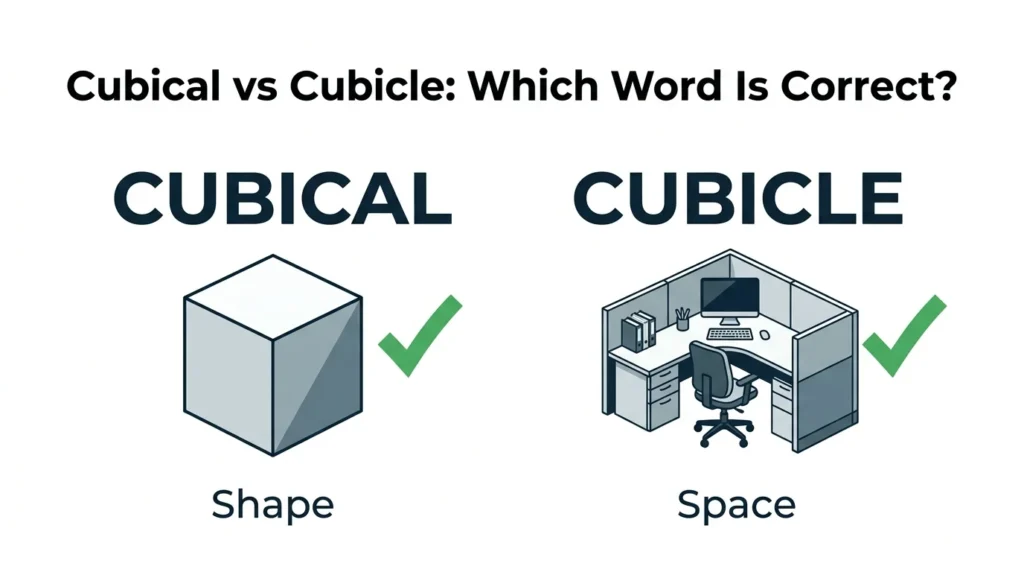

Cubical and cubicle are both correct English words, but they have different meanings and grammatical roles. Cubical is an adjective meaning “shaped like a cube” or “related to a cube.” Cubicle is a noun meaning a small enclosed or partitioned space, such as an office workspace, shower area, or changing space. If you mean an office workspace, the correct word is cubicle.
What Is the Difference Between Cubical and Cubicle?
The difference between cubical and cubicle is mainly about meaning and part of speech.
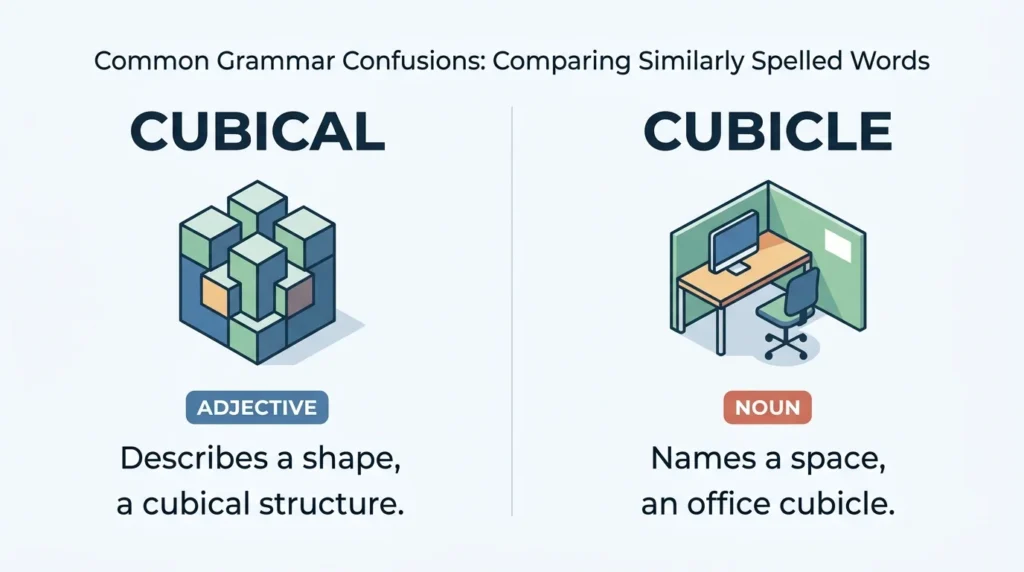
Cubical describes something. It tells you that an object or structure has the form or characteristics of a cube.
Cubicle names something. It usually refers to a small enclosed or partly enclosed space within a larger area.
The easiest way to remember the difference is:
- Cubical = describes a shape
- Cubicle = names a space
For example:
The sculpture has a cubical shape.
Here, cubical describes the sculpture.
She works in a cubicle.
Here, cubicle names the small workspace.
These words are easy to confuse because their spelling is almost identical and their pronunciation is commonly the same. The difference becomes much easier once you focus on what the word is doing in the sentence.
Why It Matters
Choosing cubical instead of cubicle can make your writing look careless, especially when you are talking about an office, workplace, school, or professional environment.
Consider this sentence:
I spent the afternoon working in my cubical.
The reader will probably understand what you mean, but the standard noun for the workspace is cubicle.
The correct sentence is:
I spent the afternoon working in my cubicle.
This distinction matters in several situations:
- Workplace communication: describing your office or workstation
- Emails: discussing office seating or workspace arrangements
- Academic writing: describing geometric shapes or structures
- Technical writing: explaining cube-shaped objects
- Architecture and design: describing three-dimensional forms
- Everyday conversation: talking about changing rooms, showers, or private spaces
The problem is not that one word is “real” and the other is “wrong.” Both are real words. The problem is using the right word for the intended meaning.
Read More: Until vs Untill: Which Spelling Is Correct?
The Core Rule
Use cubical when you are describing something as cube-shaped. Use cubicle when you are naming a small enclosed or partitioned space.
A quick test can help:
Are you describing a shape? → cubical
Are you naming a space? → cubicle
Compare:
The box is cubical.
I work in a cubicle.
The first word describes the shape of an object. The second names a physical space.
How to Use Cubical
Cubical is an adjective.
An adjective describes or modifies a noun. When you use cubical, you are saying that something has the shape, form, or characteristics of a cube.
You might use it when discussing:
- geometric shapes
- architecture
- product design
- sculpture
- three-dimensional objects
- mathematical or scientific subjects
Examples include:
The artist created a cubical sculpture.
The building contains several cubical structures.
The machine has a cubical outer casing.
The model consists of several cubical blocks.
You can also use cubical in more specialized descriptions involving volume or cubic form.
However, cubical is not the normal noun for an office workstation.
Wrong for that meaning:
I left my files in the cubical.
Correct:
I left my files in the cubicle.
How to Use Cubicle
Cubicle is a noun.
It refers to a small space that is separated from a larger room or area by walls, partitions, curtains, or similar boundaries.
One of its most familiar uses is the workplace:
She works in a small cubicle.
His cubicle is next to the conference room.
The company installed new cubicles.
But cubicle is not limited to offices.
It can also refer to spaces such as:
- shower areas
- changing spaces
- private compartments
- small enclosed areas
- certain hospital or institutional spaces
- other partitioned spaces
For example:
The gym has separate shower cubicles.
I changed in an empty cubicle.
The nurse directed the patient to a private cubicle.
So, if the word is naming a small enclosed area, cubicle is usually the word you need.
Correct Examples
Here are examples showing how each word works in real English.
Cubical Examples
- The designer created a cubical structure for the exhibition.
- The sculpture is made from several cubical blocks.
- The architect used cubical forms throughout the building.
- The package has a nearly cubical shape.
- The children arranged the cubical pieces into a larger model.
- The laboratory contains several cubical containers.
- The artist is known for using cubical shapes in her work.
- The mathematical model represents a cubical object.
- The new installation includes several cubical units.
- The room was designed around a simple cubical form.
Cubicle Examples
- I keep my notebook in my cubicle.
- She moved to a larger cubicle last month.
- The office has twenty cubicles.
- He decorated his cubicle with family photographs.
- My cubicle is beside the window.
- The manager asked everyone to keep their cubicles tidy.
- She stepped into a changing cubicle.
- The gym has individual shower cubicles.
- The company is replacing the old cubicles.
- He spends most of his working day in his cubicle.
Notice the pattern: cubical describes something, while cubicle names a space.
Incorrect vs. Correct
| ❌ Incorrect | ✅ Correct | Why |
|---|---|---|
| I work in a cubical. | I work in a cubicle. | An office workspace is a cubicle, not a cubical. |
| She decorated her cubical. | She decorated her cubicle. | The word names her enclosed workspace. |
| There are ten cubicals in the office. | There are ten cubicles in the office. | The plural noun is cubicles. |
| He sat inside the cubical. | He sat inside the cubicle. | The sentence refers to an enclosed space. |
| The object has a cubicle shape. | The object has a cubical shape. | Cubical describes a cube-like shape. |
| They built a cubicle structure. | They built a cubical structure. | If the intended meaning is cube-shaped, cubical is the adjective needed. |
| The sculpture has a cubicle form. | The sculpture has a cubical form. | The word describes the form of the sculpture. |
| My manager moved me to another cubical. | My manager moved me to another cubicle. | A workplace compartment is a cubicle. |
| The box is cubicle. | The box is cubical. | Cubical is the adjective describing the box’s shape. |
| The designer created a cubicle model of a cube. | The designer created a cubical model of a cube. | The model is being described as cube-shaped. |
Why Do People Confuse Cubical and Cubicle?
The confusion is understandable because these words are unusually close.
They Look Almost Identical
The only visible difference is near the end:
- cubical
- cubicle
Both begin with cubi-, and both have three syllables in common pronunciation.
When writing quickly, it is easy to remember the sound without remembering which ending belongs to which meaning.
They Sound the Same or Nearly the Same
In standard English pronunciation, cubical and cubicle are commonly pronounced alike.
That creates an important spelling problem.
You cannot always solve the problem by “sounding out” the word. You need to understand its meaning.
They Share the Same Basic Word Family
Both words are connected with the idea of a cube or a small enclosed space.
That shared connection makes the words feel even more interchangeable than they really are.
Spellcheck May Not Help
This is an important point for writers.
Both cubical and cubicle are legitimate English words. Therefore, a spelling checker may not identify your choice as an error.
For example:
I work in a cubical.
The spelling of cubical itself is correct. The problem is that it does not express the intended meaning of an office workspace.
This is a word-choice error, not simply a spelling error.
Translation Can Cause Confusion
English learners may also confuse these words when translating from another language in which one word is commonly used for both a small enclosed space and a cube-like form.
The safest approach is not to translate the word directly. Instead, identify the meaning you want:
shape → cubical
enclosed space → cubicle
Common Mistakes Checklist
Mistake 1: Writing “cubical” for an office
Problem: Using cubical as the noun for an office workstation.
Why it happens: The word sounds like cubicle.
Avoid it: Remember that your office is a cubicle.
Mistake 2: Writing “cubicle” when describing shape
Problem: Saying that an object is “cubicle” when you mean cube-shaped.
Why it happens: The two words look so similar that writers sometimes treat them as spelling variants.
Avoid it: Use cubical as the adjective.
Mistake 3: Assuming one word is simply the “correct spelling”
Problem: Treating cubical and cubicle as two spellings of the same word.
Why it happens: Their pronunciation and appearance are very similar.
Avoid it: Learn them as two separate vocabulary words.
Mistake 4: Trusting spellcheck completely
Problem: Assuming that a spelling checker will identify the problem.
Why it happens: Both words are correctly spelled.
Avoid it: Check meaning and grammar, not just spelling.
Mistake 5: Using “cubicals” for office spaces
Problem: Adding the plural ending to the wrong word.
Correct form: cubicles
The office has fifty cubicles.
Mistake 6: Forgetting the part of speech
Problem: Using an adjective where a noun is required.
Avoid it: Ask what job the word performs.
If it names the space, use cubicle.
If it describes the shape, use cubical.
Cubical vs. Cubicle in Real English
Cubical: Grammatically Correct but More Specialized
Cubical is a normal English adjective, but it is more likely to appear when shape or three-dimensional form matters. It fits naturally in descriptions of objects, designs, structures, models, and geometric forms. In everyday conversation, speakers may often choose alternatives such as cube-shaped or cubic depending on the context. So while “cubical” is correct, the surrounding sentence determines whether it is the most natural choice.
Cubicle: Natural and Common for Enclosed Spaces
Cubicle is the natural everyday noun when referring to a small partitioned or enclosed space. In workplace English, “office cubicle” and simply “cubicle” are standard expressions. The word is also used for changing areas, shower spaces, and other enclosed compartments. If you are talking about where a person works inside an open-plan office, cubicle is the normal choice.
“Cubical” for an Office Is Not a Natural Alternative
You may see cubical used where the writer clearly means cubicle, especially in informal online writing. The meaning may still be understood, but that does not make the usage standard. In professional writing, resumes, emails, reports, and academic work, use cubicle when naming the workspace. Reserve cubical for descriptions involving cube-like form or related ideas.
Read More: Intention vs Intension: Which Is Correct?
“Cubicle” Does Not Normally Describe Cube Shape
A cubicle can physically happen to be cube-shaped, but the noun itself does not mean “cube-shaped.” Calling an object “cubicle” when you mean that it has the form of a cube changes the grammatical and semantic role of the word. If shape is the point, cubical, cubic, or cube-shaped may be appropriate depending on the sentence.
American vs. British English
There is no major American-versus-British spelling distinction between cubical and cubicle.
Both forms are used in major varieties of English.
The main distinction is meaning:
- cubical = relating to or shaped like a cube
- cubicle = a small enclosed or partitioned space
The word cubicle can refer to different types of enclosed spaces depending on context and region, including workplace areas, shower spaces, and changing spaces. The basic spelling and core distinction remain the same.
Formal vs. Informal Usage
Both words are standard English, so neither is inherently informal.
Cubicle is common in everyday and professional workplace English:
I will take the call from my cubicle.
Cubical is also standard, but it is more likely to occur in descriptive, technical, mathematical, architectural, or design-related contexts:
The installation consists of several cubical forms.
In casual conversation, people may sometimes say cube-shaped instead of cubical because it is immediately clear.
For example:
The box is cube-shaped.
This is perfectly natural and easy to understand.
Comparison Table
| Feature | Cubical | Cubicle |
|---|---|---|
| Part of speech | Adjective | Noun |
| Main meaning | Cube-shaped or related to a cube | Small enclosed or partitioned space |
| Main job | Describes something | Names something |
| Common context | Geometry, design, architecture, objects | Offices, changing areas, showers, compartments |
| Can be plural? | Not normally as an adjective | Yes: cubicles |
| Example | A cubical structure | An office cubicle |
| Common confusion | Used incorrectly for an office | Used incorrectly to describe shape |
| Quick clue | Think cube | Think space |
How to Choose the Right Word Quickly
Use this simple decision process:
- Ask what you mean.
- If you mean the shape or form of something, choose cubical.
- If you mean a small enclosed or partitioned space, choose cubicle.
- Check the grammar of the sentence.
- If you are talking about an office workstation, choose cubicle.
For example:
The office has a new _____.
You need a noun naming a space.
Answer: cubicle
Now:
The sculpture has a _____ form.
You need an adjective describing the form.
Answer: cubical
Read More: Ladel vs Ladle: Which Spelling Is Correct?
Memory Trick
Remember:
Cubical = Cube + describes
Cubicle = Compartment
Or use the simplest version:
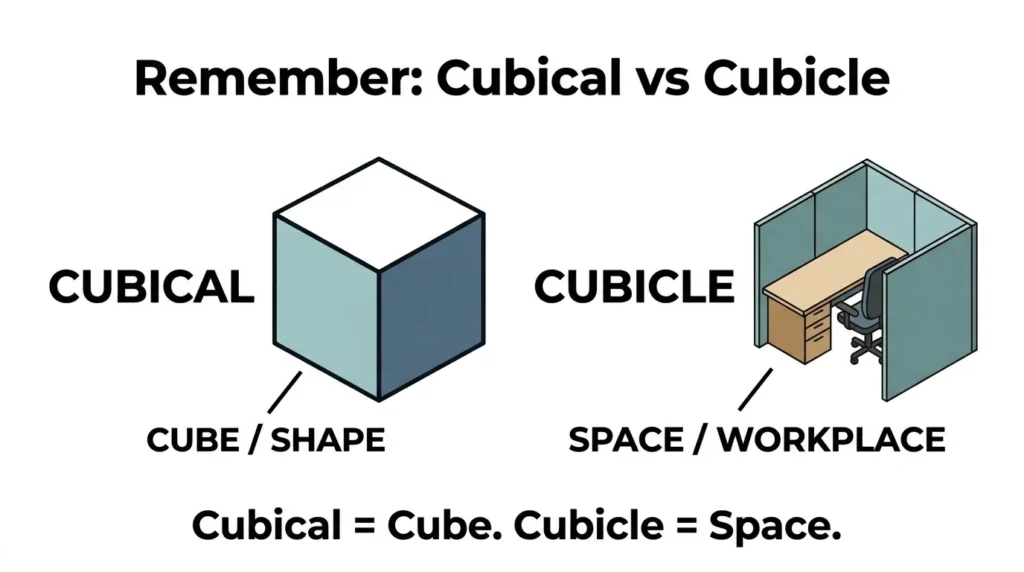
CUBICAL → CUBE
CUBICLE → SPACE
If you can replace the word with cube-shaped, think cubical.
If you can replace it with small enclosed space, think cubicle.
Real-Life Situations
In an Office
“Where is your desk?”
“I’m in the cubicle next to the window.”
Use cubicle because you are naming a workspace.
In a Design Meeting
“What shape should the display units have?”
“Let’s make them cubical.”
Use cubical because you are describing shape.
In an Email
“Please move the new employee to the empty cubicle near reception.”
Use cubicle because the email refers to a specific workplace.
In an Academic Assignment
“The model contains several cubical structures.”
Use cubical because the sentence describes geometric form.
In a Gym
“The gym has separate shower cubicles.”
Use cubicles because the word refers to separate enclosed spaces.
In a Conversation
“I can’t find Sarah.”
“She’s probably in her cubicle.”
Use cubicle because it refers to Sarah’s workspace.
Mini Quiz
| # | Question | Answer | Explanation |
|---|---|---|---|
| 1 | I work in an office _____. A) cubical B) cubicle | B) cubicle | An office workspace is a cubicle. |
| 2 | The sculpture has a _____ shape. A) cubical B) cubicle | A) cubical | Cubical describes a cube-like shape. |
| 3 | Correct the sentence: “There are twenty cubicals in our office.” | There are twenty cubicles in our office. | The plural noun for office spaces is cubicles. |
| 4 | The box is almost _____. A) cubical B) cubicle | A) cubical | The word describes the box’s shape. |
| 5 | She decorated her _____. A) cubical B) cubicle | B) cubicle | She decorates a physical workspace. |
| 6 | Which word is an adjective? A) cubical B) cubicle | A) cubical | Cubical describes a noun. |
| 7 | Which word is normally a noun? A) cubical B) cubicle | B) cubicle | Cubicle names a space or compartment. |
| 8 | Correct the sentence: “The designer created a cubicle structure shaped like a cube.” | The designer created a cubical structure. | Cubical directly describes the cube-like structure. |
| 9 | “The employee moved to a larger _____.” | cubicle | The sentence needs a noun naming the workspace. |
| 10 | “The architect used _____ forms in the design.” | cubical | The word describes the forms as cube-like. |
Expert Tips
Do Not Treat This as a Simple Spelling Problem
The most useful lesson is that cubical vs. cubicle is a vocabulary and word-choice issue.
Both spellings are correct.
The question is which meaning you need.
Look at the Word’s Job
Before choosing the spelling, ask:
Is this word naming something or describing something?
Naming a space → cubicle
Describing a shape → cubical
This method is more reliable than trying to remember the spelling visually.
Use “Cube-Shaped” as a Test
If you can replace the word with cube-shaped, then cubical may be the correct choice.
The structure is cubical.
The structure is cube-shaped.
The meanings are close.
But:
I work in a cubicle.
You cannot replace cubicle with “cube-shaped” because the sentence is naming a space.
Use “Workspace” as a Test
If you can replace the word with workspace or small enclosed space, you probably need cubicle.
My cubicle is near the entrance.
The meaning is clear.
Remember That Spellcheck Is Not Enough
A spelling checker can tell you that cubical is spelled correctly. It cannot always determine whether you intended cubicle.
Good proofreading asks two questions:
- Is the word spelled correctly?
- Is it the correct word for this meaning?
That second question is what prevents this particular mistake.
FAQ
Is “cubical” a correct English word?
Yes. Cubical is a standard English adjective. It describes something that is shaped like a cube or relates to a cube or cubic form.
Is “cubicle” the correct word for an office?
Yes. Cubicle is the standard noun for a small office workspace separated from other areas by partitions or low walls.
Is “cubical” the same as “cubicle”?
No. They are different words. Cubical is an adjective related to cube shape, while cubicle is a noun referring to a small enclosed or partitioned space.
Can I say “my cubical” for my office space?
In careful standard English, use my cubicle. Although “cubical” may be understood as a spelling mistake for “cubicle,” it is not the standard noun for an office workspace.
What is the plural of cubicle?
The plural is cubicles.
The company installed several new cubicles.
What is the plural of cubical?
Cubical is normally an adjective, so it does not normally have a plural form when used that way.
You can say:
cubical structures
or
cubical objects
The noun being described takes the plural form.
Are cubical and cubicle pronounced the same?
They are commonly pronounced the same in standard English. This is one reason the words are easy to confuse in writing.
Is “cube-shaped” better than “cubical”?
Not necessarily. Both can be correct. Cube-shaped is often very clear in everyday English, while cubical can fit naturally in technical, mathematical, architectural, or descriptive contexts.
Can a cubicle be cube-shaped?
Yes. A physical cubicle could happen to be cube-shaped. However, the word cubicle itself means an enclosed or partitioned space; it does not mean “cube-shaped.”
Is “cubicle” only used for offices?
No. A cubicle can also refer to other small enclosed or partitioned spaces, such as shower or changing areas and certain institutional spaces.
Which word should I use in a resume?
If you are describing an office workspace, use cubicle.
For example:
I managed a team working across six office cubicles.
However, if the word is relevant to a professional document, consider whether workspace, office area, or another more precise term communicates your meaning better.
Quick Summary
Cubical and cubicle are both correct words, but they are not interchangeable. Cubical is an adjective used to describe something that has the shape or characteristics of a cube. Cubicle is a noun used for a small enclosed or partitioned space, especially an office workspace, shower area, or changing space. If you are talking about where someone works, write cubicle: “She sits in a cubicle.” If you are describing the shape of an object, use cubical: “The sculpture has a cubical form.” The easiest memory trick is simple: cubical = cube; cubicle = space. Because the two words are commonly pronounced alike, meaning—not sound—should guide your spelling.