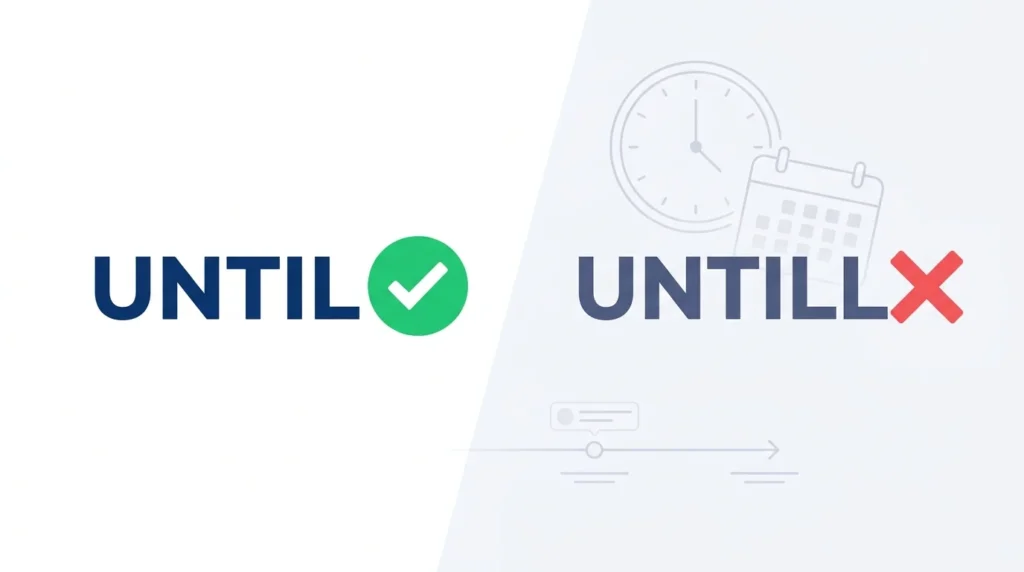

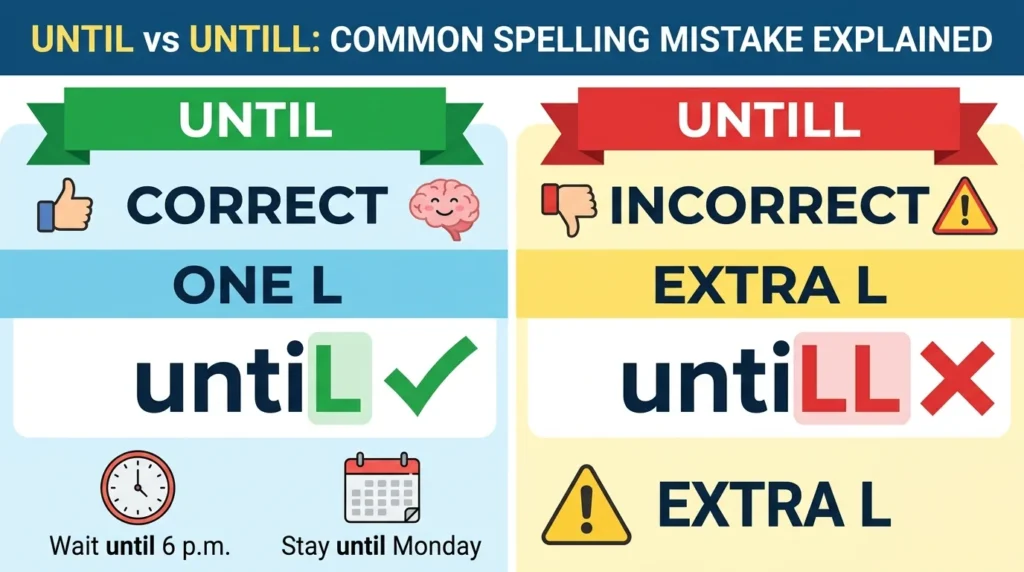
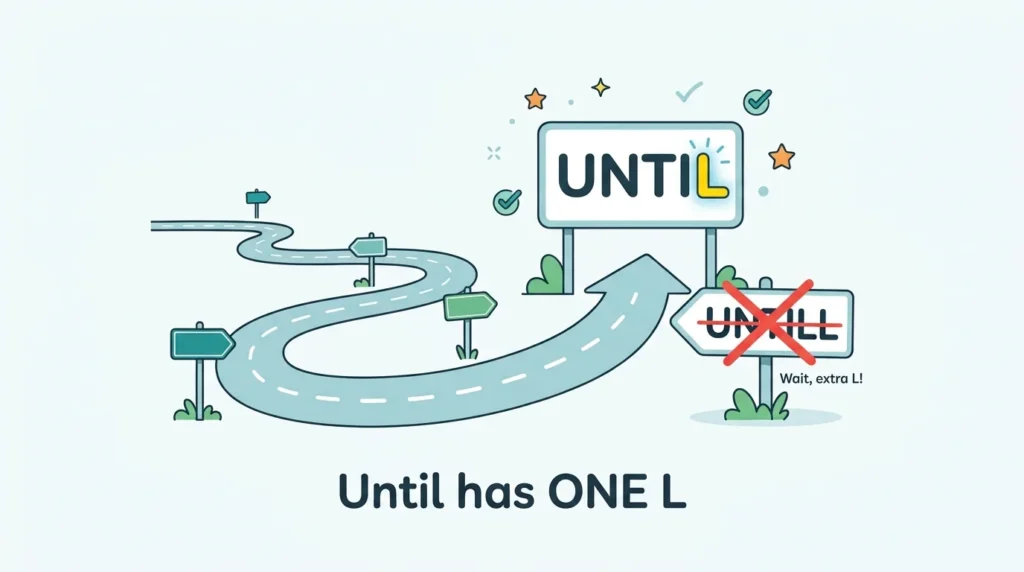
Until is the correct spelling. Untill is a common spelling mistake and is not used as a standard English word. Use until when you mean “up to a particular time or event.” For example: “I will wait until 6 p.m.” and “Please stay here until I return.” Remember: until has only one L at the end.
What Is the Difference Between Until and Untill?
The difference is simple: until is correct, while untill is incorrect.
| Word | Correct? | Meaning |
|---|---|---|
| until | ✅ Correct | Up to a particular time or event |
| untill | ❌ Incorrect | Misspelling of until |
There is no different meaning between until and untill. The second form is simply a spelling error.
The correct word can be used in sentences such as:
- I worked until midnight.
- Please wait until Monday.
- She stayed at the office until everyone left.
- Don’t open the door until I call you.
- The store is open until 9 p.m.
In every case, until tells us about a point in time up to which something continues.
English learners sometimes add a second l because the spelling looks as if it should follow words such as still, fill, or full. The pronunciation can also make the extra letter feel natural. However, standard English uses only one l in until. Cambridge’s grammar guidance specifically warns writers to spell it until, not untill.
Why It Matters
A single extra letter may look like a small problem, but repeated spelling mistakes can affect how your writing is perceived.
This matters especially in:
- Job applications
- Business emails
- Academic assignments
- Reports
- Website content
- Professional messages
- Exams
- Social media posts
- Resumes and cover letters
Compare these two sentences:
❌ I will be available untill Friday.
✅ I will be available until Friday.
The meaning is easy to understand in both sentences, but only the second sentence uses standard spelling.
In casual texting, a reader may simply understand untill as a typo. In formal or professional writing, however, there is little reason to leave the error uncorrected.
The Core Rule
Use UNTIL with one L at the end. Never spell it UNTILL in standard English.
A useful rule to remember is:
UNTIL = ONE L
UNTILL = WRONG
The spelling does not change between American and British English. Both varieties use until.
What Does Until Mean?
Until means “up to a particular time” or “up to the time when something happens.”
It can describe an action, situation, event, or condition that continues up to a certain point.
For example:
We waited until noon.
The waiting continued and reached noon.
Another example:
She studied until the exam began.
The studying continued up to the moment the exam began.
You can use until with a specific time:
- until 5 p.m.
- until midnight
- until Monday
- until tomorrow
- until next week
You can also use it with an event or action:
- until I arrive
- until the meeting ends
- until the rain stops
- until everyone leaves
- until you understand
This makes until useful in both everyday speech and formal writing.
How to Use Until
Until as a Preposition
A preposition is a word that connects another word or phrase to the rest of the sentence.
When until comes before a noun or time expression, it can function as a preposition.
Examples:
- We stayed there until midnight.
- The office is open until Friday.
- She worked until lunchtime.
- The road will remain closed until Monday.
- I will be here until tomorrow.
In these sentences, until is followed by a time expression rather than a complete clause.
Until as a Conjunction
A conjunction connects parts of a sentence.
When until introduces a clause containing a subject and verb, it functions as a conjunction.
Examples:
- Wait until I arrive.
- Don’t leave until she comes back.
- We stayed inside until the rain stopped.
- She worked until the manager arrived.
- Keep practicing until you feel confident.
The important idea is that the action continues up to the time described by the until clause.
Use the Present Tense for Future Events After Until
One common grammar mistake is using will after until when talking about the future.
Usually, English uses the present simple in the until clause.
✅ I will wait until you arrive.
❌ I will wait until you will arrive.
✅ We won’t start until everyone is ready.
❌ We won’t start until everyone will be ready.
The future meaning is already clear from the main clause, so English normally uses a present form after until for the future time reference.
Correct Examples
Here are examples of until in different real-life situations.
Everyday Conversation
- Please wait until I get back.
- I stayed awake until midnight.
- Don’t eat the cake until dinner.
- We talked until the restaurant closed.
- I will be available until 4 p.m. today.
- Please keep the documents safe until the meeting.
- The offer remains valid until Friday.
Workplace
- The office will remain open until 6 p.m.
- We cannot make a final decision until the manager arrives.
- The team worked until the project was completed.
School
- Students must remain in the classroom until the teacher arrives.
- I studied until I understood the chapter.
- Please don’t submit your paper until you have checked it.
Social Media
- I can’t wait until the weekend.
- Counting the days until our vacation.
- I stayed up until 2 a.m. watching the series.
Academic Writing
- The results remained stable until the final stage of the experiment.
- The policy remained unchanged until the government introduced a new measure.
Incorrect vs. Correct
| ❌ Incorrect | ✅ Correct | Why |
|---|---|---|
| I will wait untill you arrive. | I will wait until you arrive. | Untill is a misspelling. |
| The shop is open untill 9 p.m. | The shop is open until 9 p.m. | Until has one L. |
| She stayed untill midnight. | She stayed until midnight. | The standard spelling is until. |
| Don’t leave untill I return. | Don’t leave until I return. | The extra L is incorrect. |
| We worked untill Friday. | We worked until Friday. | Use one L. |
| Wait untill the teacher arrives. | Wait until the teacher arrives. | Untill is not standard spelling. |
| I won’t sleep untill this is finished. | I won’t sleep until this is finished. | Until is the correct form. |
| The road is closed untill Monday. | The road is closed until Monday. | The word ends in one L. |
| Stay here untill I call you. | Stay here until I call you. | The spelling is until. |
| The offer lasts untill December. | The offer lasts until December. | Double L is incorrect. |
Why Do People Make This Mistake?
The error is easy to understand because English spelling contains many words ending in ll.
Consider:
- still
- fill
- will
- full
- skill
- hill
- drill
A writer who is familiar with these patterns may unconsciously expect until to end with ll as well.
There is another source of confusion: till is a real English word and is spelled with two Ls.
So writers may mentally connect:
until → till → double L
But the spelling does not work that way.
The correct forms are:
- until ✅
- till ✅
- untill ❌
Fast typing can also cause the mistake. If you type quickly, the second L may appear automatically because the word feels as though it should have one.
Spellcheck can catch the error, but it should not be your only defense. A good writer should also recognize the correct spelling independently.
Read More: Intention vs Intension: Which Is Correct?
Common Mistakes Checklist
1. Adding a Second L
❌ untill
✅ until
Why it happens: The writer remembers the sound but not the exact spelling.
How to avoid it: Remember: until = one L.
2. Confusing Until With Till
Both are correct, but they are separate spellings.
✅ I will wait until noon.
✅ I will wait till noon.
❌ I will wait untill noon.
3. Using Until When You Mean By
This is a grammar mistake rather than a spelling mistake.
❌ Please finish the report until Friday.
If you mean the report must be completed no later than Friday, use:
✅ Please finish the report by Friday.
4. Using Until for Quantity
Until is not normally used to express a maximum number.
❌ The hall can hold until 500 people.
✅ The hall can hold up to 500 people.
5. Using Until for Distance
When talking about distance, English normally uses as far as, not until.
❌ We drove until Lahore.
Better:
✅ We drove as far as Lahore.
The distinction between time, quantity, distance, and deadlines is important because until is specifically associated with a point in time or an event.
Until in Real English
1. Grammatically Correct and Natural
“I’ll wait until you arrive.”
This is completely natural everyday English. It clearly describes an action that continues up to another person’s arrival.
“The office is open until 6 p.m.”
This is also natural and common in both conversation and professional writing. It gives a clear closing time.
2. Grammatically Possible but Less Natural
“I will remain here until the conclusion of the meeting.”
This can be grammatically correct, but in ordinary conversation it may sound unnecessarily formal. A natural speaker would often say:
“I’ll stay here until the meeting ends.”
The first sentence is not wrong. It simply uses a more formal style than most everyday situations require.
3. Natural Everyday English
“Wait till I get back.”
This is natural in casual conversation. Till is a standard English word, although until is often a better choice when you want a neutral or more formal tone.
The important point is that till is not the same spelling mistake as untill. Till is a legitimate word. Untill is not the standard spelling of until. Cambridge specifically identifies till as an accepted, generally more informal alternative.
Until vs. By: A Very Important Difference
Many learners understand the spelling of until but still use it incorrectly with deadlines.
The basic difference is:
Until = something continues up to a time.
By = something must happen no later than a time.
Compare:
I will work until Friday.
This suggests that the work continues up to Friday.
I will finish the work by Friday.
This means the work will be completed no later than Friday.
Here is another example:
❌ Please submit the application until Monday.
✅ Please submit the application by Monday.
The second sentence gives a deadline.
But:
✅ The application process remains open until Monday.
Here, until works because the process continues up to Monday.
Cambridge specifically distinguishes by from until: by is used for deadlines, while until describes something continuing up to a particular time.
Until vs. Till
Until and till can often mean the same thing.
| Feature | Until | Till |
|---|---|---|
| Correct spelling | ✅ Yes | ✅ Yes |
| Meaning | Up to a time/event | Up to a time/event |
| Standard English | Yes | Yes |
| Formal writing | Common choice | Less common |
| Everyday conversation | Very common | Very common |
| Incorrect form | — | til is not the standard form when intended as till |
Examples:
- I waited until 8 p.m.
- I waited till 8 p.m.
Both are grammatical.
In formal writing, until is generally the safer choice. In casual speech and informal writing, till is perfectly normal. Cambridge describes till as more informal than until.
Read More: Ladel vs Ladle: Which Spelling Is Correct?
American vs. British English
There is no spelling difference between American and British English here.
Both varieties use:
until ✅
Neither uses:
untill ❌
For example:
American English:
The store is open until 9 p.m.
British English:
The shop is open until 9 p.m.
The vocabulary may change in some contexts, but the spelling of until does not.
Formal vs. Informal Usage
Until works in almost every register.
It is suitable for:
- Academic writing
- Business emails
- Reports
- Formal notices
- Conversations
- Text messages
- Social media
Till is also correct, but it can feel more conversational.
Compare:
Formal/neutral:
Registration will remain open until Friday.
Conversational:
I’ll wait till Friday.
Neither sentence contains a spelling error.
However, avoid treating untill as an informal alternative. It is simply an incorrect spelling.
Common Phrases With Until
Learning common phrases can make the correct spelling easier to remember.
Until now
Means up to the present.
Until now, nobody had explained the problem.
Until then
Means up to a particular future time.
I’ll see you next week. Until then, take care.
Until recently
Means up to a short time ago.
Until recently, the company operated from a small office.
Until further notice
Means that something will continue until another announcement changes it.
The building will remain closed until further notice.
Until next time
A common phrase used when saying goodbye.
Thanks for joining us, and until next time!
Not until
Means “not before a particular time.”
The train did not arrive until midnight.
This construction is especially useful because it shows that something happened later than expected.
Until vs. Before
Until and before can sometimes look similar, but they do not always communicate the same idea.
Compare:
Wait here until I return.
This means your waiting continues up to my return.
Leave before I return.
This means your departure should happen earlier than my return.
The difference is important.
Until points toward the endpoint of an ongoing situation.
Before places one event earlier than another.
For example:
✅ Don’t open the door until I arrive.
This means keep the door closed while waiting for my arrival.
✅ Close the door before I arrive.
This means the closing should happen earlier than my arrival.
Read More: Soo vs So: Which Is Correct?
Real-Life Situations
Job Interview
An interviewer asks when you are available.
“I’m available for an interview until 4 p.m. today.”
Here, until gives the endpoint of your availability.
Business Meeting
A manager says:
“Please wait until everyone arrives before we begin.”
The waiting continues up to the arrival of everyone.
“The discount will remain available until Friday.”
The offer continues up to Friday.
Text Message
“Wait until I get there.”
This is natural and conversational.
Exam
A student writes:
“I studied until midnight.”
This tells the reader when the studying stopped.
Academic Writing
“The trend remained stable until the final year of the study.”
The word identifies the point at which the earlier condition ended or changed.
Memory Trick
Use this simple mnemonic:
UNTIL has ONE L because there is ONE final L.
Or remember it visually:
UNTIL = 1 L ✅
UNTILL = 2 L ❌
You can also connect the correct spelling to the phrase:
“Until = up to.”
When you think up to a time, think until.
Expert Tips
Tip 1: Learn the Word as a Whole
Do not try to reconstruct the spelling every time you use it.
Train yourself to recognize:
until
rather than building it letter by letter.
Tip 2: Watch for the Double-L Trap
If you type:
untill
stop and remove one L.
Tip 3: Don’t Confuse Spelling With Meaning
The main problem in until vs untill is spelling, not meaning.
You do not need to learn two definitions.
There is only one standard form for this word:
until
Tip 4: Learn Until With Common Patterns
Memorize useful combinations:
- wait until
- stay until
- work until
- open until
- closed until
- until tomorrow
- until Friday
- until I arrive
- until it ends
- until further notice
These patterns make correct usage automatic.
Tip 5: Learn By vs Until Together
If you understand this pair, you will avoid many unrelated grammar mistakes.
by Friday = deadline
until Friday = continuation
Tip 6: Don’t “Correct” Till
Some learners see till and assume it is wrong because it looks shorter.
It isn’t.
Both till and until are standard words. The spelling untill, however, is not the standard form.
Quick Reference
If you are unsure, use this checklist:
- Until = correct spelling.
- Untill = incorrect spelling.
- Until has one L at the end.
- Till is also a correct word.
- Until can refer to a time or event.
- Use by for a deadline.
- Use up to for quantities.
- Use as far as for distance.
- Use a present form after until when referring to a future event.
- Until is spelled the same way in American and British English.
Mini Quiz
| # | Question | Answer | Explanation |
|---|---|---|---|
| 1 | Choose the correct spelling: “I will wait ___ 6 p.m.” A) until B) untill | A) until | Until is the standard spelling. |
| 2 | Correct the sentence: “She stayed untill midnight.” | She stayed until midnight. | Remove the extra L. |
| 3 | Fill in the blank: “Don’t leave ___ I call you.” | until | Until introduces the event that marks the endpoint of waiting. |
| 4 | Which word gives a deadline? A) until B) by | B) by | By means no later than a particular time. |
| 5 | Is this correct? “I will wait until you will arrive.” | No. | Use the present form: “I will wait until you arrive.” |
| 6 | Choose the correct sentence: A) The shop is open untill 8. B) The shop is open until 8. | B | Until has one L. |
| 7 | Correct the sentence: “Please finish the report until Friday.” | Please finish the report by Friday. | If Friday is the deadline, use by. |
| 8 | Is “till” a correct English word? | Yes. | Till is a standard alternative to until, especially in informal contexts. |
| 9 | Choose the correct form: “We worked ___ everyone went home.” A) until B) untill | A) until | Until is the correct spelling. |
| 10 | Complete the sentence: “The office will remain closed ___ Monday.” | until | The closure continues up to Monday. |
FAQ
Is “untill” ever correct?
No. Untill is not the standard spelling of the English word until. In modern standard English, write until with one L.
Does “until” have two Ls?
No. The correct spelling is until, with only one L at the end.
Is “until” a preposition or a conjunction?
It can be either. When it is followed by a noun or time expression, it can function as a preposition. When it introduces a clause such as “until I arrive,” it functions as a conjunction.
Can I use “until” in formal writing?
Yes. Until is completely appropriate in formal writing, including academic papers, business documents, reports, and professional emails.
Is “till” grammatically correct?
Yes. Till is a standard English word and can often replace until. It is generally more informal, so until may be preferable in formal writing.
Is “’til” correct?
’Til appears in informal writing as a shortened form associated with until. It is much more casual than until, so it is generally best avoided in formal writing.
Should I say “until Friday” or “by Friday”?
It depends on what you mean. Until Friday describes something that continues up to Friday. By Friday gives a deadline by which something must happen.
Can I say “until 500 people”?
Normally, no. For a quantity, use up to.
✅ The venue can hold up to 500 people.
❌ The venue can hold until 500 people.
Can I use “until” for distance?
Normally, no. For distance, English commonly uses as far as.
✅ We drove as far as the city center.
❌ We drove until the city center.
Should I use “will” after “until”?
Usually not when the until clause refers to a future event.
✅ I will wait until she arrives.
❌ I will wait until she will arrive.
Is “until” the same in American and British English?
Yes. Both American and British English use until with the same spelling. There is no American/British spelling difference between until and untill.
Quick Summary
Until is the correct spelling, while untill is an incorrect spelling. The word until means “up to a particular time or event” and can function as either a preposition or conjunction. For example, “I worked until midnight” and “Wait until I arrive” are both correct. Remember that until has only one L at the end. Do not confuse it with till, which is also a correct word and is often more informal. Also remember the difference between until and by: until describes something continuing up to a time, while by usually gives a deadline. The spelling of until is the same in American and British English.