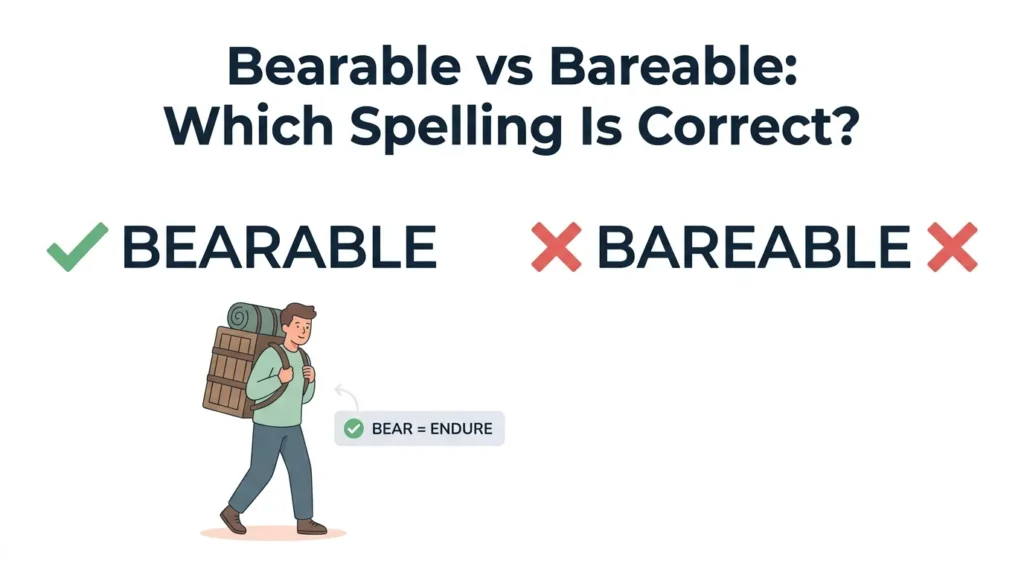

Bearable is the correct standard spelling when you mean “able to be endured, tolerated, or dealt with.” Bareable is normally a spelling mistake in this context. The word bearable comes from the verb bear, meaning to endure or tolerate. If you can bear something, it is bearable. For example: “The pain was difficult but bearable.”
What Is the Difference Between Bearable and Bareable?
The difference is simple:
- Bearable = correct standard English spelling
- Bareable = incorrect spelling when you mean “able to be endured”
Bearable is an adjective. It describes something difficult, unpleasant, painful, stressful, or uncomfortable that a person can still tolerate or deal with.
The heat was uncomfortable but bearable.
Here, bearable does not mean that the heat was pleasant. It means the heat was difficult but still possible to tolerate.
Bareable looks as though it could be a word because bare is a real English word. However, bareable is not the standard spelling of the adjective meaning “able to be endured.”
The confusion comes mainly from pronunciation. Bear and bare are pronounced alike in standard English, even though their meanings and spellings are different. Cambridge gives bearable as /ˈbeə.rə.bəl/ in British English and /ˈber.ə.bəl/ in American English.
Why It Matters
A one-letter spelling mistake can change the credibility of otherwise good writing.
You may encounter this word in:
- Emails
- School assignments
- Essays
- Business reports
- Social media posts
- Articles and blogs
- Reviews
- Workplace communication
- Academic writing
- Personal messages
Compare:
❌ The pain was barely bareable.
✅ The pain was barely bearable.
The second sentence uses the established English adjective.
The mistake is especially easy to make because bare is itself a common word. Once you hear bearable spoken aloud, your brain cannot rely on pronunciation alone to decide whether the middle of the word should contain ear or are.
That is why understanding the root word is more useful than simply memorizing the spelling.
Read More: Natzi vs Nazi: Which Spelling Is Correct?
The Core Rule
If you can BEAR something, it is BEARABLE.
The word bear can mean to tolerate, endure, or deal with something difficult.
So:
bear → bearable
Examples:
- I cannot bear the noise.
→ The noise is not bearable. - She can bear the pain.
→ The pain is bearable. - We had to bear the delay.
→ The delay was bearable.
The spelling is therefore connected to the meaning.
Do not choose bareable simply because bare is a real word.
How to Use Bearable
Use “bearable” for something you can tolerate
The most common use of bearable is for an unpleasant condition that remains within a person’s ability to tolerate.
For example:
The pain is bearable.
The noise is bearable.
The heat is bearable.
The workload is bearable.
The delay was bearable.
The word often describes something that is not good or comfortable, but is still possible to handle.
Bearable does not mean pleasant
This distinction is important.
If you say:
The weather was bearable.
You are not necessarily saying:
The weather was enjoyable.
You are saying that the weather was difficult or unpleasant, but you could tolerate it.
That is why bearable works especially well with words such as:
- pain
- heat
- cold
- noise
- stress
- pressure
- cost
- workload
- delay
- discomfort
- grief
- waiting
- living conditions
Cambridge defines bearable in terms of being able to accept or deal with an unpleasant situation and lists tolerable as a synonym.
Use comparative forms naturally
You can also say:
- more bearable
- less bearable
- most bearable
- increasingly bearable
- barely bearable
Examples:
The second week was more bearable than the first.
The cost became less bearable after the price increase.
The waiting was barely bearable.
Her support made the situation more bearable.
These forms are completely natural because bearable is an adjective.
Correct Examples
Here are examples from different areas of everyday and professional English.
Conversation
- The traffic was terrible, but it was still bearable.
- Is the pain bearable, or should we see a doctor?
- The revised deadline makes the workload much more bearable.
- Thank you for your help. You made the difficult situation more bearable.
School
- The exam was stressful, but the pressure was bearable.
- The long lecture became more bearable after the short break.
Workplace
- The new schedule makes the early morning commute more bearable.
- The additional workload is demanding but bearable for now.
Social Media
- The summer heat is finally becoming bearable.
- Good music makes a long journey much more bearable.
Academic Writing
- The researchers examined whether the treatment made the discomfort more bearable for participants.
- The policy may make the financial burden more bearable for low-income households.
Notice that bearable can describe physical discomfort, emotional difficulty, financial pressure, workload, waiting, or a general situation.
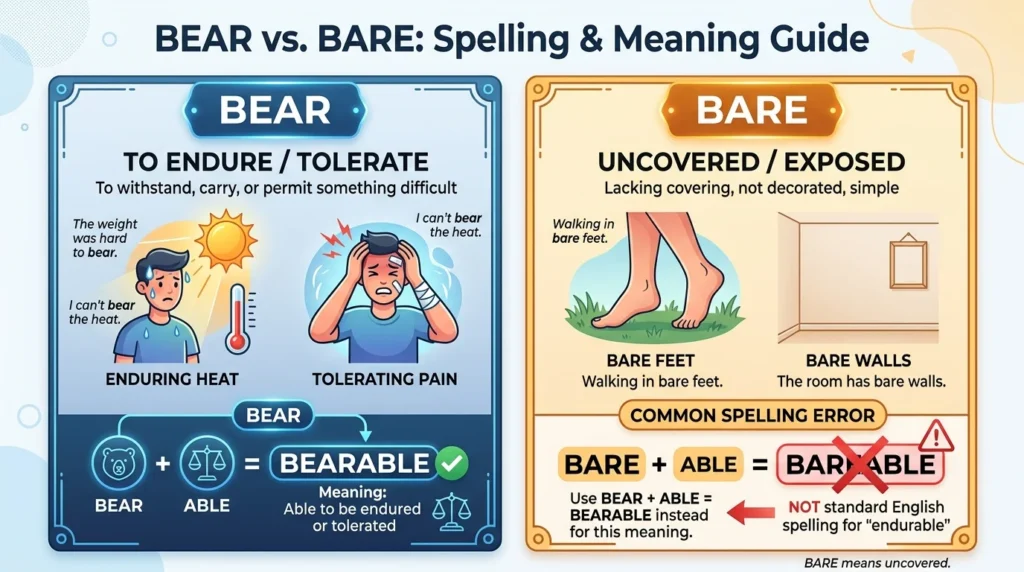
Incorrect vs. Correct
| ❌ Incorrect | ✅ Correct | Why |
|---|---|---|
| The pain was bareable. | The pain was bearable. | The adjective comes from bear, meaning to endure. |
| The heat became more bareable. | The heat became more bearable. | Bearable means tolerable or manageable. |
| The workload is barely bareable. | The workload is barely bearable. | The correct adjective is bearable. |
| The noise was not bareable. | The noise was not bearable. | Bareable is not the standard spelling for this meaning. |
| The delay was surprisingly bareable. | The delay was surprisingly bearable. | The delay could be tolerated. |
| The situation became bareable after help arrived. | The situation became bearable after help arrived. | Bearable describes something that can be endured. |
| The cost is no longer bareable. | The cost is no longer bearable. | The cost has become too difficult to tolerate. |
| The journey was tiring but bareable. | The journey was tiring but bearable. | The journey could still be endured. |
| The pressure was becoming less bareable. | The pressure was becoming less bearable. | The standard adjective is bearable. |
| The conditions were barely bareable. | The conditions were barely bearable. | The correct spelling retains bear. |
Why Do People Make This Mistake?
1. Bear and bare sound alike
This is the biggest reason.
Bear and bare are homophones: words that have the same pronunciation but different spellings and meanings.
Compare:
- bear = endure, carry, tolerate; also the animal
- bare = uncovered, exposed, or without the usual covering
For example:
I cannot bear the noise.
He walked on his bare feet.
The pronunciation does not tell you which spelling to choose.
2. “Bare” looks like a logical root
People know words such as:
- barefoot
- bare hands
- bare skin
- bare walls
- bare minimum
Because bare is familiar, bareable can look visually reasonable.
But visual logic is not enough to establish an English word.
The intended meaning determines the correct root:
endure → bear → bearable
not:
bare → bareable
3. English spelling cannot always be predicted from sound
English contains many words whose spelling cannot be reliably determined by pronunciation.
Consider:
- right / write
- their / there
- flour / flower
- sea / see
- bear / bare
When two words sound the same, meaning and word history often have to guide spelling.
4. People overgeneralize the “-able” pattern
English has many adjectives ending in -able:
- readable
- washable
- comfortable
- understandable
- acceptable
- manageable
A writer may see bare + able and assume bareable follows the same pattern.
But English word formation is not always a simple “word + suffix” calculation. Established vocabulary determines which forms are standard.
5. Spellcheck is not a substitute for understanding
Spellcheck can help identify bareable, but relying completely on software is risky.
Automatic tools can miss unusual words, names, technical vocabulary, or context-dependent errors.
Understanding the connection between bear and bearable gives you a stronger solution.
Common Mistakes Checklist
Mistake 1: Writing “bareable”
Problem: You are using the wrong spelling for the adjective meaning “able to be endured.”
Why it happens: Bear and bare sound alike.
Fix: Remember:
Bear it → bearable
Mistake 2: Thinking bearable means comfortable
Problem: You interpret bearable as something pleasant.
Why it happens: The word is sometimes used positively in everyday conversation.
Fix: Remember that bearable usually means tolerable, not necessarily enjoyable.
Mistake 3: Choosing spelling by pronunciation
Problem: You hear “BAIR-uh-bul” and automatically write bareable.
Why it happens: Pronunciation does not distinguish bear from bare.
Fix: Think about the meaning before spelling the word.
Mistake 4: Confusing bearable with unbearable
Problem: You may understand unbearable but hesitate over the positive form.
Fix: Remove un-:
unbearable → bearable
If something is unbearable, it cannot be tolerated. If it is bearable, it can be tolerated.
Mistake 5: Assuming every visible online spelling is standard
Problem: You see bareable online and assume it must be a legitimate alternative.
Why it happens: Search results and user-generated content contain spelling mistakes.
Fix: Check a reliable dictionary when a word looks uncertain.
Bearable in Real English
Grammatically correct and natural
The pain was bearable.
This is straightforward, standard English. Bearable naturally describes pain that can still be tolerated. The same pattern works with heat, noise, pressure, delays, costs, and other difficult experiences. Dictionary examples also show bearable being used for discomfort, costs, living conditions, grief, and other unpleasant circumstances.
Grammatically correct and more comparative
The situation became more bearable after she received support.
This is natural because bearable often appears in comparative constructions. The comparison does not necessarily mean that the situation became good. It means that it became easier to tolerate than before. This is a useful distinction when writing about difficult experiences.
Natural everyday English
The heat is finally bearable.
This sounds natural because bearable is commonly used to describe an unpleasant condition that has reached a tolerable level. A speaker may use the sentence even when the heat is still uncomfortable. The important idea is that the discomfort has become manageable enough to continue with normal activities.
Correct but context-dependent
The price is bearable.
This is grammatically correct, but the naturalness depends on context. If someone is discussing whether a cost can be tolerated or managed, bearable works. However, in ordinary shopping conversations, speakers may more often choose words such as affordable, reasonable, or manageable, depending on exactly what they mean.
Correct but emotionally strong
The grief eventually became bearable.
This is natural English, particularly when describing a painful emotional experience over time. Bearable does not suggest that the grief disappeared. It means the person gradually became able to live with or endure the emotional pain.
American vs. British English
There is no spelling difference between American and British English for this word.
Both varieties use:
bearable
The pronunciation has a small regional difference. Cambridge gives the British pronunciation as approximately /ˈbeə.rə.bəl/ and the American pronunciation as /ˈber.ə.bəl/. The spelling remains the same.
So:
- American English: bearable
- British English: bearable
- Incorrect for the intended meaning: bareable
You do not need to choose between bearable and bareable based on whether you are writing for an American or British audience.
Formal vs. Informal Usage
Bearable works in both formal and informal English.
Informal
The heat was barely bearable.
The wait was annoying but bearable.
Professional
The revised payment structure makes the additional cost more bearable.
Academic
The intervention appeared to make the discomfort more bearable for participants.
There is no need to replace bearable with a more complicated word simply because the writing is formal.
Depending on the context, formal alternatives may include tolerable, supportable, or endurable, but these are not automatically better. Cambridge lists tolerable and formal supportable among related words.
Comparison Table
| Feature | Bearable | Bareable |
|---|---|---|
| Standard spelling | ✅ Yes | ❌ No for this intended meaning |
| Part of speech | Adjective | Not normally accepted as the intended adjective |
| Meaning | Able to be endured or tolerated | Usually a spelling mistake |
| Root | Bear | Incorrectly based on bare |
| Related verb | Bear = endure/tolerate | Bare = uncover/expose |
| Pronunciation | /ˈber.ə.bəl/ in US English | Usually intended to sound like bearable |
| Formal writing | Appropriate | Avoid |
| Academic writing | Appropriate | Avoid |
| Everyday writing | Appropriate | Avoid |
| Example | The pain was bearable. | ❌ The pain was bareable. |
Bear vs. Bare: Understand the Root
One of the easiest ways to understand the spelling is to separate the two root words.
Bear
As a verb, bear can mean to endure, tolerate, or deal with something difficult.
I cannot bear the noise.
She could barely bear the pressure.
From this sense of bear, we get:
bearable
Bare
Bare has a completely different meaning.
It can describe something uncovered, exposed, or without its usual covering.
He walked across the floor with bare feet.
The room had bare walls.
That meaning does not produce the standard adjective bareable for “able to be endured.”
Memory Trick
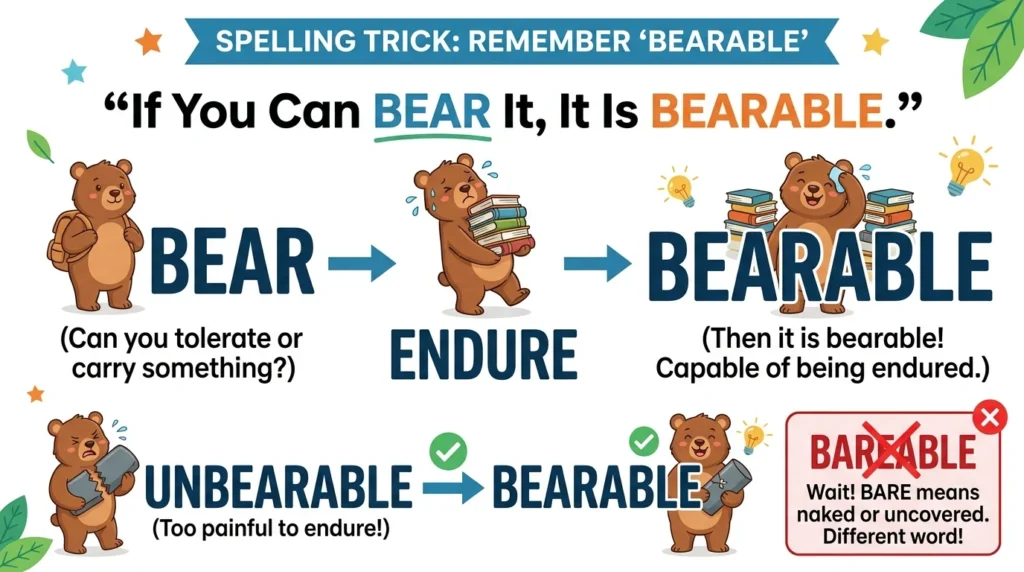
Use this sentence:
If you can BEAR it, it is BEARABLE.
That is the simplest mnemonic because it connects the spelling directly to the meaning.
You can also remember:
BEAR = ENDURE
BEAR + ABLE = BEARABLE
And the opposite:
UNBEARABLE = TOO DIFFICULT TO ENDURE
So if you are talking about pain, stress, heat, pressure, noise, cost, waiting, or another difficult experience, think bear, not bare.
Read More: Noisy vs Noisey: Which Spelling Is Correct?
Real-Life Situations
1. At the doctor
Patient: The pain is uncomfortable, but it is bearable.
Here, bearable means the patient can tolerate the pain.
2. In a meeting
Manager: Is the new workload manageable?
Employee: It is demanding, but still bearable.
The employee is saying that the workload can still be handled.
3. In an email
The revised schedule makes the transition much more bearable for the team.
The word works naturally in professional communication.
4. In a text message
This heat is barely bearable today!
This is informal but completely natural.
5. In an exam
If you need to choose between bearable and bareable, ask:
Can I bear it?
If yes:
It is bearable.
6. In an academic paper
The intervention made the treatment experience more bearable for participants.
The adjective is suitable for formal writing when the meaning is appropriate.
Mini Quiz
| # | Question | Answer | Explanation |
|---|---|---|---|
| 1 | Choose the correct spelling: The pain was (bearable / bareable). | Bearable | The pain could be endured, so use bearable. |
| 2 | Fill in the blank: The heat became more ______ after sunset. | bearable | The heat became easier to tolerate. |
| 3 | Which is correct? A) The noise was bareable. B) The noise was bearable. | B | Bearable is the standard spelling. |
| 4 | Correct the sentence: “The workload was barely bareable.” | The workload was barely bearable. | The adjective is spelled bearable. |
| 5 | What does bearable mean? | Able to be endured or tolerated | It describes something difficult that can still be handled. |
| 6 | Complete the sentence: If you can ______ something, it is ______. | bear; bearable | The two forms are directly connected in meaning. |
| 7 | Which word means “uncovered”: bear or bare? | Bare | Bare can mean uncovered or exposed. |
| 8 | Is bareable the standard spelling for “able to be endured”? | No | Use bearable. |
| 9 | Correct this sentence: “The delay was more bareable than expected.” | The delay was more bearable than expected. | Bearable is the correct adjective. |
| 10 | Choose the natural sentence: A) The exam was difficult but bearable. B) The exam was difficult but bareable. | A | The established adjective is bearable. |
Expert Tips
1. Do not memorize the word in isolation
Memorizing bearable as six or seven separate letters is less useful than connecting it to bear.
Think:
bear → endure → bearable
2. Use the opposite word
If you already know unbearable, you already know the spelling of bearable.
unbearable → bearable
This is one of the strongest memory aids for this particular confusion.
3. Ask a meaning question
Before spelling the word, ask:
Am I talking about enduring something?
If yes, choose bearable.
4. Do not let the animal meaning confuse you
The word bear has several meanings. It can refer to the animal, but it can also function as a verb meaning to carry or endure.
In bearable, it is the verb meaning to endure, not the animal.
5. Watch for “more” and “less”
These combinations are useful clues:
- more bearable
- less bearable
- barely bearable
- increasingly bearable
- completely bearable
If you are describing something that can be tolerated, these forms point to bearable.
6. Remember that “bearable” can describe more than pain
Do not restrict the word to medical situations.
It can describe:
- prices
- workloads
- weather
- waiting
- travel
- noise
- emotional situations
- living conditions
- stress
- pressure
The central idea is always tolerance or endurance.
FAQ
Is bearable or bareable correct?
Bearable is the correct standard spelling when you mean “able to be endured or tolerated.” Bareable is normally a spelling mistake in this context.
What does bearable mean in simple English?
Bearable means difficult or unpleasant but still possible to tolerate or deal with.
Is bareable a word?
Bareable is not the standard English spelling of the adjective meaning “able to be endured.” If that is the meaning you intend, use bearable.
Why is bearable spelled with “ear”?
Because it is connected to the verb bear, which can mean to endure or tolerate something.
I can bear the pain.
Therefore:
The pain is bearable.
Are bearable and bareable pronounced the same?
The intended pronunciation of bareable is usually based on bearable. The confusion exists because bear and bare are pronounced alike in standard English.
Read More: Vender vs Vendor: Which Spelling Is Correct?
What is the opposite of bearable?
The usual opposite is unbearable.
If something is unbearable, it is too difficult, painful, unpleasant, or stressful to tolerate.
Can I say “more bearable”?
Yes. More bearable is standard and natural.
The new schedule is more bearable than the old one.
Can I say “barely bearable”?
Yes.
The heat was barely bearable.
This means the heat was almost too difficult to tolerate.
Is bearable formal or informal?
It works in both formal and informal English. It can appear in everyday conversation, professional writing, and academic contexts when its meaning fits.
Is bearable the same as comfortable?
No. Something can be bearable without being comfortable. If something is bearable, you can tolerate it; it does not necessarily mean that you enjoy it.
Is bearable an adjective?
Yes. Bearable is an adjective because it describes a noun or follows a linking verb.
It was a bearable experience.
The experience was bearable.
What is the easiest way to remember bearable?
Remember:
If you can BEAR it, it is BEARABLE.
That connects the spelling directly to the meaning.
Quick Summary
Bearable is the correct standard spelling when you mean something that can be endured, tolerated, or dealt with. Bareable is normally a spelling error for this meaning. The confusion happens because bear and bare sound alike, even though they have different meanings and spellings. Bearable comes from bear in the sense of enduring or tolerating something. It can describe pain, heat, noise, stress, costs, workloads, delays, grief, and other difficult experiences. It works in both formal and informal English, and the spelling is the same in American and British English. The easiest rule is: If you can bear it, it is bearable.
Final Verdict
When choosing between bearable vs bareable, use:
✅ BEARABLE
Avoid:
❌ BAREABLE
The reason is simple:
Bear = endure or tolerate
Bearable = able to be endured or tolerated
The word bare has a different meaning, such as uncovered or exposed, so it is not the root you need here.
If you can bear the pain, the pain is bearable.
If you can bear the heat, the heat is bearable.
If you can bear the workload, the workload is bearable.
One spelling rule is enough to remember the whole distinction:
BEAR it → BEARABLE.