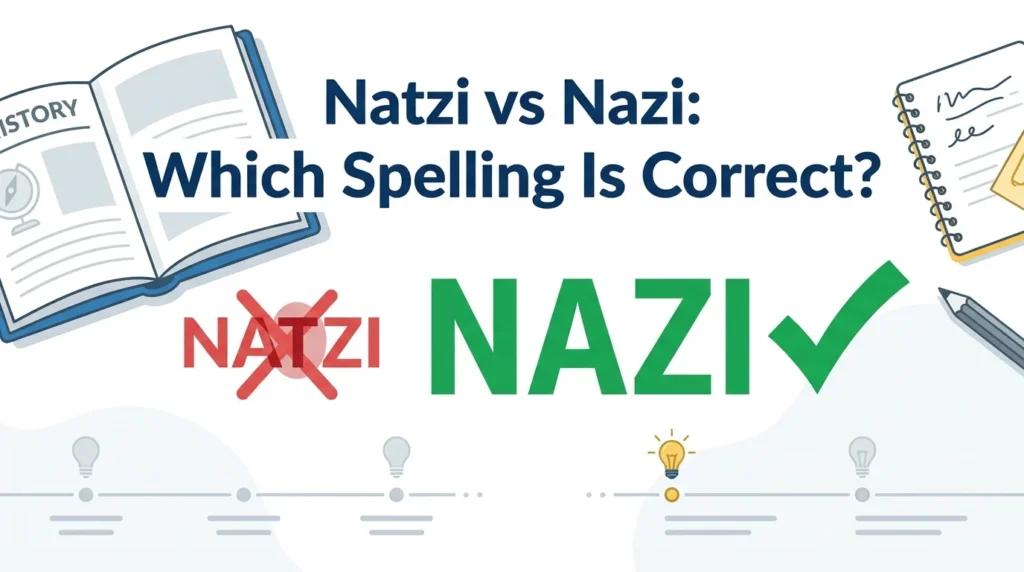

Nazi is the correct spelling. Natzi is a common misspelling when someone adds a t to the written form.
Use Nazi when writing about Nazi Germany, the Nazi Party, Nazi ideology, Nazi propaganda, or a person associated with the movement. The standard spelling is the same in American and British English, although pronunciation can vary slightly by accent. Dictionaries give the English pronunciation with a t sound, which helps explain why some people mistakenly write natzi.
What Is the Difference Between Natzi and Nazi?
The difference is simple:
- Nazi = the correct standard spelling
- Natzi = a misspelling of Nazi when referring to the historical political term
The two forms are not two different English words with different meanings. If someone writes natzi in a history essay, article, email, or social media post, they normally mean Nazi.
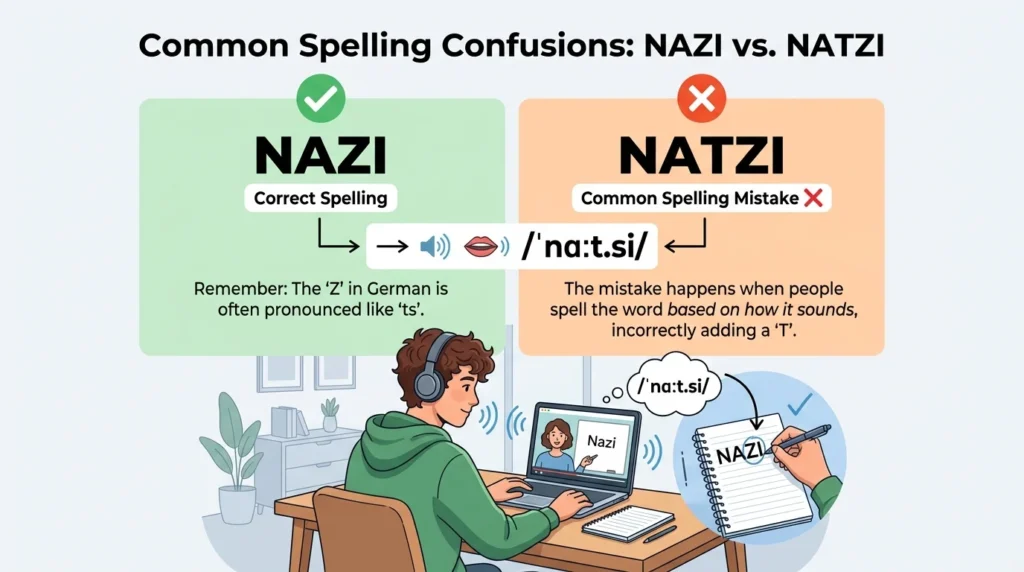
The important point is that the pronunciation can make the incorrect spelling seem logical. Standard English pronunciation includes a /t/ sound: Cambridge gives the pronunciation as /ˈnɑːt.si/ in British English and /ˈnɑːt.si/ in American English. In other words, you can hear something close to “naht-see,” even though the spelling contains no t.
Why It Matters
A one-letter spelling error may seem minor, but this particular word appears frequently in serious historical and academic contexts.
You may need to write about:
- World War II
- Nazi Germany
- the Nazi Party
- Nazi ideology
- Nazi propaganda
- the Holocaust
- concentration camps
- resistance movements
- European history
- political extremism
In these contexts, accurate terminology matters. A spelling mistake can make an otherwise careful piece of writing look less reliable.
It is especially important in academic writing. If you are writing a history assignment, research paper, article, book, documentary script, or educational post, use the established spelling Nazi.
Read More: Noisy vs Noisey: Which Spelling Is Correct?
The Core Rule
RULE: Write Nazi, not Natzi, when referring to the National Socialist movement, its members, its ideology, or things associated with it.
Remember the spelling:
N-A-Z-I
Not:
N-A-T-Z-I
The extra t does not belong in the standard English spelling.
What Does “Nazi” Mean?
Nazi can function as both a noun and an adjective.
As a noun, it can refer to a member or supporter of the National Socialist German Workers’ Party, the political party led by Adolf Hitler that controlled Germany from 1933 to 1945.
For example:
The historian interviewed a former Nazi soldier.
Here, Nazi is a noun because it identifies a person.
As an adjective, Nazi describes something associated with the Nazi movement.
For example:
The museum contains documents from the Nazi period.
Here, Nazi describes the noun period.
The word also appears in related expressions such as Nazi Germany, Nazi Party, Nazi propaganda, and Nazi regime.
Where Does the Word “Nazi” Come From?
The English word Nazi comes from the German Nazi, a shortened form associated with Nationalsozialist, meaning “National Socialist.” Dictionaries trace the English term to the twentieth century.
The political organization was formally known as the National Socialist German Workers’ Party, commonly abbreviated as NSDAP.
The short form Nazi became the standard term in English.
This origin is useful when remembering the spelling because there is no t in the written English form:
Nazi
The pronunciation, however, contains a t sound. That difference between sound and spelling is one reason learners may be tempted to write natzi.
Why Do People Write “Natzi”?
The mistake is understandable because English spelling and pronunciation do not always match perfectly.
In this case, the pronunciation actually makes the error easier to understand. Cambridge’s pronunciation guide breaks the word into sounds that include /t/ and /s/.
A person who hears the word before seeing it written may mentally represent the sound as:
nat-see
and then spell it:
natzi
But the established spelling is:
Nazi
Several factors can contribute to the mistake.
1. Phonetic spelling
Phonetic spelling means trying to write a word according to how it sounds.
A learner may hear “naht-see” and assume the written form must contain t.
That produces:
❌ Natzi
instead of:
✅ Nazi
2. Sound-to-letter confusion
The pronunciation contains a clear t sound. That does not mean the letter t appears in the spelling.
English has many words where pronunciation cannot be converted into spelling by simply writing every sound as a separate letter.
3. Limited familiarity with the word
Someone who has heard the word mainly in conversation may not have noticed its written form.
This is especially possible for learners who encounter the word while watching documentaries, films, lectures, or historical discussions.
4. Fast typing
When typing quickly, an extra letter can easily appear.
A writer may know that Nazi is correct but accidentally type natzi and fail to notice the error.
5. Repeated exposure to the misspelling
If a person repeatedly sees natzi online, the incorrect form can begin to look familiar.
Familiarity, however, does not make a spelling standard.
How to Use “Nazi” Correctly
Use Nazi when the word refers to the historical political movement, its members, its ideology, or something associated with it.
Common combinations include:
- Nazi Germany
- Nazi Party
- Nazi regime
- Nazi ideology
- Nazi propaganda
- Nazi occupation
- Nazi soldiers
- Nazi leadership
- Nazi persecution
- Nazi crimes
The noun can also appear in plural form:
Nazi → Nazis
For the ideology, the related noun is:
Nazism
For example:
The book examines the rise of Nazism in Germany.
Cambridge defines Nazism as the beliefs and policies of the National Socialist Party led by Hitler.
Correct Examples
Here are examples from different types of writing.
Conversation
“We learned about Nazi Germany in history class.”
The word correctly describes Germany under Nazi rule.
“I have attached the research notes about Nazi propaganda during World War II.”
The spelling is appropriate in a formal email.
School Writing
“The Nazi regime used propaganda to influence German society.”
Here, Nazi functions as an adjective modifying regime.
Academic Writing
“The study examines the development of Nazi ideology during the 1930s.”
This is an appropriate formal use.
Workplace
“The museum is preparing an exhibition about Nazi persecution during the war.”
The word is used precisely in a historical context.
Social Media
“This documentary explains how Nazi Germany transformed European politics.”
The correct spelling should still be used on social media.
Journalism
“The report examines evidence from the Nazi occupation.”
Historical terminology should remain accurate regardless of the platform.
History Book
“The Nazi Party gained political control in Germany in 1933.”
The term is capitalized as the name associated with the political movement.
Documentary Script
“Nazi propaganda played an important role in the regime’s public communication.”
The spelling is standard.
General Historical Discussion
“Several European countries resisted Nazi expansion during the war.”
Again, Nazi is the correct form.
Incorrect vs. Correct
| ❌ Incorrect | ✅ Correct | Why |
|---|---|---|
| The Natzi Party ruled Germany. | The Nazi Party ruled Germany. | Nazi is the established spelling. |
| He studied Natzi Germany. | He studied Nazi Germany. | The historical term is Nazi. |
| The book examines Natzi propaganda. | The book examines Nazi propaganda. | Nazi correctly describes the propaganda. |
| They discussed Natzi ideology. | They discussed Nazi ideology. | The adjective is spelled Nazi. |
| The museum displays artifacts from the Natzi period. | The museum displays artifacts from the Nazi period. | The extra t is a spelling error. |
| The documentary covers Natzi persecution. | The documentary covers Nazi persecution. | The standard historical adjective is Nazi. |
| He wrote about Natzi soldiers. | He wrote about Nazi soldiers. | Nazi is the correct modifier. |
| The essay discusses Natzi rule. | The essay discusses Nazi rule. | Natzi is not the standard spelling. |
| They researched Natzi history. | They researched Nazi history. | Use Nazi in historical writing. |
| The article describes Natzi crimes. | The article describes Nazi crimes. | The accepted spelling is Nazi. |
Why the Pronunciation Does Not Justify “Natzi”
This is one of the most useful points to understand.
It is tempting to say:
“If I can hear a t, why isn’t it written?”
Because pronunciation and spelling are different systems.
In fact, the pronunciation of Nazi does contain a t sound in standard English dictionary pronunciations. Cambridge represents it as /ˈnɑːt.si/ for both UK and US English.
So the problem is not that the speaker is necessarily hearing the word incorrectly.
The problem is assuming that every sound must have a matching letter in the spelling.
That assumption does not work reliably in English.
The correct written form remains:
Nazi
Nazi in Real English
Natural and correct
“The documentary examines Nazi Germany.”
This is natural, standard historical English. Nazi is being used as an adjective to identify the period or state associated with the Nazi regime.
Grammatically possible but context-dependent
“He was called a Nazi.”
This sentence is grammatically correct, but the meaning depends heavily on context. It may refer to historical political affiliation, or it may be an accusation about someone’s political beliefs. Because the term carries serious historical meaning, writers should avoid using it casually when the evidence does not support the label.
Correct but potentially insensitive in figurative use
“My boss is a grammar Nazi.”
This construction can be found in informal English, where Nazi is used figuratively for someone perceived as excessively strict or controlling. Dictionaries record this extended usage, but it can be offensive because it compares an ordinary disagreement or strict behavior with the Nazi movement and its crimes. In professional or sensitive writing, a clearer alternative such as grammar perfectionist or extremely strict editor is usually better.
American vs. British English
There is no spelling difference between American and British English in this case.
| Variety | Correct Spelling | Pronunciation |
|---|---|---|
| American English | Nazi | /ˈnɑːt.si/ |
| British English | Nazi | /ˈnɑːt.si/ |
| Incorrect form | Natzi | Not the standard spelling |
Both major English varieties use Nazi as the standard spelling. Cambridge lists the same basic phonemic pronunciation for UK and US English.
So you do not need to change the spelling depending on whether you are writing for an American or British audience.
Formal vs. Informal Usage
The spelling Nazi is used in both formal and informal English.
The important difference is not spelling but context and meaning.
Formal contexts
Use the term precisely in:
- Academic essays
- History books
- Research papers
- Journalism
- Museum descriptions
- Documentary scripts
- Educational materials
- Historical analysis
For example:
The paper analyzes Nazi propaganda during the Second World War.
Informal contexts
The word can also appear in conversation, online discussions, and social media.
However, figurative uses should be treated carefully.
Calling someone a “Nazi” simply because they are strict about something can be offensive or misleading. The term has a serious historical meaning, so a writer should consider whether the comparison is necessary.
Comparison Table
| Feature | Nazi | Natzi |
|---|---|---|
| Standard English spelling | ✅ Yes | ❌ No |
| Historical term | ✅ Yes | ❌ No |
| Refers to Nazi Party members | ✅ Yes | ❌ No |
| Can be an adjective | ✅ Yes | ❌ No |
| Plural | Nazis | Not standard |
| Related ideology | Nazism | — |
| Used in “Nazi Germany” | ✅ Yes | ❌ No |
| Used in “Nazi Party” | ✅ Yes | ❌ No |
| Suitable for academic writing | ✅ Yes | ❌ No |
| Contains the letter T | ❌ No | ✅ Yes |
| Standard American spelling | Nazi | Natzi is incorrect |
| Standard British spelling | Nazi | Natzi is incorrect |
Common Mistakes Checklist
Mistake 1: Adding a “t”
❌ Natzi
✅ Nazi
Why it happens: The pronunciation includes a t sound.
How to avoid it: Memorize the written form rather than trying to spell it entirely from sound.
Mistake 2: Writing “Natzis” as the plural
❌ Natzis
✅ Nazis
The plural of Nazi is Nazis.
Read More: Vender vs Vendor: Which Spelling Is Correct?
Mistake 3: Writing “Naziism” when you mean the usual form
The standard and widely recognized form is:
✅ Nazism
For example:
The book examines the rise of Nazism.
Dictionaries list Nazism as the noun for the beliefs and policies associated with the Nazi movement.
Mistake 4: Treating “natzi” as an alternative spelling
It is not a standard English alternative spelling of Nazi.
If you mean the historical movement or its members, use Nazi.
Mistake 5: Using the word as an unnecessary insult
The word has a serious historical meaning. Using it casually to describe anyone who is strict, annoying, or controlling can weaken your writing and may offend readers.
Choose a more precise word when the historical meaning is not intended.
A Note About Capitalization
When referring to the historical political movement or its members, Nazi is normally capitalized.
Examples:
- Nazi Germany
- Nazi Party
- Nazi propaganda
- Nazi soldiers
- Nazi regime
However, dictionaries also record lowercase figurative uses of nazi when the word is used as a general label for someone perceived as fanatically controlling or strict.
For historical and academic writing, capitalization and context should be handled consistently.
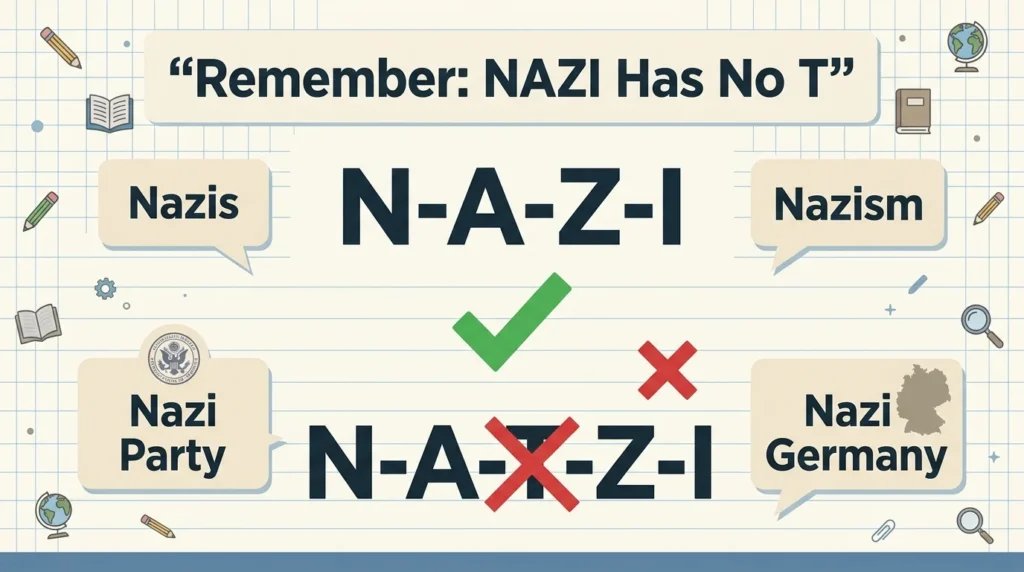
Memory Trick
Use this simple rule:
NAZI has NO T.
Think:
N-A-Z-I = Nazi
The pronunciation may sound like there is a t, but the spelling does not contain one.
A second way to remember it:
“Nazi is four letters.”
If you find yourself typing five letters — N-A-T-Z-I — stop and remove the T.
Real-Life Situations
In an interview
Question: “What period of German history did you study?”
Answer: “I focused on Nazi Germany during the Second World War.”
In a meeting
Correct: “The museum’s new exhibition examines Nazi propaganda.”
The historical term is spelled Nazi.
In an email
Correct: “I’ve completed the section on Nazi persecution and attached the updated document.”
The spelling remains the same in professional writing.
In a text message
Correct: “I’m watching a documentary about Nazi Germany.”
Even informal messages should use the standard spelling.
In an exam
Correct: “The Nazi Party came to power in Germany in 1933.”
Using Natzi would be a spelling error.
In an academic paper
Correct: “The paper analyzes the development of Nazi ideology.”
This is precise and appropriate academic usage.
In a social media post
Correct: “This documentary provides a detailed look at Nazi Germany.”
The platform does not change the spelling.
Expert Tips
1. Do not spell the word from sound
The pronunciation can contain a t sound, so sound-based spelling is particularly unreliable here.
2. Remember the four-letter form
Nazi = N-A-Z-I
That is the quickest solution.
3. Learn the related forms together
Instead of memorizing one word in isolation, remember:
- Nazi
- Nazis
- Nazism
- Nazi Party
- Nazi Germany
- anti-Nazi
- neo-Nazi
This makes the spelling pattern easier to recognize.
4. Be precise with figurative language
If you simply mean “very strict,” do not automatically use Nazi as an insult.
Words such as strict, controlling, rigid, demanding, or perfectionist may communicate your meaning more accurately.
5. Check the spelling before publishing historical content
A spelling mistake in a historical article, educational resource, or academic paper can distract readers from your main argument.
Mini Quiz
| # | Question | Answer | Explanation |
|---|---|---|---|
| 1 | Which spelling is correct: natzi or Nazi? | Nazi | Nazi is the standard English spelling. |
| 2 | Fill in the blank: The book examines ___ Germany. | Nazi | The established expression is Nazi Germany. |
| 3 | Choose the correct form: Natzi Party / Nazi Party | Nazi Party | The political party is referred to as the Nazi Party. |
| 4 | Is “Natzi” a standard spelling of the historical term? | No | It is a misspelling when the intended word is Nazi. |
| 5 | Fill in the blank: The study examines the rise of ___. | Nazism | Nazism is the noun for the ideology and policies of the Nazi movement. |
| 6 | Correct this sentence: “He studied Natzi propaganda.” | He studied Nazi propaganda. | The adjective is spelled Nazi. |
| 7 | Which is the correct plural: Natzis or Nazis? | Nazis | The standard plural of Nazi is Nazis. |
| 8 | True or false: American and British English use different spellings of Nazi. | False | Both use Nazi. |
| 9 | Why might someone write “Natzi”? | Because the pronunciation includes a t sound. | The sound can lead writers to insert a t into the spelling. |
| 10 | Choose the better formal sentence: “My manager is a Nazi about deadlines” or “My manager is extremely strict about deadlines.” | My manager is extremely strict about deadlines. | The second version is clearer and avoids an unnecessary historical comparison. |
FAQ
Is “Natzi” a word?
In standard English, natzi is not the accepted spelling when referring to the Nazi movement or its members. If you mean the historical term, use Nazi.
Is “Nazi” the correct spelling?
Yes. Nazi is the standard English spelling.
Why do people spell Nazi as “Natzi”?
The pronunciation includes a t sound, so someone may hear the word and assume that the sound should appear as the letter t in the spelling. Fast typing and unfamiliarity with the written form can also contribute to the error.
Is “Nazi” an adjective or a noun?
It can be both. As a noun, it can refer to a member or supporter of the Nazi movement. As an adjective, it describes something connected with the Nazis, as in Nazi Germany or Nazi propaganda.
What is the plural of Nazi?
The standard plural is Nazis.
What is the noun for the Nazi ideology?
The usual noun is Nazism.
Is “Nazi” spelled differently in British English?
No. The standard spelling is Nazi in both British and American English. The pronunciation may be represented slightly differently depending on the dictionary’s transcription system and accent, but the spelling remains the same.
Can “Nazi” be used as an adjective?
Yes. For example:
Nazi Germany
Nazi propaganda
Nazi ideology
Nazi occupation
Cambridge explicitly lists Nazi as both a noun and an adjective.
Is “Natzi” ever correct?
Not when you mean the standard English historical term Nazi. If Natzi appears as part of a specific name, quotation, username, or other proper noun, that would be a separate case rather than an alternative spelling of the historical term.
Is it okay to call someone a “Nazi” today?
It depends on what you mean. The word has a precise historical meaning, but dictionaries also record figurative uses for someone considered extremely controlling or fanatical. Because this figurative use can trivialize or invoke the crimes associated with Nazism, it is often better to choose a more precise description when the historical meaning is not intended.
What is the easiest way to remember Nazi?
Remember:
Nazi = N-A-Z-I
No T.
The pronunciation may contain a t sound, but the spelling does not contain the letter t.
Quick Summary
Nazi is the correct spelling, while natzi is a misspelling when referring to the historical Nazi movement, its members, ideology, or related subjects. The word can function as both a noun and an adjective: a Nazi, Nazi Germany, and Nazi propaganda are all standard constructions. The confusion often comes from pronunciation because the standard English pronunciation includes a t sound even though the written word contains no t. There is no American-versus-British spelling difference: both use Nazi. The plural is Nazis, and the related ideological noun is Nazism. For formal and academic writing, always use Nazi and use the term precisely.