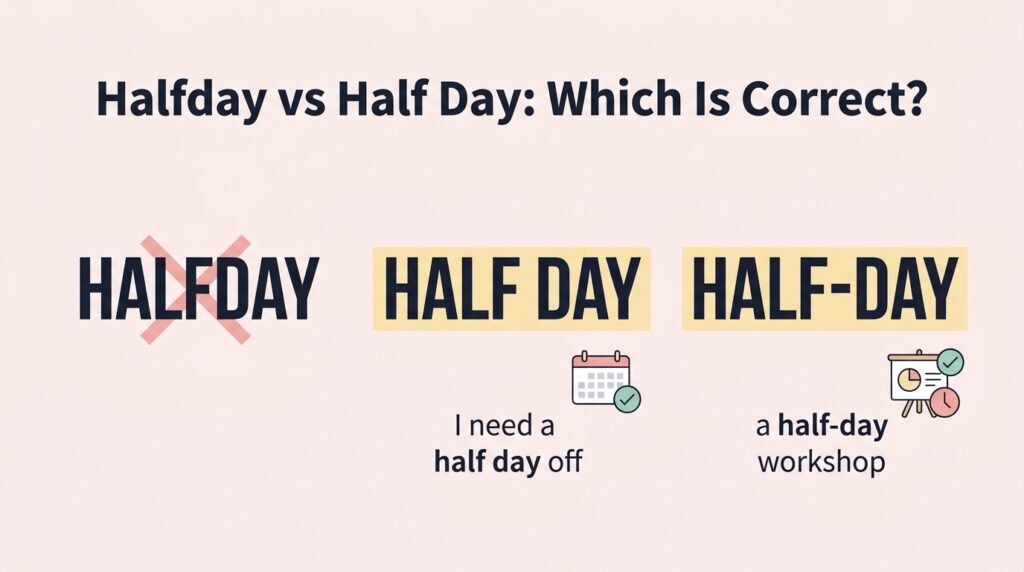

Halfday is not the standard spelling in English. The accepted forms are half day and half-day, depending on how the expression is used. Use half day when it functions as a noun phrase: “I took a half day off.” Use half-day when it modifies another noun: “We attended a half-day workshop.” However, dictionaries also record half-day as a noun, so the distinction is not an absolute rule.
What Is “Half Day”?
Half day refers to a period covering approximately half of a normal day, especially when someone works, studies, or operates for only part of the day.
For example:
- I worked a half day on Friday.
- The school has a half day tomorrow.
- The store is open for half a day.
- We attended a half-day workshop.
The expression can refer to work, school, business hours, training, travel, meetings, or other activities that take only part of a normal day.
Cambridge distinguishes half day as a noun from half-day as an adjective used before a noun. Oxford also records half-day as a noun and gives “a half-day workshop” as an example. Collins likewise recognizes half-day as a noun and notes half day as an alternative. This means the real issue is more nuanced than simply saying “one is a noun and the other is an adjective.”
Why It Matters
The spelling may look like a tiny detail, but it can affect the professionalism and clarity of your writing.
Consider these examples:
- halfday meeting
- half day meeting
- half-day meeting
The third version clearly shows that half-day works together to describe the meeting.
This matters in:
- Workplace emails
- School notices
- Training announcements
- Business proposals
- Event advertisements
- Academic writing
- Schedules
- Leave requests
- Travel descriptions
- Social media posts
A reader will usually understand what you mean even when the hyphen is missing. But standard punctuation helps readers process compound expressions quickly and keeps professional writing consistent.
The Core Rule
Do not write “halfday” as one word. Use “half day” or “half-day” according to the sentence.
A useful starting rule is:
- half day — commonly used as a noun phrase.
- half-day — commonly used before a noun as a compound modifier.
- halfday — not the standard spelling.
For example:
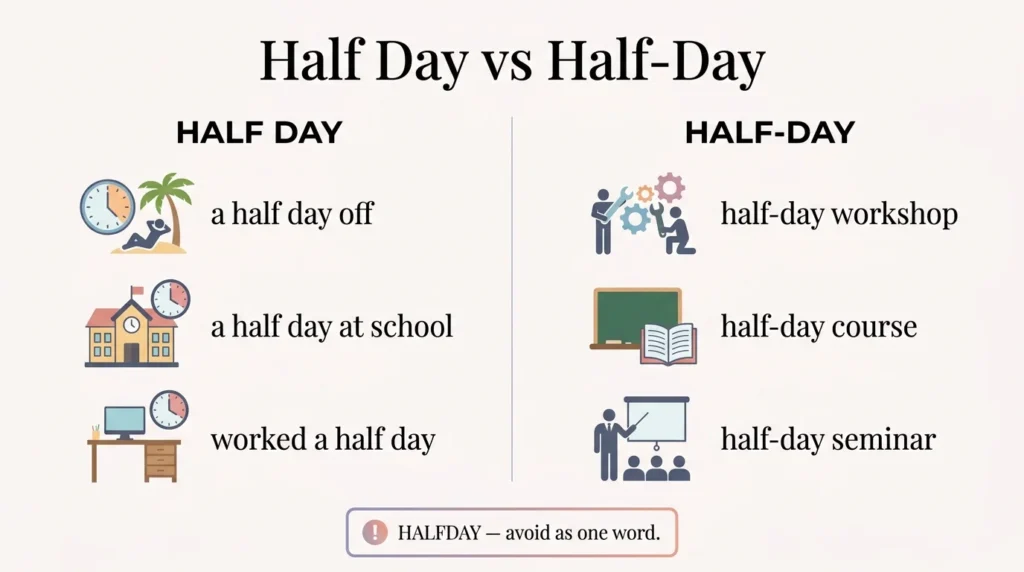
- I took a half day off work.
- We organized a half-day seminar.
- The students have a half day tomorrow.
- The company offers a half-day training program.
However, do not turn this into an inflexible rule. Half-day is also established as a noun in major dictionaries, particularly in British English and some other usage contexts. The safest approach is to follow the grammatical role of the expression and the style convention you are using.
Read More: Scarey vs Scary: Which Spelling Is Correct?
How to Use “Half Day”
Use “Half Day” as a Noun Phrase
When you are talking about the period itself, half day is a natural choice.
Examples:
- I am taking a half day tomorrow.
- She worked a half day on Monday.
- We only have a half day of classes.
- The office will operate for a half day.
- He requested a half day off.
You can often replace the expression with something like half a day, part of a day, or half of the working day.
For example:
I worked a half day.
means approximately:
I worked for half of the normal working day.
Use “Half-Day” as a Compound Modifier
When the expression directly describes a noun that follows it, half-day is commonly hyphenated.
Examples:
- a half-day workshop
- a half-day course
- a half-day seminar
- a half-day meeting
- a half-day excursion
- a half-day training session
The hyphen tells the reader that half and day are functioning together as one modifier.
Compare:
We attended a half-day workshop.
Here, half-day describes workshop.
But:
The workshop lasted half a day.
Here, half a day expresses duration.
Cambridge specifically gives examples such as “a half-day program,” “a half-day seminar,” and “a half-day workshop.”
Correct Examples
Here are examples from different real-life contexts.
Conversation
- I only worked a half day today.
- The children have a half day tomorrow.
Workplace Email
- I would like to request a half day off on Friday.
- The HR team is arranging a half-day orientation session for new employees.
School
- The school will remain open for a half day before the holiday.
- Students will attend a half-day program on Thursday.
Business
- We are planning a half-day strategy workshop for the sales team.
- The office will operate for a half day on New Year’s Eve.
Travel
- We booked a half-day city tour.
- The guide suggested spending a half day exploring the old town.
Academic Writing
- The researchers conducted a half-day training session for participants.
- The students completed the assignment in less than half a day.
Social Media
- Join us for a half-day photography workshop this Saturday.
- I finally have a half day to catch up on everything.
Notice that half-day is particularly useful when the expression comes immediately before another noun.
Incorrect vs. Correct
| ❌ Incorrect | ✅ Correct | Why |
|---|---|---|
| I booked a halfday workshop. | I booked a half-day workshop. | Half-day modifies “workshop,” so the standard compound form uses a hyphen. |
| We had a halfday meeting. | We had a half-day meeting. | The two words work together to describe the meeting. |
| I took a halfday off. | I took a half day off. | Here the expression refers to the amount of time taken off. |
| The school has a halfday tomorrow. | The school has a half day tomorrow. | Halfday is not the standard spelling. |
| She attended a half day seminar. | She attended a half-day seminar. | The phrase modifies “seminar.” |
| We spent a halfday there. | We spent half a day there. | “Half a day” is the natural expression for duration here. |
| They advertised a half day course. | They advertised a half-day course. | The phrase modifies “course.” |
| I worked a half-day yesterday. | I worked a half day yesterday. | Half day is a straightforward noun phrase here, although half-day is also found as a noun in some dictionaries and varieties. |
| The company offers a halfday training program. | The company offers a half-day training program. | The compound modifier should not be written as one word. |
| Tomorrow is a halfday at school. | Tomorrow is a half day at school. | Use the standard open form for this noun phrase. |
Why People Make This Mistake
Phonetic Similarity
When spoken aloud, half day, half-day, and halfday sound the same. English does not provide a pronunciation clue telling you whether a hyphen belongs in the written form.
That makes this a spelling-and-grammar problem rather than a pronunciation problem.
Spelling Overgeneralization
English contains many compounds that have eventually become single words:
- classroom
- notebook
- weekend
- bedroom
Writers sometimes assume that any frequently used combination should eventually become one word.
That does not work here. Halfday is not the standard spelling simply because the phrase is common.
Read More: Laser vs. Lazer: Which Spelling Is Correct?
Autocomplete and Spellcheck
Typing software may not always flag halfday. A word processor’s dictionary is not a complete grammar authority, and online platforms can contain huge amounts of nonstandard spelling.
A word appearing online does not automatically make it standard English.
Translation Interference
Learners may translate a similar expression directly from another language and combine the words into one English compound.
This is especially common when English compound formation differs from the learner’s first language.
Overgeneralizing the Hyphen Rule
The opposite mistake also occurs. Some writers learn that compound modifiers take hyphens and then add a hyphen everywhere:
I took a half-day off.
This form can be encountered, and dictionaries differ in how they treat the noun, but if you are using the common open noun phrase, a half day off is the safer general choice.
The key is not “hyphen everything.”
Common Mistakes Checklist
Writing “Halfday”
Mistake: Treating the phrase as one word.
Why it happens: The expression is common and sounds like a single unit.
Avoid it: Use half day or half-day, depending on the sentence.
Omitting the Hyphen Before a Noun
Mistake: “a half day workshop”
Better: “a half-day workshop”
Why: The phrase works together as a compound modifier before workshop.
Hyphenating Every Use
Mistake: Assuming half-day must always contain a hyphen.
Better: Consider the grammatical role first.
For example:
I took a half day off.
is a straightforward open noun phrase.
Confusing “Half Day” With “Half a Day”
These expressions can overlap in meaning, but they are not always interchangeable.
The course lasts half a day.
focuses on duration.
Friday is a half day.
identifies the type or schedule of the day.
Treating Dictionary Variation as an Error
Different dictionaries may present the noun differently. Cambridge lists half day as a noun, while Oxford and Collins also recognize half-day as a noun.
That does not mean one dictionary is “wrong.” English spelling conventions can vary by dictionary, region, editorial style, and grammatical context.
Read More: Worshipped vs Worshiped: Which Spelling Is Correct?
“Half Day” in Real English
Grammatically Correct
Half day is clearly correct when it functions as a noun phrase.
I am taking a half day off work.
This is a normal construction in workplace English. Cambridge gives half day as a noun for a day when people work only in the morning or afternoon, and its examples include “a half day.”
Grammatically Correct and Commonly Hyphenated
Half-day is standard when it functions as a compound modifier before a noun.
We attended a half-day seminar.
This is especially common in business, education, travel, and event descriptions. Cambridge explicitly uses forms such as half-day program, half-day seminar, and half-day workshop.
Grammatically Possible but Style-Dependent
A noun use such as half-day is also legitimate in some dictionaries and varieties of English.
Oxford lists half-day as a noun, while Collins gives half-day as a noun and also notes half day as an alternative.
So it would be misleading to claim that half-day is always an adjective and half day is always a noun. That simplified rule is useful for many sentences, but it does not describe the full range of standard English usage.
Not Standard
Halfday as one word is the form to avoid in standard English.
Even though you may encounter it in informal online writing, usernames, product names, business names, or other nonstandard contexts, that does not make it the conventional English spelling.
American vs. British English
There is no simple American-versus-British rule that changes the basic answer.
Both varieties use half-day before nouns:
- half-day workshop
- half-day course
- half-day session
- half-day program
There is, however, some dictionary variation in how the noun itself is represented. Cambridge gives half day as the noun, while Oxford and Collins also recognize half-day as a noun.
The practical lesson is more useful than trying to assign the difference entirely to geography:
Use the style required by your dictionary, organization, publication, or house style, and never use “halfday” as the default standard spelling.
Formal vs. Informal Usage
The same basic forms work in both formal and informal English.
In a professional email:
I would like to request a half day off on Thursday.
In a formal event description:
The university will host a half-day research workshop.
In casual conversation:
I only worked a half day today.
The main difference is not formality. It is grammatical function and editorial consistency.
In highly edited documents, consistency matters more than choosing one form arbitrarily.
Comparison Table
| Feature | Halfday | Half day | Half-day |
|---|---|---|---|
| Standard spelling? | ❌ No | ✅ Yes | ✅ Yes |
| Written as one word? | Yes | No | No |
| Written as two separate words? | No | Yes | No |
| Uses a hyphen? | No | No | Yes |
| Common noun use | ❌ Avoid | ✅ Yes | ✅ Also recognized |
| Compound modifier before a noun | ❌ No | Usually not | ✅ Yes |
| Example | halfday workshop ❌ | half day off | half-day workshop |
| Best general advice | Avoid | Use for noun phrase | Use for compound modifier |
Memory Trick
Use this simple rule:
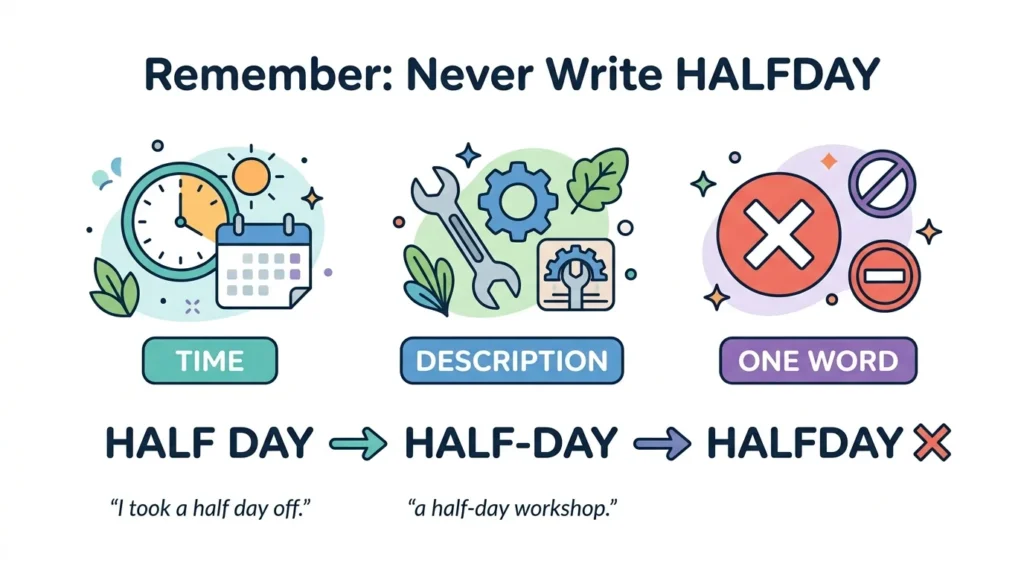
Half a day? Keep it open. Half-day something? Add the hyphen. Never make it one word.
Think:
TIME → half day
I took a half day off.
DESCRIPTION → half-day
I attended a half-day workshop.
ONE WORD → avoid
halfday ❌
This is not a perfect rule for every dictionary entry, because half-day can also function as a noun. But it is an excellent practical rule for everyday writing.
Read More: Perfer vs Prefer: Which Spelling Is Correct?
Real-Life Situations
Interview
Question: “How long is the assessment?”
Answer: “It is a half-day assessment.”
Here, half-day describes assessment.
Workplace Email
I would like to take a half day off on Friday for a personal appointment.
Here, half day refers to the amount of leave.
Meeting
We have scheduled a half-day meeting for Monday.
Here, half-day modifies meeting.
School Notice
Students will have a half day on Friday.
Here, the expression refers to the school schedule.
Travel Advertisement
Enjoy a half-day tour of the historic district.
Here, half-day modifies tour.
Exam
If you are writing:
The examination is a half-day examination.
the hyphenated form functions as a compound modifier.
If you are writing:
The examination will take half a day.
you are expressing duration.
Expert Tips
- Look at the noun after the expression. If “half-day” directly describes that noun, the hyphen is usually appropriate.
- Do not create “halfday.” Frequent online usage does not make it the standard spelling.
- Use “half a day” for duration when it sounds more natural. “The project took half a day” is often clearer than forcing “half day” into the sentence.
- Do not memorize an absolute noun/adjective rule. Dictionaries differ on whether the noun is written half day or half-day.
- Follow your publication’s style guide. If you are writing for an employer, school, journal, or publisher, consistency is important.
- Remember that the hyphen does not change pronunciation. Cambridge provides pronunciation information for both forms.
- Do not rely entirely on spellcheck. Grammar software may recognize a form without telling you whether it is the best form for your sentence.
- When in doubt, rewrite. “The training lasted half a day” is often an easy way to avoid a hyphenation question altogether.
FAQ
Is “halfday” a correct word?
No. Halfday as one word is not the standard spelling to use in normal English writing. Use half day or half-day depending on the grammatical context.
Is “half day” correct?
Yes. Half day is a standard noun phrase. For example: “I took a half day off.” Cambridge lists half day as a noun.
Is “half-day” correct?
Yes. Half-day is standard, particularly as a compound modifier before a noun, as in “a half-day workshop.” It is also recognized as a noun by dictionaries including Oxford and Collins.
Should I write “half day” or “half-day”?
It depends on the sentence. Use half-day when it modifies a following noun: “a half-day course.” Use half day when you are using the expression as a noun phrase: “I took a half day off.”
Is “half-day leave” correct?
Yes. Half-day leave is a standard compound-modifier construction because half-day describes leave. In some workplace contexts, however, “half a day of leave” may be more natural.
Is “half day off” correct?
Yes. “I took a half day off” is a natural construction. You may also hear or see “I took half a day off,” which emphasizes the duration.
Is “halfday” acceptable in informal texting?
People may use it informally, but that does not make it the standard spelling. If accuracy matters, use half day or half-day.
Is “half-day” always an adjective?
No. That is an oversimplification. Half-day can also function as a noun in dictionaries such as Oxford and Collins. Cambridge, by contrast, presents half day as the noun.
Does American English use “half-day”?
Yes. American English commonly uses half-day in compound modifiers such as “half-day program” and “half-day workshop.” Cambridge provides US and UK information for the expression.
Does British English prefer “half-day”?
British dictionaries recognize half-day as a noun, but British English also uses the open form half day. There is no reliable rule that says British writers must always use the hyphenated form.
What is the easiest way to remember the difference?
Remember: half day for the time itself, half-day when it describes something, and halfday as one word should be avoided.
Quick Summary
Halfday is not the standard English spelling. The correct choices are half day and half-day, and the best form depends on how the expression functions in the sentence. Use half-day when it acts as a compound modifier before a noun, as in “a half-day workshop” or “a half-day course.” Use half day as an open noun phrase, as in “I took a half day off.” However, dictionary usage is not completely uniform: Oxford and Collins also recognize half-day as a noun, while Cambridge lists half day as the noun.
The safest practical rule is simple: never write “halfday” as one word.
Mini Quiz
| # | Question | Answer | Explanation |
|---|---|---|---|
| 1 | Choose the correct form: “We attended a ___ workshop.” A) halfday B) half day C) half-day | C) half-day | The expression modifies “workshop,” so the hyphenated compound modifier is appropriate. |
| 2 | Fill in the blank: “I took a ___ off work.” | half day | Here the expression functions as a noun phrase referring to the amount of time taken off. |
| 3 | Correct this sentence: “The company arranged a halfday seminar.” | The company arranged a half-day seminar. | “Half-day” modifies “seminar.” |
| 4 | Which spelling should you avoid in standard English? A) half day B) half-day C) halfday | C) halfday | The closed one-word form is not the standard spelling. |
| 5 | Fill in the blank: “The tour lasted ___.” | half a day | “Half a day” is a natural way to express duration. |
| 6 | Choose the best form: “She enrolled in a ___ course.” A) half day B) half-day C) halfday | B) half-day | The compound modifies “course.” |
| 7 | Correct this sentence: “Tomorrow is a halfday at school.” | Tomorrow is a half day at school. | The standard open noun phrase is appropriate here. |
| 8 | True or false: “Half-day” can never function as a noun. | False | Oxford and Collins recognize half-day as a noun, showing that the noun spelling varies by dictionary and usage. |
| 9 | Fill in the blank: “The manager requested a ___ training session.” | half-day | The phrase describes “training session,” so the hyphenated modifier is appropriate. |
| 10 | Which sentence is best? A) I worked halfday. B) I worked a half day. C) I worked a half-day. | B) I worked a half day. | The open noun phrase is the straightforward standard choice in this construction. |