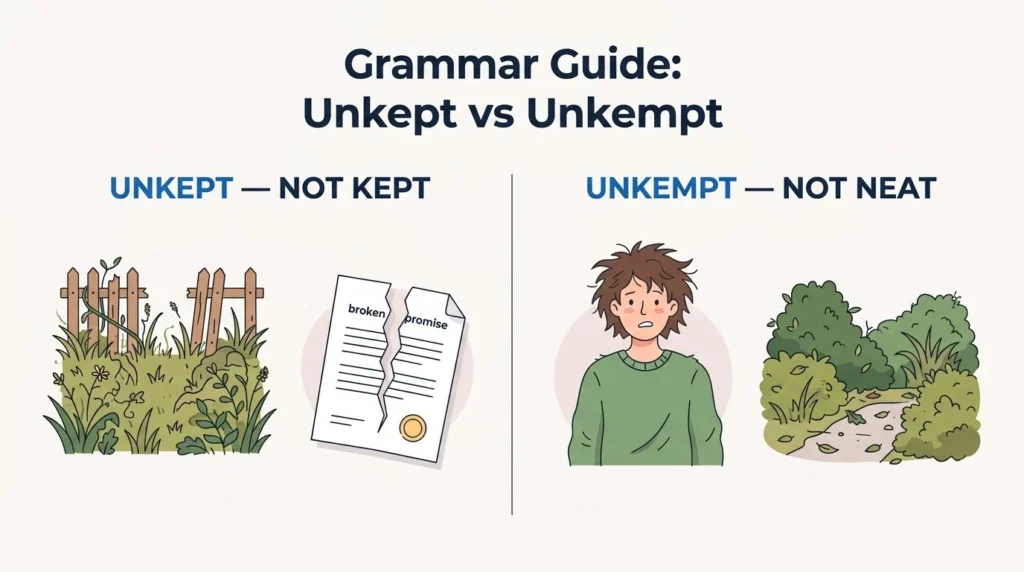

Unkept and unkempt are both correct English words, but they have different meanings. Unkept means “not kept,” “not maintained,” or “not fulfilled,” as in an unkept promise or an unkept garden. Unkempt means untidy, messy, or poorly groomed, as in unkempt hair or an unkempt appearance. The extra m changes the word and its usual meaning.
What Is the Difference Between Unkept and Unkempt?
The easiest way to separate these words is to focus on the idea behind each one:
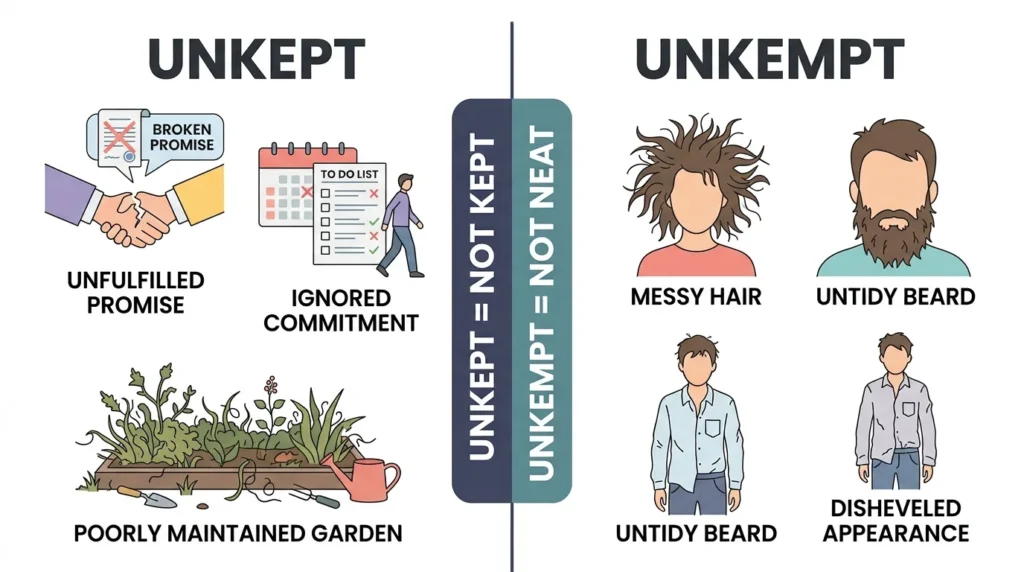
- Unkept = something has not been kept, maintained, observed, or fulfilled.
- Unkempt = something or someone is untidy, messy, disheveled, or poorly groomed.
Both words are adjectives, but they developed from different underlying ideas.
Unkept is simply un + kept. It commonly describes a promise that was not fulfilled or a place or thing that has not been properly maintained. Dictionaries also record unkept in contexts such as neglected gardens, buildings, and other property.
Unkempt, on the other hand, is associated historically with being uncombed. Today, it commonly describes hair, appearance, people, gardens, rooms, and other things that look messy or lack neatness.
So, although the two words look almost identical, they should not normally be treated as interchangeable.
Why It Matters
Using the wrong word can change the meaning of your sentence.
Consider these two examples:
The politician made an unkept promise.
This means the promise was not kept or fulfilled.
The politician arrived with unkempt hair.
This means the person’s hair was messy or poorly groomed.
The distinction matters particularly in professional, academic, and formal writing. A spelling mistake involving these words may look small, but it can make your sentence describe the wrong idea.
For example, saying:
The company made several unkempt promises.
does not communicate the intended meaning. A promise is something that can be kept or broken, so unkept is the appropriate word.
Likewise:
He arrived at the interview looking unkept.
may be understandable in context, but unkempt is normally the better choice when you mean that his appearance was untidy or poorly groomed.
The Core Rule
Rule: Use unkept for something that has not been kept, maintained, observed, or fulfilled. Use unkempt for someone or something that is untidy, messy, disheveled, or poorly groomed.
A quick test can help:
Ask: “Was something supposed to be kept?”
- If yes, unkept may be correct: an unkept promise.
- If you mean messy or untidy, use unkempt: unkempt hair.
Read More: Mama vs. Momma: Which Spelling Is Correct?
The Two-Second Test
Think:
UNKEPT → NOT KEPT
UNKEMPT → NOT NEAT
That distinction will solve most cases.
How to Use Unkept
Unkept is the straightforward negative form of kept in contexts where something has not been maintained, observed, or fulfilled.
It is especially natural with things such as:
- promises
- commitments
- agreements
- appointments
- rules or obligations
- gardens
- buildings
- property
- spaces that have not been maintained
The exact meaning depends on the noun.
Unkept Promises
One of the clearest uses is unkept promise.
The mayor faced criticism over several unkept promises.
Here, unkept means the promises were made but not fulfilled.
Unkept Places
Unkept can also describe a physical place that has not received proper care or maintenance.
The old garden had become unkept after years without regular care.
Here, the focus is on lack of maintenance.
Unkept Rules or Commitments
The word can also describe something that was supposed to be observed or honored.
The agreement contained several conditions that were left unkept.
However, depending on the exact context, alternatives such as unfulfilled, ignored, broken, or violated may sound more natural.
How to Use Unkempt
Unkempt describes a lack of neatness, grooming, or order.
It is particularly common with:
- hair
- beards
- clothing
- appearance
- people
- gardens
- rooms
- yards
- surroundings
For example:
His unkempt hair made him look as though he had just woken up.
The word does not necessarily mean dirty. Something can be unkempt because it is messy, neglected, overgrown, or not neatly maintained.
It can also describe writing or other things in a figurative sense when they lack polish or order.
Correct Examples
Here are examples showing how the two words work in different situations.
- Conversation:
“His hair looked unkempt after the long journey.” - Email:
“The property has remained unkept since the previous tenant left.” - School writing:
“The character is described as having an unkempt appearance.” - Workplace:
“The abandoned office had become unkept over the years.” - Business:
“Customers complained about the unkept landscaping around the store.” - Social media:
“The park looks beautiful in spring, but some areas become unkempt during the winter.” - Academic writing:
“The study examines the effects of neglected and unkempt public spaces.” - Formal writing:
“The minister was criticized for several unkept commitments.” - Everyday English:
“He looked unkempt after spending the night at the airport.” - Personal description:
“Her unkempt beard made him look considerably older.” - Property description:
“The house stood behind an unkept hedge.” - News-style writing:
“Residents called for action after years of unkept public spaces.”
Notice that unkept focuses on something not being kept or maintained, while unkempt focuses more strongly on visible untidiness or poor grooming.
Read More: Taught vs Tought: Which Spelling Is Correct?
Incorrect vs. Correct
| ❌ Incorrect | ✅ Correct | Why |
|---|---|---|
| He had unkept hair. | He had unkempt hair. | Hair that is messy or poorly groomed is normally described as unkempt. |
| She made an unkempt promise. | She made an unkept promise. | A promise can be kept or not kept. |
| The man looked unkept. | The man looked unkempt. | Unkempt is the established adjective for a messy or poorly groomed appearance. |
| The politician had several unkempt promises. | The politician had several unkept promises. | The promises were not fulfilled. |
| His beard was unkept. | His beard was unkempt. | A poorly groomed beard is described as unkempt. |
| The garden was unkempt because nobody maintained it. | The garden was unkept because nobody maintained it. | Unkept emphasizes lack of maintenance; unkempt can also describe a messy garden, but the intended meaning here is maintenance. |
| The contract contained an unkempt obligation. | The contract contained an unkept obligation. | The obligation was not fulfilled or honored. |
| She arrived with an unkept appearance. | She arrived with an unkempt appearance. | Unkempt naturally describes a person’s untidy appearance. |
| The company apologized for its unkempt commitments. | The company apologized for its unkept commitments. | Commitments can be kept or left unfulfilled. |
| He looked unkept and untidy. | He looked unkempt and untidy. | Unkempt is the normal word for a person’s messy appearance. |
| The building was unkempt for years because nobody cared for it. | The building was unkept for years because nobody maintained it. | Unkept directly expresses lack of maintenance. |
| She had an unkept hairstyle. | She had an unkempt hairstyle. | Unkempt is used for hair and grooming. |
One Important Qualification
Some nouns can reasonably take either word, especially physical places.
For example, both an unkept garden and an unkempt garden can occur.
The difference is one of emphasis:
- an unkept garden → a garden that has not been maintained or cared for
- an unkempt garden → a garden that looks messy, overgrown, or untidy
The words can therefore overlap in some physical contexts, but their meanings are not identical.
Why Do People Confuse Unkept and Unkempt?
The confusion is understandable because the words differ by only one letter.
1. They look almost identical
Both begin with unke- and contain kept visually.
That makes it easy to type one when you mean the other.
2. Their meanings overlap in some contexts
A neglected garden can be both unkept and unkempt.
If nobody maintains a garden, it may become visibly messy. This creates an area where the two words can appear close in meaning.
3. People associate “kept” with neatness
The phrase well-kept commonly means neat, clean, or properly maintained.
That can make learners assume that the opposite must always be unkept.
But English has the established adjective unkempt for untidy or poorly groomed appearance.
4. The pronunciation is similar
The words are pronounced differently, but the difference may not be obvious to every learner, especially in fast speech.
Unkept: /ˌʌnˈkept/
Unkempt: /ʌnˈkempt/
The extra m is pronounced in unkempt.
5. Spellcheck cannot explain meaning
A spelling checker may recognize both words as valid.
That does not mean either word is correct for your sentence.
This is an important lesson with commonly confused words: spellcheck checks spelling, not always intended meaning.
Common Mistakes Checklist
Mistake 1: Using Unkept for Hair
Problem: His hair was unkept.
Better: His hair was unkempt.
Why: When you mean messy, disheveled, or poorly groomed hair, unkempt is the standard choice.
Mistake 2: Using Unkempt for Promises
Problem: She apologized for her unkempt promises.
Better: She apologized for her unkept promises.
Why: A promise is something that can be kept or not kept.
Mistake 3: Assuming Only One Word Is Correct
Both words are legitimate English words.
The question is not:
“Is unkept or unkempt the real word?”
Both are real words.
The useful question is:
“Which meaning does my sentence require?”
Mistake 4: Treating Them as Perfect Synonyms
They can overlap when describing neglected physical places, but they are not interchangeable everywhere.
An unkept promise and an unkempt promise are not equivalent expressions.
Mistake 5: Choosing by Spelling Alone
If you are unsure, do not simply choose the word that looks more familiar.
Look at the noun and ask what you mean:
- not fulfilled? → unkept
- not neat or groomed? → unkempt
- not maintained? → unkept may be appropriate
- visibly messy? → unkempt may be appropriate
Read More: Shinning vs Shining: Which Is Correct?
Unkept vs. Unkempt in Real English
Unkept in everyday English
Unkept is grammatically correct and natural when something has not been kept, maintained, or fulfilled. It is especially straightforward with expressions such as unkept promise, unkept commitment, or unkept garden. In everyday conversation, speakers may often choose more specific words such as broken, neglected, or poorly maintained, depending on the situation.
Unkempt in everyday English
Unkempt is a natural choice when describing an untidy appearance, especially hair, facial hair, clothing, or a person’s overall appearance. It can also describe neglected or messy physical surroundings, such as a lawn or garden. It often carries a mildly negative or disapproving tone when applied to a person’s appearance.
When Both Can Describe a Garden
A garden is one of the clearest areas of overlap. Unkept emphasizes that the garden has not been maintained or cared for. Unkempt emphasizes the resulting messy or untidy appearance. Therefore, an unkept garden and an unkempt garden can both be grammatically possible, but the writer may be emphasizing a slightly different aspect of the same situation.
When Only One Fits Naturally
Some contexts strongly favor one word.
A promise is normally unkept, not unkempt.
Hair is normally unkempt, not unkept.
A person’s overall appearance is normally unkempt when the intended meaning is messy or poorly groomed.
This is why simply memorizing “both mean neglected” is not enough. The noun and intended meaning matter.
American vs. British English
There is no major American-versus-British spelling distinction between unkept and unkempt. Both forms are used in both varieties of English.
Pronunciation can be represented slightly differently in dictionary systems, but the core meanings remain the same. Cambridge, for example, lists both words in American and British English contexts.
So you do not need to choose unkept for American English and unkempt for British English, or vice versa.
The choice depends on meaning, not dialect.
Formal vs. Informal Usage
Both unkept and unkempt are suitable for formal writing when they accurately express the intended meaning.
However, the register and context can influence which alternative sounds best.
For example:
- Formal: “The organization faced criticism for its unkept commitments.”
- Everyday: “He looked unkempt after working all night.”
- Formal: “The grounds had become unkempt.”
- More direct: “The grounds had not been properly maintained.”
When writing professionally, choose the word that expresses the exact condition rather than choosing the word simply because it sounds more sophisticated.
Comparison Table
| Feature | Unkept | Unkempt |
|---|---|---|
| Part of speech | Adjective | Adjective |
| Basic meaning | Not kept, maintained, observed, or fulfilled | Untidy, messy, disheveled, or poorly groomed |
| Common with promises | Yes | No |
| Common with commitments | Yes | No |
| Common with hair | Uncommon for this meaning | Yes |
| Common with appearance | Not usually | Yes |
| Can describe gardens | Yes | Yes |
| Can describe neglected places | Yes | Yes |
| Main idea | Failure to keep or maintain | Lack of neatness or grooming |
| Extra letter | None | m |
| Memory clue | not kept | not neat |
Memory Trick
Use this mnemonic:
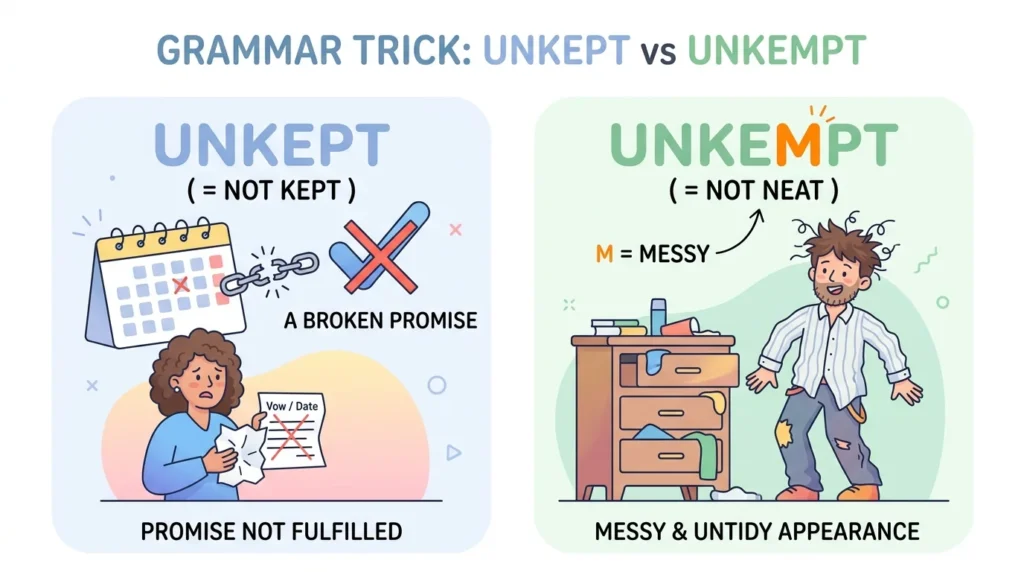
UNKEPT = NOT KEPT
UNKEMPT = NOT NEAT
You can make it even easier with two questions:
Was a promise, rule, commitment, or maintenance obligation not kept?
→ UNKEPT
Does someone or something look messy, untidy, or poorly groomed?
→ UNKEMPT
Remember:
The M in “unkempt” can remind you of “messy.”
That is not the historical origin of the word, but it is a useful memory device.
Real-Life Situations
Job Interview
Imagine someone arrives for an interview with messy hair and a poorly groomed appearance.
You could say:
He looked unkempt when he arrived for the interview.
You would not normally use unkept here when the intended meaning is poor grooming.
Business Meeting
A company promised to deliver a report but failed to do so.
The client was frustrated by the company’s unkept promise.
The issue is failure to fulfill a commitment, so unkept is appropriate.
A property manager writes:
The garden has become unkempt and needs immediate attention.
The focus is on the garden’s visible messy condition.
Alternatively:
The garden has remained unkept since the property changed ownership.
Here, the emphasis is on lack of maintenance.
Text Message
You look a little unkempt today. Everything okay?
The word refers to appearance.
Exam
A student writes:
The politician’s unkempt promises caused public anger.
The better choice is:
The politician’s unkept promises caused public anger.
The promises were not fulfilled.
Read More: Carrer vs Career: Which Spelling Is Correct?
Expert Tips
1. Do not memorize them as “messy” and “neglected” only
That shortcut is useful, but incomplete.
Think about the relationship between the word and the noun.
Promises are kept. Hair is groomed.
That makes the correct choice much easier.
2. Remember that “unkept” is not limited to promises
Promises are probably the clearest example, but unkept can also describe physical things that have not been maintained. Dictionaries specifically record uses involving gardens, buildings, and other property.
3. Do not assume “unkept” is wrong
Some writers have seen unkempt so often that they assume unkept is a spelling mistake.
It is not.
Unkept is a valid English adjective.
4. Watch for meaning overlap with physical places
A lawn can be unkept because it has not been maintained.
It can also be unkempt because it looks messy or overgrown.
The surrounding sentence determines which emphasis is intended.
5. Choose a more precise alternative when necessary
Sometimes neither word is the clearest option.
Instead of:
The facility was unkept.
you might write:
The facility was poorly maintained.
Instead of:
He looked unkempt.
you could write:
He looked disheveled.
Precision is more important than forcing one of these two words into every sentence.
FAQ
Is “unkept” a real word?
Yes. Unkept is a standard English adjective meaning not kept, maintained, observed, or fulfilled. It is commonly used with nouns such as promise and can also describe neglected physical places.
Is “unkempt” a real word?
Yes. Unkempt is a standard English adjective meaning untidy, messy, disheveled, or poorly groomed. It is particularly common with hair and personal appearance.
Is an unkept promise correct?
Yes. An unkept promise is correct and means a promise that has not been fulfilled or kept.
Is “unkempt hair” correct?
Yes. Unkempt hair is a very common and natural use of unkempt. It means hair that is messy, disheveled, or not properly groomed.
Can a garden be unkept?
Yes. Unkept garden can mean a garden that has not been properly maintained or cared for.
Can a garden be unkempt?
Yes. Unkempt garden is also correct when the emphasis is on the garden’s untidy, messy, or neglected appearance.
Is “unkept” the opposite of “kept”?
In many contexts, yes. Unkept can literally mean not kept, although English may use a more specific word such as broken, neglected, or unfulfilled depending on the context.
Is “unkempt” the opposite of “kempt”?
Historically, unkempt is connected with kempt, meaning combed or groomed. In modern English, unkempt means untidy, messy, or poorly groomed.
Can I use “unkept” to describe a person?
It can occur in descriptions involving a person’s condition or things associated with them, but when you specifically mean that a person’s appearance is messy or poorly groomed, unkempt is the more natural choice.
Which word should I use for a messy house?
Both may be possible depending on what you mean. Unkept house emphasizes that the house has not been maintained or cared for. Unkempt house emphasizes its untidy or messy condition.
How can I remember the difference quickly?
Remember:
UNKEPT = NOT KEPT
UNKEMPT = NOT NEAT
If you are talking about a promise, think kept. If you are talking about hair or appearance, think unkempt.
Mini Quiz
| # | Question | Answer | Explanation |
|---|---|---|---|
| 1 | The politician made an ___ promise. (A) unkept (B) unkempt | A — unkept | A promise can be kept or not kept. |
| 2 | His hair looked ___. (A) unkept (B) unkempt | B — unkempt | Unkempt describes messy or poorly groomed hair. |
| 3 | Fill in the blank: The abandoned garden had become ___. | unkept / unkempt | Both can work, but unkept emphasizes lack of maintenance, while unkempt emphasizes untidiness. |
| 4 | Correct this sentence: “She apologized for her unkempt promises.” | She apologized for her unkept promises. | Promises can be kept or left unfulfilled. |
| 5 | Correct this sentence: “The man arrived with unkept hair.” | The man arrived with unkempt hair. | Unkempt is the natural word for messy or poorly groomed hair. |
| 6 | Which word best describes a messy beard? (A) unkept (B) unkempt | B — unkempt | Unkempt commonly describes poorly groomed facial hair. |
| 7 | Which word fits a commitment that was not fulfilled? (A) unkept (B) unkempt | A — unkept | A commitment can be kept or not kept. |
| 8 | Fill in the blank: The house had been ___ for years, with no repairs or maintenance. | unkept | The sentence emphasizes lack of care and maintenance. |
| 9 | Choose the better sentence: (A) He looked unkempt after the trip. (B) He looked unkept after the trip. | A — He looked unkempt after the trip. | Unkempt naturally describes a person’s untidy appearance. |
| 10 | Is this sentence correct? “The company faced criticism for its unkept promises.” | Yes. | Unkept promises is a standard and precise expression. |
Quick Summary
Unkept and unkempt are both correct words, but they serve different purposes. Unkept means something has not been kept, fulfilled, or properly maintained. It works especially well with promises, commitments, and neglected property. Unkempt means untidy, messy, disheveled, or poorly groomed, and it is especially common with hair, beards, appearance, and people. Some physical things, such as gardens, can be either unkept or unkempt, depending on whether you want to emphasize lack of maintenance or visible untidiness. The easiest memory trick is simple: unkept = not kept; unkempt = not neat. When in doubt, identify the exact meaning before choosing the spelling.