
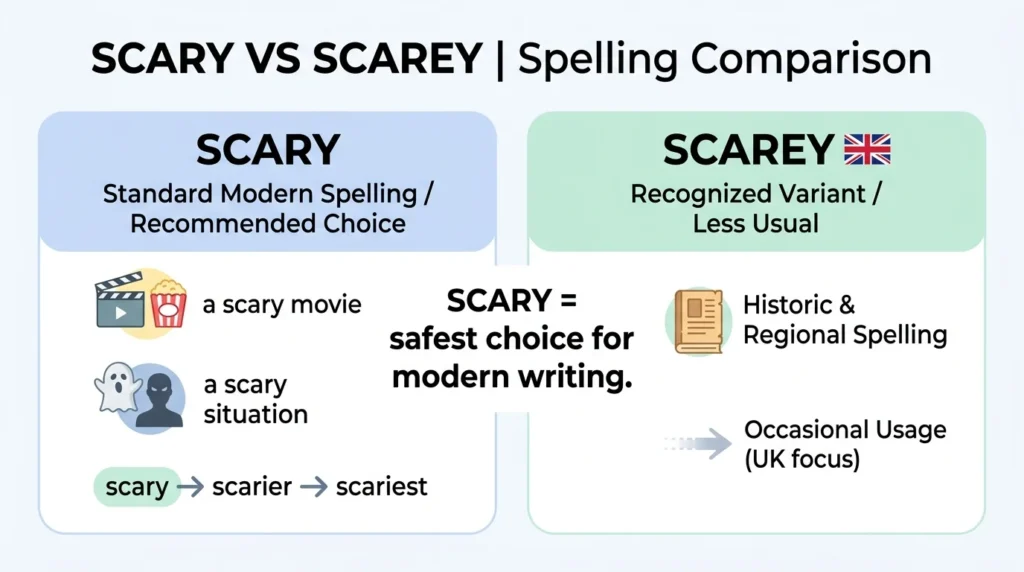
Scary is the standard spelling you should normally use. It means frightening or causing fear. Scarey is not simply a meaningless typo: dictionaries record it as a variant spelling, particularly in British English, and some sources describe it as informal or dated. However, scary is the safest choice for modern everyday, academic, professional, and international writing.
What Is the Difference Between Scarey and Scary?
Scary and scarey have the same basic meaning: something that causes fear, alarm, or nervousness.
The important difference is spelling and usage.
Scary is the normal modern spelling. It is the form you will most often see in contemporary English.
Scarey is a recognized variant spelling, not a completely invented word. Some dictionaries specifically record it as a British variant of scary, while another major dictionary lists it as a variant spelling without presenting it as the primary form.
So the practical rule is simple:
- Scary = the standard choice for modern writing.
- Scarey = a recognized but less usual variant, especially associated with British English.
- If you are unsure which one to use, choose scary.
This distinction matters because saying that scarey “does not exist” is too absolute. It does appear in dictionary records. At the same time, telling learners that scarey and scary are equally safe in every situation would also be misleading.
Why It Matters
A one-letter spelling difference may seem unimportant, but spelling choices affect how easily readers understand and judge your writing.
Consider these situations:
- You are writing an application or professional email.
- You are completing an English exam.
- You are publishing an article.
- You are writing a school assignment.
- You are creating social media content for a business.
- You are communicating with an international audience.
In these situations, scary is the straightforward choice.
If you write scarey, a reader may interpret it as a spelling mistake, even though the form has dictionary support as a variant. That is especially likely when the reader expects standard modern English.
The issue is therefore not simply right versus wrong. It is also about choosing the form that is clearest and least likely to distract your reader.
The Core Rule
Use scary when you mean “frightening” or “causing fear.”
The standard modern spelling is:
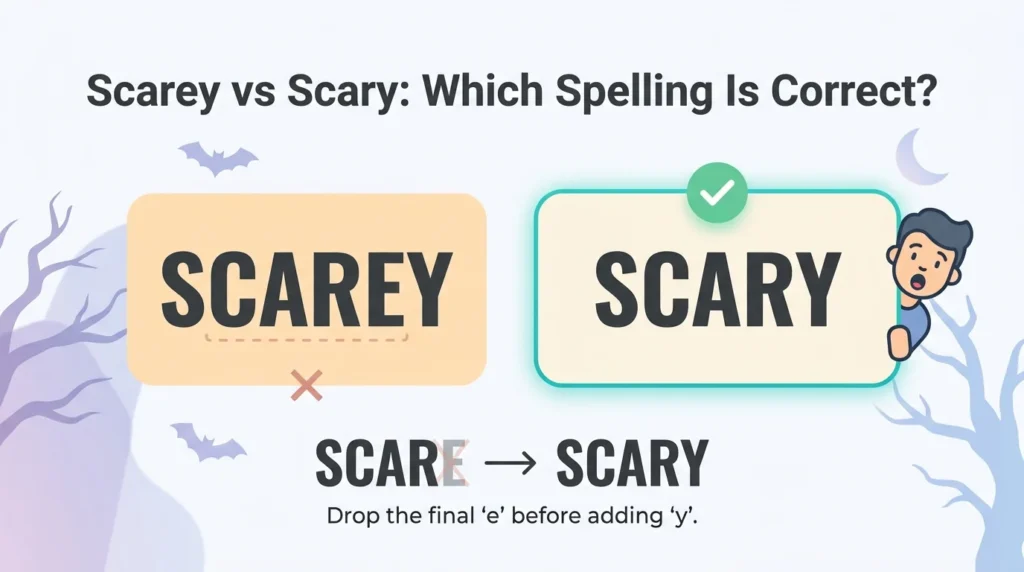
scare + y → scary
Not:
scare + y → scarey
The final e is not retained in scary.
However, there is an important qualification: scarey is recorded as a variant spelling, including as a UK variant in current dictionary sources. Therefore, the most accurate rule is not “scarey is an impossible word.” The better advice is: use scary unless you have a specific reason to use the variant scarey.
Read More: Laser vs. Lazer: Which Spelling Is Correct?
How to Use Scary
Scary is an adjective.
An adjective describes a person, thing, place, experience, situation, or idea.
For example:
The movie was scary.
Here, scary describes the movie.
You can use scary before a noun:
We heard a scary noise.
You can also use it after a linking verb such as be, look, seem, or feel:
The house looks scary at night.
That situation was scary.
The dark room felt scary.
Scary Before a Noun
This is one of the most common patterns.
- a scary movie
- a scary story
- a scary dream
- a scary situation
- a scary experience
- a scary sound
- a scary place
- a scary moment
Scary After a Linking Verb
You can also place scary after a verb such as is, was, looks, or seems.
- The movie was scary.
- The storm looked scary.
- That noise sounded scary.
- The situation seemed scary.
- The final few minutes were scary.
Comparative and Superlative Forms
The comparative form is scarier.
The superlative form is scariest.
Examples:
This movie is scarier than the first one.
That was the scariest night of my life.
Dictionary entries also give scarier and scariest as the comparative and superlative forms.
Correct Examples
Here are examples showing how scary works in different real-life contexts.
Conversation
That dog looks scary, but it is actually very friendly.
Text Message
That horror movie was so scary!
It was a scary situation, but everyone remained calm.
Workplace
The sudden drop in sales was scary for the entire team.
School
The book contains a scary story about a haunted house.
Academic Writing
The findings present a potentially scary scenario for communities that lack adequate resources.
Social Media
That was one of the scariest moments I’ve ever experienced.
Travel
Driving through the mountain road at night was scary.
News Discussion
The storm created some scary conditions for local residents.
Personal Story
I had a scary dream last night and woke up before sunrise.
Everyday Observation
That staircase looks scary in the dark.
Entertainment Review
The film is scary without relying entirely on loud sounds or sudden surprises.
Incorrect vs. Correct
The following examples focus on the spelling issue and a few related mistakes that commonly appear with scary.
| ❌ Incorrect | ✅ Correct | Why |
|---|---|---|
| That movie was scarey. | That movie was scary. | Scary is the standard modern spelling. |
| It was a scarey experience. | It was a scary experience. | Use the standard spelling in ordinary modern writing. |
| The house looks scarey. | The house looks scary. | Scary is the usual adjective form. |
| She told me a scarey story. | She told me a scary story. | The standard spelling is scary. |
| That was the scareist movie. | That was the scariest movie. | The superlative of scary is scariest. |
| This movie is scareyer than that one. | This movie is scarier than that one. | The comparative form is scarier. |
| I was scary during the storm. | I was scared during the storm. | Scary describes something that causes fear; scared describes someone experiencing fear. |
| The storm was scared. | The storm was scary. | A storm can cause fear, so scary is appropriate. |
| The clown scaredy me. | The clown scared me. | Scare is the verb; scared is its past form. |
| The noise was scare. | The noise was scary. | An adjective is needed after was to describe the noise. |
The most important distinction in this table is the difference between scary and scared.
The movie was scary.
I was scared.
The movie causes the feeling. The person experiences the feeling.
Read More: Worshipped vs Worshiped: Which Spelling Is Correct?
Why People Make the Scarey Mistake
The spelling scarey is understandable because English spelling often creates expectations that do not always work.
1. People Keep the E From Scare
The base word is scare.
When people see it, they may instinctively think:
scare + y = scarey
That looks logical at first glance.
But the standard adjective is spelled:
scare → scary
The spelling does not preserve the final e.
2. The Pronunciation Does Not Help
Scary and scarey are generally pronounced alike or very similarly. There is no useful sound difference that tells a writer which spelling to choose.
That makes this a spelling-memory problem rather than a pronunciation problem.
3. English Has Many Different Spelling Patterns
English learners encounter words such as:
- safe → safety
- noise → noisy
- ice → icy
- spice → spicy
- taste → tasty
These patterns can encourage writers to think about how a final e behaves when another ending is added.
The safest approach is not to invent a spelling rule for every word. Learn the established spelling of scary as a word.
4. Autocomplete Can Reinforce Mistakes
If you have typed scarey repeatedly, your keyboard or browser may learn the pattern. Seeing a suggested spelling does not prove that the form is the preferred choice.
Spellcheckers are useful, but they are not dictionaries. They can also vary according to language settings and software.
5. Translation Interference
Learners who think in another language may construct an English spelling based on the sound or spelling pattern of their first language.
This is especially common when two English forms sound identical but differ visually.
The solution is simple: memorize the complete word scary, rather than trying to reconstruct it every time from scare.
Common Mistakes Checklist
Mistake 1: Writing Scarey Automatically
What happens: You add the final e from scare.
Why: The spelling looks logical.
How to avoid it: Memorize scary, not scare + y = scarey.
Mistake 2: Assuming Scarey Is Always Wrong
What happens: You treat every occurrence of scarey as a spelling error.
Why: Many writing guides simplify the issue.
How to avoid it: Remember that scarey is recorded as a variant spelling, particularly in British English. It is less useful as a default form than scary.
Mistake 3: Assuming Scarey and Scary Have Different Meanings
They do not normally represent different meanings.
The important difference is spelling and usage status, not the basic meaning.
Mistake 4: Confusing Scary and Scared
Scary means something causes fear.
Scared means someone feels fear.
The film was scary.
I was scared.
Mistake 5: Writing Scareist
The correct superlative is:
scariest
Not:
scareist
Mistake 6: Writing Scareyer
The correct comparative is:
scarier
Not:
scareyer
Read More: Perfer vs Prefer: Which Spelling Is Correct?
Scarey vs. Scary in Real English
Scary: Grammatically Correct and Natural
Scary is the normal modern adjective used in everyday English. You can naturally use it for movies, stories, people, situations, experiences, sounds, places, and events. It is also the form used in standard dictionary examples and learner references.
Scarey: Grammatically Possible but Less Usual
Scarey is not simply a fabricated spelling. It is recorded as a variant, and current dictionary evidence specifically identifies it as a UK variant. However, it is not the form most learners should automatically choose. If you write scarey in a context where readers expect standard modern English, some may perceive it as an error.
Natural Everyday Choice
If your goal is clear, modern, widely understood English, choose scary.
That was a scary movie.
The road was scary at night.
It was a scary experience.
These sentences sound ordinary because scary is the familiar modern spelling.
American vs. British English
There is a regional distinction worth knowing here, although it is more subtle than many spelling differences.
Current dictionary evidence labels scarey as a UK variant of scary. In other words, British English has a documented use of scarey, while standard American learner references use scary.
| Feature | American English | British English |
|---|---|---|
| Standard spelling | scary | scary |
| Variant spelling | scarey is not the normal choice | scarey is recorded as a variant |
| Meaning | frightening | frightening |
| Comparative | scarier | scarier |
| Superlative | scariest | scariest |
| Best choice for international writing | scary | scary |
So this is not like color/colour or center/centre, where each region has a clearly established standard spelling.
The safest conclusion is:
Scary is the standard choice in both varieties; scarey is additionally recognized as a British variant.
That is more accurate than saying scarey is “wrong everywhere.”
Formal vs. Informal Usage
Scary itself is generally an informal adjective. Learner dictionaries label it informal and give examples such as a scary movie and a scary experience. More formal writing may choose words such as frightening, alarming, disturbing, or fear-inducing, depending on the intended meaning.
For example:
Informal:
That was a scary situation.
More formal:
That was an alarming situation.
However, scary is not grammatically wrong in professional writing. Register depends on context.
For scarey, the practical advice is more cautious: because it is a less common variant, scary is usually the better choice when clarity and standard usage matter.
Comparison Table
| Feature | Scary | Scarey |
|---|---|---|
| Basic meaning | Frightening; causing fear | Same basic meaning |
| Spelling | Standard modern form | Variant spelling |
| Dictionary status | Main/common form | Recorded variant |
| British English | Standard | Recognized variant |
| American English | Standard choice | Not the normal choice |
| Everyday writing | Recommended | Usually avoid |
| Professional writing | Recommended | Usually avoid |
| Academic writing | Recommended | Usually avoid |
| Comparative | scarier | scareier is not standard |
| Superlative | scariest | scareiest is not standard |
| Best choice for learners | Yes | Only when a specific reason exists |
Memory Trick
Use this simple mnemonic:
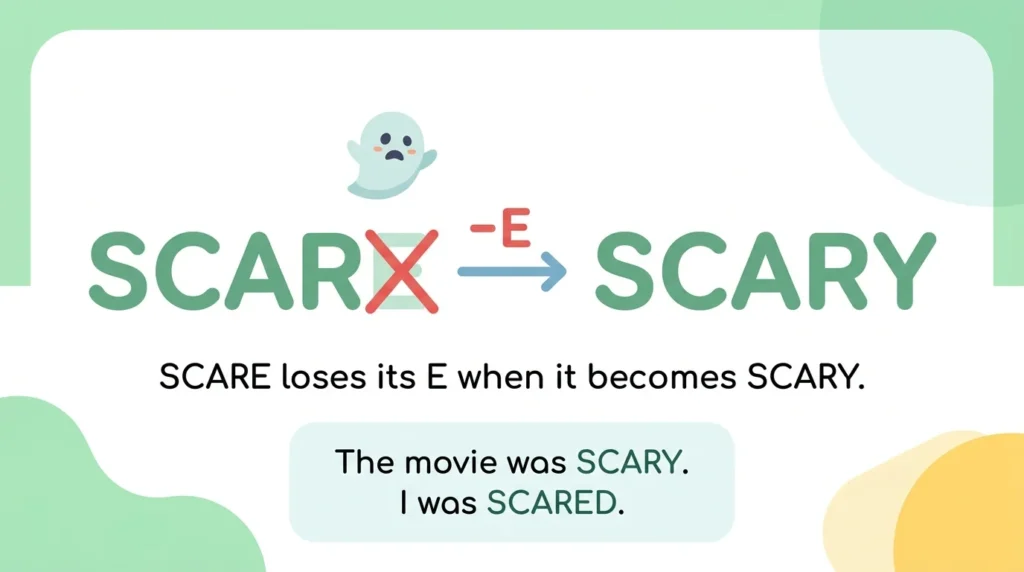
SCARE loses its E when it becomes SCARY.
Think:
SCARE → SCARY
Not:
SCARE → SCAREY
You can also remember:
A scary thing causes a scare.
The word scary keeps the sc and ar, but the final e disappears before y.
Real-Life Situations
Job Interview
If you are describing a difficult experience, you could say:
“It was a scary situation at first, but I stayed calm and solved the problem.”
The word scary describes the situation.
Workplace Meeting
“The initial numbers looked scary, but the underlying trend was improving.”
Here, scary describes the appearance or impression created by the numbers.
“The storm created some scary conditions on the road, so I decided to work from home.”
This is natural everyday professional English.
Text Message
“That was scary! I thought we were going to miss the flight.”
The informal tone makes scary particularly natural.
English Exam
If the question asks for the standard spelling, choose:
scary
Do not automatically choose scarey simply because it can be found in some dictionaries.
Social Media
“That was the scariest roller coaster I’ve ever ridden!”
The superlative form is scariest.
Academic Context
For highly formal writing, consider whether a more precise word such as alarming or disturbing would communicate your meaning better.
Expert Tips
1. Don’t Memorize “Scarey = Fake”
That shortcut is not completely accurate.
A better rule is:
Scary is the standard form; scarey is a recognized variant.
This gives you a more accurate understanding of modern English.
2. Choose the Form Your Reader Expects
If you are writing for an international audience, scary is the safest option.
3. Don’t Confuse Spelling With Grammar
The issue is mainly one of orthography, which simply means the conventional way a word is spelled.
Both forms can be understood to refer to the same adjective, but they do not have the same status in ordinary modern writing.
4. Learn the Related Forms Together
Instead of memorizing only one word, learn this group:
- scare
- scared
- scary
- scarier
- scariest
- scarily
This makes it easier to distinguish their grammatical roles.
5. Remember the Difference Between Scary and Scared
Ask:
Does it cause fear?
Use scary.
Does the person feel fear?
Use scared.
The snake is scary.
I am scared.
6. Don’t Let Search Results Decide Grammar
A word appearing on the internet does not automatically make it the best choice for formal writing.
At the same time, a word being less common does not automatically mean it is nonexistent.
Dictionary evidence matters.
Quick Summary
Scary is the standard modern spelling for the adjective meaning “frightening” or “causing fear.” Scarey has the same basic meaning but is recorded as a variant spelling, particularly in British English. Therefore, it is too strong to call scarey completely nonexistent or always wrong. For everyday, professional, academic, and international writing, however, scary is the safest and clearest choice. Remember the spelling as SCARE → SCARY. Also remember that scary describes something that causes fear, while scared describes someone who feels fear: “The movie was scary, but I wasn’t scared.”
FAQ
Is scarey a correct spelling?
Yes, scarey is a recognized variant spelling of scary. Current dictionary sources identify it particularly as a UK variant. However, scary is the better default for modern English writing.
Is scary or scarey more common?
Scary is the standard and more familiar modern form. It is the spelling learners and most writers should normally use.
Is scarey a British spelling?
It can be. Current dictionary evidence specifically labels scarey as a UK variant of scary. This does not mean that scarey is the only or preferred British spelling; scary is also standard British English.
Is scarey wrong in American English?
If you are writing standard American English, scary is the safer and expected spelling. American learner-dictionary references list scary as the adjective.
Does scarey mean something different from scary?
No. When scarey is used as the variant spelling of scary, the basic meaning is the same: frightening or causing fear.
How do you spell scary in the comparative form?
The comparative is scarier.
This movie is scarier than the last one.
How do you spell scary in the superlative form?
The superlative is scariest.
That was the scariest movie I’ve ever watched.
Is “I am scary” correct?
It can be grammatically correct, but it means that you cause other people to feel fear.
If you mean that you feel fear, say:
I am scared.
Compare:
The dog is scary.
The child is scared.
Why isn’t it spelled scarey?
The standard spelling of the adjective is scary, not scarey. English spelling does not always preserve the final e from the base word scare when forming related words. The easiest solution is to memorize the established spelling rather than trying to reconstruct it.
Can I use scarey in formal writing?
It is better to use scary in formal or professional writing. Although scarey has dictionary recognition as a variant, scary is the clearer and more conventional modern choice.
What is the easiest way to remember scary?
Remember:
SCARE → SCARY
Drop the final e and use y.
Mini Quiz
| # | Question | Answer | Explanation |
|---|---|---|---|
| 1 | Choose the standard spelling: scarey / scary | Scary | Scary is the standard modern form. |
| 2 | The movie was very _____. | scary | The adjective describes the movie. |
| 3 | I was _____ during the storm. | scared | Scared describes the person’s feeling. |
| 4 | Which is correct: scarier / scareyer? | scarier | The comparative form is scarier. |
| 5 | Which is correct: scariest / scareist? | scariest | The superlative form is scariest. |
| 6 | Correct the sentence: “That was a scarey experience.” | That was a scary experience. | Scary is the standard spelling. |
| 7 | True or false: “Scarey” has absolutely no dictionary recognition. | False | It is recorded as a variant spelling, particularly in British English. |
| 8 | Complete: “The haunted house was _____, but I wasn’t _____.” | scary; scared | The house causes fear; the person experiences fear. |
| 9 | Which is better for international professional writing: scary / scarey? | Scary | It is the safer standard form for a broad audience. |
| 10 | Correct the sentence: “That was the scareist scene in the movie.” | That was the scariest scene in the movie. | The correct superlative is scariest. |