
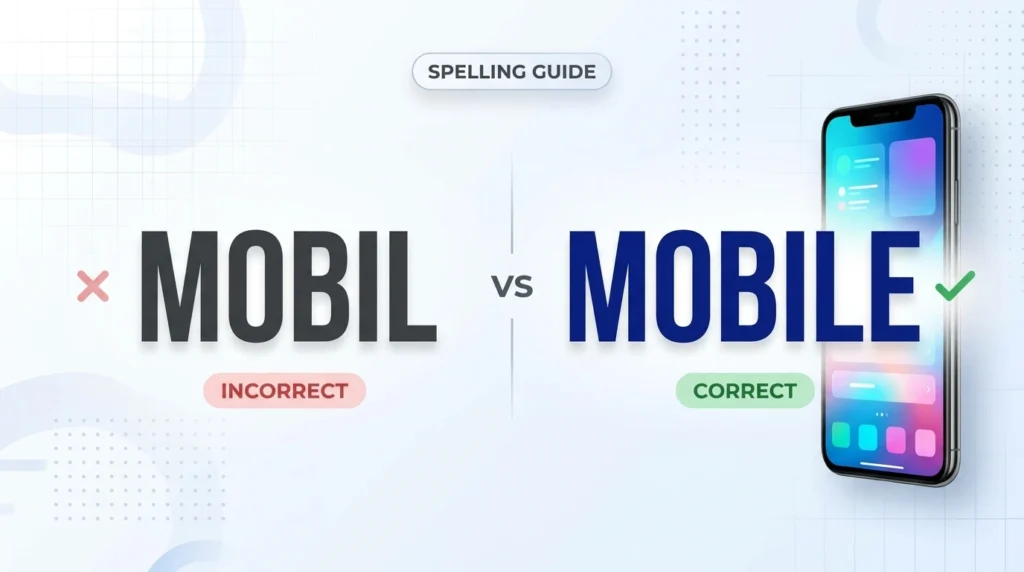

The correct spelling in standard English is mobile, not mobil. Mobile is an adjective meaning capable of moving or being moved, and it is also a noun referring to a mobile phone or another movable object. Mobil is not a standard English spelling of this word. However, Mobil can appear as a proper name or brand name, so it is not always meaningless.
What Is the Difference Between Mobil and Mobile?
The difference between mobil and mobile is primarily a matter of spelling and meaning. Mobile is the standard English word used to describe something that can move easily, be transported, or operate in different locations. It can also refer to a mobile phone, particularly in British English.
Mobil, without the final E, is not the standard spelling of this English word. It is best known in English as a proper name, especially the Mobil fuel and lubricant brand. Therefore, the correct choice depends on what you want to communicate.
What Does Mobile Mean?
Mobile is an adjective and a noun.
As an adjective, it describes someone or something that can move, be moved, or operate in different places. It is also widely used in technology to describe devices, applications, networks, and services designed for portable use.
As a noun, mobile can refer to:
- A mobile phone, especially in British English.
- A hanging decorative object with parts that move freely.
- A portable device or unit when the context makes its meaning clear.
Examples:
- The medical team operates a mobile clinic in rural areas.
- My mobile is running out of battery.
- The company has developed a mobile application.
- The artist created a beautiful mobile for the exhibition.
What Does Mobil Mean?
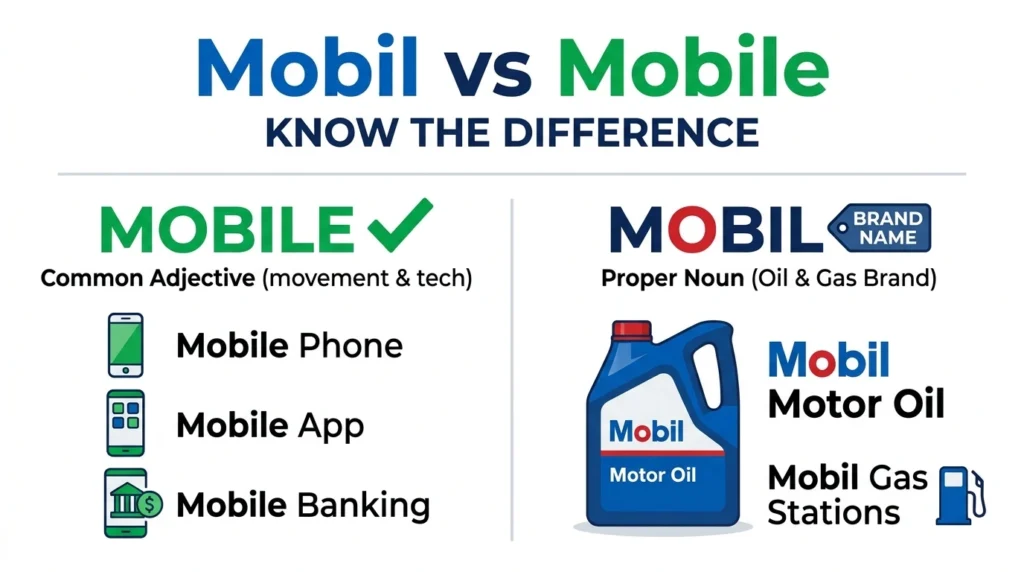
Mobil is a proper name rather than the ordinary English word meaning movable or portable.
Its most familiar English-language use is the name of the petroleum and lubricant brand Mobil, associated with ExxonMobil.
Examples:
- My father uses Mobil engine oil in his car.
- The company introduced a new Mobil lubricant.
- We stopped at a Mobil service station during our journey.
Notice that Mobil begins with a capital M when referring to the brand.
Writing “mobil phone” instead of “mobile phone” is a spelling mistake in standard English. However, writing “Mobil” when referring to the brand is correct.
Why Does the Difference Matter?
A missing letter might seem like a small mistake, but spelling can change the meaning of a sentence.
When you write mobile, readers understand that you are describing something portable or referring to a phone. When you write Mobil, they may understand that you are referring to a particular brand.
This distinction matters in several situations:
- Professional emails: Incorrect spelling can make business communication look careless.
- Academic writing: Standard spelling is important for clarity and credibility.
- Website content: Incorrect spelling can weaken the quality of product descriptions and articles.
- Marketing: A missing letter in a product or service description can create confusion.
- Everyday communication: Readers may understand your intention, but the spelling remains incorrect.
For example:
- Incorrect: Our company provides mobil app development.
- Correct: Our company provides mobile app development.
The second sentence uses the standard spelling and communicates the intended service clearly.
Read More: Copyright vs Copywrite: Which Is Correct?
The Core Rule: Mobil or Mobile?
Correct standard English
MOBILE
Use mobile when describing something portable, movable, or related to mobile technology.
Proper name
MOBIL
Use Mobil when referring to the established brand name or another specific proper name spelled this way.
Remember: The ordinary English word has a final E. Do not remove it when writing about phones, applications, devices, or anything that can move.
How to Use Mobile Correctly
The word mobile is flexible because it can function as both an adjective and a noun. Understanding its role in a sentence helps you use it correctly.
1. Use Mobile to Describe Something That Can Move
When a person, object, or machine can move easily or be transported, mobile is the correct adjective.
Examples:
- The patient is mobile enough to walk without assistance.
- We need a mobile generator for the outdoor event.
- The rescue team operates a mobile emergency unit.
- The equipment is lightweight and mobile.
In these examples, mobile describes the ability to move or the convenience of transportation.
2. Use Mobile in Technology and Business
Mobile is especially common in modern technology and business communication.
It appears in expressions such as:
- Mobile phone
- Mobile application
- Mobile banking
- Mobile network
- Mobile device
- Mobile advertising
- Mobile technology
- Mobile internet
- Mobile-friendly website
- Mobile payment system
Examples:
- Our website needs a mobile-friendly design.
- Customers can complete payments through mobile banking.
- The business is investing in mobile advertising.
- The new software supports multiple mobile devices.
In all these expressions, mobile is spelled with a final E.
3. Use Mobile as a Noun When Referring to a Phone
In British English, mobile is commonly used as a shortened form of mobile phone.
Examples:
- I left my mobile at home.
- Please send the details to my mobile.
- She received an important call on her mobile.
- My mobile needs to be charged.
In American English, cell phone or cellphone is generally more common for this meaning.
4. Use Mobile for a Hanging Decoration
Mobile can also describe an artistic object made of suspended pieces that move freely, often because of air currents.
Examples:
- A colourful mobile hangs above the baby’s bed.
- The museum displayed a metal mobile in its main gallery.
- The artist designed a mobile using wooden shapes and thin wires.
This is a separate meaning of the same English word.
5. Use Mobil Only as a Proper Name
When referring to the Mobil brand, preserve its established spelling.
Examples:
- He purchased Mobil engine oil.
- Mobil products are available at the service station.
- The advertisement featured Mobil lubricants.
Do not apply this spelling to ordinary English expressions.
Correct Examples of Mobile and Mobil
The following examples show how both forms work in different everyday situations.
| Situation | Correct example |
|---|---|
| Everyday conversation | I forgot my mobile at home. |
| Business email | Our team is developing a mobile application. |
| School assignment | A mobile object can move from one location to another. |
| Workplace | Employees can access the system through mobile devices. |
| Social media | Our new website is now mobile-friendly. |
| Academic writing | Mobile populations often experience changes in their living conditions. |
| Healthcare | The organisation operates a mobile medical clinic. |
| Technology | The company launched a mobile payment service. |
| Automotive discussion | I bought Mobil engine oil for my vehicle. |
| Art exhibition | The gallery displayed a beautiful hanging mobile. |
| Marketing | Mobile advertising helps businesses reach smartphone users. |
| Travel | Keep your mobile phone fully charged during the journey. |
These examples demonstrate that mobile is the normal English spelling, while Mobil belongs to specific naming contexts.
Incorrect vs. Correct: Mobil or Mobile
The following table highlights common spelling mistakes and explains how to correct them.
| ❌ Incorrect | ✅ Correct | Why |
|---|---|---|
| I lost my mobil yesterday. | I lost my mobile yesterday. | Mobile is the standard spelling for a phone in British English. |
| She bought a new mobil phone. | She bought a new mobile phone. | The adjective mobile requires its final E. |
| We need a mobil application. | We need a mobile application. | Mobile is the correct technology term. |
| Our website is not mobil friendly. | Our website is not mobile-friendly. | The compound adjective uses mobile. |
| He works with mobil devices. | He works with mobile devices. | Mobile describes portable electronic devices. |
| The hospital operates a mobil clinic. | The hospital operates a mobile clinic. | A clinic that travels between locations is mobile. |
| Please check your mobil number. | Please check your mobile number. | Mobile is the standard spelling in this expression. |
| I use mobil banking regularly. | I use mobile banking regularly. | Mobile banking is the established expression. |
| The company offers mobil advertising. | The company offers mobile advertising. | Mobile is the correct adjective. |
| My mobil is out of battery. | My mobile is out of battery. | Mobile is the standard spelling for the phone. |
| We purchased mobil equipment. | We purchased mobile equipment. | Mobile describes equipment that can be moved. |
| The business launched a mobil service. | The business launched a mobile service. | Mobile is required when describing a portable service. |
Important exception: The sentence “I use Mobil engine oil” is correct when Mobil refers to the brand. It should not be changed to mobile.
Why Do People Make This Mistake?
Although the difference is only one letter, several factors can make people write mobil instead of mobile.
1. Pronunciation Can Be Confusing
The final E in mobile is not pronounced as a separate sound. Depending on the English accent, mobile is commonly pronounced in ways such as “MOH-buhl” or “MOH-byle.”
Because the final E is not clearly heard, learners may forget to include it when writing.
This is particularly common among people who learn English mainly through conversation rather than reading.
2. Typing Quickly
People often shorten words or accidentally remove letters when typing quickly on phones and computers.
For example:
- Intended: mobile
- Typed: mobil
The missing E may go unnoticed, especially in informal messages.
3. Autocorrect Does Not Catch Every Error
Spellcheck tools are helpful, but they do not always understand the meaning of a sentence.
A tool may overlook a mistake when a spelling resembles a recognised name, brand, or word in another language.
Always review the complete sentence instead of depending entirely on automatic corrections.
4. Confusion Between Brand Names and Common Words
People sometimes see the spelling Mobil on fuel stations, engine oil containers, and advertisements.
They may assume that mobil is another accepted spelling of mobile.
However, a brand name can have its own spelling. That does not make it an alternative spelling of an ordinary English word.
5. Translation Interference
Some English learners are familiar with words in other languages that use a similar form without the final E.
For example, Urdu speakers commonly use the borrowed word موبائل (mobile) in everyday conversation. When switching between languages, spelling patterns can become mixed.
The solution is simple: remember the standard English spelling when writing in English.
Common Mistakes Checklist
Use this checklist to avoid confusing mobil and mobile.
- Dropping the final E: Writing mobil phone instead of mobile phone. Always retain the E.
- Using mobil in technology: Writing mobil app instead of mobile app. Remember the established technology expression.
- Confusing a brand with an adjective: Mobil is a proper name, while mobile is an ordinary English word.
- Incorrect capitalization: Do not write Mobil when describing a general mobile device. Use lowercase mobile unless it begins a sentence or appears in a title.
- Ignoring the audience: British readers commonly use mobile for a phone, whereas American readers generally prefer cell phone.
- Trusting autocorrect completely: Check spelling and meaning together.
- Forgetting compound expressions: Write mobile-friendly, mobile banking, and mobile application correctly.
A useful final check is to ask yourself: Am I talking about something portable, a phone, or mobile technology? If yes, use mobile.
Mobile in Real English
Understanding a word means more than knowing its spelling. You should also understand whether it sounds natural in everyday communication.
1. Grammatically Correct
“She bought a new mobile phone last week.”
This is grammatically correct and natural English. Mobile describes the type of phone, and phone is the noun. The same construction works in formal emails, advertisements, educational writing, and everyday conversation. It is widely understood in both American and British English, although Americans often use cell phone in everyday speech.
2. Grammatically Possible but Unnatural
“I purchased a mobile to communicate with my colleagues.”
This sentence is understandable, and mobile can function as a noun meaning mobile phone. However, its naturalness depends on the audience. In British English, it can sound perfectly normal. In everyday American English, “I purchased a cell phone” or simply “I got a phone” would generally sound more natural.
3. Natural, Everyday English
“Can you call me on my mobile?”
This is a natural expression, particularly in British English. It is short, clear, and commonly understood. In American English, a speaker would more commonly say, “Can you call me on my cell phone?” Both sentences communicate the same basic idea, but the preferred everyday vocabulary differs by region.
4. Incorrect Standard English
“Our company develops mobil applications for businesses.”
This sentence contains a spelling error. The correct form is “Our company develops mobile applications for businesses.” Mobil cannot replace mobile when describing applications or portable technology. Even if readers understand the intended meaning, the missing E makes the spelling incorrect in standard English.
American vs. British English: Is There a Difference?
There is no difference in the standard spelling of mobile between American and British English. Both varieties use mobile with a final E.
However, there is a difference in everyday vocabulary when referring to a phone.
| Feature | American English | British English |
|---|---|---|
| Standard spelling | Mobile | Mobile |
| Common phone term | Cell phone | Mobile phone |
| Shortened phone term | Cell | Mobile |
| Mobile application | Mobile app | Mobile app |
| Mobile device | Mobile device | Mobile device |
| Mobil brand | Mobil | Mobil |
American English Examples
- I left my cell phone in the office.
- My mobile device needs a software update.
- The company launched a new mobile application.
British English Examples
- I left my mobile in the office.
- My mobile needs a software update.
- The company launched a new mobile application.
The important point: American and British English may differ in their preferred phone vocabulary, but neither uses mobil as the standard spelling of mobile.
Formal vs. Informal Usage
The spelling distinction does not change between formal and informal English. Mobile remains the correct spelling in both settings.
However, the choice of expression may depend on the communication style and audience.
Formal Usage
In professional and academic communication, mobile is commonly used in technical and descriptive expressions.
Examples:
- The organisation provides mobile healthcare services.
- The research examines mobile populations.
- Our company specialises in mobile application development.
- Employees can access business information through mobile devices.
Informal Usage
In everyday conversation, people often use shorter expressions.
Examples:
- My mobile is not working.
- I forgot my mobile at home.
- Can I borrow your mobile charger?
- Send me the details on my mobile.
Both formal and informal sentences retain the final E in mobile.
For American audiences, cell phone may sound more natural when discussing an everyday phone.
Read More: Gray vs Grey: Which Spelling Is Correct?
Comparison Table: Mobil vs. Mobile
| Feature | Mobile | Mobil |
|---|---|---|
| Standard English word | Yes | No, not as the ordinary adjective |
| Final letter | E | No final E |
| Part of speech | Adjective and noun | Proper name in familiar English usage |
| General meaning | Movable or portable | Brand name |
| Phone-related usage | Mobile phone | Not standard |
| Technology usage | Mobile app, mobile device | Not standard |
| Automotive usage | Can describe movable equipment | Mobil brand |
| Capitalization | Usually lowercase | Capital M for the brand |
| American spelling | Mobile | Mobil as a brand |
| British spelling | Mobile | Mobil as a brand |
The table makes the distinction clear: mobile is the ordinary English word, while Mobil is a specific name.
Memory Trick: Never Lose the E in Mobile
Here is a simple way to remember the correct spelling.
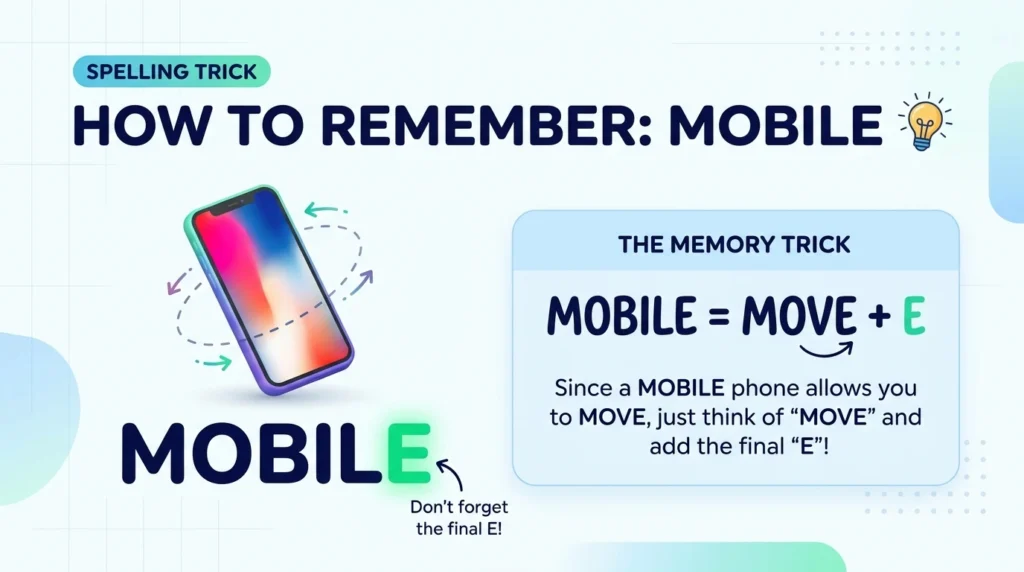
MOBILE = MOVE + E
Think of mobile as something that can MOVE from one place to another. The final E is part of the correct spelling.
Remember these three points:
- Mobile has an E and describes something movable or portable.
- Mobil has no E and is a recognised brand name.
- Mobile phone is correct; mobil phone is incorrect.
Whenever you write about a phone, mobile application, mobile device, or portable service, remember to keep the final E.
Real-Life Situations: When Should You Use Each Word?
The following situations show how the spelling works in practical communication.
1. During a Job Interview
Interviewer: What type of applications can you develop?
Candidate: I specialise in mobile application development.
Why it works: Mobile correctly describes applications designed for portable devices.
2. In a Business Meeting
Manager: How can we improve our website experience?
Marketing Executive: We should create a mobile-friendly website that works smoothly on smartphones and tablets.
Why it works: Mobile-friendly is the standard compound adjective.
3. In a Professional Email
Incorrect: Please send the report to my mobil number.
Correct: Please send the report to my mobile number.
Why it works: Mobile is the correct spelling in this expression.
4. In a Text Message
Incorrect: My mobil battery is almost dead.
Correct: My mobile battery is almost dead.
A more natural alternative is: “My phone battery is almost dead.”
Why it works: Mobile is correctly spelled, although phone battery is often the simpler everyday expression.
5. During an Examination
Question: Which spelling is correct when describing a portable medical unit?
A. Mobil unit
B. Mobile unit
C. Mobiel unit
D. Mobeil unit
Correct answer: B. Mobile unit.
Why it works: Mobile is the adjective describing something that can move between locations.
Read More: Propose vs Purpose: Meaning, Differences & 20+ Examples.
6. While Discussing Automotive Products
Customer: Which engine oil did you purchase?
Friend: I purchased Mobil engine oil.
Why it works: Mobil is the correct brand spelling. It should not be changed to mobile.
FAQ: Mobil vs. Mobile
1. Is it mobil or mobile?
Mobile is the correct spelling in standard English when referring to something portable, movable, or a mobile phone. Mobil is not the standard spelling of this ordinary English word.
2. Is mobil a real word?
Mobil is a recognised proper name, particularly the name of a fuel and lubricant brand. However, it is not the standard English spelling of the adjective mobile. MeaningVs+1
3. Why is mobile spelled with an E?
The final E is part of the established English spelling. Although it is not pronounced as a separate sound, it must remain in the written word.
4. Is mobile phone correct English?
Yes. Mobile phone is correct English. It refers to a portable telephone that can be used without a fixed telephone connection. It is particularly common in British English.
5. Is mobil phone ever correct?
No, not when referring to an ordinary portable telephone. The correct expression is mobile phone. Mobil phone is a spelling mistake.
6. Is mobile American or British English?
Mobile is used in both American and British English. However, British speakers commonly use mobile to mean a mobile phone, while American speakers generally prefer cell phone.
7. What is the plural of mobile?
The plural of mobile, when used as a countable noun, is mobiles.
Examples:
- The shop sells different types of mobiles.
- The artist created several decorative mobiles.
When referring to phones, the phrase mobile phones is also correct.
8. What is the difference between Mobil and ExxonMobil?
Mobil is an established brand name associated with ExxonMobil, an energy company. Mobile, on the other hand, is an ordinary English word meaning movable or portable. The two spellings serve different purposes.
9. Should I write mobile app or mobil app?
Always write mobile app. Mobile is the correct adjective describing an application designed for smartphones and other portable devices.
10. Is mobile-friendly correct?
Yes. Mobile-friendly is a standard compound adjective used to describe websites, applications, and digital content that work well on mobile devices.
11. How do you pronounce mobile?
Pronunciation varies by English accent. Common pronunciations include:
- American English: /ˈmoʊ.bəl/ or /ˈmoʊ.baɪl/
- British English: /ˈməʊ.baɪl/
The final E is not pronounced as a separate letter. English meaning – Cambridge Dictionary+1
12. What is the easiest way to remember mobil vs. mobile?
Remember that mobile has the final E whenever you describe something movable, portable, or related to phones and technology. Mobil without E is mainly recognised as a brand name.
Quick Summary
Mobile is the correct standard English spelling when describing something movable, portable, or related to mobile technology. It can also refer to a mobile phone, particularly in British English. Mobil without the final E is not the standard spelling of this ordinary English word, although it is a recognised proper name, especially for a fuel and lubricant brand. Both American and British English use mobile, but Americans generally prefer cell phone while British speakers commonly say mobile. Remember the simple rule: if you are writing about a phone, application, portable device, or movable object, always use mobile with the final E.
Mini Quiz: Test Your Understanding of Mobil vs. Mobile
Test your knowledge with these 10 questions. Each answer includes an explanation to help you understand the difference.
| No. | Question | Answer | Explanation |
|---|---|---|---|
| 1 | Which is the correct spelling: mobil or mobile? | Mobile | Mobile is the standard English spelling. |
| 2 | She purchased a new _____ phone. (mobil/mobile) | Mobile | Mobile describes the portable phone. |
| 3 | Is Mobil a correct spelling when referring to a fuel brand? (Yes/No) | Yes | Mobil is an established brand name. |
| 4 | Correct this sentence: “Our company develops mobil applications.” | Our company develops mobile applications. | Mobile is the correct technology term. |
| 5 | Which word describes something that can be moved easily? (Mobil/Mobile) | Mobile | Mobile means movable or capable of movement. |
| 6 | I left my _____ at home. (mobil/mobile) | Mobile | Mobile is commonly used for a phone in British English. |
| 7 | Fill in the blank: The hospital operates a _____ medical clinic. | Mobile | A mobile clinic can travel between locations. |
| 8 | Is “mobil-friendly website” correct English? | No | The correct expression is mobile-friendly website. |
| 9 | Correct this sentence: “I bought Mobil engine oil for my car.” | No correction needed. | Mobil is correctly spelled as the brand name. |
| 10 | Which expression is correct? (Mobile banking / Mobil banking) | Mobile banking | Mobile banking is the standard expression for banking through mobile devices. |


