
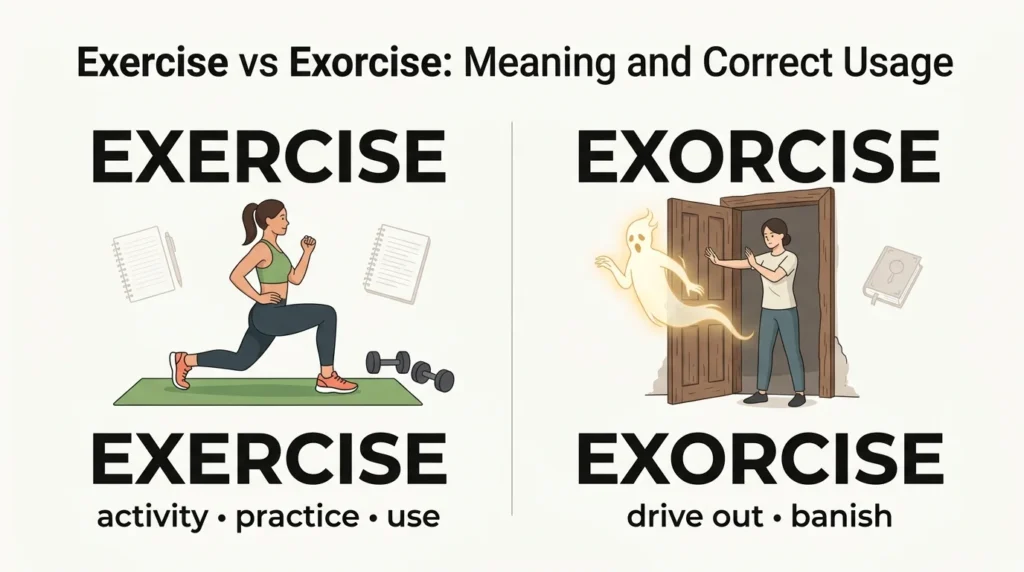

Use exercise when you mean physical activity, practice, training, or using something such as a right, skill, authority, caution, or judgment. Use exorcise when you mean driving out an evil spirit or, figuratively, getting rid of something troubling. For example, “I exercise every morning” is correct, while “The priest tried to exorcise the spirit” is correct. The two words are not interchangeable.
What Is the Difference Between Exercise and Exorcise?
The main difference is meaning.
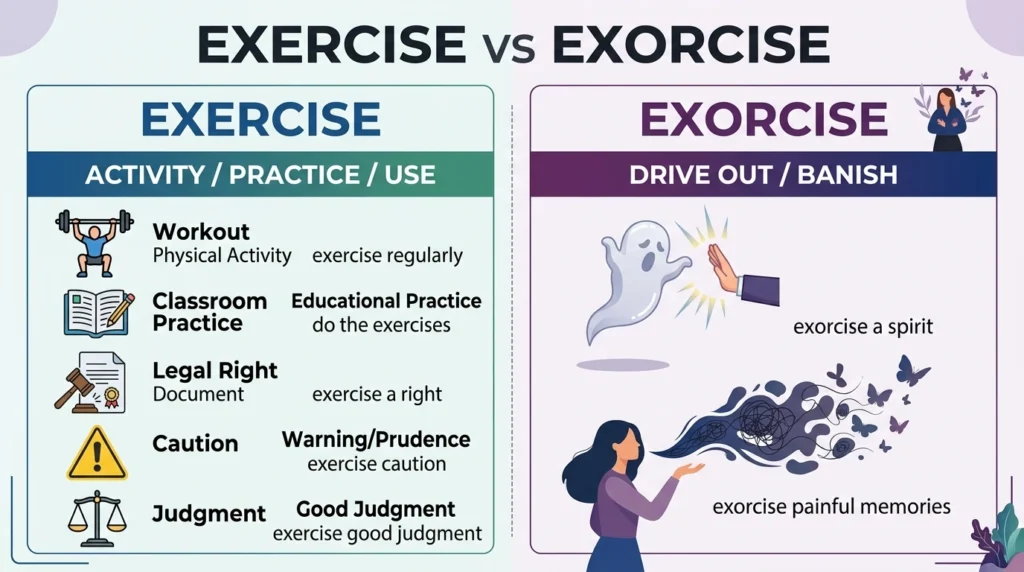
Exercise has a broad range of everyday uses. It can be a noun or a verb. You can exercise your body, complete a grammar exercise, exercise caution, exercise judgment, or exercise a legal right.
Exorcise is a verb with a much narrower meaning. Its traditional meaning is to drive out an evil spirit from a person or place, usually through prayers, rituals, or other ceremonial means. It can also be used figuratively to mean getting rid of the effects of something frightening, painful, or troubling.
Think of the distinction this way:
- Exercise = activity, practice, or use
- Exorcise = drive out or remove something unwanted
For example:
She exercises three times a week.
Here, exercise refers to physical activity.
The priest attempted to exorcise the spirit.
Here, exorcise refers to driving out an evil spirit.
The words look and sound similar enough to cause confusion, but the context usually makes the intended meaning clear.
Why It Matters
Choosing the wrong word can completely change the meaning of your sentence.
Imagine writing:
The doctor recommended regular exorcise.
The reader may understand what you meant, but exorcise is a verb and does not belong in this sentence. The correct noun is exercise.
Now consider:
The priest was called to exercise the demon.
The sentence suggests that the priest was somehow going to “use” or “practice” the demon rather than drive it out. The intended word is exorcise.
This distinction matters in several settings:
- School: “Complete the exercise on page 20.”
- Health: “Regular exercise can support physical fitness.”
- Work: “Managers should exercise good judgment.”
- Law: “Citizens have the right to exercise their rights.”
- Religion or supernatural fiction: “The priest attempted to exorcise the spirit.”
- Figurative writing: “She wanted to exorcise the painful memories of her past.”
A single letter can therefore separate two completely different ideas.
The Core Rule
Use exercise for activity, practice, training, or the use of something. Use exorcise for driving out an evil spirit or, figuratively, removing something that troubles or haunts you.
A fast decision test is:
- Is the sentence about a workout, practice, training, or a task? → exercise
- Is it about using a right, power, skill, authority, caution, or judgment? → exercise
- Is it about driving out a spirit or demon? → exorcise
- Is it about banishing a painful memory, fear, influence, or other troubling thing? → exorcise
Read More: Fliers vs Flyers: Which Spelling Is Correct?
How to Use Exercise
Exercise is both a noun and a verb.
Exercise as a noun
As a noun, exercise can refer to physical activity, a practice task, or an activity designed for training.
Examples:
- Regular exercise is important for maintaining fitness.
- The trainer added a new exercise to our routine.
- The students completed a grammar exercise.
- The piano teacher gave us several exercises to practice.
- Breathing exercises helped the performers prepare.
It does not have to involve the body. A classroom activity can also be called an exercise.
Exercise as a verb
As a verb, exercise can mean to engage in physical activity.
I exercise before breakfast.
It can also mean to use or apply something.
The manager exercised good judgment.
Other common expressions include:
- exercise caution
- exercise patience
- exercise restraint
- exercise authority
- exercise control
- exercise a right
- exercise an option
- exercise judgment
In these expressions, exercise does not mean “work out.” It means to use, apply, or put something into effect.
Exercise can also mean practice
A teacher might say:
This exercise will help you understand verb tenses.
Here, exercise means a task or activity designed to develop a particular skill.
That is why the word has a much wider meaning than physical fitness alone.
How to Use Exorcise
Exorcise is a verb.
Its traditional meaning is to force or attempt to force an evil spirit to leave a person or place. Cambridge also records a figurative use involving the removal of the bad effects of a frightening or upsetting event.
Examples:
The priest was asked to exorcise the spirit.
The ritual was intended to exorcise the demon.
She hoped to exorcise the painful memories of her childhood.
The last example is figurative. No literal supernatural spirit is necessarily involved. The writer is using exorcise to express the idea of banishing something that continues to trouble a person.
This figurative use is important because exorcise is not limited to horror stories or religious contexts.
You can encounter expressions such as:
- exorcise a fear
- exorcise painful memories
- exorcise the ghosts of the past
- exorcise an old influence
- exorcise a troubling memory
The underlying idea remains the same: something unwanted is being driven away or removed.
Correct Examples
Here are examples showing the different uses of exercise and exorcise.
Conversation
1. “I need to get more exercise before the summer.”
Here, exercise is a noun referring to physical activity.
2. “Do you exercise every morning?”
Here, exercise is a verb meaning to engage in physical activity.
3. “Please exercise caution when opening the attached file.”
Here, exercise means to use or apply caution.
School
4. “Complete the final exercise before leaving the classroom.”
Here, exercise means a practice task.
Workplace
5. “The supervisor exercised good judgment during the negotiation.”
Here, exercise means to use or apply judgment.
Legal writing
6. “The company may exercise its contractual option before the deadline.”
Here, exercise means to make use of a legal or contractual right.
Social media
7. “A little daily exercise can become a healthy habit.”
Here, exercise refers to physical activity.
Academic writing
8. “The study examines how people exercise control over their working environment.”
Here, exercise means to use or exert control.
Supernatural fiction
9. “The priest entered the house to exorcise the spirit.”
Here, exorcise means to drive out a spirit.
Figurative writing
10. “Writing about the experience helped her exorcise some of the painful memories.”
Here, exorcise is used figuratively to mean getting rid of the emotional effect of something troubling. This figurative sense is established English usage.
Incorrect vs. Correct
| ❌ Incorrect | ✅ Correct | Why |
|---|---|---|
| I need more exorcise. | I need more exercise. | Exercise is the noun for physical activity. |
| I exorcise every morning. | I exercise every morning. | Exercise is the verb for physical activity. |
| The doctor recommended daily exorcise. | The doctor recommended daily exercise. | The sentence needs a noun referring to physical activity. |
| Please exorcise caution. | Please exercise caution. | The established expression is exercise caution, meaning to act carefully. |
| She exorcised good judgment. | She exercised good judgment. | Exercise can mean to use or apply judgment. |
| He completed a grammar exorcise. | He completed a grammar exercise. | A practice task is an exercise. |
| The priest tried to exercise the demon. | The priest tried to exorcise the demon. | Exorcise means to drive out an evil spirit. |
| They called someone to exercise the spirit. | They called someone to exorcise the spirit. | The intended meaning is to drive out the spirit. |
| She wanted to exercise her painful memories. | She wanted to exorcise her painful memories. | Exorcise can be used figuratively for banishing troubling memories. |
| The ritual was designed to exercise the evil spirit. | The ritual was designed to exorcise the evil spirit. | The ritual is intended to drive the spirit away. |
The important point is that some errors are spelling errors, while others are meaning errors.
For example, exorcise is correctly spelled, but it is still wrong in:
I get thirty minutes of exorcise every day.
The problem is not spelling. The problem is that the sentence needs the noun exercise.
Why People Make This Mistake
The words look very similar
Both words begin with ex- and contain many of the same letters. When someone is writing quickly, the visual similarity can make the wrong word seem familiar.
Their pronunciation is similar
The words have closely related sound patterns, particularly around the final -cise sound. That makes them easy to confuse when a person knows the meaning but has to choose the spelling from memory.
Exercise is much more common
Most English learners encounter exercise regularly in health, education, sports, school, and everyday conversation.
Exorcise is much less common and tends to appear in religious, supernatural, literary, or figurative contexts.
Because exercise is the familiar word, writers may unconsciously substitute it when they need exorcise.
Spellcheck cannot understand every meaning
A spelling checker may recognize both words as correctly spelled.
If you write:
The priest will exercise the demon.
The spelling of exercise is correct. The problem is that the word is inappropriate for the intended meaning.
This is a useful lesson: a spellchecker can identify many spelling errors, but a correctly spelled word can still be the wrong word.
Translation can contribute to confusion
English learners sometimes translate ideas directly from another language into English. If the learner knows the general idea but has not developed a strong association between the English word and its context, similar-looking words can become interchangeable in memory.
The solution is not to memorize spelling alone. Connect each word to its meaning and typical context.
Common Mistakes Checklist
Mistake 1: Using exorcise for physical activity
❌ I do exorcise for thirty minutes every day.
✅ I do exercise for thirty minutes every day.
Why it happens: The writer remembers the sound but not the spelling.
How to avoid it: Associate exercise with the gym, movement, fitness, and training.
Mistake 2: Using exercise for a spirit
❌ The priest tried to exercise the demon.
✅ The priest tried to exorcise the demon.
Why it happens: Exercise is the much more familiar word.
How to avoid it: Associate exorcise with exorcist and exorcism.
Mistake 3: Forgetting that exercise can mean more than fitness
❌ The manager used caution during the crisis.
This sentence is grammatical, but if the intended phrase is the established expression, a more precise choice is:
✅ The manager exercised caution during the crisis.
Why it happens: Some learners know only the fitness meaning of exercise.
How to avoid it: Remember that exercise can mean “use” or “apply.”
Mistake 4: Treating exorcise as only a literal supernatural word
A writer may assume:
exorcise = demons only
But English also uses exorcise figuratively.
For example:
The novel helped him exorcise the ghosts of his past.
This does not necessarily mean literal ghosts. It means the writing helped him confront or banish something troubling.
Mistake 5: Confusing the noun and verb forms
Exercise can be both a noun and a verb.
Exercise is important.
I exercise regularly.
Exorcise is a verb.
They tried to exorcise the spirit.
The noun for the process is exorcism.
The story describes an exorcism.
Exercise and Exorcise in Real English
Exercise: grammatically correct and natural
I exercise three times a week.
This is ordinary, natural English. Exercise is the normal word for physical activity.
She exercises caution when dealing with unfamiliar websites.
This is also natural, although the phrase is more formal than simply saying “She is careful.” The verb exercise commonly occurs with abstract nouns such as caution, judgment, restraint, authority, and control.
Exercise: grammatically possible but meaning-dependent
He exercises his influence over the organization.
This is grammatical and established, but it belongs to a different meaning of exercise. It does not mean that he is physically working out. It means he uses or applies his influence.
This broader sense is important because reducing exercise to “physical activity” gives an incomplete picture of the word.
Exorcise: grammatically correct and natural in the right context
The priest attempted to exorcise the spirit.
This is natural in a religious, supernatural, historical, or fictional context where the word’s traditional meaning is relevant.
Exorcise: natural in figurative writing
She hoped to exorcise the memories that had haunted her for years.
This is a figurative use. The memories are treated metaphorically as something that can be driven away. Such uses are established in English, although the word is more marked and literary than everyday alternatives such as overcome, let go of, or move past. Cambridge documents figurative uses involving the removal of the effects of frightening or upsetting events.
Read More: Affend vs Offend: Which Spelling Is Correct?
Exorcise: possible but more specialized
The government hoped to exorcise the fear surrounding the policy.
The sentence can work as a metaphor, but remove, reduce, or dispel may be more straightforward in ordinary prose.
This is a useful distinction for writers: a word can be grammatically correct without being the most natural choice for every audience or context.
American vs. British English
There is one genuine spelling difference worth knowing.
Exorcise is the standard spelling in British English and is also widely used in international English.
In American English, exorcize is also used as a spelling variant. Cambridge specifically lists exorcize as a US variant of exorcise.
So you may encounter:
- British/international: exorcise
- American: exorcise or exorcize
The meaning does not change.
However, this variation does not apply to exercise.
Do not write exorcize when you mean physical activity.
I need more exercise. ✅
Not:
I need more exorcize. ❌
Formal vs. Informal Usage
Exercise
Exercise is completely normal in both everyday and formal English.
Informal:
I need to exercise more.
Professional:
Employees should exercise caution when handling confidential information.
Academic:
The participants were instructed to complete the exercise independently.
Legal or formal:
The holder may exercise the right at any time before the deadline.
The meaning changes with context, but the word itself is not restricted to one level of formality.
Exorcise
The literal use of exorcise is specialized because it relates to driving out an evil spirit.
The priest was asked to exorcise the spirit.
The figurative use can sound more literary or dramatic:
The author used the novel to exorcise his memories of the past.
In ordinary conversation, people may choose simpler words such as remove, overcome, forget, let go of, or get rid of, depending on the intended meaning.
Read More:Whose vs Whos: Which Is Correct? Easy Grammar Guide.
Comparison Table
| Feature | Exercise | Exorcise |
|---|---|---|
| Main meaning | Physical activity, practice, training, or use | Drive out an evil spirit or figuratively remove something troubling |
| Part of speech | Noun and verb | Verb |
| Fitness context | Very common | Incorrect |
| School/practice context | Very common | Incorrect |
| Rights/authority context | Common | Incorrect |
| Caution/judgment context | Common | Incorrect |
| Spirit/demon context | Incorrect | Common |
| Figurative use | Use, application, or activity | Banishing something troubling |
| Noun form | Exercise | Exorcism |
| American spelling variant | No special variant needed | Exorcize is also used |
| Typical memory association | Gym, practice, activity | Exorcist, spirit, demon |
Exercise, Exorcise, Exorcism, and Exorcize
These related-looking words deserve separate attention.
Exercise
Exercise can be a noun or a verb.
Regular exercise is important.
She exercises every morning.
It can also mean practice, use, or application.
The exercise tested the students’ understanding.
He exercised his right to appeal.
Exorcise
Exorcise is a verb.
The priest attempted to exorcise the spirit.
It can also be used figuratively.
She wanted to exorcise the painful memories.
Exorcism
Exorcism is a noun referring to the process or act of exorcising.
The film centers on an exorcism.
Exorcize
Exorcize is an alternative spelling of exorcise, particularly in American English. (Cambridge Dictionary)
The priest attempted to exorcize the spirit.
The important distinction is:
exercise → activity, practice, use
exorcise/exorcize → drive out
exorcism → the act or process
Memory Trick
Use this simple association:
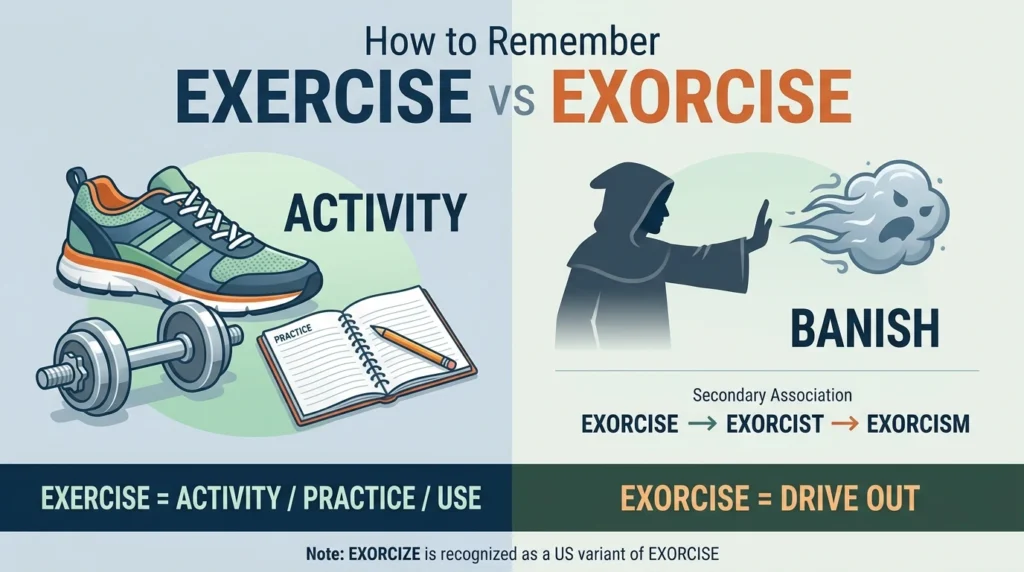
EXERCISE = ENERGY
Think of moving, training, practicing, or using something.
EXORCISE = EXORCIST
If you see a demon, spirit, possession, or an exorcist, think exorcise.
Another quick rule:
Exercise something. Exorcise something unwanted.
Examples:
Exercise your body.
Exercise your rights.
Exercise caution.
But:
Exorcise a demon.
Exorcise a painful memory.
Real-Life Situations
At the gym
Your friend asks:
“What are you doing after work?”
You say:
“I’m going to exercise.”
Exercise is correct because you mean physical activity.
In a classroom
A teacher says:
“Complete exercise five before you start the next section.”
Exercise is correct because the word refers to a practice task.
In a business meeting
A manager says:
“We need to exercise caution before approving the contract.”
Exercise means to use or apply caution.
In an email
You write:
“Please exercise your judgment before sharing the document.”
Again, exercise means to use or apply judgment.
In a supernatural story
A character says:
“We need someone who can exorcise the spirit.”
Exorcise is correct because the character wants the spirit driven out.
In literary writing
A writer says:
“He hoped to exorcise the memories of the war.”
Exorcise is being used figuratively to express the idea of banishing painful memories.
In an exam
If the question asks:
“Which word means physical activity?”
Choose exercise.
If it asks:
“Which word means to drive out an evil spirit?”
Choose exorcise.
Expert Tips
1. Do not learn exercise as only “working out”
That definition is too narrow.
You can:
- exercise a right
- exercise authority
- exercise caution
- exercise judgment
- exercise control
- exercise a skill
- complete an exercise
Learning the broader meaning will prevent many future mistakes.
2. Learn exorcise with its word family
Instead of memorizing exorcise by itself, connect it with:
exorcise → exorcism → exorcist
This makes the unusual spelling easier to remember.
3. Check meaning, not just spelling
Both exercise and exorcise are correctly spelled words.
That means a spellchecker may not flag the wrong choice.
Ask:
“What am I trying to say?”
If the answer is activity, practice, or use, choose exercise.
If the answer is drive out or banish, choose exorcise.
4. Watch for the figurative use of exorcise
Do not assume that exorcise always requires a literal demon.
English writers can use it metaphorically:
exorcise a fear
exorcise painful memories
exorcise the ghosts of the past
The meaning is essentially about removing something that continues to trouble or haunt someone.
5. Remember that context decides the word
Compare:
She exercises her authority.
with:
She exorcises the spirit.
The first sentence is about using authority.
The second is about driving out a spirit.
The spelling difference is small, but the semantic difference is enormous.
FAQ
Is exercise or exorcise correct?
Both are correct words. Exercise refers to physical activity, practice, training, or the use of something such as a right or judgment. Exorcise means to drive out an evil spirit and can also be used figuratively for removing something troubling.
Is exorcise a spelling of exercise?
No. Exorcise is a separate word with a different meaning. It is not a spelling variant of exercise.
What does exercise mean besides working out?
It can mean practice or training, as in a classroom exercise. As a verb, it can also mean to use or apply something, as in exercise caution, exercise judgment, or exercise a right.
What does exorcise mean in figurative English?
It can mean to get rid of something troubling or remove the effects of something frightening or upsetting. For example, a writer may say that someone is trying to exorcise painful memories.
Is exorcise always related to demons?
No. Its traditional meaning involves driving out an evil spirit, but it can also be used figuratively for banishing something unwanted, such as a fear, memory, or influence.
Can exercise be a noun and a verb?
Yes. Exercise is both a noun and a verb.
Regular exercise is beneficial.
I exercise every morning.
Is exorcise a noun?
No. Exorcise is a verb. The related noun is exorcism.
Is exorcize correct English?
Yes. Exorcize is an alternative spelling of exorcise, particularly in American English.
Can I say “exercise a right”?
Yes. Exercise a right is an established expression meaning to make use of a right.
The employee exercised her right to appeal.
Can I say “exorcise a fear”?
Yes. This is a figurative use. It means to banish or remove a fear. However, depending on the context, simpler words such as overcome, remove, or confront may sound more direct.
Why do exercise and exorcise get confused?
Their spelling and pronunciation are similar, and both contain the familiar ex- beginning and -cise ending. The much more common word exercise can also overshadow the less frequent exorcise in memory.
What is the easiest way to remember exercise vs. exorcise?
Think exercise = activity or use and exorcise = drive out. For spelling, connect exorcise with exorcist and exorcism.
Quick Summary
Exercise and exorcise are both correct English words, but they are not interchangeable. Exercise can be a noun or verb and commonly refers to physical activity, practice, training, or the use of something such as a right, authority, skill, caution, or judgment. Exorcise is a verb meaning to drive out an evil spirit and can also be used figuratively for banishing something troubling, such as a painful memory or fear. Remember the difference with this simple rule: exercise means activity, practice, or use; exorcise means drive out or banish. In American English, exorcize is also an accepted spelling variant of exorcise.
Mini Quiz
| # | Question | Answer | Explanation |
|---|---|---|---|
| 1 | I need more ___ to stay healthy. (exercise / exorcise) | exercise | Here the word means physical activity. |
| 2 | The priest attempted to ___ the spirit. (exercise / exorcise) | exorcise | The meaning is to drive out an evil spirit. |
| 3 | Complete the grammar ___. (exercise / exorcise) | exercise | A practice task is an exercise. |
| 4 | Correct the sentence: “She exorcises caution when driving.” | She exercises caution when driving. | The established expression is exercise caution, meaning to act carefully. |
| 5 | Which word can mean “to use or apply a right”? (exercise / exorcise) | exercise | You can exercise a right or legal option. |
| 6 | Which word is a verb meaning to drive out an evil spirit? | exorcise | Exorcise means to drive out an evil spirit. |
| 7 | Choose the correct sentence: A) I exorcise every morning. B) I exercise every morning. | B | Exercise is the verb used for physical activity. |
| 8 | Choose the correct sentence: A) The ritual was intended to exorcise the spirit. B) The ritual was intended to exercise the spirit. | A | Exorcise is the appropriate verb for driving out a spirit. |
| 9 | Fill in the blank: “Writing helped her ___ the painful memories.” (exercise / exorcise) | exorcise | This is a figurative use meaning to banish or remove troubling memories. |
| 10 | Which sentence uses exercise in the sense of “use or apply”? A) He exercises every morning. B) She exercised good judgment. | B | Exercised good judgment means she used or applied good judgment. |