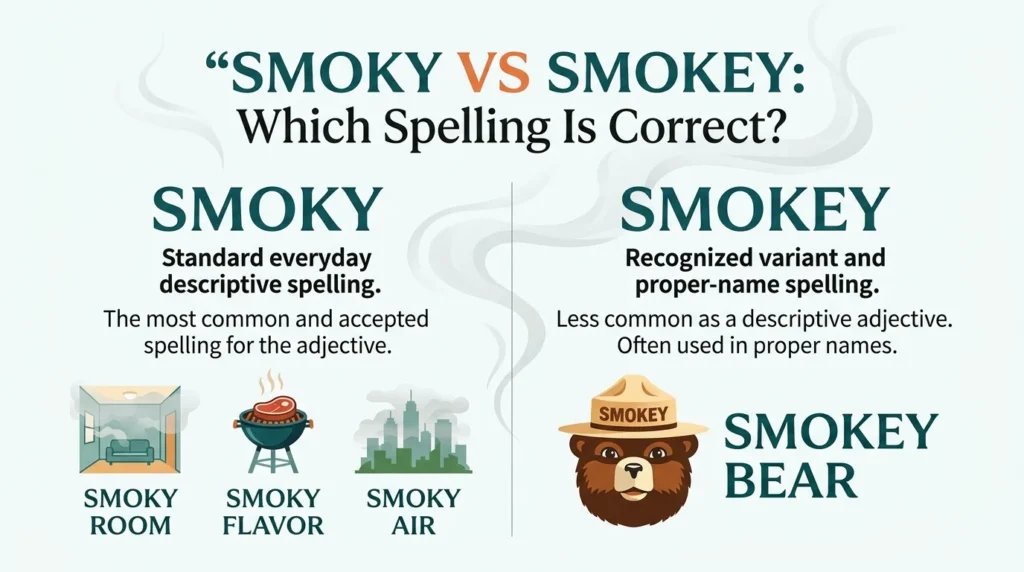

Smoky is the standard spelling you should normally use when describing something filled with smoke, producing smoke, or having the taste, smell, color, or appearance of smoke. Smokey is also a recognized variant spelling, so it is not accurate to call every use of it a misspelling. However, for ordinary formal, academic, professional, and everyday writing, smoky is the safer and more widely preferred choice. Smokey is also used in established names such as Smokey Bear.
What Is Smoky vs Smokey?
Smoky and smokey are two spellings associated with the adjective related to smoke.
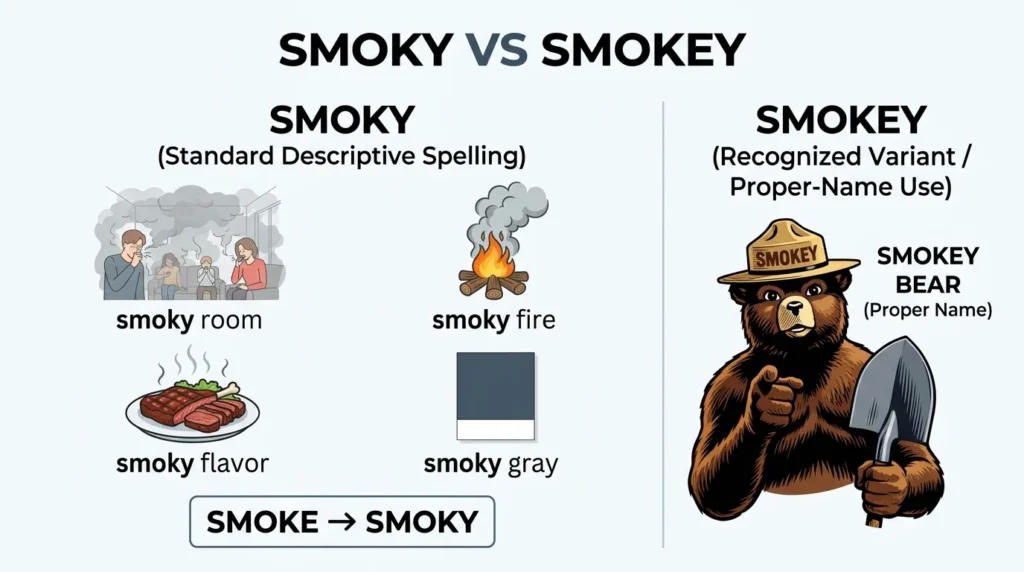
The standard spelling is smoky:
- a smoky room
- smoky air
- a smoky smell
- a smoky flavor
- smoky gray eyes
- a smoky fire
The spelling smokey also exists. Dictionaries recognize it as a variant of smoky. That means the situation is more nuanced than simply saying “one is correct and the other is incorrect.”
In ordinary descriptive writing, however, smoky is the form you should generally choose.
There is also an important special case: Smokey appears as part of established names, most famously Smokey Bear, the U.S. Forest Service wildfire-prevention mascot.
So the easiest practical rule is:
Use “smoky” for ordinary descriptions. Use “Smokey” when that spelling belongs to a specific name or established usage.
Why It Matters
A one-letter difference can make a sentence look less polished, especially when you are writing something formal.
Consider these situations:
- a student describing a smoky room in an essay
- a restaurant describing the smoky flavor of grilled food
- a journalist describing smoky skies
- a company describing a smoky color in a product listing
- a professional writing an email about smoke damage
- a teacher correcting a spelling exercise
In all these ordinary descriptive situations, smoky is the natural standard choice.
The issue becomes slightly different when you are referring to a proper name. For example, changing Smokey Bear to Smoky Bear would change the established spelling of the name.
This is why treating smokey as universally wrong creates a problem of its own. English contains legitimate variant spellings and proper names, and context matters.
The Core Rule
For normal descriptive English, use “smoky.” Use “smokey” when it is an established variant, proper name, or other context that specifically uses that spelling.
A simple way to remember the everyday rule is:
smoke → smoky
You normally remove the final e from smoke before adding -y.
Standard descriptive examples
- smoky room
- smoky atmosphere
- smoky fire
- smoky flavor
- smoky smell
- smoky blue
- smoky glass
- smoky haze
Special-name example
- Smokey Bear
The capital S is important because Smokey is part of a proper name.
How to Use It
Use “smoky” for smoke-filled places
When something contains a lot of smoke, smoky is the normal choice.
Examples:
- The kitchen became smoky after the food burned.
- The firefighters entered the smoky building carefully.
- We had to leave because the room was too smoky.
- A smoky atmosphere filled the restaurant.
Read More: Treet vs Treat: Which Spelling Is Correct?
Use “smoky” for something that produces smoke
You can also use smoky to describe something that produces a lot of smoke.
- The fire became smoky when the wood started to burn poorly.
- The old chimney produced a smoky cloud.
- The candle left a smoky mark on the ceiling.
Use “smoky” for taste and smell
Food and drinks can be described as smoky when they have a flavor or smell associated with smoke or smoked food.
- The grilled chicken had a smoky flavor.
- The sauce has a rich, smoky taste.
- The cheese has a slightly smoky aroma.
- The barbecue gave the meat a deep smoky flavor.
Use “smoky” for appearance or color
Something can also be called smoky when it resembles smoke in color or appearance.
- She chose a smoky gray dress.
- The windows had a smoky appearance.
- He used a smoky blue shade for the walls.
- Her eyes were described as smoky gray.
Use “Smokey” when it is part of a proper name
Some names deliberately use Smokey.
The best-known example is Smokey Bear.
If you are writing the name of that character, preserve the established spelling:
Correct: Smokey Bear
Do not change it simply because smoky is the usual adjective.
Correct Examples
| Situation | Correct sentence |
|---|---|
| Conversation | The kitchen is getting smoky. |
| The office still has a smoky smell after the incident. | |
| School | The students described the smoky atmosphere in the building. |
| Workplace | We noticed a smoky odor near the equipment. |
| Social media | The grilled vegetables have such a delicious smoky flavor. |
| Academic writing | The researchers observed a smoky haze over the region. |
| Food writing | The sauce adds a rich, smoky taste to the dish. |
| Fashion | She wore a smoky gray jacket. |
| Interior design | The designer selected a smoky blue for the walls. |
| Proper name | The campaign featured Smokey Bear. |
| Description | A smoky cloud covered the valley. |
| Informal conversation | My clothes still smell smoky from the campfire. |
Incorrect vs. Correct
| ❌ Incorrect or unsuitable | ✅ Correct | Why |
|---|---|---|
| The room was very smokey. | The room was very smoky. | Smoky is the standard descriptive spelling. |
| The meat has a smokey flavor. | The meat has a smoky flavor. | Food with a smoke-like flavor is normally described as smoky. |
| We walked through a smokey hallway. | We walked through a smoky hallway. | Smoky is the usual adjective for a smoke-filled place. |
| She chose a smokey gray color. | She chose a smoky gray color. | Smoky is the standard spelling for a smoke-like color. |
| The fire became smokey. | The fire became smoky. | The adjective describing smoke production is normally smoky. |
| The cheese has a smokey smell. | The cheese has a smoky smell. | The ordinary descriptive form is smoky. |
| His clothes smelled smokey after the fire. | His clothes smelled smoky after the fire. | Smoky is the normal spelling in this context. |
| The sky looked smokey after the wildfire. | The sky looked smoky after the wildfire. | The word describes a smoke-like appearance. |
| Smoky Bear is the wildfire mascot. | Smokey Bear is the wildfire mascot. | The established proper name is spelled Smokey Bear. |
| The restaurant had a smokey atmosphere. | The restaurant had a smoky atmosphere. | Smoky is the standard choice for ordinary descriptive writing. |
One important qualification is worth remembering: “smokey” is not automatically an error in every context. It is recognized as a variant spelling of smoky. The problem is using it when you intend ordinary standard descriptive English and have no reason to choose the variant.
Why People Make This Mistake
The pronunciation is identical
Smoky and smokey are pronounced the same way.
When two spellings sound identical, pronunciation cannot help the writer decide which letters to use.
This is especially difficult for learners who are more comfortable hearing English than reading it.
The word “smoke” already contains an e
The base word is:
smoke
It is natural to think:
smoke + y = smokey
But the standard adjective is:
smoke → smoky
The final e is removed.
English spelling does this in many adjective formations, although spelling patterns are not completely predictable.
Familiar names reinforce the “-ey” spelling
Many people have seen Smokey Bear, so the spelling smokey looks completely normal.
That familiarity can cause writers to transfer the spelling into unrelated sentences:
The room was smokey.
The name is spelled Smokey, but the standard descriptive adjective is normally smoky.
Read More: Their vs Thier: Which Spelling Is Correct?
Spellcheck may not catch it
A spelling checker does not necessarily treat smokey as an obvious error because smokey exists as a recognized English word or variant.
That creates an important lesson:
A word being accepted by spellcheck does not automatically mean it is the best word or spelling for your particular sentence.
Translation can influence spelling
Learners who study English as another language may encounter different dictionary entries, translated examples, or local teaching materials.
If one resource presents smokey as a variant and another emphasizes smoky as the standard form, the learner may reasonably become uncertain.
The solution is to focus on function and context, not just whether a dictionary happens to contain the spelling.
Common Mistakes Checklist
Mistake 1: Calling “smokey” always wrong
This is too absolute.
Smokey is a recognized variant spelling of smoky, and it occurs in established names.
Better approach: Use smoky for normal descriptive writing, but recognize that smokey has legitimate uses.
Mistake 2: Using “smokey” because it sounds natural
Pronunciation cannot distinguish the two forms.
Better approach: Remember the standard spelling:
smoke → smoky
Mistake 3: Changing “Smokey Bear” to “Smoky Bear”
A proper name should normally be reproduced exactly.
Better approach: Keep the established spelling Smokey Bear.
Mistake 4: Assuming dictionary inclusion means equal preference
Two forms can both exist in dictionaries without being equally useful in every context.
Better approach: Look at whether the form is the standard entry, a variant, a proper name, or another specialized use.
Mistake 5: Trusting autocorrect completely
Spellcheck tools are designed to identify many spelling problems, but they do not always decide which valid word is most appropriate for your context.
Better approach: Understand the distinction yourself.
Smoky vs Smokey in Real English
Grammatically correct and natural
Smoky is the normal choice in sentences such as:
The kitchen became smoky.
The meat had a smoky flavor.
The valley was covered in smoky haze.
These sentences use smoky as an ordinary adjective describing a quality connected with smoke. This is the form most writers should choose when they want clear, standard English.
Read More: Pricy vs Pricey: Which Spelling Is Correct?
Grammatically possible but less expected
Smokey can function as a variant spelling of the adjective. Therefore, it is too strong to say that every lowercase use of smokey is impossible or meaningless.
However, a writer using smokey in ordinary prose may be choosing a less standard or less usual form when smoky would communicate the same idea more conventionally.
Natural because it is a name
Smokey becomes completely natural when it belongs to an established name.
For example:
The poster featured Smokey Bear.
Here, Smokey is not simply an alternative way of describing something as smoky. It is part of a specific proper name, so changing the spelling would be inappropriate.
American vs. British English
There is no major American-versus-British spelling change comparable to “color” and “colour” here.
Both American and British English use smoky as the standard descriptive adjective.
Dictionaries also recognize smokey as a variant. Therefore, you should not switch from smoky to smokey simply because you are writing for British readers, nor should you assume that American English requires a different spelling.
For both varieties, these are standard choices:
- smoky room
- smoky fire
- smoky flavor
- smoky flavour
- smoky air
- smoky gray
- smoky grey
The difference between flavor and flavour, or gray and grey, is a separate American/British issue. The spelling of smoky itself does not change.
Formal vs. Informal Usage
For formal and professional writing, smoky is the safest default.
Use it in:
- academic essays
- business reports
- professional emails
- news-style writing
- educational material
- product descriptions
- formal correspondence
Smokey can appear in informal writing, variant usage, names, branding, or other contexts where that spelling has been deliberately chosen.
The important point is not that smokey is forbidden. It is that smoky is the conventional spelling to reach for when you are simply describing something related to smoke.
Comparison Table
| Feature | Smoky | Smokey |
|---|---|---|
| Part of speech | Adjective | Adjective as a variant; also noun/proper-name uses |
| Main ordinary meaning | Related to, filled with, producing, or resembling smoke | Variant of smoky in adjective use |
| Standard descriptive choice | Yes | Usually not the first choice |
| Used for smoke-filled rooms | Yes | Possible as a variant, but less standard |
| Used for food flavor | Yes | Possible as a variant |
| Used for color/appearance | Yes | Possible as a variant |
| Used in formal writing | Preferred | Usually avoid unless context calls for it |
| Used in proper names | Sometimes | Yes, notably Smokey Bear |
| American English | Standard | Recognized variant/specialized use |
| British English | Standard | Recognized variant |
| Pronunciation | /ˈsmoʊki/ in American English | Same pronunciation |
| Best default for learners | Yes | No |
Memory Trick
Use this simple rule:
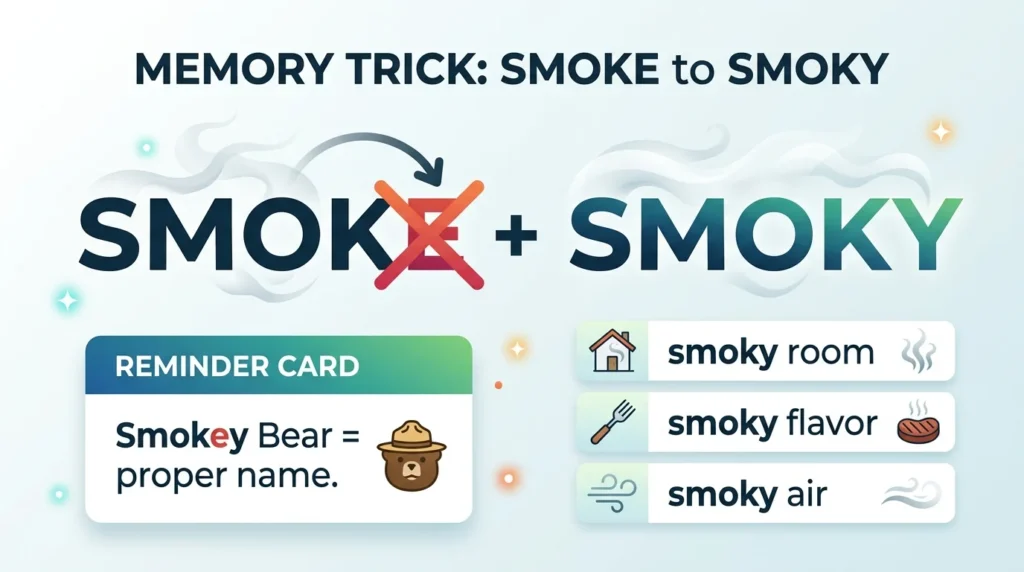
Smoke loses its final “e” before becoming smoky.
Think:
SMOKE → SMOKY
Not:
SMOKE → SMOKEY
But when you see a recognized name such as Smokey Bear, keep the name exactly as established.
A second memory trick is:
Description = smoky.
Name = Smokey.
This is not a complete rule for every possible occurrence of smokey, but it is an excellent practical shortcut for everyday writing.
Real-Life Situations
In an interview
Interviewer: Why did you leave the room?
Candidate: It became too smoky to stay inside.
Here, smoky describes the condition of the room.
In a workplace meeting
Manager: Why is there a smell in the office?
Employee: The kitchen became smoky because something burned.
Again, smoky is an ordinary adjective.
In an email
The storage area has a smoky smell, so we may need to inspect the ventilation system.
This is professional descriptive writing, so smoky is the natural choice.
In a text message
The whole kitchen is smoky after dinner 😂
Informal writing still normally uses smoky.
In an exam
Question: Choose the correct spelling.
The correct answer for a normal descriptive sentence is:
The room was smoky.
In a restaurant review
The ribs had a rich smoky flavor without tasting bitter.
Here, smoky describes taste.
In a history or geography assignment
The city was covered by a smoky haze after the large fire.
The standard descriptive spelling remains smoky.
When discussing the mascot
Smokey Bear has been used in U.S. wildfire-prevention campaigns.
Here, Smokey is part of the proper name, so the spelling with e should be retained.
Expert Tips
1. Do not confuse “valid” with “preferred”
English can contain more than one legitimate spelling for a word.
If a dictionary lists smokey as a variant, that does not mean you must use it.
For most ordinary writing, smoky remains the straightforward choice.
2. Context matters more than a simple right/wrong label
The question “Which one is correct?” is useful, but incomplete.
A better question is:
“Which spelling is appropriate for this context?”
That immediately separates ordinary descriptive English from proper names and variant usage.
3. Keep proper names unchanged
If a company, product, character, organization, or person uses Smokey, preserve that spelling when referring to the name.
Do not “correct” a proper name into smoky.
Read More: Tweek vs Tweak Difference: Which Spelling Is Correct?
4. Do not rely on the extra e
The pronunciation gives no clue because both spellings sound alike.
Train yourself to remember the written pattern instead:
smoke → smoky
5. Remember that “smoky” has several meanings
It does not only mean “full of smoke.”
It can describe:
- smoke-filled air
- something producing smoke
- smoke-like appearance
- smoke-like color
- smoke-related smell
- smoke-related taste
Understanding these meanings makes the word much easier to use naturally.
6. Do not overcorrect someone automatically
If you see smokey in a text, first ask what it is doing there.
It might be a variant spelling, a proper name, a brand, a nickname, or another established use.
Correcting every occurrence to smoky can itself create an error.
FAQ
Is “smoky” or “smokey” correct?
Smoky is the standard spelling for ordinary descriptive writing. Smokey is also a recognized variant spelling, so it is not universally incorrect. The context determines which form is appropriate.
Is “smokey” a real word?
Yes. Dictionaries recognize smokey as a variant of smoky. It also has other documented uses, including noun and proper-name uses in American English.
Is “smokey” a misspelling?
Not necessarily. If you are simply describing something as related to smoke, smoky is the normal standard choice. But smokey can be a legitimate variant or part of a proper name.
Should I use “smoky” in formal writing?
Yes. Smoky is the safest and most conventional choice for formal, academic, professional, and general descriptive writing.
Is “Smokey Bear” spelled with an e?
Yes. The established name is Smokey Bear. The U.S. National Park Service specifically uses this spelling.
Is “smoky” American or British English?
Smoky is used in both American and British English. There is no need to change it to smokey because of the variety of English you are using.
Why does “smokey” look correct?
The spelling is visually plausible because the base word is smoke, which already ends in e. In addition, people encounter Smokey in established names. Both factors make the spelling feel natural.
Is “smoky flavor” correct?
Yes. Smoky flavor is a standard expression for food or drink that has a taste associated with smoke or smoked food.
Is “smoky smell” correct?
Yes. Smoky smell is natural when a smell resembles or comes from smoke.
Can “smokey” be used as an adjective?
Yes. Smokey is recognized as a variant spelling of the adjective smoky. However, smoky is the better default for standard descriptive writing.
What is the easiest way to remember smoky?
Remember:
smoke → smoky
Drop the final e before adding y. Then remember the special name Smokey Bear separately.
What is the difference between smoky and smokey?
For ordinary description, smoky is the standard form. Smokey is a recognized variant and also occurs in established names. They are pronounced the same.
Mini Quiz
| # | Question | Answer | Explanation |
|---|---|---|---|
| 1 | Choose the standard spelling: “The room was ___ after the fire.” | smoky | Smoky is the standard descriptive adjective. |
| 2 | Fill in the blank: “The steak had a rich ___ flavor.” | smoky | The word describes a flavor associated with smoke. |
| 3 | Which is the established name: Smoky Bear or Smokey Bear? | Smokey Bear | Smokey Bear is the established proper name. |
| 4 | Correct this sentence: “The kitchen became smokey.” | The kitchen became smoky. | Smoky is the standard choice for an ordinary description. |
| 5 | True or false: “Smokey” is never a valid English spelling. | False | Smokey is recognized as a variant and has other established uses. |
| 6 | Choose the better formal spelling: “a smokey atmosphere” or “a smoky atmosphere.” | a smoky atmosphere | Smoky is the conventional standard form. |
| 7 | Fill in the blank: “She chose a ___ gray color.” | smoky | Smoky can describe a color or appearance resembling smoke. |
| 8 | Correct this sentence: “Smoky Bear is a famous wildfire-prevention mascot.” | Smokey Bear is a famous wildfire-prevention mascot. | The proper name uses Smokey. |
| 9 | Which is more appropriate in a professional report: “smokey odor” or “smoky odor”? | smoky odor | Smoky is the standard descriptive spelling. |
| 10 | Complete the memory rule: “smoke → ___.” | smoky | The normal adjective is formed as smoky, not smokey. |
Quick Summary
Smoky is the standard spelling to use when describing something filled with smoke, producing smoke, or having a smoke-like smell, taste, color, or appearance. Smokey is also a real English spelling: dictionaries recognize it as a variant of smoky, and it has established uses in names such as Smokey Bear. For ordinary formal, academic, professional, and everyday writing, choose smoky as your default. Do not treat every occurrence of smokey as an error, because context matters. The easiest memory trick is smoke → smoky. If the word is part of a proper name such as Smokey Bear, preserve the established spelling.