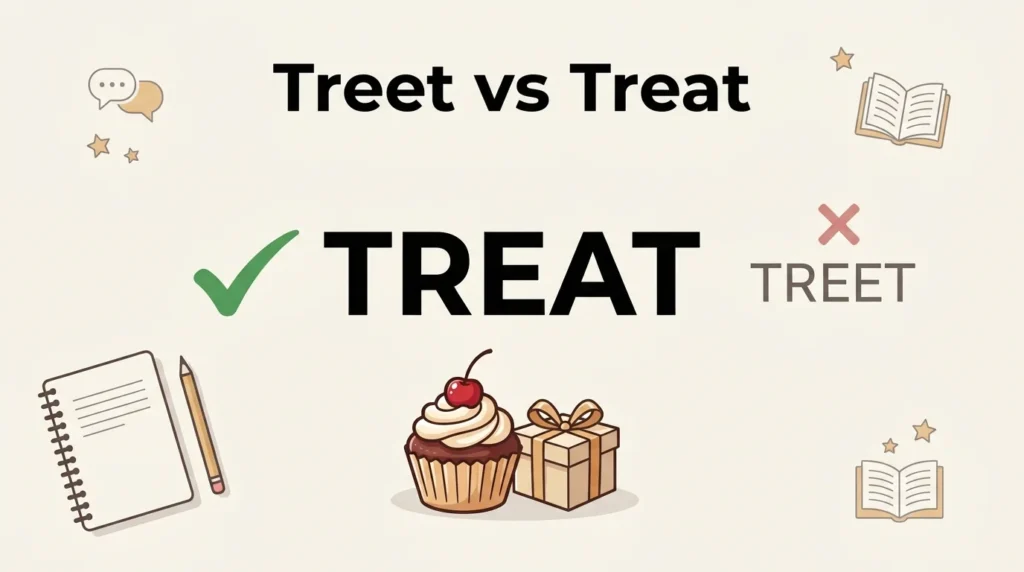

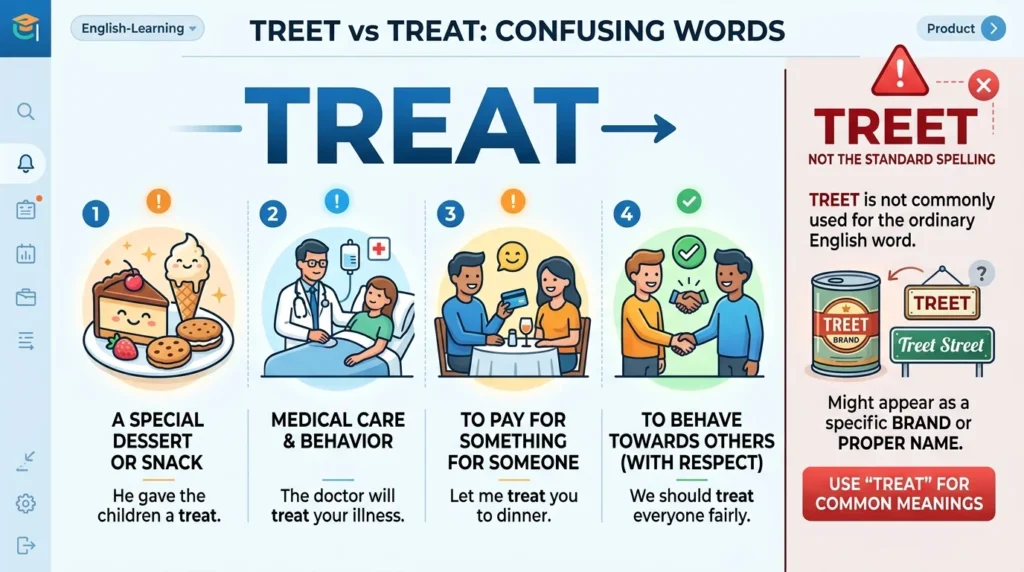
If you are wondering whether the correct spelling is treet or treat, the standard English word is treat. Use treat when you mean something enjoyable, a reward, a special experience, medical care, the way someone is handled, or paying for something for another person. Treet is not the ordinary spelling of this word, although it can appear as a proper name or brand name.
What Is Treet vs Treat?
Treet and treat look almost identical, but they do not have the same status in standard English.
Treat is an established English word. It works as both a noun and a verb and has several meanings.
As a noun, treat can mean something enjoyable, special, or rewarding:
- The concert was a real treat.
- Chocolate is an occasional treat.
- The children received a special treat.
As a verb, treat can mean to behave toward someone in a particular way, provide medical care, pay for something for someone, or deal with something in a particular way:
- Please treat everyone with respect.
- The doctor will treat the patient.
- Let me treat you to dinner.
- The report treats the subject carefully.
Treet, by contrast, is not the standard spelling to use when you mean the ordinary English word treat. It may appear in a specific name, product name, or other proper designation, but that does not make it a replacement spelling for the common word.
Why It Matters
A one-letter spelling mistake can change how a sentence looks to the reader.
If you write:
“She bought me a special treet.”
Most readers will understand what you intended, but they will likely see treet as a spelling error.
The standard form is:
“She bought me a special treat.”
This matters particularly in situations where accurate spelling affects how your writing is perceived:
- School assignments
- Job applications
- Professional emails
- Business documents
- Website content
- Social media posts
- Academic writing
- Customer communication
The mistake is especially easy to notice in familiar expressions such as “trick or treat” and “treat yourself.”
Read More: Their vs Thier: Which Spelling Is Correct?
The Core Rule
Use “treat” when you mean the ordinary English word. Do not spell it “treet.”
The spelling is:
T-R-E-A-T
Not:
T-R-E-E-T
A useful way to think about it is this:
Treat = standard English word
Treet = not the standard spelling of treat
If you encounter Treet with a capital letter, check whether it is being used as a specific name, brand, product, or title. A name can have its own spelling without changing the standard spelling of the English word.
How to Use It
The word treat has several common uses. Learning these meanings makes the correct spelling easier to remember.
Treat as a Noun: Something Enjoyable
A treat can be something special that gives someone pleasure or enjoyment.
Examples:
- Ice cream is a nice treat after dinner.
- The trip was a wonderful treat.
- Getting the afternoon off was an unexpected treat.
It can also refer specifically to food that is enjoyed in addition to ordinary meals.
- The dog received a small treat.
- We bought some sweet treats for the party.
Treat as a Noun: Something Someone Pays For
The expression “my treat” means that the speaker will pay for something, such as a meal or drink.
- “Don’t worry about the bill. It’s my treat.”
- “You paid last time, so dinner is my treat tonight.”
This is a common everyday use of treat.
Treat as a Verb: Behave Toward Someone
Treat can mean to behave toward someone in a particular way.
- You should treat people with respect.
- She treated everyone fairly.
- The manager treated the employees professionally.
The meaning depends on what follows the verb.
Treat as a Verb: Provide Medical Care
Doctors and other healthcare professionals can treat an illness, injury, or patient.
- The doctor treated the infection.
- The hospital treated several patients.
- The injury was successfully treated.
This is a standard professional and medical use of the word.
Treat as a Verb: Pay for Something
Treat someone to something means to buy or pay for something for that person.
- I’ll treat you to lunch.
- She treated her parents to dinner.
- He decided to treat himself to a new watch.
This pattern is important because learners sometimes write the word incorrectly when using it in everyday conversation.
Treat as a Verb: Deal With or Consider Something
Treat can also mean to deal with something in a particular way or consider it in a particular manner.
- The company treats customer complaints seriously.
- The researchers treated the two groups separately.
- The article treats the subject as a historical issue.
This use is common in academic, professional, and formal writing.
Correct Examples
Here are original examples showing how treat works in different situations.
| Situation | Correct Example |
|---|---|
| Conversation | “Let me treat you to coffee.” |
| Family | “We gave the children a special treat.” |
| School | “The teacher reminded us to treat everyone fairly.” |
| Workplace | “Employees should be treated with respect.” |
| “Thank you for treating my request seriously.” | |
| Medical | “The doctor treated the injury immediately.” |
| Social media | “That sunset was a real treat.” |
| Business | “The report treats the issue in detail.” |
| Academic | “The study treats these cases as separate categories.” |
| Everyday life | “I bought myself a little treat after work.” |
| Halloween | “The children shouted, ‘Trick or treat!’” |
| Pet care | “Give the dog a treat after the training exercise.” |
Incorrect vs. Correct
| ❌ Incorrect | ✅ Correct | Why |
|---|---|---|
| I bought a chocolate treet. | I bought a chocolate treat. | Treat is the standard spelling for something enjoyable or special. |
| Let me treet you to lunch. | Let me treat you to lunch. | The verb meaning “pay for something for someone” is treat. |
| The doctor will treet the patient. | The doctor will treat the patient. | Medical care is expressed with the verb treat. |
| Please treet everyone equally. | Please treat everyone equally. | Treat means to behave toward someone in a particular way. |
| She gave her dog a treet. | She gave her dog a treat. | A small reward of food is a treat. |
| It was a wonderful treet. | It was a wonderful treat. | A special or enjoyable experience is a treat. |
| This dinner is my treet. | This dinner is my treat. | My treat means that I will pay. |
| You should treet yourself today. | You should treat yourself today. | The established expression is treat yourself. |
| The students were treeted fairly. | The students were treated fairly. | The past form of treat is treated. |
| “Treet or treat!” | “Trick or treat!” | The familiar Halloween expression uses treat. |
Why People Make This Mistake
The confusion between treet and treat is understandable because the two spellings are visually close and the pronunciation of treat contains the long /iː/ vowel. Cambridge gives the pronunciation of treat as /triːt/ in its main English pronunciation entry.
When learners hear the word, they may mentally divide it as something like “tree-t.” That can encourage the spelling treet, because tree is already a familiar English spelling.
Several factors can contribute to the mistake:
- Pronunciation influence — spelling a word the way it sounds can produce an extra letter.
- Visual similarity — treat and treet differ by only one vowel.
- Fast typing — people often type familiar words without checking every letter.
- Spelling uncertainty — learners may remember the sound but not the established spelling.
- Autocomplete limitations — software can correct some mistakes but cannot replace careful proofreading.
- Translation interference — learners may transfer spelling patterns from another language.
- Limited reading exposure — seeing a word repeatedly in correct written form strengthens spelling memory.
The solution is not to invent a complicated spelling rule. The simplest solution is to learn the established spelling: treat.
Common Mistakes Checklist
Adding an Extra E
The most direct mistake is writing:
❌ treet
Instead, remember:
✅ treat
The correct sequence is t-r-e-a-t.
Writing “Treet Yourself”
The familiar expression is:
Treat yourself.
For example:
“After finishing the project, I decided to treat myself to a nice dinner.”
Writing “Treet or Treat”
The standard Halloween expression is:
Trick or treat!
Not:
❌ Trick or treet!
The word refers to the “treat” offered as part of the traditional expression.
Read More: Pricy vs Pricey: Which Spelling Is Correct?
Confusing Sound With Spelling
The pronunciation of treat can make treet look logical when you are writing from sound.
However, pronunciation alone does not determine English spelling.
The safest habit is to connect the written form directly with the meaning:
treat → reward, enjoyment, care, behavior, payment, or dealing with something
Misspelling Related Forms
The same spelling should remain visible in its related forms:
- treat
- treats
- treated
- treating
Examples:
- She treats everyone kindly.
- The doctor treated the injury.
- They are treating the problem seriously.
Treet vs Treat in Real English
Grammatically Correct
Treat is the grammatically correct standard form when you mean the ordinary English noun or verb. It can describe an enjoyable experience, a special food, payment for someone, behavior toward another person, medical care, or the way something is handled. These uses occur across casual conversation, professional communication, academic writing, and specialized contexts.
Grammatically Possible but Not Ordinary Standard English
Treet is not the ordinary alternative spelling of treat in standard English. However, seeing the sequence Treet does not automatically mean that the letters are meaningless. A specific name, brand, product, title, or other proper designation may deliberately use that spelling. In that situation, preserve the official name rather than silently changing it.
Natural Everyday English
In normal conversation and writing, native and proficient English users expect treat, not treet, when referring to the common word. Natural expressions include “treat yourself,” “my treat,” “a special treat,” and “trick or treat.” If treet appears in one of these ordinary expressions, readers are likely to interpret it as a spelling mistake rather than as a natural alternative.
American vs. British English
There is no standard American-versus-British spelling difference between treat and treet.
Both varieties use treat for the ordinary English word.
The pronunciation is also represented with the long /iː/ vowel in Cambridge’s main UK and US pronunciation entry.
Some dictionary pronunciation systems may use different phonetic notation, but this does not create a different spelling.
So you do not need to switch from treat to treet depending on whether you are writing for an American or British audience.
Formal vs. Informal Usage
Treat works in both formal and informal English, although particular meanings and expressions may have different levels of formality.
Informal and Everyday
- “Ice cream is a nice treat.”
- “It’s my treat.”
- “Treat yourself.”
- “That movie was a real treat.”
Professional or Academic
- “The report treats the two issues separately.”
- “The material was treated with a protective coating.”
- “The study treats these cases as independent observations.”
The spelling does not change between registers.
Treet should not be substituted for treat simply because the context is casual.
Comparison Table
| Feature | Treat | Treet |
|---|---|---|
| Standard everyday English word | Yes | No |
| Can be a noun | Yes | Not as the ordinary word |
| Can be a verb | Yes | Not as the ordinary word |
| Means something enjoyable | Yes | No |
| Means medical care | Yes | No |
| Used in “treat yourself” | Yes | No |
| Used in “my treat” | Yes | No |
| Used in “trick or treat” | Yes | No |
| May appear as a proper name | Yes | Yes, depending on the name |
| Correct spelling for ordinary English | Yes | No |
Memory Trick
Use this simple mnemonic:
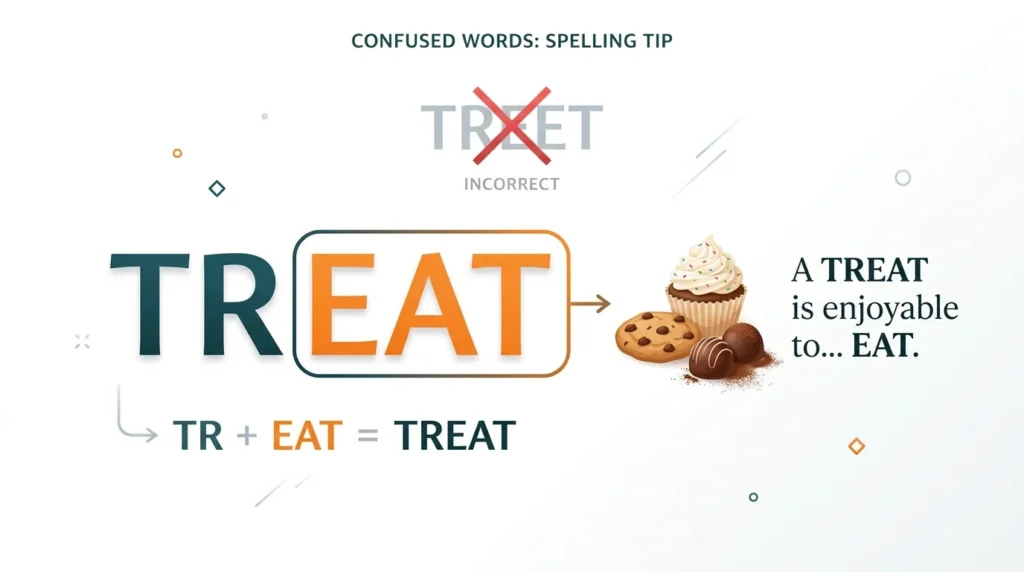
TREAT has “EAT” inside it — and a treat is often something you eat.
Look at the word:
TR + EAT = TREAT
A treat can be a cookie, cake, chocolate, dessert, or another enjoyable food.
So when you are deciding between treet and treat, remember:
TREAT → EAT → something enjoyable
This is not a rule for the spelling of every word in English. It is simply a memory aid for this particular word.
Read More: Tweek vs Tweak Difference: Which Spelling Is Correct?
Real-Life Situations
In a Conversation
Your friend offers to pay for dinner.
“Don’t worry about the bill. It’s my treat.”
Here, treat means the speaker will pay.
In a Restaurant
You want to pay for your parents.
“Tonight, I’m going to treat my parents to dinner.”
Here, treat someone to something means paying for something enjoyable for them.
In a Workplace Meeting
A manager discusses how employees should be handled.
“We should treat every employee fairly.”
Here, treat means behave toward someone in a particular way.
In an Email
You are discussing a serious issue.
“Please treat this information as confidential.”
Here, treat means consider or handle something in a particular way.
In School
A student writes about a reward.
“The teacher gave us a small treat after the final activity.”
Here, treat is a noun meaning something special or enjoyable.
In a Medical Setting
A doctor explains a treatment plan.
“The medication is being used to treat the infection.”
Here, treat means provide medical care.
In a Text Message
A friend wants to celebrate.
“I finished my exams! I’m going to treat myself tonight.”
Here, treat myself means doing or buying something enjoyable for yourself.
At Halloween
Children visit houses asking for candy.
“The children shouted, ‘Trick or treat!’”
The established expression uses treat.
Expert Tips
Learn the Word as a Family
Do not memorize only treat. Connect it with its common forms:
treat → treats → treated → treating
This helps you recognize the correct spelling when the word changes form.
Learn Common Expressions
Some phrases are especially useful because they reinforce the spelling naturally:
- treat yourself
- my treat
- a special treat
- treat someone fairly
- treat someone with respect
- treat an illness
- treat someone to dinner
- trick or treat
Do Not Rely Only on Pronunciation
English spelling cannot always be reconstructed perfectly from pronunciation.
If you hear /triːt/, that tells you how the word sounds. It does not tell you that the spelling must be treet.
Remember the established written form:
treat
Pay Attention to Capitalization
If you see Treet with a capital T, do not automatically assume it is an alternative spelling of treat.
Ask whether it is:
- A brand
- A product name
- A company or organization name
- A title
- Another proper name
If it is an official name, keep its official spelling.
Proofread Familiar Words Too
Spelling errors often happen with words we think we know well.
Before submitting an important document, search visually for common errors such as:
- treet → treat
- treated → correct
- treating → correct
- treats → correct
A quick final check can catch mistakes that spellcheck may not handle as expected.
FAQ
Is treet or treat correct?
Treat is the standard spelling when you mean the ordinary English word. It can be a noun or verb and has several meanings, including something enjoyable, medical care, behavior toward someone, and paying for something.
Is “treet” a word?
Treet is not the standard spelling of the ordinary English word treat. However, it may appear as part of a specific name, product name, or brand. Context matters when a capitalized or specially named Treet appears.
Why do people spell treat as treet?
The mistake is often caused by pronunciation. Treat is pronounced with the long /iː/ vowel, which can make the word sound similar to an imagined spelling such as treet. Fast typing and limited exposure to written English can also contribute to the mistake. (Cambridge Dictionary)
What does treat mean?
Treat has several meanings. As a noun, it can mean something special or enjoyable. As a verb, it can mean behaving toward someone in a particular way, providing medical care, paying for something for someone, or dealing with something in a particular manner.
Is it “trick or treat” or “trick or treet”?
The standard expression is “trick or treat.” The spelling treet should not be used in this familiar Halloween phrase.
Is “treat yourself” correct?
Yes. Treat yourself is a standard expression meaning to do or buy something enjoyable for yourself.
For example:
“You worked hard this week, so treat yourself to a nice meal.”
What does “my treat” mean?
My treat means that the speaker will pay for something, usually something enjoyable such as food, drinks, or entertainment.
For example:
“You paid last time. This time, it’s my treat.”
Is treat a noun or a verb?
It can be both.
As a noun:
“The cake was a special treat.”
As a verb:
“Please treat everyone kindly.”
What is the past tense of treat?
The past tense is treated.
- Present: treat
- Past: treated
- Present participle: treating
For example:
“The doctor treated the patient yesterday.”
Is treat the same in American and British English?
Yes, treat is the standard spelling in both American and British English. There is no standard spelling change to treet in either variety.
Can Treet be a name?
Yes. A particular product, company, brand, title, or other proper name may use Treet as its official spelling. That does not make treet an alternative spelling of the common English word treat.
Quiz
| # | Question | Answer | Explanation |
|---|---|---|---|
| 1 | Choose the correct spelling: “I bought myself a ___ after work.” A) treet B) treat | B) treat | A special or enjoyable thing is a treat. |
| 2 | Fill in the blank: “Let me ___ you to dinner.” | treat | The expression treat someone to something means to pay for something for them. |
| 3 | Correct the sentence: “The doctor will treet the patient.” | The doctor will treat the patient. | The standard verb for providing medical care is treat. |
| 4 | Which is correct? A) My treet B) My treat | B) My treat | My treat means that I will pay. |
| 5 | Fill in the blank: “Please ___ everyone with respect.” | treat | Here, treat means behave toward someone in a particular way. |
| 6 | Correct the sentence: “The children shouted, ‘Trick or treet!’” | The children shouted, ‘Trick or treat!’ | The established Halloween expression is trick or treat. |
| 7 | Which spelling is standard for the ordinary English word? A) treet B) treat | B) treat | Treat is the standard English spelling. |
| 8 | Fill in the blank: “The manager ___ all employees fairly.” | treated | Treated is the past tense of treat. |
| 9 | Correct the sentence: “I decided to treet myself to a new book.” | I decided to treat myself to a new book. | The standard expression is treat myself to something. |
| 10 | Which sentence is correct? A) “The movie was a real treet.” B) “The movie was a real treat.” | B) The movie was a real treat. | A special or enjoyable experience can be called a treat. |
Quick Summary
Treat is the standard English spelling. It can be a noun meaning something special or enjoyable, such as a reward, food, or pleasant experience. It can also be a verb meaning to behave toward someone in a certain way, provide medical care, pay for something for another person, or deal with something in a particular manner. Treet should not normally replace treat in everyday English. It may appear as part of a specific name, brand, or product, but that is a separate use. Remember the spelling as T-R-E-A-T. A helpful mnemonic is “TREAT has EAT inside it,” because a treat is often something enjoyable to eat.