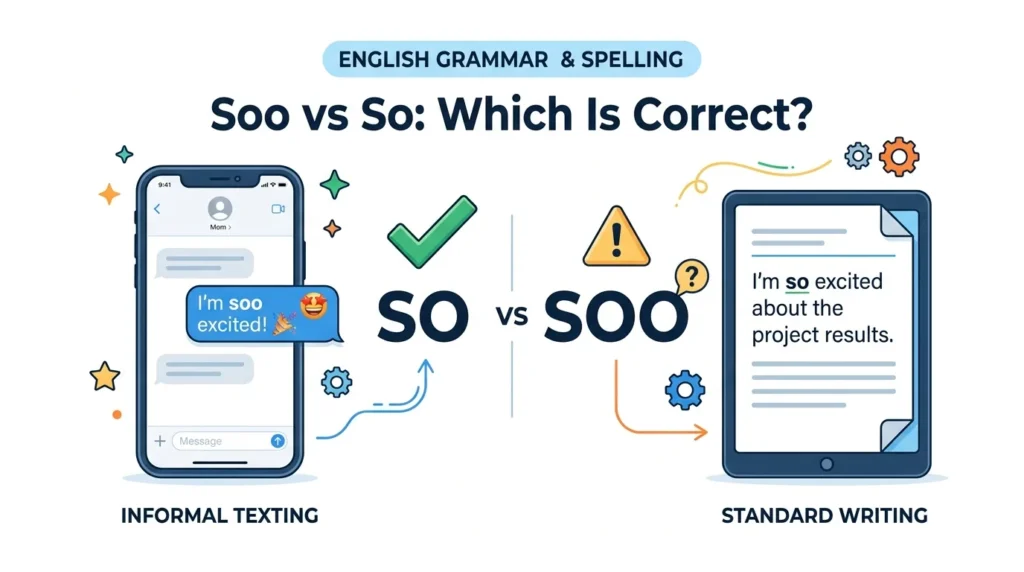

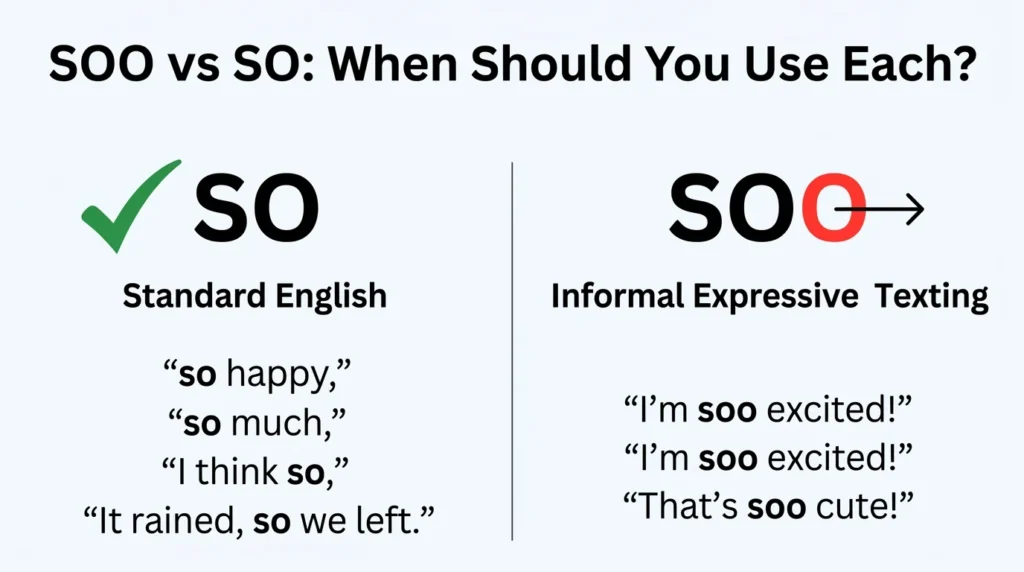
So is the standard English spelling when you mean the common word used to express degree, result, similarity, or agreement. Soo is usually an informal, expressive spelling used online to stretch the sound of so for extra emphasis, as in “I’m soo excited!” It is appropriate only when you deliberately want a playful or exaggerated texting style. In professional, academic, and formal writing, use so.
What Is the Difference Between Soo and So?
The difference between soo vs so is mainly about standard spelling versus expressive informal writing.
So is a normal English word with several grammatical functions. It can express degree, show a result, introduce a purpose, indicate agreement, or replace information already mentioned.
For example:
- The movie was so good.
- It was raining, so we stayed home.
- I think so.
- So am I.
- I left early so I could catch the train.
By contrast, soo is commonly seen in digital communication as a stretched version of so. The additional o visually represents a longer or more emotional pronunciation:
I am soo excited!
The meaning is usually understood as “I am so excited,” but the spelling adds an expressive tone.
There is one important detail: Soo can also be a genuine dictionary term in a different context. In American English, Soo is an alteration of Sault, referring to the region around Sault Ste. Marie in northern Michigan and southern Ontario.
So, if you are asking about the ordinary English word meaning “to such a degree,” so is the form you want.
Why It Matters
A single extra letter can change the tone of your writing.
In a text to a close friend, writing:
I’m soo happy for you!
can communicate excitement or warmth.
But in a job application, academic essay, business report, or professional email, the same spelling can look deliberately informal or careless:
We are soo pleased to announce the results.
In that situation, write:
We are so pleased to announce the results.
The distinction matters because standard English and expressive internet spelling serve different purposes.
A reader may understand soo perfectly, but understanding does not automatically make a spelling appropriate for every context.
The Core Rule
Use “so” in standard English writing. Use “soo” only when you intentionally want an informal, expressive, stretched spelling in casual digital communication.
Remember:
- so = standard English
- soo = informal expressive spelling when you want to stretch the sound
- so belongs in professional and academic writing
- soo can appear in texts, DMs, comments, and playful social posts
- Soo may also be a proper name or regional term unrelated to the ordinary word so.
How to Use “So”
The word so has several important uses. Understanding them helps explain why soo cannot simply replace so everywhere.
So to Show Degree
Here, so means “to such a great degree” or “very.”
Examples:
- The water is so cold.
- She was so tired that she went straight to bed.
- This book is so interesting.
- He speaks so quietly.
- The exam was so difficult.
In this use, so commonly comes before an adjective or adverb.
So to Show a Result
So can connect one situation with its result.
- I was hungry, so I made a sandwich.
- The shop was closed, so we went somewhere else.
- She missed the bus, so she called a taxi.
Here, replacing so with soo would not make sense:
❌ She missed the bus, soo she called a taxi.
The extra o would be an expressive spelling where no expressive stretching is needed.
So to Mean “In the Same Way”
English also uses so in structures such as:
- So am I.
- So do I.
- So can she.
- So have they.
These structures express agreement or similarity. The verb and subject are inverted after so.
For example:
“I love classical music.”
“So do I.”
Not:
❌ “Soo do I.”
So as a Substitute for Earlier Information
We often use so to avoid repeating an entire idea.
- Do you think he will come? I think so.
- Is the store open? I hope so.
- Will they win? I don’t think so.
Again, soo does not normally work here.
❌ I think soo.
So to Introduce a Result or Purpose
So can also appear in structures involving purpose:
I saved the document so I wouldn’t lose my work.
It can also occur in so that:
She spoke quietly so that the baby would not wake up.
These are grammatical uses of so, not places where soo should replace it.
Correct Examples
Here are examples showing how so works across different situations.
| Situation | Correct Example |
|---|---|
| Conversation | That restaurant was so good. |
| Text message | I’m so happy you came! |
| Thank you so much for your help. | |
| Workplace | The instructions were so clear that everyone understood them. |
| Meeting | The deadline is so close that we need to act today. |
| School | The assignment was so challenging. |
| Academic writing | The results were so significant that further analysis was required. |
| Social media | This view is so beautiful. |
| Customer service | We are so sorry for the inconvenience. |
| Personal writing | I was so relieved when I heard the news. |
| Cause and result | It started raining, so we went inside. |
| Agreement | “I enjoyed the lecture.” “So did I.” |
Incorrect vs. Correct
The important point is that soo is not automatically wrong because people never use it. It is usually wrong when a writer intends to produce standard English.
| ❌ Incorrect | ✅ Correct | Why |
|---|---|---|
| I am soo tired today. | I am so tired today. | Standard English uses so. |
| She is soo beautiful. | She is so beautiful. | The extra o is unnecessary in standard writing. |
| The movie was soo interesting. | The movie was so interesting. | So is the standard degree adverb. |
| I was soo happy to see you. | I was so happy to see you. | Use so in standard personal writing. |
| We are soo pleased with the results. | We are so pleased with the results. | Professional writing should use the standard spelling. |
| It was raining, soo we stayed home. | It was raining, so we stayed home. | Here so shows a result, not emotional emphasis. |
| I think soo. | I think so. | So substitutes for an earlier statement. |
| Soo did I. | So did I. | This is the standard agreement structure. |
| Please finish it soo we can leave. | Please finish it so we can leave. | So introduces the intended result or purpose. |
| I hope soo. | I hope so. | So is the standard form. |
An Important Exception
Consider this sentence:
I’m soo excited about the concert!
If this appears in a casual text or social media post, the writer may be intentionally using soo to stretch the pronunciation.
That is different from accidentally spelling so incorrectly.
The key question is therefore not simply “Have I ever seen soo?”
The better question is:
“Am I using the extra o intentionally as an informal expressive device?”
Why People Make This Mistake
Phonetic Similarity
The confusion begins with pronunciation.
When people strongly emphasize so, they may naturally stretch the vowel:
“I’m sooo happy!”
When that sound is transferred into writing, the writer may type soo or sooo.
English spelling normally does not work this way, but informal digital writing often tries to reproduce spoken emotion visually.
Spelling Overlap
The two forms differ by only one letter:
- so
- soo
Because the visual difference is tiny, it is easy to assume they are simply alternative spellings.
They are not equivalent in standard written English.
Overgeneralisation
Someone may learn that soo can express emphasis in a text and then begin using it everywhere.
For example:
❌ It was late, soo we left.
The writer has taken an expressive texting convention and applied it to a grammatical function where it does not belong.
Autocomplete and Spellcheck
Spellcheck can help identify unfamiliar words, but it cannot always determine the writer’s intended tone.
A casual message may contain:
sooo good
sooo cute
noooo way
These spellings can be intentional. The absence of a correction does not necessarily mean that an expressive spelling is suitable for formal writing.
Translation Interference
Learners sometimes assume that if a sound can be lengthened in speech, the spelling should also be lengthened.
That is not generally how standard English spelling works.
In spoken English, a speaker can stretch a sound through pronunciation. In standard writing, emphasis is usually communicated through word choice, sentence structure, or punctuation rather than by changing the spelling of a normal word.
Common Mistakes Checklist
Using “soo” in formal writing
Problem: You write soo in an essay, report, application, or professional email.
Why it happens: Digital communication makes stretched spellings look familiar.
Fix: Replace it with so.
Thinking “soo” is always a spelling mistake
Problem: You assume every occurrence of soo is accidental.
Why it happens: You have learned only the standard spelling.
Fix: Consider the context. In a casual message, soo may be an intentional expressive spelling.
Replacing every “so” with “soo”
Problem: You treat the two forms as interchangeable.
Why it happens: You notice that soo can express stronger emotion.
Fix: Use soo only when the purpose is deliberate informal emphasis.
Using “soo” to show a result
Problem:
It was late, soo we went home.
Fix:
It was late, so we went home.
Here so connects cause and result. There is no reason to stretch the word.
Using “soo” in “I think so”
Problem:
I think soo.
Fix:
I think so.
The so in this sentence stands for an earlier idea. It is not an adjective or adverb being emphasized.
Soo vs So in Real English
Natural standard English: “I’m so happy.”
This is the normal form in everyday speech and writing. It works in a text, conversation, email, workplace message, or academic context. There is nothing unnatural about using the standard spelling even when the emotion is strong. So is flexible enough to express emphasis without changing its spelling.
Read More: All-Time Favorite vs All Times Favorite: Which Is Correct?
Natural casual digital English: “I’m soo happy!”
In a relaxed text, comment, or social post, soo can communicate a deliberately stretched pronunciation. The reader may interpret the extra o as extra excitement or emotion. It is better understood as an expressive writing choice than as a new standard spelling of so.
Grammatically possible but stylistically marked: “I’m sooo happy!”
Multiple extra letters push the same idea even further. This kind of spelling is common in informal digital communication because written text does not carry vocal tone. However, the more exaggerated the spelling becomes, the more clearly it signals casual, playful, or dramatic communication rather than neutral prose.
Wrong for standard meaning: “It was raining, soo we left.”
Here soo does not communicate extra emotion. The word is connecting two clauses and showing a result. Standard English requires so:
It was raining, so we left.
This is a useful distinction: soo is associated with expressive emphasis, not a general replacement for every grammatical use of so.
American vs. British English
There is no meaningful American-versus-British spelling difference for the ordinary word so.
Both American and British English use:
so
The expressive spelling soo is not an alternative standard spelling of so in either variety.
There is, however, a separate regional use of Soo. Collins records Soo in American English as an alteration of Sault, referring to the region around Sault Ste. Marie in northern Michigan and southern Ontario.
So do not confuse the regional noun Soo with the informal texting spelling soo.
Formal vs. Informal Usage
| Context | Recommended Form | Example |
|---|---|---|
| Academic essay | so | The results were so significant… |
| Business email | so | Thank you so much. |
| Job application | so | I am so interested in this position. |
| Professional report | so | Demand was so high… |
| School assignment | so | The experiment was so successful. |
| Personal email | so | I’m so glad to hear from you. |
| Text to a friend | so or intentional soo | I’m soo excited! |
| Social media caption | so or intentional soo | This is soo cute! |
| Formal public post | so | We are so grateful for your support. |
The safest rule is simple:
If the writing needs to look standard and polished, choose “so.”
Comparison Table
| Feature | So | Soo |
|---|---|---|
| Standard English spelling | ✅ Yes | ❌ No, when used as a stretched so |
| Expresses degree | ✅ Yes | Sometimes imitates this informally |
| Shows a result | ✅ Yes | ❌ No |
| Means “in the same way” | ✅ Yes | ❌ No |
| Used in “I think so” | ✅ Yes | ❌ No |
| Common in formal writing | ✅ Yes | ❌ No |
| Can appear in texting | ✅ Yes | ✅ Yes, as an expressive spelling |
| Can show exaggerated emotion online | Yes | ✅ Especially associated with this |
| Used in academic writing | ✅ Yes | ❌ No |
| Used in professional writing | ✅ Yes | ❌ No |
| Can be a separate proper/regional term | — | ✅ “Soo” can refer to the Sault region |
Memory Trick
Think:
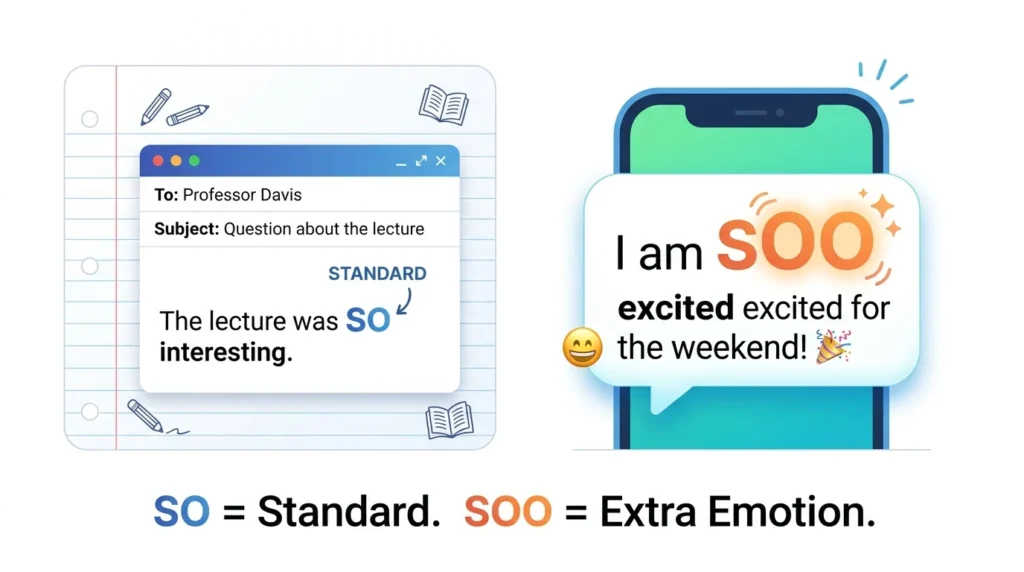
One O = ordinary “so.”
Extra O = extra emotion.
If you are simply using the normal English word, stop at so.
If you deliberately add another o to make a casual message sound stretched or dramatic, soo can signal that style.
For professional writing, remember:
“One O for every serious situation.”
Real-Life Situations
Job Interview
You might say:
“I’m so interested in this position because it matches my experience.”
Use so, even though you may pronounce it with strong emphasis.
Business Email
“Thank you so much for your detailed feedback.”
Do not write:
❌ Thank you soo much…
The standard spelling keeps the email polished.
Text Message
A friend asks whether you are excited about your vacation.
“I’m soo excited! I can’t wait!”
Here the extra o is intentional and expressive.
Social Media
You post a photograph of a beautiful sunset:
“This sky is soo beautiful!”
The spelling creates a playful, enthusiastic tone.
Academic Essay
“The findings were so significant that the researchers conducted a second analysis.”
Use the standard spelling.
Customer Message
“We are so sorry for the delay.”
Even when the message is warm and emotional, so is the appropriate standard form.
Mini Quiz
| # | Question | Answer | Explanation |
|---|---|---|---|
| 1 | Choose the standard spelling: “She is ___ kind.” | so | So is the standard degree adverb. |
| 2 | Fill in: “It was raining, ___ we stayed home.” | so | Here so shows a result. |
| 3 | Which is better in an academic essay: “The test was so difficult” or “The test was soo difficult”? | The test was so difficult. | Academic writing uses standard spelling. |
| 4 | Is “I’m soo excited!” possible in a casual text? | Yes | It can be an intentional expressive spelling. |
| 5 | Correct the sentence: “I think soo.” | I think so. | So replaces the idea already mentioned. |
| 6 | Which is standard: “So am I” or “Soo am I”? | So am I. | This is a standard agreement structure. |
| 7 | Correct the sentence: “She was tired, soo she went home.” | She was tired, so she went home. | So introduces the result. |
| 8 | Which fits a professional email: “We are so pleased” or “We are soo pleased”? | We are so pleased. | Professional writing requires standard spelling. |
| 9 | A friend writes, “I’m ___ happy right now!” You want to sound playful and excited. Which could you choose? | soo | The extra o can deliberately show expressive emphasis. |
| 10 | Is “soo” a standard replacement for every use of “so”? | No | It is mainly an informal expressive spelling and cannot replace grammatical uses such as so in “I think so” or “so we left.” |
Expert Tips
Do not confuse pronunciation with spelling
You can stretch so when speaking:
“I’m sooo tired.”
That does not mean the standard spelling has changed.
Look at the function of the word
Ask what so is doing.
Is it:
- expressing degree?
- showing a result?
- indicating agreement?
- replacing an earlier statement?
- introducing purpose?
If yes, the standard form is so.
Read More: Pent vs Pant: Which Word Is Correct?
Treat extra letters as tone markers
In informal digital communication, extra letters often communicate emotion:
- so → standard
- soo → stretched
- sooo → more strongly stretched
- sooooo → highly exaggerated
These spellings communicate tone rather than creating a new set of grammatical rules.
Do not let social media rewrite your formal spelling
Seeing soo frequently online can make it look like a normal alternative spelling. Familiarity does not make it appropriate for every context.
When writing something important, return to the standard form:
so
Remember that “Soo” can have another meaning
If you encounter Soo with a capital letter in a geographical context, it may refer to the Sault region rather than being an expressive spelling of so.
FAQ
Is “soo” a correct English word?
Usually, not when you mean the ordinary word so. In online communication, soo is commonly used as an informal expressive spelling. However, Soo does exist as a separate regional term related to Sault Ste. Marie.
Is “soo” acceptable in texting?
Yes. In a casual text, soo can intentionally stretch the word so and communicate extra excitement, affection, frustration, or emphasis. It is a stylistic choice rather than the standard spelling.
Can I use “soo” on social media?
You can if the tone is deliberately casual or playful. For example, “This is soo cute!” can signal enthusiasm. If the post represents a business, organization, or professional brand, so is generally the safer choice.
Is “soo” a misspelling?
It can be a misspelling if the writer intended standard so. But in a casual digital context, it can also be intentional. Context determines whether the extra o is an error or an expressive choice.
Is “sooo” also correct?
Sooo is another informal way of stretching so in digital writing. It can suggest even stronger emphasis. It is not the standard spelling used in formal English.
Should I write “soo much” or “so much”?
Use so much in standard writing:
I appreciate your help so much.
Soo much may appear in an intentionally informal message, but it is an expressive spelling rather than the standard form.
Can I use “soo” in a formal email?
You should normally use so. For example:
We are so pleased to welcome you.
Using soo makes the message noticeably informal and may look like a spelling error.
Does “soo” have a different pronunciation from “so”?
Usually, the extra o in informal writing represents a deliberately stretched pronunciation of so. It is meant to show how the writer imagines the word being drawn out rather than establishing a new standard pronunciation.
Is “so” always better than “soo”?
For standard English, yes. But soo can be useful as a deliberate stylistic device in casual digital communication. The issue is not that expressive spelling has no purpose; it is that it should not be mistaken for standard spelling.
Is there a difference between “soo” and “sooo”?
Both can be expressive spellings. The additional letters generally make the written emphasis stronger. Neither should replace standard so in formal or academic writing.
Is “Soo” ever a real word?
Yes, in a different sense. Soo is recorded in American English as an alteration of Sault, referring to a region around Sault Ste. Marie in Michigan and Ontario. This has nothing to do with the informal texting spelling. (Collins Dictionary)
Quick Summary
So is the standard English spelling and the form you should use in normal, professional, academic, and formal writing. It can express degree, show a result, indicate similarity or agreement, replace previously mentioned information, and introduce purpose. Soo is commonly used online as an informal, expressive version of so, usually to make the word appear stretched or more emotional. It can work in casual texts, comments, and playful social posts, but it should not replace standard so in serious writing. Also remember that Soo can have a separate geographical meaning connected with Sault Ste. Marie. When in doubt, choose so.