

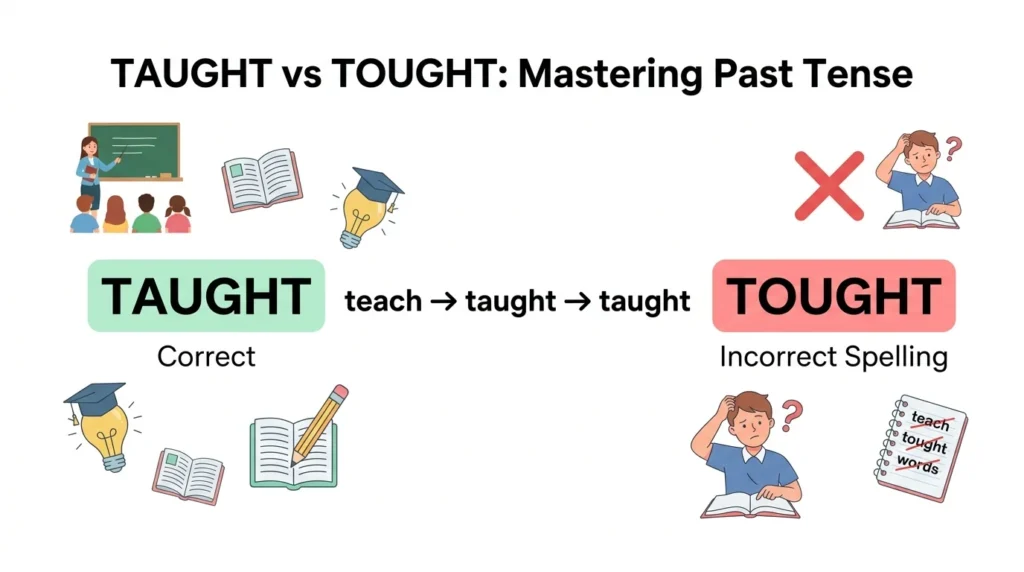
Taught is the correct spelling when you mean the past tense or past participle of teach. Tought is a common spelling mistake and is not the standard past form of teach. The correct verb pattern is teach → taught → taught. For example, “My teacher taught me English” is correct, while “My teacher tought me English” is incorrect.
What Is the Difference Between Taught and Tought?
The difference is simple: taught is a real English word, while tought is an incorrect spelling when you mean the past form of teach.
Taught is the simple past tense and past participle of the irregular verb teach. It means that someone gave another person knowledge, instruction, training, or a skill. Standard dictionaries list the verb forms as teach – taught – taught.
Tought, on the other hand, is not the standard spelling of this verb form.
So, if you are describing something that happened in the past, use:
teach → taught
Not:
teach → tought
This distinction matters because the two spellings look believable at first glance. English contains many words such as thought, bought, fought, and sought, so it is easy to assume that teach should follow the same spelling pattern.
It does not.
Why It Matters
A single spelling error may not prevent someone from understanding your sentence, but it can affect how your writing is perceived.
Consider these examples:
- “My manager taught me how to use the software.”
- “My manager tought me how to use the software.”
The meaning of the second sentence is easy to understand, but the spelling error can make the writer appear careless, especially in professional or academic communication.
The distinction matters most in situations such as:
- School assignments and examinations
- University essays
- Job applications
- Professional emails
- Business reports
- Training documents
- Resumes and cover letters
- Published articles
- Educational content
In casual texting, readers may understand tought immediately. But recognition does not make the spelling correct.
The Core Rule
Use “taught” as the past tense and past participle of “teach.” “Tought” is not the standard English form.
The essential verb pattern is:
Teach → taught → taught
Examples:
- I teach English.
- I taught English last year.
- I have taught English for ten years.
Because teach is an irregular verb, it does not form its past tense by adding -ed. You do not normally write teached, either.
The correct forms are:
Present: teach
Past: taught
Past participle: taught
Dictionary references confirm that taught functions as both the past simple and past participle of teach.
Read More: Shinning vs Shining: Which Is Correct?
How to Use Taught
Use “taught” for something someone instructed you to do
When someone showed you how to perform an action, taught is the appropriate word.
My father taught me how to swim.
The teaching happened in the past, so taught is used.
Use “taught” for school or academic instruction
Professor Ahmed taught economics at the university.
Here, taught describes the professor’s past teaching activity.
Use “taught” for skills
Teaching does not have to happen in a classroom.
My brother taught me how to repair a bicycle.
The person provided knowledge or instruction, so taught is correct.
Use “taught” for lessons learned from experience
The word can also describe knowledge gained through an event or experience.
The experience taught me to be more patient.
No classroom is necessary. The experience itself provided a lesson.
Use “taught” in passive constructions
Because taught is also the past participle of teach, it can appear after forms of be or have.
We were taught how to use the new system.
She has taught English for many years.
I had been taught to double-check every document.
These constructions are grammatically different, but the spelling remains taught.
Correct Examples of Taught
Here are examples from everyday conversation, education, work, email, social media, and academic writing.
- Conversation: My uncle taught me how to drive.
- School: Our science teacher taught us about renewable energy.
- University: Professor Khan taught modern history for several years.
- Workplace: My colleague taught me how to use the new software.
- Email: She taught me everything I needed to know before the presentation.
- Family: My grandmother taught me how to make this recipe.
- Training: The instructor taught the employees basic safety procedures.
- Social media: My first business failure taught me an important lesson.
- Academic writing: The study taught researchers that the original assumption was incomplete.
- Personal experience: Traveling alone taught him to become more independent.
- Self-learning: She taught herself how to play the piano.
- Professional development: The workshop taught us several useful negotiation techniques.
Notice that taught can refer to formal instruction, informal guidance, practical skills, or lessons learned through experience. The common idea is that knowledge, understanding, or a skill was imparted or learned.
Incorrect vs. Correct
| ❌ Incorrect | ✅ Correct | Why |
|---|---|---|
| My teacher tought me English. | My teacher taught me English. | The past form of teach is taught. |
| She tought me how to cook. | She taught me how to cook. | Tought is an incorrect spelling. |
| He tought mathematics last year. | He taught mathematics last year. | The verb changes from teach to taught. |
| My father tought me to drive. | My father taught me to drive. | Taught is the correct irregular past form. |
| We were tought the procedure. | We were taught the procedure. | The past participle is also taught. |
| She has tought hundreds of students. | She has taught hundreds of students. | Taught follows has as the past participle. |
| The coach tought us a new technique. | The coach taught us a new technique. | The spelling is taught, not tought. |
| Experience tought him patience. | Experience taught him patience. | Experiences can “teach” lessons, so the past form is taught. |
| I was tought to respect my elders. | I was taught to respect my elders. | Passive constructions use the past participle taught. |
| They tought me everything I know. | They taught me everything I know. | Teach has the irregular past form taught. |
Why Do People Write Tought?
The mistake is understandable because English spelling often creates patterns that look logical but are not actually reliable.
Phonetic confusion
Taught is pronounced roughly like “tawt” in many varieties of English. The pronunciation does not clearly reveal whether the spelling should contain au, ou, or another vowel combination.
When people remember a word mainly by sound, they may reconstruct the spelling incorrectly.
Similar-looking words
English has many common words with -ought:
- thought
- bought
- fought
- sought
- brought
That visual pattern can make tought look plausible.
But spelling patterns in English do not always work predictably across different words.
Irregular verb confusion
Many English verbs form their past tense with -ed:
- walk → walked
- play → played
- work → worked
Teach does not.
It changes internally:
- teach → taught
A learner who is already trying to remember an irregular verb may also accidentally modify the spelling.
Autocomplete and spellcheck
Modern typing tools can help, but they are not a substitute for knowing the correct word.
A person may type tought quickly and move on without noticing the error. A spellchecker may catch it, but not every writing environment provides equally strong correction.
Translation interference
English learners sometimes transfer spelling patterns from another language into English. When a word’s pronunciation is easier to remember than its written form, this can increase the chance of producing a phonetic spelling.
The best solution is to memorize the complete verb pattern rather than trying to spell the past form from pronunciation alone.
Read More: Carrer vs Career: Which Spelling Is Correct?
Common Mistakes Checklist
Mistake 1: Writing “tought”
What happens: You remember the pronunciation but choose the wrong vowel pattern.
Why it happens: Words such as thought and bought make the spelling look reasonable.
How to avoid it: Memorize teach → taught as a pair.
Mistake 2: Writing “teached”
What happens: You apply the regular -ed rule to an irregular verb.
Why it happens: Many English verbs use -ed in the past tense.
How to avoid it: Remember that teach is irregular: teach → taught.
Mistake 3: Confusing “taught” with “thought”
What happens: You choose thought when you mean that someone gave instruction.
Why it happens: The words look similar and have similar vowel sounds in some accents.
How to avoid it: Ask yourself: “Was someone teaching, or was someone thinking?”
Mistake 4: Confusing “taught” with “tough”
What happens: You choose tough when you mean taught.
Why it happens: The spellings look related even though their meanings and pronunciations are different.
How to avoid it: Connect taught with teach, and tough with difficult/strong.
Mistake 5: Assuming a repeated spelling must be correct
What happens: You see tought online and assume it must be an accepted variant.
Why it happens: Online writing contains many unedited spelling errors.
How to avoid it: When uncertain, check a reliable dictionary rather than counting how often a form appears online.
Taught in Real English
Taught: Grammatically correct and natural
Taught is the normal English form when referring to past instruction or a lesson learned from experience. Sentences such as “My teacher taught me grammar” and “The experience taught me patience” are both natural. The word works comfortably in conversation, education, workplace communication, formal writing, and everyday storytelling. Dictionary examples likewise use taught for instruction and knowledge gained from experience.
Tought: Grammatically incorrect
Tought is not an alternative form of taught. If your intended meaning is “gave instruction,” replacing taught with tought does not create a different grammatical construction; it simply creates a spelling error. A reader may understand what you mean from context, especially in an informal message, but standard written English calls for taught.
“Teached”: Grammatically incorrect in standard English
Teached may seem logical because many English verbs form the past tense with -ed, but teach is irregular. Standard English uses taught, not teached, for both the simple past and past participle. So the reliable pattern is not teach → teached but teach → taught → taught.
“Taught” in formal and everyday English
Taught does not belong only to formal English. It is completely normal in casual conversation as well as professional and academic writing. You can say, “Dad taught me to fish,” or write, “The study taught researchers an important lesson.” The register changes according to the surrounding sentence, not because the word taught itself is formal.

American vs. British English
There is no spelling difference between American and British English for this word.
Both varieties use:
teach → taught → taught
The pronunciation can vary slightly between accents, but the standard spelling remains taught. Cambridge lists taught as the past simple and past participle of teach in both its British and American dictionary entries.
| Variety | Correct spelling | Example |
|---|---|---|
| American English | taught | She taught English. |
| British English | taught | She taught English. |
| International English | taught | She taught English. |
| Incorrect form | tought | She tought English. ❌ |
Read More: Halfday vs Half Day: Which Is Correct?
Formal vs. Informal Usage
Taught works in both formal and informal contexts.
Informal
My dad taught me how to fix a bike.
Professional
The training session taught employees how to use the new system.
Academic
The findings taught researchers that the original assumption required further investigation.
Formal
The experience taught the organization an important lesson about risk management.
There is no need to replace taught with another word simply because the writing is formal.
The problem is tought, which should be corrected regardless of register.
Taught vs. Tought Comparison Table
| Feature | Taught | Tought |
|---|---|---|
| Correct standard English spelling | ✅ Yes | ❌ No |
| Related to teach | ✅ Yes | ❌ No |
| Past tense of teach | ✅ Yes | ❌ No |
| Past participle of teach | ✅ Yes | ❌ No |
| Standard dictionary form | ✅ Yes | ❌ No as the past form of teach |
| Suitable for academic writing | ✅ Yes | ❌ No |
| Suitable for professional writing | ✅ Yes | ❌ No |
| Used in American English | ✅ Yes | ❌ No |
| Used in British English | ✅ Yes | ❌ No |
| Meaning | Gave instruction or provided a lesson | — |
Taught vs. Thought vs. Tough vs. Taut
The confusion becomes easier to solve when you separate the similar-looking words.
| Word | Meaning | Example |
|---|---|---|
| taught | Past tense/past participle of teach | She taught me French. |
| thought | Past tense of think; an idea or opinion | I thought you were busy. |
| tough | Difficult, strong, or durable | The exam was tough. |
| taut | Tight or stretched | The rope was taut. |
| tought | Incorrect spelling in this context | She tought me French. ❌ |
These words are worth learning separately because replacing one with another can completely change the meaning of a sentence.
Memory Trick
Use this simple sentence:
My teacher TAUGHT me how to spell TAUGHT.
The word you are trying to remember appears twice.
Another useful pattern is:
Teach = now
Taught = before
For example:
I teach English now.
I taught English last year.
And remember:
Teach → Taught → Taught
Do not let the -ought spelling of thought persuade you to write tought.
Real-Life Situations
In an interview
Interviewer: What skills did your previous manager help you develop?
Candidate: She taught me how to manage difficult client conversations.
The candidate is describing something learned in the past, so taught is correct.
In a meeting
“Our consultant taught us a more efficient way to organize the workflow.”
The consultant provided instruction.
In an email
“Thank you for the guidance you taught me during my first month.”
A more natural version would often be:
“Thank you for what you taught me during my first month.”
The key point is that taught remains the correct spelling.
In a text message
“My brother taught me how to make this!”
Even in casual writing, taught is the standard spelling.
In an exam
“The teacher taught us how to analyze the poem.”
Writing tought would be a spelling error.
In a workplace report
“The project taught the team several important lessons about customer retention.”
Here, the project itself is presented as the source of learning.
Read More: Scarey vs Scary: Which Spelling Is Correct?
Expert Tips
Learn irregular verbs as families
Do not memorize only the isolated word taught. Memorize the complete sequence:
teach → taught → taught
This makes it easier to retrieve the correct form when writing.
Learn the meaning before the spelling
If you are unsure whether to write taught or thought, ask:
Was someone teaching, or was someone thinking?
- Teaching → taught
- Thinking → thought
Do not trust pronunciation alone
English spelling frequently contains letters that are not obvious from pronunciation. Trying to spell taught purely from its sound is one reason learners may produce tought.
Check the base verb
When you see a confusing past-tense form, mentally return to its present form.
If the verb is:
teach
its past form is:
taught
Watch for “teached”
Tought is not the only mistake. Teached is also incorrect in standard English.
Correct:
She taught English for five years.
Incorrect:
She teached English for five years.
Quick Summary
Taught is the correct spelling and is the simple past and past participle of teach. The correct verb pattern is teach → taught → taught. Tought is a common misspelling, not an alternative form of the verb. The mistake often happens because taught sounds like words with other spellings, while words such as thought, bought, and fought make tought look plausible. Use taught when someone gave instruction, training, knowledge, or a lesson, including lessons learned from experience. The spelling is the same in American and British English and works in both formal and informal writing. If you are unsure, remember: teach today, taught before.
Frequently Asked Questions
Is “tought” a correct English word?
No. When you mean the past tense or past participle of teach, tought is an incorrect spelling. The correct form is taught.
What is the past tense of teach?
The past tense of teach is taught.
Present: I teach English.
Past: I taught English.
What is the past participle of teach?
The past participle is also taught.
For example:
She has taught English for many years.
Cambridge and Merriam-Webster both identify taught as the past participle of teach.
Is “teached” correct?
No. Teach is an irregular verb, so its standard past form is taught, not teached.
Why do people spell taught as tought?
The most likely reason is the combination of pronunciation and misleading spelling patterns. Words such as thought, bought, and fought contain -ought, which can make tought look like a reasonable spelling even though it is incorrect.
Is taught the same in American and British English?
Yes. Both American and British English use taught as the past tense and past participle of teach. The spelling does not change by variety.
Can taught describe something learned from experience?
Yes. A situation or experience can metaphorically “teach” someone a lesson.
The mistake taught me to be more careful.
This use is standard English.
Is taught a verb?
Yes. Taught is a verb form: specifically, the simple past and past participle of teach.
What is the easiest way to remember taught?
Remember the three-part verb:
teach → taught → taught
You can also use:
My teacher taught me taught.
Or, more naturally:
My teacher taught me how to spell taught.
What is the difference between taught and thought?
Taught comes from teach and means instructed or gave someone knowledge.
Thought comes from think and refers to having an idea, belief, or opinion.
She taught me French.
I thought she was French.
What is the difference between taught and tough?
Taught is the past form of teach. Tough means difficult, strong, durable, or resilient.
My coach taught me a new technique.
The training was tough.
Mini Quiz
| # | Question | Answer | Explanation |
|---|---|---|---|
| 1 | Choose the correct word: “My teacher ___ me grammar.” A) tought B) taught C) thought | B) taught | Taught is the past form of teach. |
| 2 | Fill in the blank: “She has ___ English for ten years.” | taught | Taught is also the past participle of teach. |
| 3 | Correct the sentence: “My father tought me how to swim.” | My father taught me how to swim. | Tought is an incorrect spelling. |
| 4 | Which word means “had an idea or opinion”? A) taught B) tough C) thought | C) thought | Thought is the past form of think. |
| 5 | Which sentence is correct? A) He teached history. B) He taught history. | B) He taught history. | Teach is irregular and changes to taught. |
| 6 | Fill in the blank: “The experience ___ me to be more careful.” | taught | An experience can teach someone a lesson. |
| 7 | Correct the sentence: “We were tought how to use the machine.” | We were taught how to use the machine. | The passive construction requires the past participle taught. |
| 8 | Which word means “difficult or strong”? A) taught B) tough C) thought | B) tough | Tough is an adjective with meanings related to difficulty, strength, or durability. |
| 9 | Choose the correct verb pattern: A) teach → teached B) teach → tought C) teach → taught | C) teach → taught | Teach is an irregular verb. |
| 10 | Correct the sentence: “The mistake tought him an important lesson.” | The mistake taught him an important lesson. | The correct past form of teach is taught. |
Final Rule to Remember
If you mean “gave instruction,” “trained,” “showed someone how,” or “provided a lesson,” use:
TAUGHT
The correct pattern is:
TEACH → TAUGHT → TAUGHT
Never replace taught with tought in standard English.