
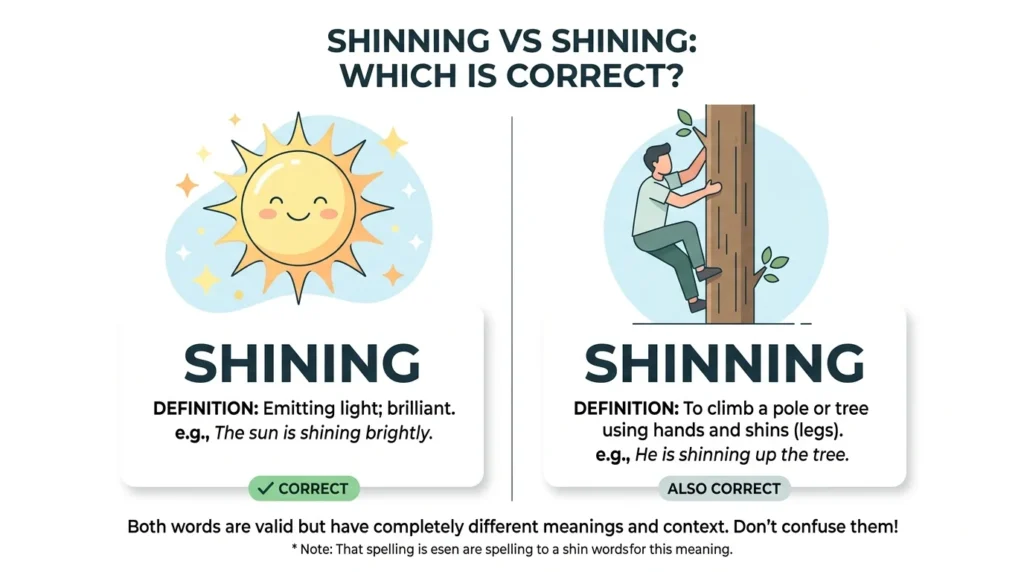

Shining is the correct word when you mean giving off or reflecting light, looking bright, or being excellent or impressive. It is the present participle of shine: The sun is shining. Shinning is also a real English word, but it comes from shin and means climbing something by gripping it with the hands and legs. In ordinary writing about light, brightness, or success, use shining, not shinning.
What Is the Difference Between Shinning and Shining?
Shining and shinning are two different words, not two spellings of the same word.
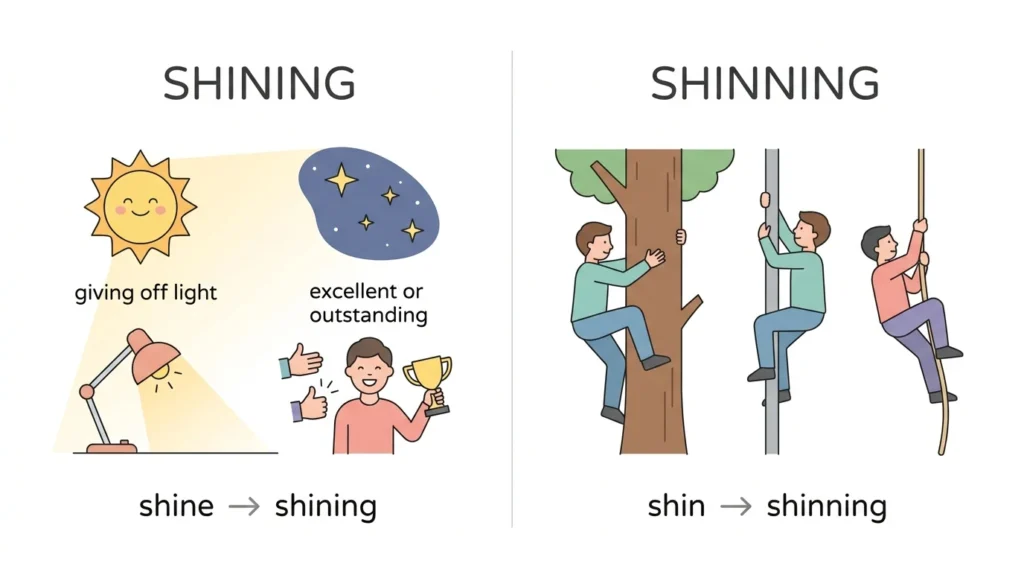
Shining comes from the verb shine. It can describe light, brightness, or something that stands out because of its quality or excellence:
- The stars are shining tonight.
- She gave a shining performance.
- He is a shining example of patience.
Shinning comes from the verb shin. It describes climbing by gripping a rope, pole, tree, fence, or another surface with the hands and legs. The verb shin can also mean to hit or kick someone in the shin.
So the easiest distinction is:
Shining = light, brightness, or excellence.
Shinning = climbing or an action involving the shin.
The extra n is not an alternative spelling of shining. It changes the word’s base verb and therefore changes its meaning.
Why It Matters
This spelling difference is small, but the meaning difference is large.
Writing The sun is shinning instead of The sun is shining makes your sentence look like a spelling mistake. The reader may understand what you intended, but the error can make schoolwork, professional writing, website content, emails, and social media posts look less polished.
The problem becomes even more noticeable when the word appears in a phrase such as:
- shining star
- shining example
- shining light
- shining personality
- shining achievement
In all of these common expressions, shining is the appropriate form.
At the same time, it would be inaccurate to say that shinning is simply an incorrect word. Dictionaries recognize it as the present participle of shin. The form is uncommon, but it is legitimate when the context involves the verb shin.
The Core Rule
Use shining for light, brightness, appearance, or excellence. Use shinning only when you mean the action described by the verb shin, such as climbing by gripping with your hands and legs.
Remember the base verbs:
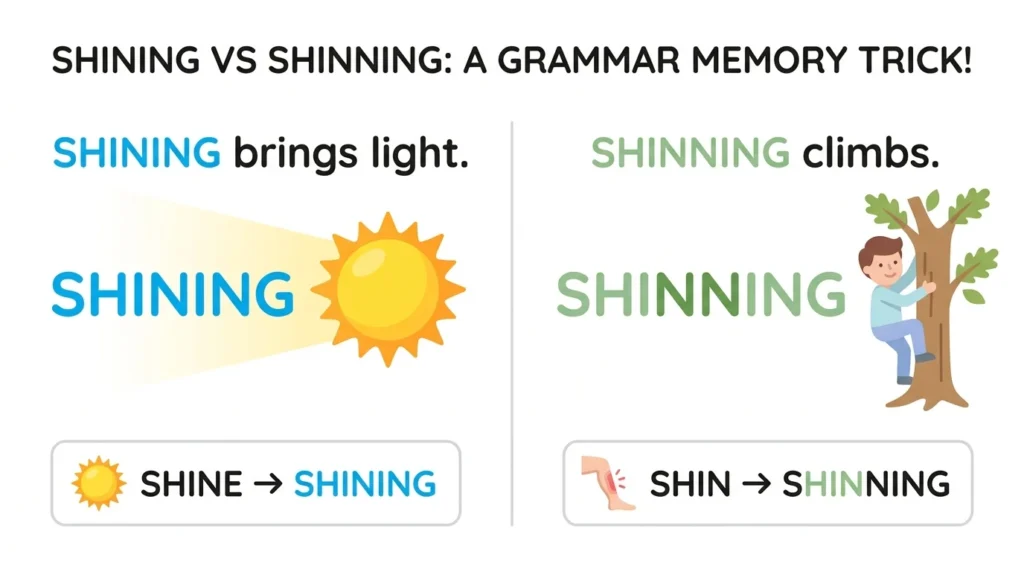
shine → shining
shin → shinning
This is the most reliable way to choose the correct spelling.
Read More: Carrer vs Career: Which Spelling Is Correct?
How to Use Shining
Shining Means Giving Off or Reflecting Light
Use shining when something produces light or reflects light.
Examples include the sun, stars, lamps, polished metal, glass, jewelry, and other reflective surfaces.
- The moon was shining through the clouds.
- The polished floor was shining in the afternoon light.
- Her silver necklace was shining under the lamp.
Shining Can Describe Something Excellent
Shining also has a figurative meaning. It can describe someone or something that is unusually good, impressive, successful, or admirable.
For example:
- She has a shining reputation in her field.
- His honesty is a shining example for younger employees.
- The student showed shining determination throughout the competition.
This figurative use is well established in English. Dictionary definitions include senses connected with being outstanding as well as literal brightness.
Shining Can Be a Verb Form
In a sentence such as The sun is shining, shining is the present participle of shine.
A present participle is the -ing form of a verb. It commonly appears after forms of be to create a progressive verb phrase:
- The sun is shining.
- The stars were shining.
- The lamp was shining through the window.
It can also function as an adjective:
- a shining star
- a shining example
- shining shoes
How to Use Shinning
Shinning Means Climbing
Shinning is the present participle of shin. One meaning of shin is to climb something by gripping it with the hands or arms and legs.
For example:
- The boy was shinning up the tree.
- They were shinning up the pole.
- He kept shinning up the rope despite the difficult conditions.
This use is recognized in major dictionaries, although it is much less common in everyday English than shining.
Shinning Can Also Relate to Hitting the Shin
The verb shin can also mean to kick or hit someone in the shin. Therefore, shinning can occur in a context involving that action.
However, this sense is uncommon enough that many readers may encounter shinning primarily in descriptions of climbing.
Why the Extra N Exists
The spelling becomes easier to understand when you look at the base word.
shin + ing → shinning
The final consonant is doubled in this form.
By contrast:
shine + ing → shining
The final e is removed before -ing is added.
So these are two different spelling processes because they involve two different verbs.
Correct Examples
Here are examples showing how shining and shinning work in different real-life contexts.
- Conversation:
The sun is shining, so we can eat outside. - Email:
Thank you for your hard work. You have been a shining example of professionalism. - School:
The stars were shining brightly during our field trip. - Workplace:
Maria is a shining example of how a team leader should communicate. - Academic writing:
The polished surface was shining under the experimental light. - Social media:
Keep shining and keep believing in yourself. - Describing a person:
Her shining personality made everyone feel welcome. - Describing an object:
The newly polished shoes were shining in the display window. - Physical climbing:
The child was shinning up the old tree. - Adventure or outdoor writing:
The climber was shinning up the narrow pole to reach the platform. - Literary description:
A bright moon was shining over the quiet village. - Professional praise:
His report was a shining example of clear technical writing.
Notice that the first eight examples use shining because they involve brightness, excellence, or appearance. The final two use shinning because they describe the physical action associated with shin.
Read More: Halfday vs Half Day: Which Is Correct?
Incorrect vs. Correct
| ❌ Incorrect | ✅ Correct | Why |
|---|---|---|
| The sun is shinning today. | The sun is shining today. | The verb is shine, not shin. |
| The stars were shinning brightly. | The stars were shining brightly. | Brightness requires shining. |
| She is a shinning example of kindness. | She is a shining example of kindness. | The figurative expression comes from shine. |
| Keep shinning! | Keep shining! | The expression means continuing to do well or stand out. |
| The lamp was shinning through the window. | The lamp was shining through the window. | A lamp gives off light, so use shining. |
| He has a shinning career ahead of him. | He has a shining career ahead of him. | The word describes excellence or promise. |
| Her shoes were shinning in the sunlight. | Her shoes were shining in the sunlight. | The shoes were reflecting light. |
| The moon was shinning over the lake. | The moon was shining over the lake. | The moon is the source of the brightness. |
| The boy was shining up the tree. | The boy was shinning up the tree. | Here the verb is shin, meaning to climb using the limbs. |
| They were shining up the pole. | They were shinning up the pole. | The sentence describes climbing, not emitting light. |
| The climber was shinning up the rope. | The climber was shinning up the rope. | Shinning is the appropriate form of shin. |
| The room was shinning with light. | The room was shining with light. | The sentence concerns brightness. |
The key is not simply “one n is correct and two n’s are wrong.” Both spellings can be correct when they come from their respective verbs.
Why People Make This Mistake
The Words Look Almost Identical
The difference between shining and shinning is only one letter, so it is easy to overlook while typing.
The words also begin with the same three letters:
shin-
That visual similarity encourages people to treat them as spelling variants when they are actually forms of different verbs.
English Has Many Double-Consonant Patterns
Learners regularly see forms such as:
- run → running
- sit → sitting
- stop → stopping
- plan → planning
This can create the expectation that shine should become shinning.
But the base verb is shine, and its standard present participle is shining.
Pronunciation Adds to the Confusion
The words are not pronounced exactly the same.
Shining is generally pronounced approximately SHY-ning: /ˈʃaɪnɪŋ/.
Shinning is approximately SHIN-ing: /ˈʃɪnɪŋ/.
The vowel in the first syllable changes, which reflects the different base words shine and shin.
Spellcheck Is Not Always Enough
A spelling checker may recognize shinning as a legitimate English word because it really is one. That means software cannot always determine whether you meant shining or shinning from the spelling alone.
For example, if you write:
The sun is shinning.
A basic spellchecker may not necessarily flag shinning as an invalid word because shinning exists in English.
The real problem is word choice, not merely spelling.
Translation Can Cause Interference
Learners who translate directly from another language may choose a form based on sound or a familiar spelling pattern rather than the English base verb.
The safest approach is to ask:
What is the base verb?
If the intended verb is shine, write shining.
If the intended verb is shin, write shinning.
Common Mistakes Checklist
- Mistake: Writing “shinning” for light.
Use shining when something gives off or reflects light. - Mistake: Assuming “shinning” is just an alternative spelling.
It is a form of a different verb, shin. - Mistake: Applying the double-consonant pattern automatically.
Do not assume every short-looking verb doubles its final consonant. - Mistake: Trusting spellcheck completely.
Shinning is a legitimate word, so software may not identify the contextual mistake. - Mistake: Forgetting the figurative meaning of shining.
Shining can describe excellence, not only physical light. - Mistake: Replacing “shinning” with “shining” without checking the meaning.
If someone is climbing a pole or tree, shinning may actually be correct.
Read More: Scarey vs Scary: Which Spelling Is Correct?
Shinning vs. Shining in Real English
“The sun is shining.”
This is grammatically correct and completely natural everyday English. English speakers routinely use shining for sunlight and other sources of brightness. The form comes directly from the verb shine.
“She is a shining example.”
This is grammatically correct and natural English. The phrase has a figurative meaning: the person is an especially good example of a quality or behavior. It is appropriate in both ordinary and formal writing.
“He was shinning up the tree.”
This is grammatically correct but much less common in everyday English. The word shinning is legitimate, but the activity it describes is relatively specific. Dictionary sources define shin in this sense as climbing by gripping with the hands or arms and legs.
“The stars are shinning.”
This is not natural standard English for the intended meaning. The reader almost certainly expects shining, because the sentence describes stars producing or appearing to give off light.
“Keep shining!”
This is natural everyday English, especially when encouraging someone to continue doing well or showing their positive qualities. The expression uses the figurative sense of shine, not the physical climbing sense of shin.
American vs. British English
There is no major American-versus-British spelling difference between shining and shinning.
Both varieties use shining as the normal present participle of shine, and shinning is a legitimate form of shin when the meaning requires it.
There is, however, a small vocabulary difference worth knowing. In the climbing sense, American English can also use shinny as a verb. Collins lists shinny as a U.S. form associated with the climbing sense of shin.
So:
- shine → shining in both major varieties.
- shin → shinning is possible in both.
- shinny may be used in American English for the climbing sense.
Do not turn this into a spelling rule: shinning is not an American spelling of shining.
Formal vs. Informal Usage
Shining is suitable in virtually every register when its meaning is appropriate. You can use it in casual conversation, emails, academic writing, professional reports, journalism, and creative writing.
Shinning is grammatically valid in the climbing sense, but that sense is relatively uncommon. In a formal document, use it when the physical action genuinely needs to be described. If your audience may not know the word, a more familiar phrase such as climbing up the pole may be clearer.
The important distinction is therefore not formal versus informal. It is meaning and context.
Comparison Table
| Feature | Shining | Shinning |
|---|---|---|
| Base verb | shine | shin |
| Main meaning | Giving off or reflecting light | Climbing by gripping with the hands/legs |
| Figurative meaning | Can mean excellent or outstanding | Usually physical and literal |
| Present participle | Yes | Yes |
| Common in everyday English | Very common | Uncommon |
| Example | The sun is shining. | He was shinning up the pole. |
| Pronunciation | SHY-ning | SHIN-ing |
| Correct when discussing brightness? | Yes | No |
| Correct when describing climbing? | No | Yes |
| American/British spelling difference? | No major difference | No major difference |
Memory Trick
Use the E test:
SHINE has an E → SHINING
When the word means light or excellence, think of the original E in shine before you add -ing:
shine → shining
For the climbing word:
shin → shinning
A second quick memory line is:
Shining brings light. Shinning climbs.
If you can replace the word with glowing, bright, or excellent, choose shining.
If you can replace it with climbing using the limbs, shinning may be the word you need.
Real-Life Situations
In an Interview
You want to praise a candidate:
“She was a shining example of professionalism throughout the interview.”
Here, shining means exceptionally good or admirable.
In a Meeting
A manager praises an employee:
“Your presentation was a shining example of clear communication.”
Again, the meaning is excellence.
In an Email
You are congratulating a colleague:
“You did a great job on the project. Keep shining!”
The figurative meaning is natural and encouraging.
In a Text Message
A friend sends you good news:
“That’s amazing! Keep shining!”
This is casual, positive English.
In an Exam
You need to complete this sentence:
“The moon was ___ brightly above the village.”
The correct answer is shining because the sentence describes light.
Read More: Laser vs. Lazer: Which Spelling Is Correct?
In a School Story
A student describes an outdoor activity:
“The boys were shinning up the old tree.”
Here shinning can be correct because the sentence describes climbing.
In a Professional Report
“The company has become a shining example of sustainable growth.”
Shining is correct because the company is being presented as an excellent example.
Expert Tips
Start With the Base Verb
When you are uncertain, do not stare at the two spellings. Work backward.
Ask:
Is the verb shine or shin?
- shine → shining
- shin → shinning
This solves the problem more reliably than trying to remember the spelling by appearance.
Do Not Memorize “One N = Correct”
That shortcut is incomplete.
It is true that shining is normally the word you need when discussing light. But shinning is not simply a misspelling. It is a legitimate form of shin.
The context determines which word is correct.
Check the Meaning Before Checking the Spelling
Ask what the sentence is actually saying.
If something is:
- glowing
- bright
- reflecting light
- excellent
- outstanding
then shining is likely the answer.
If someone is:
- climbing a pole
- climbing a rope
- climbing a tree by gripping it
then shinning may be appropriate.
Be Careful With “Shining Example”
The expression shining example is established English. Do not write shinning example.
For example:
She is a shining example of leadership.
The word does not refer to physical light. It means she is an especially good example.
Remember That Spellcheck Cannot Always Detect Context
Because shinning exists as a real word, software may accept it even when your sentence needs shining.
Human meaning still matters.
Quick Summary
Shining and shinning are both legitimate English forms, but they come from different verbs and have different meanings. Shining is the present participle of shine and is used for giving off or reflecting light, as well as for describing something excellent or outstanding. Shinning is the present participle of shin, a less common verb meaning to climb by gripping something with the hands and legs; shin can also refer to hitting or kicking the shin. When writing about sunlight, stars, brightness, success, or excellence, use shining. When describing the specific climbing action associated with shin, shinning can be correct. The easiest rule is: shine → shining; shin → shinning.
FAQ
Is “shinning” a correct English word?
Yes. Shinning is a real English word. It is the present participle of shin, especially in the sense of climbing something by gripping it with the hands and legs. It is much less common than shining.
Is “shinning” ever correct for sunlight?
No. If you mean that sunlight, the sun, stars, or another source is giving off or reflecting light, use shining.
Correct:
The sun is shining.
Incorrect for that meaning:
The sun is shinning.
Why is “shine” spelled “shining” instead of “shinning”?
Because shining is formed from the verb shine. The final silent e is removed before the -ing ending is added:
shine → shining
The word shinning comes from a different base verb:
shin → shinning
Is “shinning” a misspelling?
It can be a misspelling when the writer means shining, but the word itself is not inherently misspelled. Dictionaries recognize shinning as the present participle of shin.
Which is correct: “Keep shining” or “Keep shinning”?
Keep shining is correct when you mean “continue doing well,” “continue being excellent,” or “continue showing your positive qualities.”
Keep shinning would communicate a different and unusual physical meaning related to shin.
Is “shining star” correct?
Yes. Shining star is standard English. It can refer literally to a star that appears bright or figuratively to a person who is especially talented or successful.
Is “shinning star” correct?
Not if you mean a bright or talented star. In that context, write shining star.
Do Americans and British people spell “shining” differently?
No. Shining is the standard form in both American and British English. There is no major AmE/BrE spelling difference here.
How do you pronounce “shining”?
Shining is generally pronounced approximately SHY-ning, /ˈʃaɪnɪŋ/. The first syllable has the vowel sound heard in shine.
How do you pronounce “shinning”?
Shinning is approximately SHIN-ing, /ˈʃɪnɪŋ/. Its first syllable has the vowel sound heard in shin.
What is the easiest way to remember the difference?
Remember:
Shining = light or excellence.
Shinning = climbing.
Then connect each word to its base verb:
shine → shining
shin → shinning
Quiz
| # | Question | Answer | Explanation |
|---|---|---|---|
| 1 | Choose the correct word: The sun is ___ brightly. A) shinning B) shining | B) shining | The sentence describes sunlight, so the verb is shine → shining. |
| 2 | Fill in the blank: She is a ___ example of dedication. | shining | Shining example is a standard expression meaning an excellent or admirable example. |
| 3 | Choose the correct sentence. A) The stars are shinning. B) The stars are shining. | B | Stars are described as giving off or appearing to give off light, so shining is correct. |
| 4 | Fill in the blank: The boy was ___ up the tree. | shinning | Here the intended verb is shin, meaning to climb by gripping the surface with the limbs. |
| 5 | Is “Keep shinning!” correct if you mean “Keep doing well”? | No | The correct expression is “Keep shining!” because the figurative meaning comes from shine. |
| 6 | Which base verb produces shining? A) shin B) shine | B) shine | Shining is the present participle of shine. |
| 7 | Correct the sentence: The moon was shinning over the lake. | The moon was shining over the lake. | The sentence concerns moonlight, so shining is required. |
| 8 | Which word can describe climbing a pole by gripping it with the hands and legs? A) shining B) shinning | B) shinning | Shinning is the present participle of shin in this climbing sense. |
| 9 | Correct the sentence: He was shining up the rope. | He was shinning up the rope. | If the intended meaning is climbing the rope using the limbs, shinning is the appropriate form. |
| 10 | Complete: shine + ing = ___ | shining | Remove the final e from shine and add -ing: shining. |