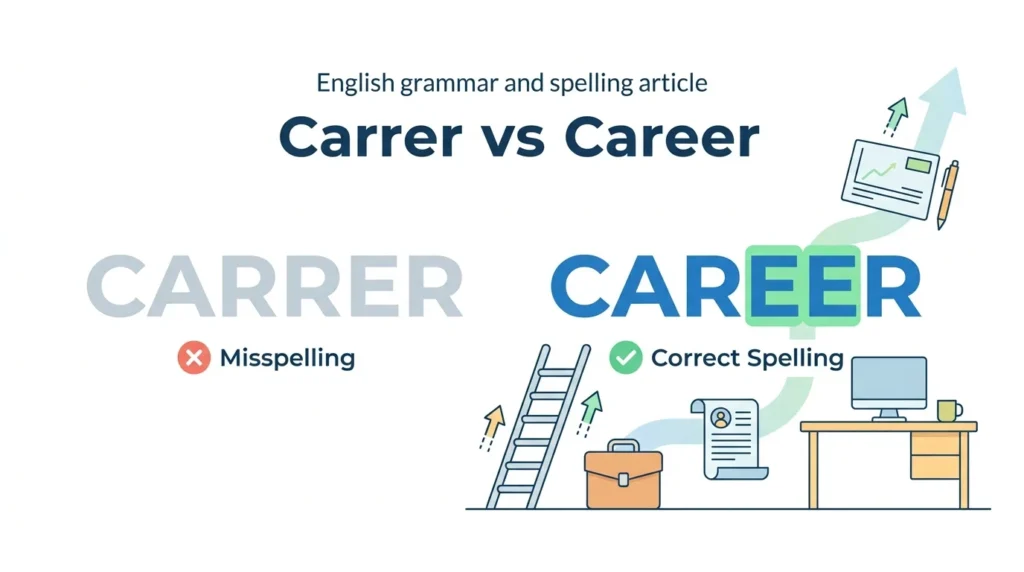

Career is the correct spelling when you mean a profession, occupation, or long-term working life. Carrer is normally a spelling mistake in English. For example, write “She wants a career in medicine,” not “She wants a carrer in medicine.” The spelling career is used in both American and British English, so there is no regional spelling difference to remember.
What Is the Difference Between Carrer and Career?
The difference is simple:
- Career = the correct English word for a profession, occupation, or working life.
- Carrer = usually an incorrect spelling of career in English.
The word career is a noun in its most common use. It can describe someone’s professional journey, a particular occupation, or a field in which someone develops over time.
For example:
She built a successful career in education.
You can also use career as a verb. In that less common use, it means to move very quickly, usually in an uncontrolled way:
The car careered down the hill.
Major English dictionaries recognize these noun and verb uses of career.
Career Has More Than One Meaning
Most people searching carrer vs career are asking about professional work. But career has another legitimate English use.
As a noun:
He had a long career as a journalist.
As a verb:
The truck careered across the road.
The professional meaning is by far the one you are likely to need in a résumé, cover letter, email, school assignment, or conversation about employment.
Why Does the Correct Spelling Matter?
A spelling error may look tiny, but context matters.
If you write carrer in a casual text message, the reader will probably understand what you mean. But spelling becomes more important when you are writing a résumé, job application, cover letter, LinkedIn profile, business email, academic assignment, or professional report.
Consider these:
I am looking for a new career opportunity.
I am looking for a new carrer opportunity.
The second sentence is understandable, but the spelling mistake can make the writer appear less careful.
This does not mean one typo automatically determines someone’s ability or professionalism. It means that when a document is specifically presenting your qualifications, there is little reason to leave an easily corrected spelling error in it.
The Core Rule
RULE: Use career when you mean a profession, occupation, or working life. Spell it C-A-R-E-E-R.
Remember the two e’s:
C-A-R-E-E-R
Not:
C-A-R-R-E-R
The most important visual difference is the middle of the word:
career → E-E
carrer → R-E
If you are writing about someone’s professional life, choose career.
Read More: Halfday vs Half Day: Which Is Correct?
How to Use Career Correctly
Use Career for a Professional Path
Use career when discussing the work a person does over a period of time.
She chose a career in medicine.
He is planning a career in engineering.
Her career in journalism began after university.
Use Career for Professional Development
Career can refer to advancement, opportunities, goals, and progress.
The course could improve your career prospects.
He is thinking carefully about his career goals.
She received useful career advice from her mentor.
Use Career for a Person’s Working Life
A career can include several different jobs.
Someone might work as an assistant, manager, consultant, and director at different times while remaining in the same broad career field.
He spent most of his career in finance.
This is one reason career is not simply a synonym for job. A job is usually a particular position. A career can describe the larger professional journey.
Use Career as a Modifier
Career can also come before another noun:
- career development
- career advice
- career planning
- career goals
- career change
- career opportunities
- career path
- career growth
- career choice
- career prospects
For example:
The university offers excellent career development programs.
Career Can Also Be a Verb
The verb career means to move rapidly and often uncontrollably.
The bicycle careered down the slope.
The vehicle careered into a barrier.
This meaning is different from the professional noun meaning, but the spelling remains career.
Correct Examples
Here are examples of career in different real-world situations.
| Situation | Correct Example |
|---|---|
| Conversation | “What career are you considering after graduation?” |
| “I would appreciate your advice about my career options.” | |
| Résumé | “Career Summary: Marketing specialist with eight years of experience.” |
| Job application | “I am interested in developing my career in finance.” |
| Workplace | “She has made excellent progress in her career.” |
| Interview | “I chose this field because I want to build a long-term career in technology.” |
| School | “The counselor helped students explore different career choices.” |
| Academic writing | “Economic conditions can influence an individual’s career decisions.” |
| Social media | “Starting a new career can be challenging, but it can also be rewarding.” |
| Business writing | “The company provides training to support employees’ career development.” |
| LinkedIn profile | “I am passionate about building a career in digital marketing.” |
| Everyday English | “He changed careers after working in retail for ten years.” |
Incorrect vs. Correct
| ❌ Incorrect | ✅ Correct | Why |
|---|---|---|
| I want a carrer in medicine. | I want a career in medicine. | Career is the correct English spelling for a profession. |
| She has a successful carrer. | She has a successful career. | The professional noun is spelled career. |
| What is your carrer goal? | What is your career goal? | Career goal is the standard expression. |
| He changed his carrer last year. | He changed his career last year. | The word for a professional path is career. |
| My carrer began in teaching. | My career began in teaching. | Career refers to the person’s working life. |
| This course will help your carrer. | This course will help your career. | The correct spelling is career. |
| She is planning her carrer carefully. | She is planning her career carefully. | Career planning is the standard expression. |
| I need better carrer advice. | I need better career advice. | Career advice is the natural phrase. |
| He is happy with his carrer. | He is happy with his career. | The intended word is career. |
| They discussed my future carrer. | They discussed my future career. | Future career is the correct collocation. |
| She wants to advance her carrer. | She wants to advance her career. | Advance one’s career is a normal English expression. |
| His carrer prospects are excellent. | His career prospects are excellent. | The established phrase is career prospects. |
Why Do People Write Carrer Instead of Career?
The mistake is easy to understand once you look at the spelling.
The Two E’s Are Easy to Miss
The word career contains two consecutive e’s:
C-A-R-E-E-R
When people type quickly, one of those letters can disappear:
career → carrer
This is particularly easy when the writer already knows what the word means. The mistake is often a spelling or typing problem rather than a vocabulary problem.
Read More: Scarey vs Scary: Which Spelling Is Correct?
Pronunciation Does Not Clearly Show the Spelling
English spelling and pronunciation do not always match perfectly.
Depending on the English variety, career is pronounced roughly like kuh-REER in American English and kuh-REER / kuh-RI-uh in British English.
The pronunciation does not give you an obvious reason to remember two written e’s.
Similar Words Create Visual Confusion
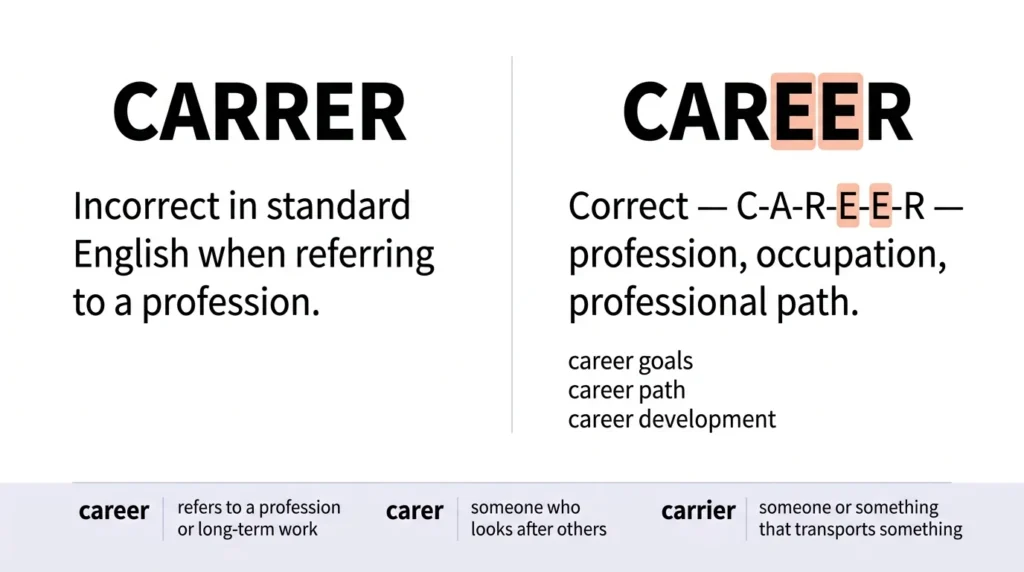
Words such as career, carer, and carrier look related even though they have different meanings.
Compare:
- career — professional life or occupation
- carer — a person who looks after someone
- carrier — something or someone that carries or transports something
The similarity can make a spelling error easier to produce.
Typing and Autocorrect Can Contribute
Fast typing, mobile keyboards, predictive text, and imperfect spell-checking can all allow small mistakes to slip through.
A spell-checker is useful, but it should not replace proofreading.
Translation Interference Can Matter
English learners may encounter similar-looking words in other languages.
For example, carrer is a real word in Catalan, where it means street. That does not make carrer the English word for a profession. In English, the word for that meaning is career.
This is an important distinction because a word can be valid in one language while being incorrect in another.
Common Mistakes Checklist
Mistake 1: Dropping the Second E
Problem: Writing carrer instead of career.
Why it happens: The two e’s occur together and are easy to overlook while typing.
How to avoid it: Remember the spelling as CARE + ER or simply visualize E-E in the middle.
Mistake 2: Writing “Carreer”
Another common spelling is:
❌ carreer
The correct form is:
✅ career
Do not add an extra r or rearrange the vowels.
Mistake 3: Confusing Career With Carrier
These are completely different words.
She wants a career in medicine.
The delivery carrier arrived at noon.
The first concerns professional life. The second relates to carrying or transporting something.
Mistake 4: Confusing Career With Carer
A carer is a person who provides care for someone.
Her sister works as a carer.
A career is a professional path or occupation.
Read More: Laser vs. Lazer: Which Spelling Is Correct?
Mistake 5: Assuming Spell-Check Means Perfect Writing
A spelling checker can identify many errors, but not every possible error.
If a word happens to be recognized as something valid in another language, software may not interpret your intended language correctly.
Proofread important documents manually.
Career in Real English
Career Is Grammatically Correct and Natural
When you mean someone’s profession, working life, or professional development, career is both grammatically correct and completely natural in everyday English. Phrases such as career path, career goals, career change, career advice, and career opportunities are standard expressions. You can use career comfortably in conversation, education, business writing, job applications, and academic contexts.
Carrer Is Not a Natural English Alternative
In ordinary English writing, carrer is not an alternative spelling of career. If you are discussing employment or professional life, writing carrer will normally be understood as a spelling mistake. There is no American-versus-British choice between career and carrer. The standard spelling is career in both varieties of English.
Career Can Be Natural in Several Grammatical Patterns
English commonly uses career with phrases such as have a career, build a career, pursue a career, start a career, change careers, and advance your career. These patterns are useful because learning the word as part of a phrase can make the correct spelling easier to remember than memorizing the six letters by themselves.
Career Is Not the Same as Job
In natural English, job and career overlap but are not identical. A job usually refers to a particular position or paid role. A career can describe the broader professional path that develops across multiple jobs and years. Someone can leave one job without changing careers, while moving from teaching into software engineering could represent a career change.
American vs. British English
There is no genuine spelling difference here.
| English Variety | Correct Spelling |
|---|---|
| American English | career |
| British English | career |
| International English | career |
The pronunciation can differ slightly between American and British English, but the spelling remains career. Cambridge gives separate US and UK pronunciations while retaining the same spelling.
So you do not need to learn a special British version or American version.
Formal vs. Informal Usage
There is no meaningful formal/informal spelling distinction between career and carrer.
Use career in every register:
- Formal reports
- Academic writing
- Résumés
- Cover letters
- Business emails
- Interviews
- Everyday conversation
- Text messages
- Social media
Carrer should not be selected as an informal alternative. If you see it in casual writing, it is generally a spelling error rather than a deliberately informal form.
Read More: Worshipped vs Worshiped: Which Spelling Is Correct?
Comparison Table
| Feature | Career | Carrer |
|---|---|---|
| Standard English spelling | ✅ Yes | ❌ No |
| Meaning: profession | ✅ Yes | ❌ No |
| Meaning: working life | ✅ Yes | ❌ No |
| Used in résumés | ✅ Yes | ❌ No |
| Used in academic writing | ✅ Yes | ❌ No |
| Used in business writing | ✅ Yes | ❌ No |
| Used in everyday English | ✅ Yes | ❌ No |
| British English | career | ❌ |
| American English | career | ❌ |
| Two E’s in the middle | ✅ Yes | ❌ No |
| Common reason for appearance | Correct spelling | Usually a typo |
What About “Carrer” in Other Languages?
This is a useful exception to understand.
Although carrer is not the standard English word for a professional life, it exists in other languages. In Catalan, carrer means street.
That means you might legitimately see carrer on a multilingual website, map, sign, address, or document.
For example, a Catalan phrase may contain carrer because it belongs to Catalan—not because English speakers have an alternative spelling of career.
This distinction is especially useful for ESL learners:
A word can be correctly spelled in one language and still be incorrect in English.
So if your English sentence means profession or working life, use career.
Memory Trick
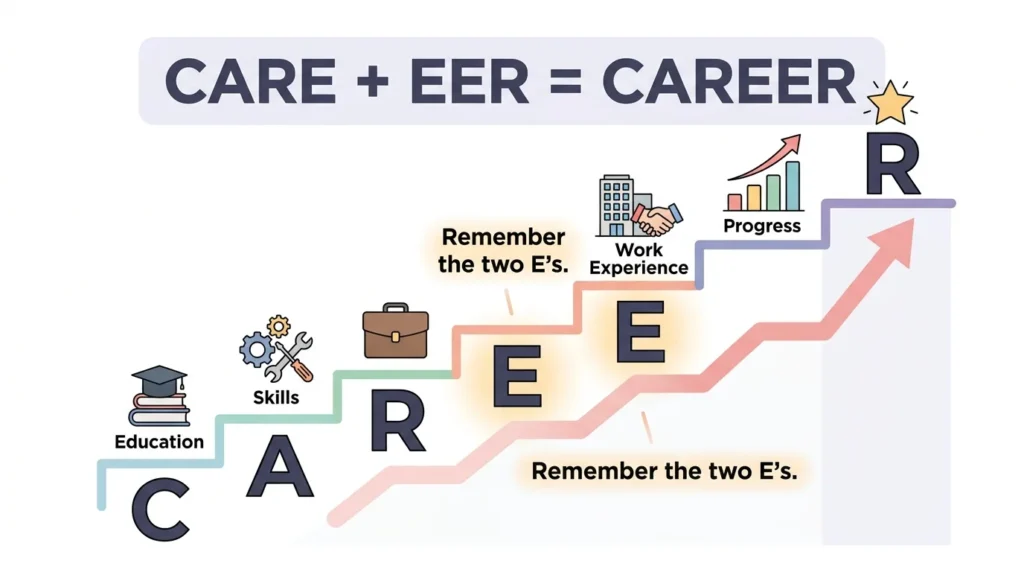
CARE + EER = CAREER
Think:
CARE + EER → CAREER
Then connect the word to its meaning:
CARE about your CAREER.
The important visual reminder is:
CAREER = two E’s
Imagine the two E’s as two steps on a career ladder:
C-A-R-E-E-R
Two E’s → two steps → career growth.
It is not a spelling rule. It is simply a memory device.
Real-Life Situations
1. Job Interview
Interviewer: “Where do you see your career going over the next five years?”
Candidate: “I hope to develop my skills and move into a leadership role.”
Here, career refers to the person’s broader professional development.
2. Email to a Teacher
Dear Professor,
Could you recommend some resources for students considering a career in economics?
Career is correct because the student is discussing a profession.
3. Workplace Meeting
“We should give employees more opportunities for career development.”
Again, career refers to professional growth.
4. Social Media
“Changing careers at 35 can feel risky, but it can also open new opportunities.”
The correct spelling is careers.
5. Academic Writing
“Education can influence an individual’s career choices and long-term employment opportunities.”
The word is career, not carrer.
Mini Quiz
| # | Question | Answer | Explanation |
|---|---|---|---|
| 1 | Choose the correct spelling: carrer / career | career | Career is the standard English spelling. |
| 2 | Fill in the blank: “She wants a ___ in medicine.” | career | A profession or professional path is a career. |
| 3 | Which is correct? “He changed his carrer.” / “He changed his career.” | He changed his career. | The word is spelled C-A-R-E-E-R. |
| 4 | Fill in the blank: “What are your career ___?” | goals | Career goals is a standard expression. |
| 5 | True or false: “Carrer” is the British spelling of “career.” | False | British English also uses career. |
| 6 | Correct this sentence: “She is building a successful carrer.” | She is building a successful career. | Career is the correct spelling. |
| 7 | Which word means a professional working path: career or carrier? | career | Carrier has a different meaning related to carrying or transporting. |
| 8 | Fill in the blank: “He is considering a ___ change.” | career | Career change is the standard phrase. |
| 9 | Is this correct? “My carrer began in 2015.” | No | It should be “My career began in 2015.” |
| 10 | Which spelling has two E’s in the middle? | career | C-A-R-E-E-R contains two consecutive E’s. |
Expert Tips
Learn the Word in Phrases
Instead of memorizing only:
career
learn useful combinations:
- career path
- career goals
- career change
- career advice
- career development
- career opportunities
- career prospects
- successful career
- professional career
- pursue a career
This gives your brain more context and makes spelling errors easier to notice.
Proofread Professional Documents Backward
When proofreading a résumé or cover letter, do not only read for meaning.
Search specifically for:
carrer
Then search for:
carreer
Also check:
carrier
This catches spelling mistakes that ordinary reading can overlook.
Don’t Trust the Sound Alone
English spelling cannot always be predicted from pronunciation.
If you know the word from conversation but rarely write it, memorize the written form separately.
Watch the Middle
If you are unsure, look at the center of the word:
CAR-E-E-R
The two E’s are the key.
Remember the Bigger Distinction
A useful vocabulary comparison is:
Career = professional path
Job = particular position
Carer = person who provides care
Carrier = something or someone that carries
Learning these four together can prevent several different spelling and vocabulary mistakes.
FAQ
Is “carrer” correct in English?
No, not when you mean a profession or working life. The standard English spelling is career. Carrer is normally a misspelling in this context.
How do you spell career correctly?
The spelling is C-A-R-E-E-R. The word contains two consecutive e’s in the middle.
Is “carreer” also wrong?
Yes. Carreer is another common misspelling. The correct form is career.
Is career the same as a job?
Not exactly. A job usually means a particular position or role, while a career can describe the broader professional path a person follows over time.
Can career be used as a verb?
Yes. As a verb, career means to move very quickly, usually in an uncontrolled manner. For example: “The car careered down the road.
Does “career” have the same spelling in American and British English?
Yes. Both American and British English spell it career. The pronunciation can differ slightly, but the spelling does not.
Is “carrer” a word in another language?
Yes. Carrer is used in Catalan with the meaning street. That does not make it an English alternative to career.
Why do people spell career as carrer?
The most straightforward explanation is that the second e is easy to omit when typing quickly. Visual similarity with other words and second-language spelling patterns can also contribute.
Should I use career on my résumé?
Yes. If you mean your professional path, use career. For example: “Career Summary,” “Career Objective,” or “Career Development.”
What is the difference between career and carrier?
Career refers to professional life or, as a verb, rapid uncontrolled movement. Carrier refers to someone or something that carries, transports, or transmits something.
What is the difference between career and carer?
A career is a profession or professional path. A carer is a person who looks after someone who needs care.
What is the easiest way to remember career?
Remember CARE + EER = CAREER. Most importantly, visualize the two E’s in the middle: C-A-R-E-E-R.
Quick Summary
When comparing carrer vs career, the correct English spelling for a profession, occupation, or person’s working life is career. It is spelled C-A-R-E-E-R, with two E’s in the middle. Carrer is normally a spelling mistake in English and should not be used in résumés, applications, academic work, business communication, or everyday English when you mean a professional path. Career is used in both American and British English, so there is no regional spelling difference. The word can also function as a verb meaning to move rapidly and uncontrollably. A simple way to remember the spelling is CARE + EER = CAREER. When in doubt, look for the two E’s.