
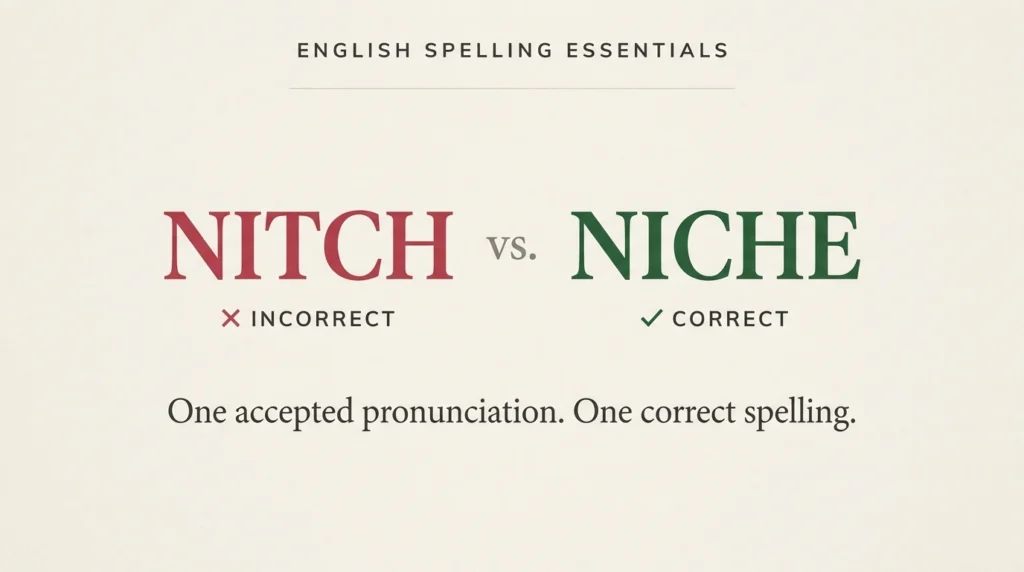

Niche is the correct spelling, while nitch is a nonstandard spelling. However, “nitch” is also an accepted way to pronounce the word niche. The word refers to a specialized area, a suitable role, a particular market, or a recessed space in a wall. Whether you pronounce it “nitch” or “neesh,” always write it as niche in emails, essays, business documents, websites, and professional communication.
What Is the Difference Between Nitch and Niche?
The difference between nitch and niche is primarily a spelling distinction, not a difference in meaning.
Niche is the standard English spelling of the word. It can describe a specialized market, an individual’s suitable position, an ecological role, or a small recessed space in a wall.
Nitch is often written by people who pronounce niche as “nitch.” However, that pronunciation does not make the spelling nitch correct.
The core rule
Always write NICHE.
You can pronounce it “nitch” or “neesh,” but the standard spelling remains niche.
| Word | Status | Explanation |
|---|---|---|
| Niche | Correct | Standard spelling in English |
| Nitch | Incorrect as a standard spelling | Nonstandard spelling based on pronunciation |
| Nitch | Acceptable pronunciation | A recognized way of saying niche |
This is why the confusion exists: the pronunciation “nitch” is correct, but writing nitch instead of niche is not correct in standard English.
What Does Niche Mean?
Niche is a noun that describes a specialized place, position, function, role, or area that suits someone or something particularly well.
Its meaning depends on the context in which it is used.
Niche in Business and Marketing
In business, a niche is a specific segment of the market that a company, brand, or individual focuses on serving.
Instead of trying to sell products to everybody, a business may target a smaller group of customers with particular needs, interests, preferences, or buying habits.
For example:
- A clothing brand that sells modest fashion for working women.
- A website that publishes guides about indoor plants.
- A coffee business specializing in organic coffee beans.
- A marketing agency serving local restaurants.
- A shop selling shoes designed specifically for hikers.
These businesses operate within particular niches because they focus on specific customers or needs.
Example:
The company found a profitable niche by selling affordable skincare products for teenagers.
Here, niche refers to a specialized section of the market that the company serves.
Niche as a Suitable Role or Position
The word can also describe a place where someone feels comfortable, successful, or naturally suited to their abilities.
Examples:
- She found her niche in digital marketing.
- He has finally found his niche as a documentary filmmaker.
- Teaching young children became her niche.
- The designer found a niche in luxury interior decoration.
In these sentences, niche refers to a role, career, activity, or environment in which someone fits particularly well.
Niche in Ecology
In ecology, a niche refers to the role an organism plays within its environment, including how it obtains food, interacts with other organisms, and survives under particular environmental conditions.
For example, bees occupy an important ecological niche because they help pollinate flowering plants.
An animal’s niche is not simply the place where it lives. It also includes its function and relationships within the ecosystem.
Niche as a Recess in a Wall
Niche can also refer to a small recessed space in a wall, often designed to hold a statue, decorative object, candle, or other item.
Example:
The architect created a small niche in the wall for the antique vase.
This meaning is commonly used in architecture, interior design, and home decoration.
Read More: Coma vs Comma: The Spelling Mistake That Changes Everything!
Why Does the Nitch vs Niche Confusion Matter?
The confusion usually occurs because people trust the way a word sounds when deciding how to spell it.
When someone hears niche pronounced “nitch,” the spelling nitch may seem logical. English spelling, however, does not always follow pronunciation.
Writing nitch in a professional document, website, academic assignment, business proposal, or email may make the writer appear careless, particularly when the intended word is niche.
This can matter in situations such as:
- SEO and blogging: Writing “find your nitch” in an article about marketing or blogging.
- Business communication: Using the incorrect spelling in a business plan or presentation.
- Academic writing: Misspelling the word in an essay, research paper, or assignment.
- Social media: Publishing a caption or professional post containing the incorrect spelling.
- Website content: Using nitch in page titles, headings, product descriptions, or website copy.
The good news is that the mistake is easy to prevent once you understand that pronunciation and spelling are two different things.
The Core Rule: Pronunciation Does Not Change the Spelling
The simplest rule is:
The word is always spelled niche, regardless of whether you pronounce it “nitch” or “neesh.”
English contains many words whose spellings do not perfectly match the way they sound. The same principle applies here.
You may hear a person pronounce niche differently from you. That does not mean either speaker needs to change the spelling of the word.
| Situation | Correct form |
|---|---|
| Writing about a specialized market | Niche market |
| Writing about someone’s suitable career | Find your niche |
| Writing about a specialized website topic | Blogging niche |
| Pronouncing the word like “ditch” | Niche |
| Pronouncing the word like “sheesh” | Niche |
The spelling stays the same in every situation.

How to Use Niche Correctly
Niche is used in different contexts, but the spelling does not change. Learning its common applications can help you use it naturally and confidently.
1. Use Niche for a Specialized Market
A niche market is a specific group of customers with a particular interest, problem, or need.
Examples:
- The company targets a niche market.
- We are looking for a niche with less competition.
- Handmade leather bags have become her business niche.
- The brand focuses on a niche market of environmentally conscious consumers.
2. Use Niche for a Specialized Topic
When discussing websites, blogs, YouTube channels, or content creation, a niche refers to the specific subject area on which you focus.
Examples:
- Indoor plants is a promising niche for blogging.
- He started a YouTube channel in the history niche.
- Choosing a profitable niche is an important step in building an online business.
- The website focuses on coffee knowledge and brewing techniques.
3. Use Niche for Someone’s Strength or Career
The word can describe an area where a person performs well or feels naturally suited.
Examples:
- She found her niche in graphic design.
- His niche is writing emotional documentary scripts.
- Public speaking became his niche after years of practice.
- He has a natural niche for teaching complex subjects simply.
4. Use Niche in Science and Nature
In scientific writing, particularly ecology, niche refers to an organism’s role within its environment.
Examples:
- Every species occupies a particular ecological niche.
- The birds compete for similar niches.
- Changes in the environment can affect an organism’s niche.
- The species has adapted to a narrow ecological niche.
5. Use Niche in Architecture and Interior Design
The word can describe a recessed space built into a wall.
Examples:
- The bathroom features a niche for storing shampoo.
- The artist placed a sculpture inside a wall niche.
- The architect designed a decorative niche above the fireplace.
- The recessed niche provides space for displaying ornaments.
Correct Examples of Niche in Everyday English
The following examples show how niche is correctly used in everyday conversations, business, education, marketing, and professional writing.
| Situation | Example sentence |
|---|---|
| Conversation | I think I have finally found my niche. |
| We are exploring a niche market for our new product. | |
| School assignment | Each species has a unique ecological niche. |
| Workplace | Her niche in the company is customer relationship management. |
| Social media | Finding your niche is the first step toward building a loyal audience. |
| Blogging | I want to start a blog in the indoor plants niche. |
| Marketing | The brand specializes in a niche audience. |
| Business plan | Our niche is affordable premium footwear. |
| Academic writing | This research examines the role of organisms within their ecological niche. |
| Interior design | The decorative niche provides a perfect place for the sculpture. |
| YouTube | He created a channel in the history niche. |
| Career development | She discovered her niche in creative writing. |
All these sentences use the correct spelling, niche, even though the word can be pronounced in two different ways.
Nitch vs Niche: Incorrect vs Correct Examples
The following mistakes commonly occur when writers spell the word according to its pronunciation. In standard English writing, replace nitch with niche.
| ❌ Incorrect | ✅ Correct | Why |
|---|---|---|
| I found my nitch in marketing. | I found my niche in marketing. | Niche describes a suitable professional area or role. |
| We need to identify a profitable nitch. | We need to identify a profitable niche. | A specialized business market is called a niche. |
| She created a blog in the gardening nitch. | She created a blog in the gardening niche. | The standard spelling is niche. |
| This product serves a small nitch market. | This product serves a small niche market. | Niche market is the correct spelling of the expression. |
| He has a nitch for storytelling. | He has a niche for storytelling. | The word should not be respelled to match its pronunciation. |
| Their company entered a new nitch. | Their company entered a new niche. | A specialized area of business is a niche. |
| I want to find my own nitch on YouTube. | I want to find my own niche on YouTube. | The word is spelled niche when describing a channel’s topic. |
| The brand focuses on a profitable nitch. | The brand focuses on a profitable niche. | A focused market segment is a niche. |
| She built her business around a beauty nitch. | She built her business around a beauty niche. | Niche is the standard spelling in business writing. |
| This website covers a very specific nitch. | This website covers a very specific niche. | A specialized topic or subject area is a niche. |
The mistake in all these examples is the spelling. The intended meaning is clear, but nitch should be replaced with niche in standard writing.
Why People Make the Nitch Spelling Mistake
There are several reasons people write nitch instead of niche.
1. Phonetic Spelling
Phonetic spelling means writing a word according to the sounds you hear.
When people pronounce niche as “nitch,” they may naturally assume that the word should be spelled with a t.
English does not always work this way. A word’s pronunciation does not necessarily tell you its exact spelling.
2. The Pronunciation Is Accepted
This is the most important reason for the confusion.
“Nitch” is a legitimate pronunciation of niche. Because people hear the pronunciation regularly, some assume that nitch is also a legitimate written form.
However, an accepted pronunciation and an accepted spelling are not the same thing.
3. English Spelling Can Be Unpredictable
English contains words that are pronounced differently from what learners might expect based on their spelling.
The spelling of niche is one of those cases where a learner may feel tempted to simplify or change the letters to match the spoken form.
The correct approach is to remember the established spelling rather than invent a phonetic alternative.
4. Spellcheck Does Not Replace Language Knowledge
Spellcheck and autocorrect can help identify spelling mistakes, but they are not a substitute for understanding a word.
A writer may overlook an error, ignore a correction, or use a tool that does not identify the intended word correctly in a particular context.
Knowing that niche is the correct spelling makes the mistake easier to catch.
5. Translation and Language Learning
English learners sometimes transfer spelling patterns from their first language into English.
If a sound is commonly represented by a particular letter combination in their native language, they may use the same logic when spelling English words.
This can lead to writing nitch instead of niche, even when the writer knows the word’s meaning.
Common Mistakes Checklist
Check your writing before publishing
- Did I write nitch instead of niche?
- Am I confusing pronunciation with spelling?
- Did I use nitch in a website heading or SEO title?
- Did I miss the word in a business document?
- Did I assume that the pronunciation “nitch” requires the spelling nitch?
- Did I check the word in my blog, email, assignment, or social media post?
Mistake 1: Treating Nitch as an Alternative Spelling
What happens: Writers believe nitch and niche are two interchangeable spellings.
Why it happens: The pronunciation “nitch” is accepted, so the written form seems reasonable.
How to avoid it: Memorize niche as the only standard spelling.
Mistake 2: Correcting Someone’s Pronunciation Unnecessarily
What happens: Someone hears “nitch” and assumes the speaker is wrong.
Why it happens: They may be familiar with only the “neesh” pronunciation.
How to avoid it: Recognize both pronunciations as acceptable. The difference in pronunciation is not automatically a grammar or spelling error.
Mistake 3: Using the Wrong Spelling in SEO Content
What happens: A blogger uses nitch in an article, heading, or website title.
Why it happens: The word is typed according to how it sounds.
How to avoid it: Use niche in titles, headings, URLs, articles, business content, and website copy.
Mistake 4: Thinking Niche Is Only a Business Term
What happens: A writer uses niche only when discussing markets or marketing.
Why it happens: The term is frequently used in digital marketing and online business.
How to avoid it: Remember that niche can also refer to a suitable career, an ecological role, or a recessed space in a wall.
Mistake 5: Changing the Spelling to Match the Audience
What happens: A writer uses nitch in American English but niche in British English.
Why it happens: They assume regional pronunciation differences require different spelling.
How to avoid it: Keep the spelling niche in both American and British English.
Nitch vs Niche in Real English
The most useful distinction is between how a word is pronounced and how it is written. In everyday conversation, speakers may pronounce niche as “nitch” or “neesh.” Neither pronunciation is inherently wrong. The written form, however, remains niche. Someone may say “nitch market” in a meeting and write “niche market” in the presentation. This is perfectly normal because spoken and written English do not always follow the same sound patterns.
Read More: Payed vs Paid: Which Spelling Is Correct?
Grammatically Correct
The following sentences are grammatically correct and natural:
- I found my niche in marketing.
- This company serves a niche market.
- She has carved out a niche for herself in the fashion industry.
- The website focuses on a niche topic.
- He is looking for his niche in the business world.
These examples use the standard spelling and the word in an appropriate context.
Grammatically Possible but Incorrect in Standard Spelling
The following sentences are understandable, but the spelling is nonstandard:
- I found my nitch in marketing.
- This company serves a nitch market.
- She has carved out a nitch for herself.
- The website focuses on a nitch topic.
The reader can understand what the writer means. However, the spelling should be corrected to niche in standard English.
Natural Everyday English
In natural everyday English, people use niche when talking about specialization, business, career choices, interests, and particular areas of expertise.
For example:
- “That’s a really interesting niche.”
- “I think you have found your niche.”
- “We’re trying to find a niche in the market.”
- “This channel is focused on a very specific niche.”
These expressions are common and natural. You do not need to avoid the word because it sounds formal or business-oriented. It works perfectly well in everyday conversations.
American vs. British English
The spelling niche is the same in American and British English.
The main difference is pronunciation preference, not spelling.
| Feature | American English | British English |
|---|---|---|
| Standard spelling | Niche | Niche |
| Pronunciation | “Nitch” and “neesh” | “Neesh” and “nitch” |
| Meaning | Specialized area, role, or market | Specialized area, role, or market |
| Alternative spelling nitch | Nonstandard | Nonstandard |
| Spelling in formal writing | Niche | Niche |
American speakers commonly use the “nitch” pronunciation. British speakers commonly use “neesh,” although both pronunciations are heard in English-speaking regions.
Regardless of the accent, the spelling remains niche.
Formal vs. Informal Usage
Niche is suitable for both formal and informal communication. It is not a slang word, and it does not need to be avoided in professional writing.
| Context | Example | Suitability |
|---|---|---|
| Casual conversation | I think travel blogging is my niche. | Natural |
| Text message | Found my niche at last! | Natural |
| Business meeting | We need to identify our target niche. | Professional |
| Marketing strategy | Our brand serves a niche market. | Professional |
| Academic writing | The species occupies a specialized ecological niche. | Formal |
| Resume or portfolio | Specialized niche expertise in digital marketing. | Professional |
The only form you should avoid in standard writing is nitch as a spelling.
Nitch vs Niche: Comparison Table
| Feature | Nitch | Niche |
|---|---|---|
| Standard spelling | No | Yes |
| Accepted pronunciation | Yes, as a pronunciation of niche | Yes |
| Correct written form | No | Yes |
| Meaning | Intended meaning is usually niche | Specialized area, role, market, or recess |
| Business usage | Incorrect spelling | Correct spelling |
| Marketing usage | Incorrect spelling | Correct spelling |
| Academic usage | Incorrect spelling | Correct spelling |
| SEO content | Avoid | Use |
| American English | Pronunciation accepted; spelling nonstandard | Standard spelling |
| British English | Pronunciation accepted; spelling nonstandard | Standard spelling |
Memory Trick: Niche Has an SH or CH Sound, but No T
Say it your way. Spell it N-I-C-H-E.
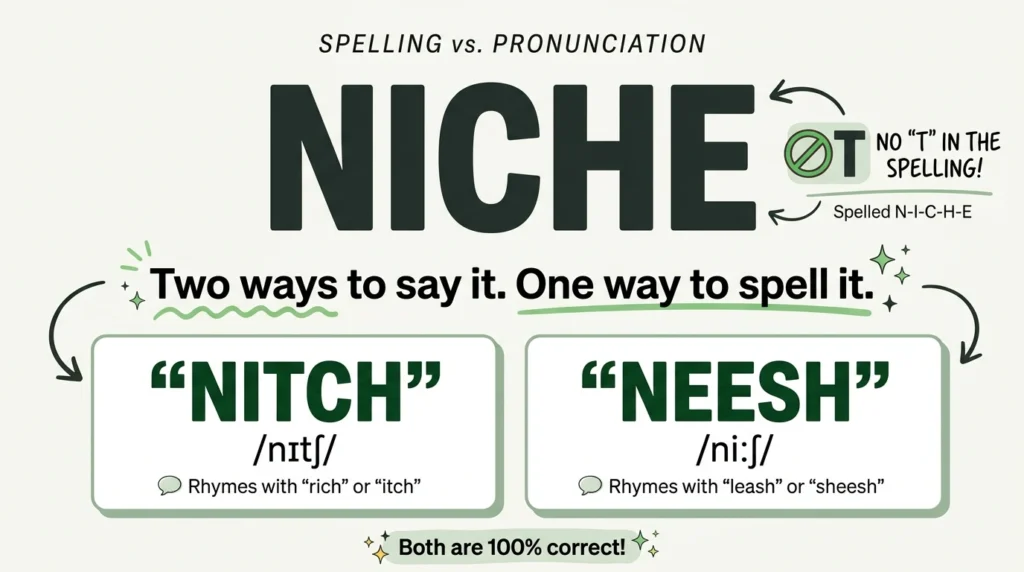
You can say “nitch” or “neesh,” but never insert a T into the spelling.
Remember this simple sentence:
“My niche may sound like nitch, but it never gets a T.”
The trick works because it separates the sound you hear from the letters you write.
Whenever you are unsure, remember that niche has five letters: N-I-C-H-E. The word nitch is missing the correct spelling pattern and introduces a T that does not belong.
Nitch vs Niche in Real-Life Situations
Understanding the rule is easier when you see how it applies in everyday life.
Situation 1: A Business Meeting
Your manager asks the team to identify a specific market segment.
Incorrect:
“We should find a profitable nitch before launching the product.”
Correct:
“We should find a profitable niche before launching the product.”
The correct spelling should be used in presentations, meeting notes, proposals, and business reports.
Read more: Straight vs. Strait: Meaning, Difference & Examples Explained.
Situation 2: A Job Interview
You are asked what type of work you enjoy most.
Incorrect:
“I believe I have found my nitch in content strategy.”
Correct:
“I believe I have found my niche in content strategy.”
Here, niche refers to a role or area of work in which you are particularly suited.
Situation 3: A Blog or Website
You are creating a website about indoor plants.
Incorrect:
“I want to build a website in the indoor plants nitch.”
Correct:
“I want to build a website in the indoor plants niche.”
This is especially important in published content, where spelling errors can reduce the quality and credibility of the page.
Situation 4: A Text Message
You are messaging a friend who has started a photography business.
Incorrect:
“You should focus on a wedding photography nitch.”
Correct:
“You should focus on a wedding photography niche.”
Even informal messages should use the correct spelling when you want to write standard English.
Situation 5: An Academic Assignment
You are writing about animals and their environments.
Incorrect:
“Each organism occupies a unique nitch in its ecosystem.”
Correct:
“Each organism occupies a unique niche in its ecosystem.”
In academic writing, the standard spelling is particularly important because readers expect careful language and precise terminology.
Expert Tips to Remember Niche
Knowing the spelling is one thing; using the word confidently is another. These tips will help you avoid confusion.
- Remember the spelling, not just the sound. The word is niche, even when you pronounce it “nitch.”
- Do not correct accepted pronunciations. Both “nitch” and “neesh” are acceptable pronunciations.
- Use niche market correctly. This is one of the most common expressions in business, marketing, and entrepreneurship.
- Use niche to describe specialization. It works for careers, websites, hobbies, products, services, and markets.
- Be consistent in writing. Always use niche in your website content, professional communication, academic writing, and marketing materials.
- Do not add a T because you hear one. Pronunciation is not always a reliable spelling guide in English.
- Proofread your headings. Words in titles, H1s, page names, and URLs are particularly important because spelling mistakes are highly visible.
Quick Summary
Niche is the correct standard spelling, while nitch is a nonstandard spelling. However, “nitch” is an accepted pronunciation of the word niche. You can also pronounce it “neesh.” Both pronunciations are acceptable, and neither changes the spelling. A niche is a specialized market, role, area of interest, ecological function, or recessed space in a wall. The word is widely used in business, marketing, blogging, careers, science, and everyday conversation. Whether you use American or British English, always write niche. Remember: you can say “nitch,” but you should always write “niche.”
FAQ: Nitch vs Niche
1. Is nitch or niche correct?
Niche is the correct standard spelling. Nitch is a nonstandard spelling, although “nitch” is an accepted pronunciation of niche.
2. Is nitch a real word?
Nitch is commonly encountered as a pronunciation of niche, but it is not the standard spelling when referring to a specialized market, role, or area. Use niche in standard written English.
3. Is niche pronounced nitch or neesh?
Both pronunciations are accepted. “Nitch” rhymes with ditch, while “neesh” rhymes with sheesh. The pronunciation varies among speakers and regions.
4. Why do people spell niche as nitch?
People often spell words according to the way they hear them. Because niche can be pronounced “nitch,” some writers assume the spelling should include a T. However, the standard spelling remains niche.
5. Is nitch wrong in American English?
Yes, nitch is nonstandard as a written spelling in American English, even though the pronunciation “nitch” is accepted and common. Standard American writing uses niche.
6. Is niche a business or marketing word?
Niche is frequently used in business and marketing to describe a specialized market, a focused customer group, or a particular area of expertise. However, it is not limited to business. It is also used in science, careers, hobbies, architecture, and everyday language.
7. What does niche market mean?
A niche market is a specialized segment of a larger market that serves customers with particular needs, interests, preferences, or characteristics. For example, a business selling organic skincare products specifically for sensitive skin may target a niche market.
8. What does find your niche mean?
“Find your niche” means discovering an area, role, activity, or career that suits your interests, abilities, personality, or expertise particularly well.
For example, a person who enjoys research and storytelling may find their niche in documentary writing.
9. Is niche formal or informal?
Niche is suitable for both formal and informal English. You can use it in casual conversations, text messages, business proposals, academic writing, marketing content, and professional presentations.
10. Does niche have a different spelling in British English?
No. Niche is the standard spelling in both British and American English. Pronunciation preferences may vary, but the written form does not change.
Nitch vs Niche Quiz
Test your understanding of the correct spelling, meaning, and pronunciation of niche.
| # | Question | Answer | Explanation |
|---|---|---|---|
| 1 | Multiple choice: Which is the correct spelling? A) Nitch B) Niche C) Neesh | B) Niche | Niche is the standard written spelling. |
| 2 | Fill in the blank: She found her ___ in digital marketing. | Niche | The word refers to an area of work particularly suited to her. |
| 3 | Correct the sentence: We need to find a profitable nitch. | We need to find a profitable niche. | Niche is the correct spelling in business English. |
| 4 | Multiple choice: Which pronunciation is accepted? A) Nitch B) Neesh C) Both | C) Both | Both “nitch” and “neesh” are accepted pronunciations. |
| 5 | Fill in the blank: The company serves a small ___ market. | Niche | A niche market is a specialized segment of a larger market. |
| 6 | Correct the sentence: He has finally found his nitch in life. | He has finally found his niche in life. | Niche refers to a suitable role or position. |
| 7 | Multiple choice: Does British English use a different spelling? A) Yes, nitch B) Yes, neesh C) No, niche | C) No, niche | The standard spelling is the same in British and American English. |
| 8 | Fill in the blank: Bees occupy an important ecological ___. | Niche | In ecology, a niche describes an organism’s role in its environment. |
| 9 | Correct the sentence: This blog targets a specific nitch. | This blog targets a specific niche. | A specialized subject or topic area is a niche. |
| 10 | Multiple choice: What is the easiest way to remember the spelling? A) Add a T when saying nitch B) Always write niche C) Spell it differently in British English | B) Always write niche | Pronunciation may change, but the standard spelling remains the same. |