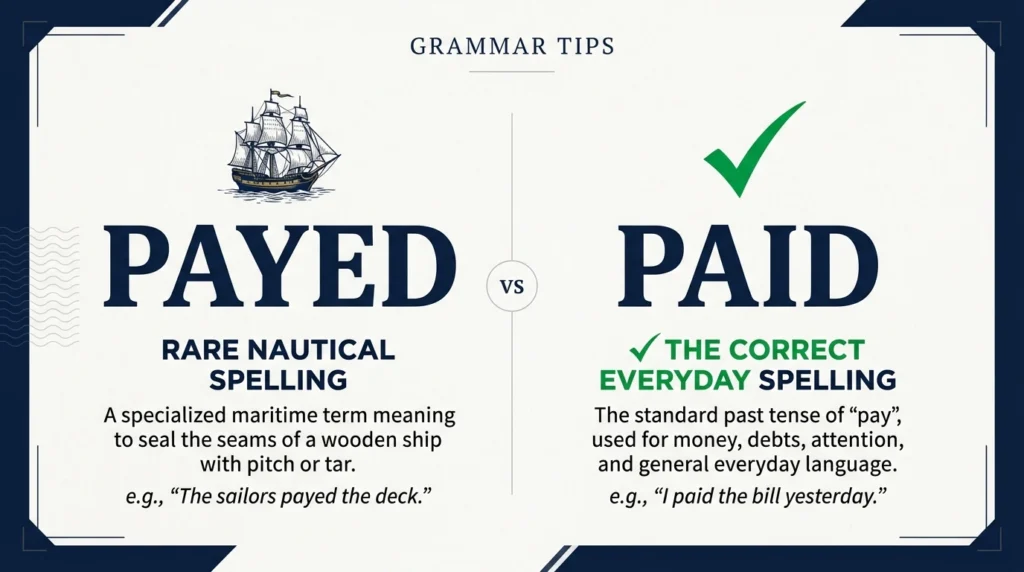

The correct spelling in almost all everyday situations is paid. It is the past tense and past participle of pay, meaning to give money for something, settle a bill, or compensate someone for work. Payed is a real but very uncommon word used mainly in specialized nautical contexts, such as sealing a ship’s seams with tar or pitch. If you are talking about money, wages, bills, or purchases, always use paid.
The difference between paid and payed depends on the meaning of the verb pay.
- Paid: The standard past tense and past participle of pay. It covers financial transactions, wages, bills, debts, attention, respect, and many other expressions.
- Payed: A rare form used in specialized nautical language, particularly when describing the release of a rope or cable or the application of a protective coating to a ship.
The important point is that paid is not limited to situations involving money. English also uses it in expressions such as paid attention, paid respect, and paid a visit.
Why Is Paid the Standard Spelling?
The verb pay is an irregular verb. An irregular verb does not always follow the usual pattern of adding -ed to form its past tense.
For example:
- Walk → walked
- Talk → talked
- Work → worked
- Pay → paid
- Say → said
- Lay → laid
Although payed might look like a logical spelling, it is not the standard past tense of pay when referring to ordinary payments.
Consider these sentences:
- I pay my bills every month.
- I paid my bills yesterday.
- I have paid all my outstanding bills.
The verb changes from pay to paid, whether you are describing something that happened in the past or something that has already been completed.
Why Does the Difference Between Payed and Paid Matter?
Spelling mistakes can change how professional and reliable your writing appears.
This distinction matters in several everyday situations:
1. Business communication
If you write to a supplier, customer, or business partner, the correct spelling helps maintain professional communication.
Incorrect: We have payed your invoice.
Correct: We have paid your invoice.
2. Employment and salaries
Employees, employers, and HR professionals frequently use the word paid when discussing wages and compensation.
Incorrect: All employees were payed last Friday.
Correct: All employees were paid last Friday.
3. Academic writing
Students should use the correct irregular verb form in essays, assignments, and examinations.
Incorrect: The government payed for the construction project.
Correct: The government paid for the construction project.
4. Everyday communication
Even in text messages and social media posts, paid remains the correct spelling when discussing money or other ordinary meanings of pay.
Read More: Straight vs. Strait: Meaning, Difference & Examples Explained.
The Core Rule: When Should You Use Paid or Payed?
Standard English
Use PAID for ordinary meanings of pay, including money, salaries, bills, debts, attention, respect, and compensation.
Example: I have paid the registration fee.
Specialized nautical English
Use PAYED for certain specialized maritime meanings, such as letting out a rope or applying protective material to a ship.
Example: The sailors payed out the anchor cable.
Easy rule: If you are writing about an ordinary payment, choose paid. You will almost always need this spelling.
How to Use Paid and Payed Correctly
1. Use Paid When Talking About Money
This is the most common use of the word.
Use paid when someone gives money in exchange for a product, service, or obligation.
Examples:
- She paid $100 for the new laptop.
- I paid the electricity bill yesterday.
- They paid the restaurant before leaving.
- We have already paid the school fees.
- The customer paid the full amount.
2. Use Paid When Talking About Salaries and Wages
When discussing employment, compensation, or earnings, use paid.
Examples:
- The company paid its employees on time.
- He gets paid every two weeks.
- The workers were paid for their overtime.
- She has never been paid fairly for her work.
3. Use Paid in Expressions That Do Not Directly Involve Money
One common misunderstanding is that paid should only be used when money changes hands.
That is incorrect.
English uses pay in several established expressions where the word refers to giving attention, showing respect, or performing an action.
Examples:
- Paid attention: She paid attention during the lecture.
- Paid respect: The community paid respect to the victims.
- Paid a visit: We paid a visit to our former teacher.
- Paid a compliment: He paid her a genuine compliment.
- Paid the price: They paid the price for their poor decisions.
All these expressions require paid, not payed.
4. Use Paid as an Adjective
Paid can also describe something connected with receiving money or something that has already been settled.
Examples:
- She accepted a paid internship.
- The company offers paid leave.
- He is looking for a paid position.
- The invoice is fully paid.
- They attended a paid training programme.
Here, paid describes a noun or the condition of something.
5. Use Payed in Specialized Nautical Contexts
Payed is a legitimate English word, but its use is highly specialized.
In nautical terminology, it can describe:
- Letting out or slackening a rope, cable, or chain.
- Applying tar, pitch, or another protective substance to a ship’s seams or surfaces.
Examples:
- The sailors payed out the anchor cable.
- The crew payed the wooden seams with protective pitch.
These meanings are uncommon in everyday communication. Unless you are writing about sailing, ships, or maritime operations, you probably will not need this spelling.
6. Understand the Difference Between Paid Out and Payed Out
This is one of the more interesting exceptions.
When describing the release of a rope or cable, payed out is a specialized nautical form. However, paid out is also used and accepted in this context.
For example:
- The sailor paid out the rope slowly.
- The sailor payed out the rope slowly.
Both forms occur in nautical usage. The spelling can depend on the technical convention being followed.
For ordinary financial meanings, however, paid out is the standard form.
Examples:
- The insurance company paid out the compensation.
- The business paid out its annual dividends.
- The organization paid out financial assistance.
Do not use payed out for ordinary financial distributions.

Correct Examples of Paid and Payed in Sentences
The following examples show how the two spellings work in different situations.
Everyday Conversation
- I paid for our lunch yesterday.
- Have you paid the electricity bill yet?
- She paid me back the money I lent her.
- We paid extra for the faster delivery.
Business and Workplace
- The company paid all its employees before the holiday.
- Our client has paid the outstanding invoice.
- The manager paid the supplier in advance.
- Every temporary worker was paid according to the agreed rate.
Education and Academic Writing
- The university paid for the research equipment.
- The students paid attention to the professor’s explanation.
- The government paid for the new educational programme.
- The researcher paid a considerable price for conducting the experiment.
Email and Professional Communication
- I have paid the requested amount.
- Please confirm that the invoice has been paid.
- The payment was made, and the supplier was paid in full.
Social Media and Informal Writing
- Finally paid off my student loan!
- Hard work paid off after months of preparation.
- I paid for my first car with my savings.
Specialized Maritime Writing
- The sailors payed out additional rope as the vessel moved forward.
- The shipbuilders payed the seams with tar to prevent water from entering.
These final two examples demonstrate the specialized use of payed.
Incorrect vs. Correct: Payed or Paid?
The following table covers common mistakes and explains why the correct spelling is necessary.
| ❌ Incorrect | ✅ Correct | Why |
|---|---|---|
| I payed the bill yesterday. | I paid the bill yesterday. | The financial past tense is paid. |
| She has payed the rent. | She has paid the rent. | Paid is the past participle. |
| He payed me yesterday. | He paid me yesterday. | Money given to someone requires paid. |
| We payed for dinner. | We paid for dinner. | Ordinary purchases use paid. |
| They payed their employees. | They paid their employees. | Wages and salaries use paid. |
| Have you payed the fees? | Have you paid the fees? | The present perfect requires the past participle paid. |
| I payed attention in class. | I paid attention in class. | The established expression is paid attention. |
| She payed him a compliment. | She paid him a compliment. | This expression always uses paid. |
| The company payed out compensation. | The company paid out compensation. | Financial distributions use paid out. |
| All the debts have been payed. | All the debts have been paid. | The passive construction requires paid. |
| His hard work payed off. | His hard work paid off. | The expression is paid off. |
| We payed our respects. | We paid our respects. | The established expression is paid respects. |
Important exception: The sentence “The sailors payed out the rope” can be correct in specialized nautical usage. It is not an alternative spelling for ordinary financial payments.
Why People Make the Payed vs Paid Mistake
There are several reasons English learners and even experienced writers confuse these two spellings.
1. The Regular Past-Tense Pattern
Most English verbs form their past tense by adding -ed.
For example:
- Walk → walked
- Clean → cleaned
- Open → opened
- Work → worked
Because pay ends in a consonant sound followed by y, writers may assume that adding -ed produces payed.
However, pay is irregular in its ordinary meanings. Its standard past tense is paid.
2. The Spelling Looks Logical
The spelling payed looks reasonable because it follows a familiar English pattern.
Compare:
- Play → played
- Stay → stayed
- Pay → paid
The first two verbs are regular in their past-tense forms. Pay is different.
This is why copying the spelling pattern of play or stay can lead to an error.
3. The Words Sound the Same
In standard English pronunciation, paid and payed are pronounced alike: /peɪd/.
They are homophones in the usual pronunciation of these words. Homophones are words that sound the same but have different spellings or meanings.
Because pronunciation cannot help writers distinguish them, remembering the correct grammatical form is important.
Read More: Mobil vs Mobile: Which Spelling Is Correct?
4. Spellcheck Does Not Always Understand Context
A spelling checker may recognize payed as a legitimate word because it exists in specialized English.
However, recognizing a word does not mean it is appropriate in every sentence.
For example:
- I payed the invoice. — Incorrect.
- The sailors payed out the cable. — Correct in specialized nautical usage.
Always check whether the word fits the meaning of your sentence.
5. Translation Interference
Some English learners translate sentences directly from their first language.
If their language uses one regular past-tense pattern for most verbs, they may naturally apply that pattern to pay.
The solution is to learn common irregular verbs as complete forms rather than assuming every verb follows the same rule.

Common Mistakes Checklist
Use this checklist to identify and prevent the most frequent errors.
- Writing payed for a purchase: Use paid because buying something is an ordinary financial transaction.
- Writing payed for salaries: Use paid when discussing wages, compensation, or employment.
- Writing payed attention: The established expression is paid attention.
- Writing payed off: Use paid off when describing a debt being settled or an effort producing a positive result.
- Writing payed in the present perfect: Use have paid, not have payed, for ordinary meanings.
- Assuming payed is always meaningless: It is a legitimate word in specialized nautical contexts.
- Trusting pronunciation alone: Both forms are pronounced the same, so pronunciation cannot determine the spelling.
- Confusing paid with paying: Paid describes a completed action or a condition, while paying is the present participle.
A useful proofreading habit is to identify what the verb means before choosing its spelling.
Paid and Payed in Real English
Understanding the difference between what is grammatically correct, what is possible but unusual, and what people naturally write makes this comparison much easier.
1. Grammatically Correct: Paid
Paid is the standard form in ordinary modern English. It works in financial transactions, employment, compensation, and established expressions such as paid attention, paid respect, and paid off. It is appropriate in conversation, professional emails, academic assignments, business reports, and formal documents. If you are unsure which spelling to choose, paid is the correct choice for everyday writing.
2. Grammatically Possible but Unusual: Payed
Payed is grammatically valid when the verb has a specialized nautical meaning. It can describe letting out a rope or cable or applying a protective coating to a ship. These meanings are associated with maritime terminology rather than ordinary conversation. Most people will rarely encounter this spelling outside technical descriptions, historical sailing accounts, or specialist maritime publications.
3. Natural, Everyday English: Paid
In everyday English, people naturally write and say paid in sentences such as “I paid the bill,” “She got paid yesterday,” and “Our efforts finally paid off.” They also use it in expressions that have nothing to do with direct financial transactions, including “paid attention” and “paid a visit.” Using payed in these sentences looks like a spelling mistake rather than a natural alternative.
American vs. British English: Is There a Difference?
There is no meaningful American-versus-British spelling difference between paid and payed.
Both American English and British English use:
- Paid the bill.
- Paid for the tickets.
- Paid attention.
- Paid employees.
- Paid off a debt.
The specialized nautical spelling payed is also not an American-versus-British distinction.
Remember: Whether you are writing for an American, British, Australian, or international audience, use paid for ordinary meanings of pay.
Formal vs. Informal Usage
The spelling distinction does not change between formal and informal English.
| Situation | Correct form | Example |
|---|---|---|
| Formal business email | Paid | The invoice has been paid. |
| Academic essay | Paid | The government paid for the research. |
| Workplace conversation | Paid | Everyone was paid on Friday. |
| Text message | Paid | I’ve paid already. |
| Social media | Paid | Hard work paid off! |
| Maritime technical writing | Payed (where appropriate) | The crew payed out the cable. |
In formal writing, it is particularly important to use the standard spelling because spelling mistakes can distract readers from your message.
Payed vs. Paid: Comparison Table
| Feature | Paid | Payed |
|---|---|---|
| Is it a real word? | Yes | Yes |
| Common in modern English? | Very common | Very rare |
| Ordinary past tense of pay? | Yes | No |
| Ordinary past participle of pay? | Yes | No |
| Financial transactions | Correct | Incorrect |
| Salaries and wages | Correct | Incorrect |
| Paying bills | Correct | Incorrect |
| Paying attention | Correct | Incorrect |
| Paying respect | Correct | Incorrect |
| Paying off debts | Correct | Incorrect |
| Releasing a rope or cable | Also used | Specialized form |
| Applying protective material to a ship | Not the usual specialized form | Correct |
| Everyday writing | Standard | Avoid |
The Verb Forms of Pay
It is useful to learn all the main forms of this irregular verb together.
| Verb form | Correct spelling | Example |
|---|---|---|
| Base form | Pay | I pay my bills. |
| Third-person singular | Pays | She pays monthly. |
| Past tense | Paid | He paid yesterday. |
| Past participle | Paid | We have paid. |
| Present participle | Paying | They are paying now. |
| Adjective | Paid | She has a paid position. |
Notice that paid serves as both the simple past tense and the past participle.
Memory Trick: How to Remember Paid vs. Payed
Here is a simple way to remember the difference:
PAID = Payment Already Done.
Think of the letter combination in paid as a reminder that the payment has been completed.
For example:
- I paid the bill.
- She paid the rent.
- They paid the employees.
Remember this short rule:
Money, attention, or respect? Choose PAID. Ships, ropes, or maritime work? PAYED may be correct.
You do not need to memorize complicated grammar terminology to get this spelling right.
Read More: Copyright vs Copywrite: Which Is Correct?
Real-Life Situations: Paid or Payed?
The following situations demonstrate how to choose the correct spelling in practical communication.
1. Paying an Invoice
Situation: A business owner has transferred money to a supplier and wants to confirm the payment.
Correct: “We have paid your invoice. Please confirm receipt.”
Why: The sentence describes a completed financial transaction.
2. Discussing a Salary in an Interview
Situation: A job applicant is explaining their previous employment.
Correct: “I was paid a monthly salary at my previous company.”
Why: The sentence describes compensation received for work.
3. Talking About School Fees
Situation: A parent is informing the school that the fees have been settled.
Correct: “I have already paid the school fees for this month.”
Why: Paid is the past participle used with have.
4. Sending a Text Message
Situation: A friend asks whether you have paid for the movie tickets.
Correct: “Yes, I’ve paid for both tickets.”
Why: This is an ordinary payment.
5. Discussing a Successful Project
Situation: A team has worked hard for several months and finally achieved its goal.
Correct: “All our hard work paid off.”
Why: Paid off is an established expression meaning that the effort produced a worthwhile result.
6. Describing a Sailing Operation
Situation: A sailor is explaining how the crew released an anchor cable.
Correct: “The sailors payed out the anchor cable carefully.”
Why: Here, payed out describes a specialized nautical action.
Frequently Asked Questions (FAQ)
Is payed ever correct in English?
Yes. Payed is a legitimate English word used mainly in specialized nautical contexts. It can describe letting out a rope or cable or applying a protective substance to a ship. However, it is incorrect for ordinary financial payments, salaries, bills, and common expressions.
Is it paid or payed attention?
The correct expression is paid attention. For example: “The students paid attention to their teacher.” The spelling payed attention is incorrect because this established expression uses the irregular past tense of pay.
Is it paid off or payed off?
The correct expression is paid off. It can mean that someone has completely settled a debt or that an effort has produced a successful result.
Examples:
- I finally paid off my loan.
- All our hard work paid off.
Is it have paid or have payed?
The correct expression is have paid when referring to ordinary payments. For example: “We have paid the registration fee.” The verb pay uses paid as its past participle, not payed.
Is paid a past tense or past participle?
Paid is both the simple past tense and the past participle of pay.
Examples:
- Simple past: She paid the bill yesterday.
- Past participle: She has paid the bill.
The past participle is used with helping verbs such as has, have, and had.
Why is paid spelled differently from played?
Because pay is an irregular verb, while play is a regular verb.
Their past-tense forms are:
- Pay → Paid
- Play → Played
The spelling paid is an established irregular form that must be learned rather than created by simply adding -ed.
Is payed a misspelling or a real word?
It is a real word, but its use is limited. It is associated mainly with specialized nautical meanings. When discussing money, wages, attention, or debts, payed is a misspelling.
Is it paid in full or payed in full?
The correct expression is paid in full. It means that the entire amount owed has been settled.
Example: “The customer has paid the invoice in full.”
Can I write payed out instead of paid out?
In specialized nautical contexts, both payed out and paid out are found when describing the release of rope or cable. For ordinary financial payments, use paid out, as in “The insurance company paid out the claim.”
What is the easiest way to remember paid vs. payed?
Remember this simple rule: Use paid for everyday payments and ordinary expressions involving pay. Reserve payed for its specialized nautical meanings. If you are writing a business email, school assignment, social media post, or everyday message, paid is almost certainly correct.
Quick Summary: Payed vs. Paid
The difference between payed and paid is mainly about meaning and context. Paid is the standard past tense and past participle of pay. Use it when discussing money, salaries, bills, debts, attention, respect, or completed payments. Payed is a genuine but extremely uncommon word used mainly in specialized nautical language, particularly when letting out ropes or cables or applying protective material to a ship. Both spellings are pronounced alike, which makes them easy to confuse. American and British English follow the same ordinary spelling rule. Remember: if you are talking about everyday payments, always write paid.
Mini Quiz: Test Your Knowledge of Paid vs. Payed
Test yourself with these 10 questions. Each question includes its correct answer and an explanation.
| No. | Question | Answer | Explanation |
|---|---|---|---|
| 1 | I have already ___ the electricity bill. (A) Payed (B) Paid | B. Paid | Paid is the past participle of pay. |
| 2 | She ___ $50 for the new shoes yesterday. | Paid | Ordinary purchases require paid. |
| 3 | Choose the correct sentence: (A) He payed attention. (B) He paid attention. | B | The established expression is paid attention. |
| 4 | The company has ___ all its employees. | Paid | Wages and salaries use paid. |
| 5 | Is “payed” always an incorrect English word? (Yes/No) | No | It is valid in specialized nautical contexts. |
| 6 | Our hard work finally ___ off. | Paid | The correct expression is paid off. |
| 7 | Correct this sentence: “I payed for the dinner.” | I paid for the dinner. | Paid is the ordinary past tense of pay. |
| 8 | The sailors ___ out the anchor cable. (A) Paid (B) Payed | B. Payed | Payed is a specialized nautical form. Paid out is also used in this context. |
| 9 | Which is correct? (A) Have payed (B) Have paid | B. Have paid | Paid is the correct past participle for ordinary meanings. |
| 10 | Correct this sentence: “The invoice has been payed in full.” | The invoice has been paid in full. | Paid is required in this passive construction. |
How Well Did You Score?
- 9–10 correct: Excellent! You understand the difference.
- 7–8 correct: Very good! Review the specialized nautical exception.
- 5–6 correct: Good start. Practise the examples again.
- Below 5: Revisit the core rule and try the quiz once more.