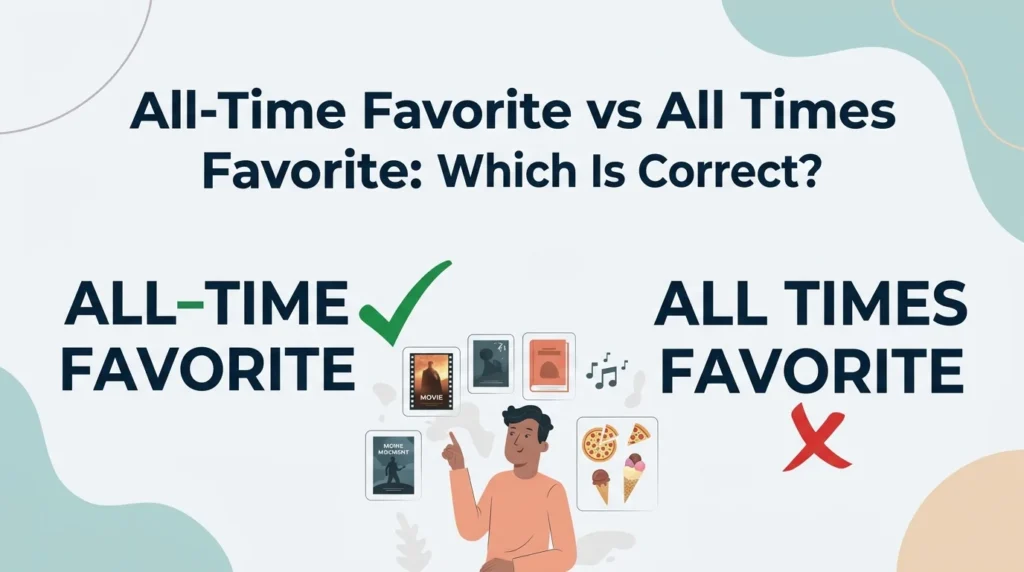

All-time favorite is the correct and natural expression when you mean something you like more than anything else over your entire experience or across all time.
- ✅ My all-time favorite movie is Interstellar.
- ✅ This is one of my all-time favorite books.
- ✅ That restaurant is my all-time favorite.
- ❌ This is my all times favorite movie.
The alternative favorite of all time is also correct: This is my favorite movie of all time.
What Is “All-Time Favorite”?
All-time favorite means the person or thing you like best when you consider the whole period of time relevant to the comparison.
For example:
This is my all-time favorite song.
The speaker is saying that, among all the songs they have considered or experienced, this one ranks as their favorite.
The expression can describe almost anything:
- a movie
- a song
- a book
- a restaurant
- a food
- a city
- a sports team
- a teacher
- an actor
- a memory
- a vacation
- a product
- a hobby
The key idea is highest personal preference across time.
The word favorite itself means the person or thing that someone likes best or enjoys most.
The phrase all-time adds the idea of considering the entire relevant period. Dictionaries use it in expressions such as all-time high, all-time record, all-time great, and all-time favorite.
Why It Matters
A small spelling or grammar mistake may not prevent readers from understanding you, but it can make otherwise polished writing look careless.
This matters especially when you are writing:
- a professional email
- a product review
- an academic assignment
- a blog article
- a social media caption
- a business website
- a school essay
- a recommendation
- a movie or book review
Compare:
❌ This is my all times favorite book.
with:
✅ This is my all-time favorite book.
The meaning is easy to understand in the first sentence, but the second follows standard English usage and reads naturally.
The Core Rule
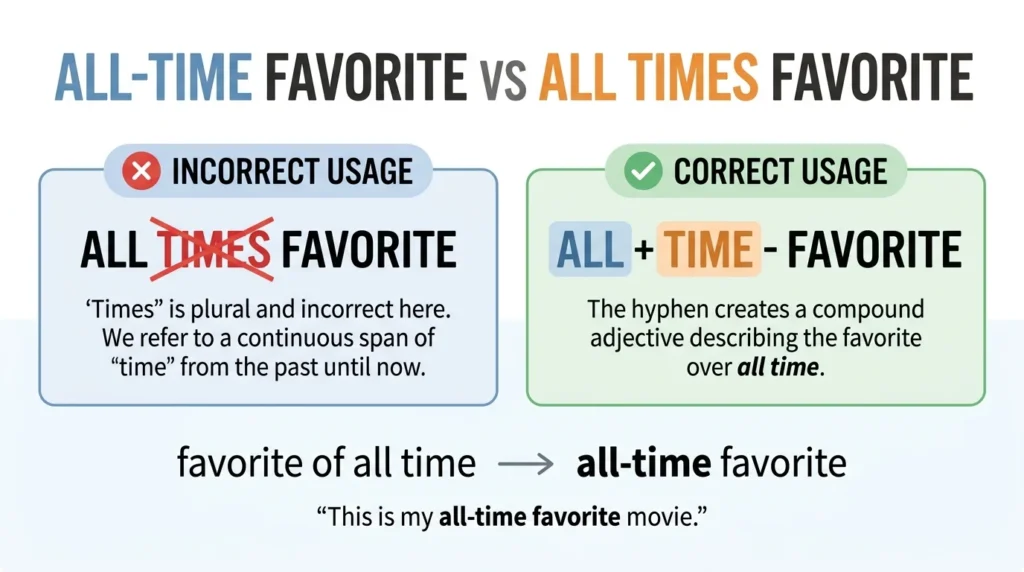
Use “all-time favorite” when you mean “favorite of all time.” Keep “time” singular and use the hyphen in the compound modifier.
Correct
all-time favorite
Incorrect for this meaning
all times favorite
Also correct
favorite of all time
Oxford specifically lists all-time as an adjective and gives my all-time favorite song as an example.
Read More: Pent vs Pant: Which Word Is Correct?
How to Use “All-Time Favorite”
The phrase is straightforward once you understand what all-time is doing.
Use “all-time favorite” before a noun
When all-time comes directly before the noun it helps describe, the hyphenated form is the standard choice.
- My all-time favorite movie is Interstellar.
- She is my all-time favorite singer.
- This is my all-time favorite restaurant.
- That is his all-time favorite book.
- Football is his all-time favorite sport.
Here, all-time works as a compound modifier.
Use “all-time favorite” as a noun phrase
The noun that follows favorite can sometimes be understood from context.
This movie is my all-time favorite.
The missing noun is understood to be something like movie.
You can also say:
This is one of my all-time favorites.
Notice that favorites is plural here because the sentence means one item among several things that rank highly for you.
Use “favorite of all time” as an alternative
You can also put the idea into a longer phrase:
This is my favorite movie of all time.
This means essentially the same thing as:
This is my all-time favorite movie.
Both are standard English.
Correct Examples
Here are examples across different situations.
Conversation
“What’s your all-time favorite movie?”
“Pizza is still my all-time favorite food.”
The restaurant we visited last week is one of my all-time favorites.
School
The Hobbit is one of my all-time favorite books.
Workplace
That presentation was one of the team’s all-time favorite training sessions.
Academic Writing
The novel remains one of the author’s most influential works and an all-time favorite among many readers.
Social Media
One of my all-time favorite travel memories.
Review
This is easily one of my all-time favorite documentaries.
Personal Writing
That summer remains one of my all-time favorite periods of my life.
Entertainment
She is one of my all-time favorite actresses.
Sports
He is one of my all-time favorite athletes.
Incorrect vs. Correct
| ❌ Incorrect | ✅ Correct | Why |
|---|---|---|
| This is my all times favorite movie. | This is my all-time favorite movie. | All-time is the established compound modifier. |
| She is my all times favorite singer. | She is my all-time favorite singer. | Times is not used in this compound expression. |
| Pizza is my all times favorite food. | Pizza is my all-time favorite food. | The intended meaning is “favorite of all time.” |
| That is my all times favorite book. | That is my all-time favorite book. | Use singular time in all-time. |
| He is my all times favorite player. | He is my all-time favorite player. | All-time modifies favorite player. |
| This is one of my all times favorite songs. | This is one of my all-time favorite songs. | The compound remains all-time; songs is plural because of “one of.” |
| It is her all times favorite restaurant. | It is her all-time favorite restaurant. | All times does not mean “favorite ever.” |
| That was my all times favorite vacation. | That was my all-time favorite vacation. | Use all-time for the highest preference across time. |
| This may be my all times favorite memory. | This may be my all-time favorite memory. | All-time is the correct compound form. |
| He called it his all times favorite album. | He called it his all-time favorite album. | Time stays singular in the compound. |
Why People Make This Mistake
The error is understandable because all times is a real combination of words in other contexts.
For example:
The instructions must be followed at all times.
Here, all times is correct because it means every occasion or whenever the situation applies.
But that does not make all times favorite correct.
Phonetic similarity
When people hear all-time favorite in fast speech, the boundaries between words can become less obvious.
The phrase may sound like one continuous unit:
all-time-favorite
Someone who has mainly heard the expression rather than seen it written may reconstruct it incorrectly as all times favorite.
Spelling overlap
The words time and times are both common English words. Since the meaning involves a broad period, learners may instinctively add -s.
But English does not form this compound by simply pluralizing time.
Overgeneralization
“If I mean many times, I should write times.”
That reasoning works in sentences such as:
Learners may think:
I have visited London three times.
It does not work in all-time favorite, because all-time is an established compound modifier.
Autocomplete and spellcheck
Spellcheck can identify many spelling errors, but it does not always understand whether a phrase is natural in context.
A sentence containing all times favorite may contain no obviously misspelled individual word. The problem is the combination, not the spelling of all, times, or favorite separately.
Translation interference
Learners may also construct the phrase according to the grammar of another language. English frequently forms fixed compound modifiers that cannot be translated word-for-word.
Learning the complete phrase all-time favorite is therefore more useful than trying to build it from individual words.
Common Mistakes Checklist
1. Writing “all times favorite”
Mistake:
❌ My all times favorite song.
Why it happens:
The writer thinks of several times or periods rather than the established compound all-time.
Avoid it:
Memorize the phrase as one unit:
✅ all-time favorite
2. Writing “all-times favorite”
Adding a hyphen does not solve the problem.
❌ all-times favorite
The issue is not simply punctuation. The standard compound is all-time, with singular time.
✅ all-time favorite
3. Forgetting the hyphen
In carefully edited writing, use:
✅ my all-time favorite book
rather than:
my all time favorite book
The hyphen shows that all-time functions together as a compound modifier.
4. Confusing “all-time” with “all the time”
These expressions have different meanings.
She is my all-time favorite singer.
= She is my favorite singer ever.
She listens to music all the time.
= She listens to music very frequently or continuously.
5. Forgetting the plural after “one of my”
Compare:
❌ One of my all-time favorite song
✅ One of my all-time favorite songs
After one of my, the noun normally needs to be plural because you are selecting one item from a group.
All-Time Favorite in Real English
1. “All-time favorite” — natural and standard
My all-time favorite movie is The Shawshank Redemption.
This is a normal way to express a strong personal preference. The phrase is compact, familiar, and suitable for everyday conversation as well as ordinary written English. The compound all-time directly expresses the idea of ranking something against the full relevant range of possibilities. Dictionary examples explicitly include all-time favorite and similar compounds.
Read More: Natzi vs Nazi: Which Spelling Is Correct?
2. “Favorite of all time” — natural and standard
This construction is also completely natural. Instead of putting all-time before favorite, it uses the phrase of all time after the noun. The meaning is essentially the same. Choose whichever version fits the rhythm of your sentence better.
3. “All times favorite” — not natural for this meaning
This is my all times favorite movie.
A reader can understand the intended meaning, but all times favorite is not the standard compound expression. The problem is not that the sentence is impossible to interpret; it is that English normally expresses this idea with all-time favorite or favorite of all time.
This is my favorite movie of all time.
4. “All times” — possible in a different structure
Keep your phone with you at all times.
Here, all times is perfectly natural because times refers to occasions. This is an important distinction: all times is not an impossible phrase. It simply does not form the standard adjective in all times favorite.
American vs. British English
There is a genuine spelling difference between American and British English, but the grammar of the expression stays the same.
| English variety | Correct form |
|---|---|
| American English | all-time favorite |
| British English | all-time favourite |
American English uses favorite, while British English uses favourite. Cambridge identifies favorite as the US spelling and favourite as the UK spelling. (Cambridge Dictionary)
The important point is that both varieties retain:
all-time
Not:
❌ all times
So the difference is favorite/favourite, not time/times.
Formal vs. Informal Usage
All-time favorite is neutral enough for most contexts.
It works naturally in:
- everyday conversation
- emails
- reviews
- blogs
- social media
- workplace writing
- general articles
In highly formal academic writing, you may sometimes prefer a more precise description if the statement is subjective.
For example:
This remains my all-time favorite novel.
is perfectly understandable, but:
This is the novel I consider most influential in my reading experience.
may be more appropriate if the purpose is formal analysis rather than personal preference.
There is no general rule that all-time favorite is informal. The phrase itself is standard English.
All-Time Favorite vs. Favorite of All Time
| Feature | All-Time Favorite | Favorite of All Time |
|---|---|---|
| Correct? | ✅ Yes | ✅ Yes |
| Meaning | Favorite ever | Favorite ever |
| Structure | Compound modifier + noun | Noun + “of all time” |
| Example | My all-time favorite song | My favorite song of all time |
| Hyphen | Yes, in all-time | No hyphen in of all time |
| Natural in conversation | Yes | Yes |
| Natural in writing | Yes | Yes |
| Main difference | More compact | More expanded |
Neither expression is inherently more correct.
Choose:
my all-time favorite book
or:
my favorite book of all time
Both communicate the same basic idea.
All-Time Favorite vs. All Times Favorite
| Feature | All-Time Favorite | All Times Favorite |
|---|---|---|
| Standard expression? | ✅ Yes | ❌ No |
| Singular “time”? | ✅ Yes | ❌ No |
| Hyphenated? | ✅ Yes | ❌ No |
| Meaning “favorite ever”? | ✅ Yes | ❌ No |
| Natural English? | ✅ Yes | ❌ No |
| Example | my all-time favorite movie | my all times favorite movie |
The easiest way to understand the difference is this:
all-time is a compound modifier.
all times is a separate phrase in which times is a plural noun.
They do different grammatical jobs.
All-Time vs. All the Time vs. All Time
These three forms are easy to confuse.
| Expression | Meaning | Example |
|---|---|---|
| all-time | Across the whole relevant period; ever | She is my all-time favorite singer. |
| all the time | Continuously or very frequently | She listens to music all the time. |
| all time | Usually appears in expressions such as “of all time” | This is the best song of all time. |
| all times | Every occasion, usually in a phrase such as “at all times” | Keep the door locked at all times. |
The most useful distinction is:
All-time ranks. All the time repeats.
And:
of all time gives the longer alternative to all-time.
When “All Times” Is Actually Correct
Do not conclude that all times is always grammatically wrong.
It can be correct when times genuinely means occasions or periods.
Example 1
At all times, employees must follow the safety rules.
Here, all times means every relevant occasion.
Example 2
The museum preserves objects from all times and cultures.
Here, times refers to different historical periods.
Example 3
People from all times have searched for answers to difficult questions.
Again, the plural times has its ordinary noun meaning.
But none of these structures produces:
❌ all times favorite
When the intended meaning is favorite ever, use:
✅ all-time favorite
Why the Hyphen Matters
A hyphen can connect words that function together as one modifier.
Consider:
an all-time favorite song
The words all-time work together before favorite song.
Other familiar compound modifiers follow the same general pattern:
- full-time employee
- long-term plan
- high-speed internet
- well-known writer
- last-minute decision
- all-time record
The dictionary form all-time is explicitly treated as an adjective, including before nouns such as favorite.
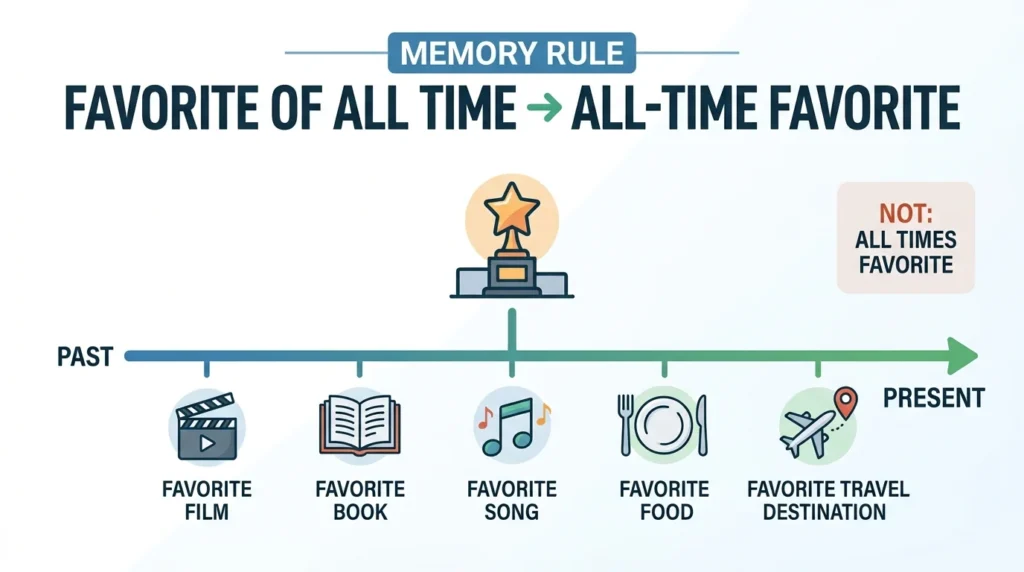
Memory Trick
Use this simple substitution:
all-time favorite = favorite of all time
If you can replace the phrase with favorite of all time, you probably need all-time.
Example
My all-time favorite book.
Expand it:
My favorite book of all time.
Same basic meaning.
Remember:
ALL + TIME = ONE IDEA → ALL-TIME
Never add the s when you mean favorite ever.
Real-Life Situations
Interview
Interviewer: “What is your all-time favorite book?”
Candidate: “Probably 1984. I first read it at school, and I still think about it.”
Meeting
That campaign is still one of our all-time favorite projects.
Thank you for the recommendation. That restaurant has become one of my all-time favorites.
Text Message
Just watched it again. Still my all-time favorite!
Exam
Correct the sentence: “This is my all times favorite poem.”
Correct answer:
This is my all-time favorite poem.
Social Media
One of my all-time favorite travel memories.
Expert Tips
Tip 1: Learn the phrase, not just the words
Instead of memorizing separate definitions for all, time, and favorite, memorize:
all-time favorite
This prevents the common mistake of changing time to times.
Tip 2: Use “favorite of all time” when you are unsure
If the hyphenated structure feels confusing, use the expanded version:
my favorite movie of all time
It is completely correct.
Tip 3: Watch “one of”
If you write:
one of my all-time favorite…
the noun after it should normally be plural:
one of my all-time favorite books
not:
❌ one of my all-time favorite book
Tip 4: Keep your spelling consistent
If you choose American English, write:
favorite
If you choose British English, write:
favourite
Do not mix the two forms without a reason.
Tip 5: Don’t let spellcheck teach you grammar
A spellchecker may accept all times favorite because every individual word exists in English. That does not mean the entire phrase is standard.
Grammar and natural usage operate at the phrase level, too.
Read More: Noisy vs Noisey: Which Spelling Is Correct?
FAQ
Is “all-time favorite” grammatically correct?
Yes. All-time favorite is the standard expression for something you like best across the relevant span of time. Major dictionaries list all-time as an adjective and give examples involving favorite/favourite. (Oxford Learner’s Dictionaries)
Is “all times favorite” ever correct?
Not when you mean favorite ever. In that meaning, use all-time favorite or favorite of all time.
Should “all-time” always have a hyphen?
When all-time functions as the established compound modifier before a noun, the hyphenated form is the standard choice: an all-time favorite song. Dictionaries list all-time as a hyphenated adjective.
Can I say “my favorite of all time”?
Yes. My favorite of all time is grammatically possible, although when the noun is stated, my favorite song of all time is clearer.
Is “favorite of all time” better than “all-time favorite”?
No. Both are correct. All-time favorite is simply the more compact construction.
Is “all-time favorite” American English only?
No. The compound all-time is used in both American and British English. The spelling of favorite/favourite changes between the varieties.
What is the difference between “all-time favorite” and “all the time”?
All-time favorite means your favorite ever. All the time means continuously, repeatedly, or very frequently.
She is my all-time favorite singer.
She listens to her music all the time.
Can “all times” be grammatically correct?
Yes. For example:
The equipment must be supervised at all times.
Here, times means occasions. The phrase is grammatically different from all-time favorite.
Can I write “all time favorite” without the hyphen?
You may encounter it in informal writing, but for polished standard writing, use all-time favorite. The established dictionary form is all-time.
Is “one of my all-time favorite” correct?
It needs a plural noun when the noun is stated:
❌ One of my all-time favorite movie
✅ One of my all-time favorite movies
What is the easiest way to remember the correct form?
Think:
favorite of all time → all-time favorite
If you mean favorite ever, use all-time, not all times.
Mini Quiz
| # | Question | Answer | Explanation |
|---|---|---|---|
| 1 | Choose: “This is my ___ movie.” A) all times favorite B) all-time favorite | B | All-time favorite is the standard compound expression. |
| 2 | Fill in: “She is my ______ singer.” | all-time favorite | The intended meaning is “my favorite singer ever.” |
| 3 | Correct the sentence: “Pizza is my all times favorite food.” | Pizza is my all-time favorite food. | Use singular time in the compound all-time. |
| 4 | Which is correct? A) favorite of all time B) favorite of all times | A | The standard phrase is of all time. |
| 5 | Choose: “This is one of my all-time favorite ___.” A) book B) books | B | One of my is followed by a plural noun. |
| 6 | Correct the sentence: “He is my all-times favorite player.” | He is my all-time favorite player. | Adding -s is incorrect; the compound is all-time. |
| 7 | Which sentence is correct? A) Keep your passport with you at all times. B) Keep your passport with you at all-time. | A | At all times means on every relevant occasion. |
| 8 | Fill in: “She listens to that song ______.” | all the time | Here the meaning is frequently or continuously, not “favorite ever.” |
| 9 | Which is correct in American English? A) all-time favorite B) all-time favourite | A | Favorite is the US spelling. |
| 10 | Correct the sentence: “That is my favorite song of all times.” | That is my favorite song of all time. | The established expression is of all time, with singular time. |
Quick Summary
All-time favorite is the correct standard expression when you mean something you like best ever or across the whole relevant span of time. All times favorite is not the normal English construction for this meaning. The word all-time is a compound adjective, so it uses singular time and a hyphen. You can also say favorite of all time, which has essentially the same meaning. In American English, use favorite; in British English, use favourite. Do not confuse all-time with all the time, which means continuously or frequently, or at all times, which means on every occasion. When in doubt, remember: favorite of all time → all-time favorite.