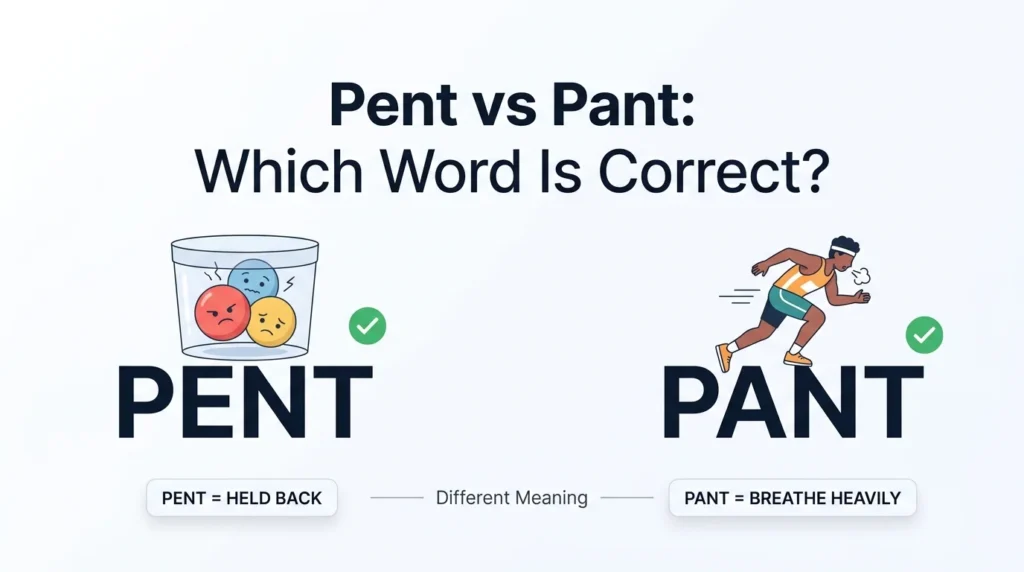

Pent and pant are both correct English words, but they have completely different meanings and grammatical roles. Pent means confined, restrained, or held back and is most commonly seen in pent-up. Pant means to breathe quickly and heavily, usually after exercise, heat, fear, or exertion. If you are talking about breathing, use pant. If you mean something that has been held back or confined, use pent.
What Is the Difference Between Pent and Pant?
The main difference is meaning and word function.
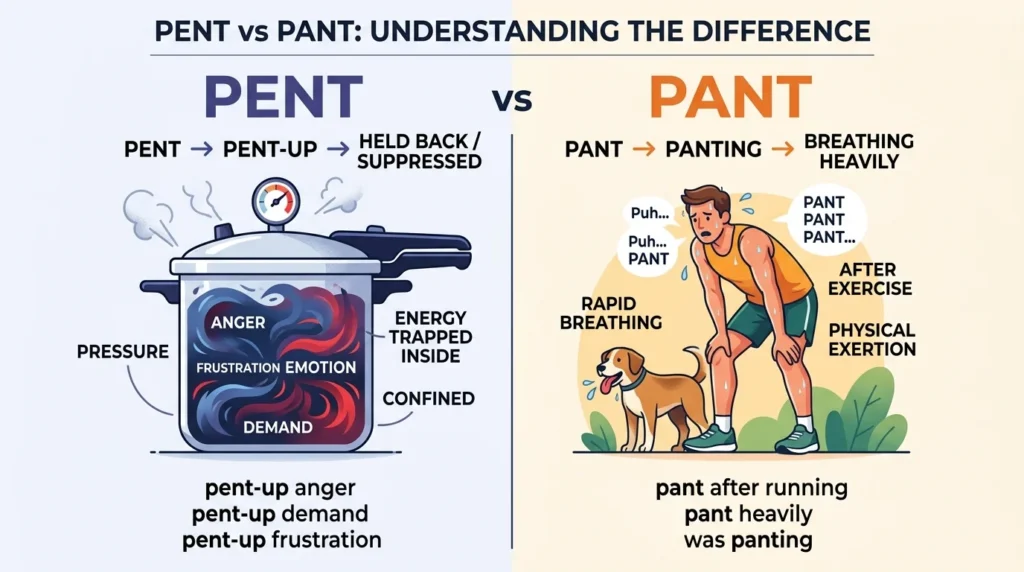
Pent describes something that has been confined, restricted, or held inside. In modern English, it is most familiar in pent-up, which describes feelings, energy, pressure, or other things that have been held back.
Pant is a verb. It describes rapid or heavy breathing, often because someone or an animal has been exercising, running, feeling overheated, frightened, or physically exhausted.
Compare:
- She released her pent-up frustration.
- The dog began to pant after the long walk.
The first sentence is about something being held back.
The second is about breathing.
That one distinction solves most pent vs pant mistakes.
Why It Matters
Choosing the wrong word can completely change the meaning of a sentence.
Consider:
The runner began to pent after the race.
The reader may understand what you intended, but pent does not mean “breathe heavily.” The correct verb is pant:
The runner began to pant after the race.
Now consider:
He had pant-up anger for years.
That is also incorrect. The established expression is:
He had pent-up anger for years.
These errors are small in spelling but large in meaning. They can make a sentence look careless in an exam, email, article, report, or professional document.
The Core Rule
Use pant when you mean breathe quickly or heavily. Use pent when you mean confined, restrained, or held back—especially in pent-up.
Easy rule to remember
- Pant = breathing
- Pent = held back
- Pent-up = suppressed or unreleased
- Panting = breathing heavily
If someone has just run five kilometers, they may pant.
If someone has been silently holding anger inside for months, they may have pent-up anger.
What Does “Pent” Mean?
Pent is a real English word meaning confined, enclosed, restrained, or held in.
However, there is an important usage point: modern English does not commonly use pent by itself in everyday conversation.
You are much more likely to see it in the compound expression pent-up.
For example:
- pent-up anger
- pent-up frustration
- pent-up emotion
- pent-up energy
- pent-up demand
- pent-up resentment
The basic idea is that something has been kept inside instead of being released.
Examples of “Pent”
She finally expressed her pent-up frustration.
The children had pent-up energy after spending the entire day indoors.
Years of pent-up resentment affected their relationship.
The company benefited from pent-up demand after the market reopened.
In each case, something has accumulated or remained contained.
What Does “Pant” Mean?
Pant is primarily a verb meaning to breathe quickly and heavily.
It commonly describes breathing after physical effort or because of heat, excitement, fear, or another cause of heavy breathing.
For example:
The dog began to pant after chasing the ball.
She was panting after climbing the stairs.
He stopped running and stood there, panting heavily.
The word also has related forms:
- pant — base form
- pants — third-person singular
- panted — past tense
- panting — present participle
For example:
The dog pants when it gets too hot.
The dog panted after the race.
The dog was panting when we found it.
Pent vs Pant: Comparison Table
| Feature | Pent | Pant |
|---|---|---|
| Main meaning | Confined, restrained, held back | Breathe quickly or heavily |
| Main word class | Past participle/adjectival form | Verb |
| Common expression | Pent-up anger | Pant after running |
| Related idea | Suppression or confinement | Heavy breathing |
| Common in everyday speech? | Mostly in “pent-up” | Yes |
| Example | pent-up frustration | The dog began to pant |
| Can describe breathing? | No | Yes |
| Can describe suppressed feelings? | Yes, especially “pent-up” | No |
How to Use “Pent” Correctly
The safest modern use of pent is usually pent-up.
1. Pent-up emotions
She finally talked about her pent-up emotions.
The emotions had been held inside rather than openly expressed.
2. Pent-up anger
His pent-up anger became difficult to control.
The anger had been suppressed for a period of time.
3. Pent-up frustration
The meeting gave employees a chance to express their pent-up frustration.
The frustration had built up without being openly expressed.
4. Pent-up energy
The children had plenty of pent-up energy after the long flight.
The energy had not been released through normal activity.
5. Pent-up demand
The retailer experienced strong pent-up demand after reopening.
Here, the idea is not emotion. Demand had accumulated because people had previously been unable or unwilling to make purchases.
How to Use “Pant” Correctly
Use pant when the sentence describes rapid or heavy breathing.
After exercise
The athlete began to pant after the final sprint.
After running
I was panting when I reached the top of the hill.
For animals
The dog was panting in the afternoon heat.
After climbing
She stopped to catch her breath and began to pant.
In dialogue
“Wait for me,” he panted.
Here, panted tells us that the person spoke while breathing heavily.
Read More: Natzi vs Nazi: Which Spelling Is Correct?
10 Correct Examples
| Situation | Correct Example |
|---|---|
| Conversation | “The dog started to pant after chasing the ball.” |
| “The team has pent-up concerns that need to be addressed.” | |
| School | “The novel describes the character’s pent-up anger.” |
| Workplace | “Employees expressed their pent-up frustration during the meeting.” |
| Exercise | “I was panting after running up the stairs.” |
| Social media | “After that workout, I could barely walk—I was panting!” |
| Academic writing | “The character’s pent-up emotions influence his later decisions.” |
| Everyday life | “The puppy was panting in the heat.” |
| Business | “The store saw pent-up demand when customers returned.” |
| Storytelling | “He reached the door, panting and exhausted.” |
Notice how the two words operate in completely different contexts.
Incorrect vs. Correct
| ❌ Incorrect | ✅ Correct | Why |
|---|---|---|
| The dog began to pent after running. | The dog began to pant after running. | Pant is the verb for heavy breathing. |
| She was pent after climbing the stairs. | She was panting after climbing the stairs. | The action is breathing heavily. |
| He had pant-up anger. | He had pent-up anger. | The established expression is pent-up. |
| The athlete was penting after the race. | The athlete was panting after the race. | The -ing form of pant is panting. |
| She released her pant-up frustration. | She released her pent-up frustration. | Pent-up describes suppressed frustration. |
| The runner began to pent for breath. | The runner began to pant for breath. | Pant relates to rapid breathing. |
| His pant-up emotions finally surfaced. | His pent-up emotions finally surfaced. | The emotions were held back. |
| The horse was penting after the race. | The horse was panting after the race. | Panting describes the breathing action. |
| Years of pant frustration affected him. | Years of pent-up frustration affected him. | The frustration had been suppressed. |
| She was pent heavily after the workout. | She was panting heavily after the workout. | Panting heavily is the natural construction. |
Why Do People Confuse Pent and Pant?
There are several reasons these words cause mistakes.
Similar spelling
The difference between pent and pant is only one vowel.
That makes them easy to confuse when typing quickly, especially for English learners.
Similar pronunciation
The words are also close in sound. Pent has the vowel sound /ɛ/, while pant has /æ/ in standard American and British pronunciation. The distinction can be difficult for learners whose first language does not make the same vowel contrast.
Familiarity with “pent-up”
Many learners know pent-up anger but may not understand that pent itself carries the idea of something being confined or held back.
Overgeneralization
A learner may see one familiar form and try to use it in another context.
For example, someone who remembers pent-up may incorrectly write pent when they mean “breathe heavily.”
Spellcheck and autocomplete
Spellcheck tools can catch some spelling errors, but they cannot reliably determine what you mean in every context.
A sentence can contain a correctly spelled word that is still the wrong word.
For example:
The dog began to pent.
There is no obvious spelling error to a basic spellchecker, but pent is wrong for the intended meaning.
Translation interference
Some learners translate directly from their first language and choose a word that seems semantically close. This can produce errors because English divides related concepts into different words.
Common Mistakes Checklist
Mistake 1: Using “pent” for heavy breathing
❌ The dog was pent after running.
✅ The dog was panting after running.
Why it happens: The words look almost identical.
How to avoid it: Connect pant with breathing.
Mistake 2: Writing “pant-up”
❌ pant-up anger
✅ pent-up anger
Why it happens: Writers associate “pant” with the similar-looking word pent.
How to avoid it: Remember that pent-up means something has been held inside.
Mistake 3: Using “penting”
❌ The horse was penting.
✅ The horse was panting.
Why it happens: The writer starts with the wrong base word.
How to avoid it: The verb is pant, so its -ing form is panting.
Mistake 4: Assuming “pent” is the normal everyday word for restraint
Although pent is correct, modern English strongly favors familiar expressions such as pent-up in many everyday contexts.
Instead of forcing pent into an unusual sentence, use the established form when appropriate.
Read More: Noisy vs Noisey: Which Spelling Is Correct?
Pent vs Pant in Real English
Pent: grammatically correct but often most natural in “pent-up”
Pent is a legitimate English word, but its modern everyday use is strongly associated with pent-up. Saying “pent-up frustration” sounds normal and clear. A sentence such as “The emotions were pent within him” is grammatically possible, but it has a more literary or formal feel. For ordinary writing, pent-up emotions or suppressed emotions will usually be clearer.
Pant: normal everyday English
Pant is a normal, productive verb. People can pant, pant heavily, pant after running, or pant for breath. Its forms—pants, panted, panting—are also straightforward. If you are describing someone or an animal breathing rapidly, pant is the natural word.
Pent-up: especially natural for suppressed feelings
Pent-up is common when talking about emotions, frustration, anger, excitement, energy, or demand that has accumulated without being released. It is not limited to emotions. For example, pent-up demand is common in business and economics. The shared idea is something that has been held back and is now ready to be released.
American vs. British English
There is no major American-vs.-British difference between pent and pant in their basic meanings.
Both varieties use:
- pent-up for something held back or suppressed
- pant for rapid or heavy breathing
However, there is a useful related distinction involving pants.
In American English, pants commonly means trousers or other clothing worn on the lower body.
In British English, pants traditionally means underwear, while trousers is the usual word for the outer garment.
This matters because a learner searching for pent vs pant may actually be trying to spell pants.
For example:
- American English: “I bought new pants.”
- British English: “I bought new trousers.”
But:
- “The dog began to pant.”
works in both varieties.
Formal vs. Informal Usage
Pant is suitable in ordinary conversation, journalism, storytelling, academic writing, and professional writing whenever rapid breathing is being described.
Pent-up is also widely usable, but the exact noun it modifies determines the tone.
Examples:
- pent-up anger — natural and common
- pent-up frustration — natural
- pent-up demand — common in business/economic writing
- pent-up energy — common in everyday language
The standalone adjective pent can sound more literary than pent-up. If your goal is simple modern English, pent-up is usually the safer choice.
Pent, Pant, and Pants: Do Not Mix Them Up
These three words are worth separating:
| Word | Meaning | Example |
|---|---|---|
| pent | confined or held back | pent-up frustration |
| pant | breathe rapidly | The dog began to pant. |
| pants | clothing in American English | These pants are comfortable. |
A useful three-word memory system is:
Pent = pressure held inside.
Pant = breathing outside.
Pants = clothing.
What About “Pant” as a Noun?
Pant is primarily taught as a verb meaning to breathe rapidly, but pant can also occur as a noun in specialized or technical contexts.
For ordinary English learners, however, the most important use is the verb:
The dog began to pant.
Do not confuse this with pants, the clothing noun.
In everyday American English:
I bought a pair of pants.
is normal.
I bought a pant.
is generally not the normal way to refer to one complete garment.
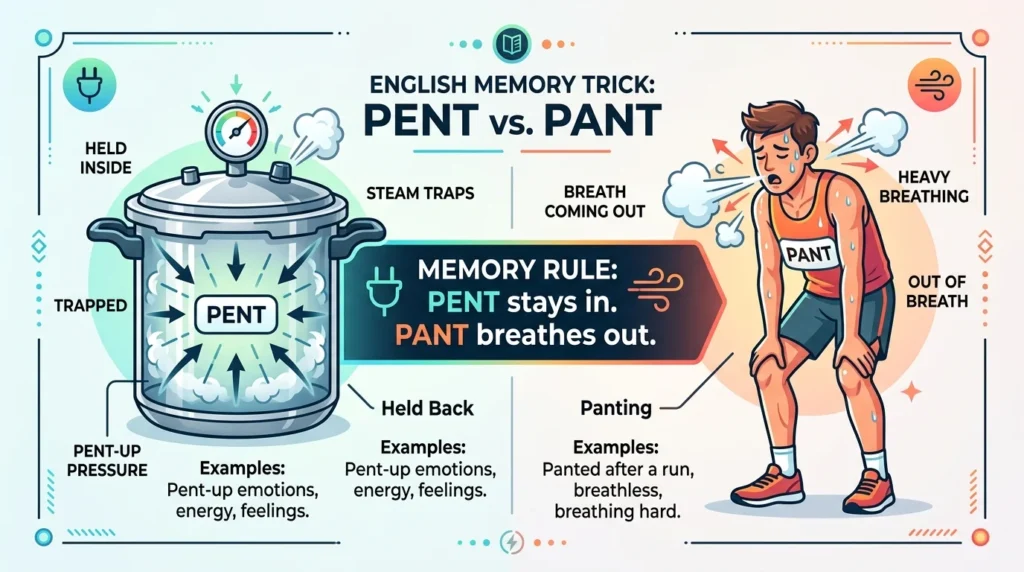
Memory Trick
Use this:
PENT = trapped INSIDE.
PANT = breath coming OUT.
Think of a pressure cooker.
Something pent-up is trapped inside.
Now imagine a runner who has just finished a race. The runner is panting.
So:
Feelings held inside → pent-up
Heavy breathing → pant
Real-Life Situations
In an interview
“I had some pent-up concerns about the project, so I decided to discuss them with my manager.”
The concerns had been held back.
After exercise
“I was panting after running to catch the bus.”
The person was breathing heavily.
In a meeting
“Several employees expressed pent-up frustration about the new policy.”
The frustration had accumulated over time.
In a text message
“Give me a minute—I’m still panting after that run.”
The speaker is breathing heavily.
In an exam
“The character’s pent-up anger eventually leads to a confrontation.”
The word describes suppressed emotion.
In a business report
“The company expects pent-up demand to increase sales.”
Demand had been restrained or delayed.
Expert Tips
1. Learn the phrase, not just the word
Instead of memorizing pent = confined, remember:
pent-up anger
pent-up frustration
pent-up demand
This makes correct usage much easier.
2. Learn “pant” as an action
Connect pant with a physical action:
run → breathe heavily → pant
That mental chain makes the word easier to retrieve.
3. Look at the surrounding words
If you see:
- anger
- frustration
- resentment
- emotion
- demand
- energy
then pent-up may be appropriate.
If you see:
- run
- exercise
- heat
- stairs
- breath
- dog
then pant may be appropriate.
Context is often more useful than spelling.
4. Do not trust spelling alone
Pent and pant are both legitimate words.
The question is not:
“Which spelling looks right?”
The better question is:
“What meaning do I need?”
5. Remember that “pent-up” is not limited to emotions
Many learners associate it only with anger or frustration.
But you can also have:
- pent-up energy
- pent-up demand
- pent-up excitement
- pent-up pressure
The common idea is something accumulated or held back.
Quick Summary
Pent and pant are different words with different meanings. Pent means confined, restrained, or held back and is most commonly encountered in pent-up, as in “pent-up anger” or “pent-up demand.” Pant is a verb meaning to breathe quickly and heavily, as in “The dog began to pant after running.” Do not use them interchangeably. Remember the simple rule: pent = held back; pant = breathe heavily. If you are describing clothing, you may actually mean pants, which is a separate word. Once you connect each word to its core meaning, the spelling difference becomes much easier to remember.
FAQ
Is “pent” a correct English word?
Yes. Pent is a real English word meaning confined, restrained, or held back. In modern English, it is especially common in the expression pent-up, such as “pent-up anger.”
Is “pant” a correct English word?
Yes. Pant is a verb meaning to breathe quickly and heavily. For example: “The dog began to pant after running.”
What is the difference between pent and pant?
Pent relates to something being confined or held back. Pant relates to rapid or heavy breathing. They have different meanings and cannot normally replace one another.
Is “pent-up” the same as “suppressed”?
They are often close in meaning, especially when describing emotions. Pent-up anger, for example, is anger that has been held back or not openly expressed.
Can I say “I am pent”?
It is grammatically possible in certain contexts, but it is not the most natural everyday expression for most situations. Modern English commonly uses pent-up in phrases such as “pent-up frustration” or “pent-up emotions.”
Can “pant” describe an animal?
Yes. Pant is commonly used for animals as well as people.
The dog was panting after the walk.
What is the past tense of pant?
The past tense is panted.
The dog panted after running.
The present participle is panting.
What is the correct phrase: “pant-up” or “pent-up”?
The correct phrase is pent-up.
She had years of pent-up frustration.
Pant-up is incorrect for this meaning.
Is “pent” related to the word “pen”?
Yes. The sense of pent is historically connected with the idea of being enclosed or confined. This relationship helps explain why pent-up refers to something being held in.
Does pent mean the same thing as pants?
No. Pent and pants are different words. Pent means confined or held back, while pants refers to clothing in American English and usually underwear in British English.
Is there a British English difference between pent and pant?
No major difference exists in their basic meanings. Both British and American English use pent-up for something held back and pant for rapid or heavy breathing.
Mini Quiz
| # | Question | Answer | Explanation |
|---|---|---|---|
| 1 | The dog began to ___ after running. A) pent B) pant | B) pant | Pant means to breathe quickly or heavily. |
| 2 | She finally released her ___ anger. A) pant B) pent-up | B) pent-up | Pent-up describes anger that has been held back. |
| 3 | Choose the correct sentence: A) He was pent after the race. B) He was panting after the race. | B | Panting describes heavy breathing. |
| 4 | Which phrase is correct? A) pant-up frustration B) pent-up frustration | B | The established expression is pent-up frustration. |
| 5 | Fill in the blank: “The horse was ___ after the long ride.” | panting | The sentence describes rapid breathing. |
| 6 | Fill in the blank: “Years of ___ resentment affected their relationship.” | pent-up | The resentment had been held back. |
| 7 | Correct the sentence: “The runner began to pent heavily.” | The runner began to pant heavily. | Pant is the verb for heavy breathing. |
| 8 | Which word means “confined or held back”? A) pant B) pent | B) pent | Pent carries the meaning of confinement or restraint. |
| 9 | Which word belongs in this sentence? “The company experienced ___ demand after reopening.” | pent-up | Demand had accumulated because it had previously been restrained or delayed. |
| 10 | Correct the sentence: “She had pant-up emotions.” | She had pent-up emotions. | Pent-up is the correct expression for suppressed emotions. |
Final Takeaway
If you remember only one thing, remember this:
PENT = HELD BACK
PANT = BREATHE HEAVILY
Pent → pent-up anger, pent-up frustration, pent-up demand.
Pant → pant after running, pant in the heat, pant for breath.
And if you are talking about clothing, check whether you actually mean pants.