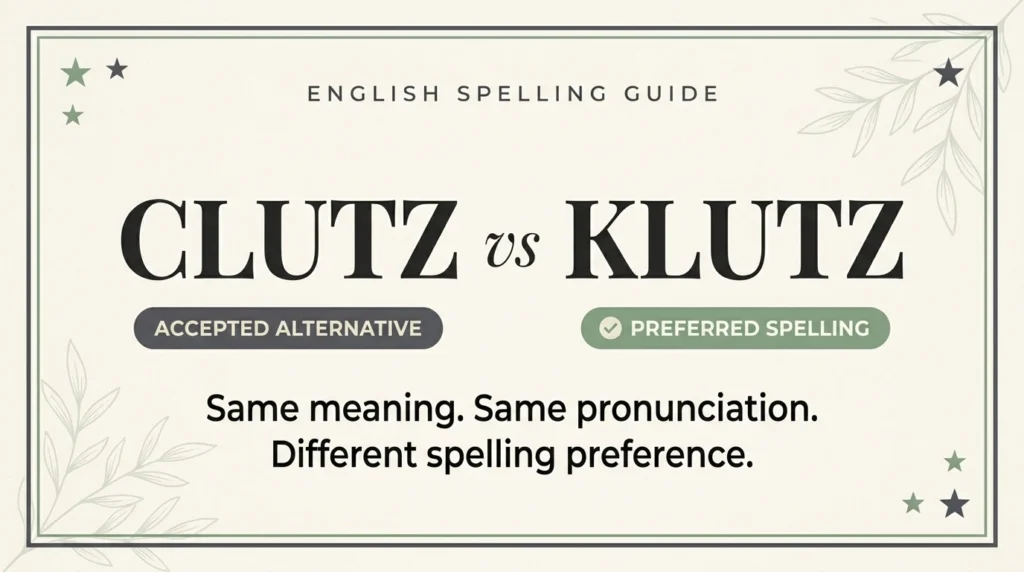

Klutz is the standard spelling in American English, while clutz is a recognized alternative spelling. Both spellings refer to a clumsy person who frequently drops things, bumps into objects, or makes awkward physical mistakes. Although klutz is the more widely preferred spelling in American English, clutz is not simply a misspelling. The two forms have the same meaning and pronunciation.
What Is the Difference Between Clutz and Klutz?
There is no difference in meaning between clutz and klutz. Both words describe someone who is physically awkward, careless with movements, or prone to accidental mishaps.
The difference is spelling preference and usage frequency.
- Klutz: The preferred and more widely recognized spelling.
- Clutz: A legitimate alternative spelling with the same meaning.
Both forms are nouns, and both can be used to describe someone who accidentally spills drinks, trips over objects, drops things, or struggles with coordination.
The core rule
KLUTZ is the preferred spelling.
Clutz is also an accepted spelling. Both have the same meaning and pronunciation, but klutz is generally the safer choice.
| Word | Status | Meaning |
|---|---|---|
| Klutz | Preferred spelling | A clumsy or physically awkward person |
| Clutz | Accepted alternative spelling | A clumsy or physically awkward person |
Unlike many confused-word pairs, this is not a case where one word is correct and the other is completely wrong. Both forms are accepted, but klutz is the spelling most writers should prefer.
What Does Klutz Mean?
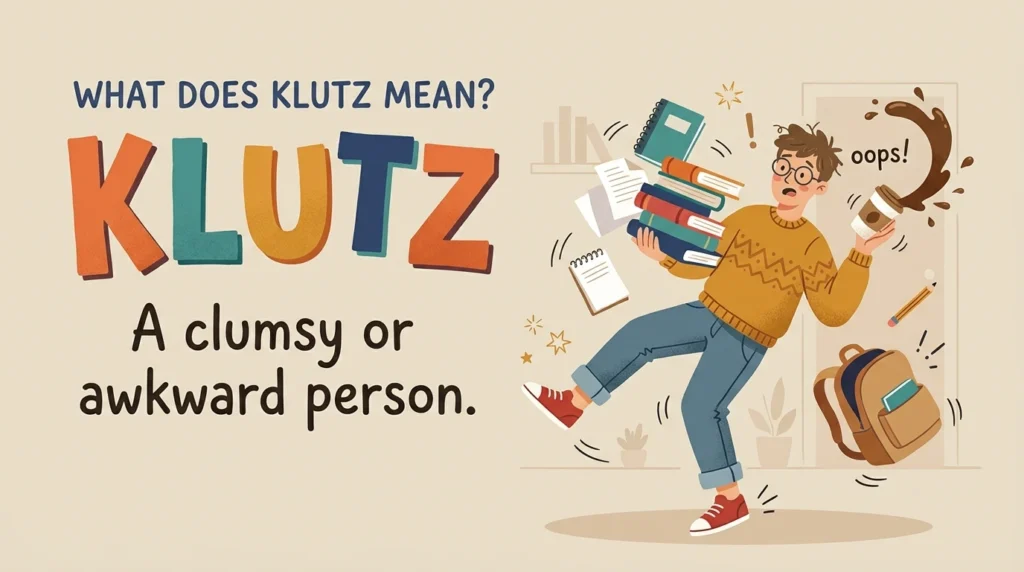
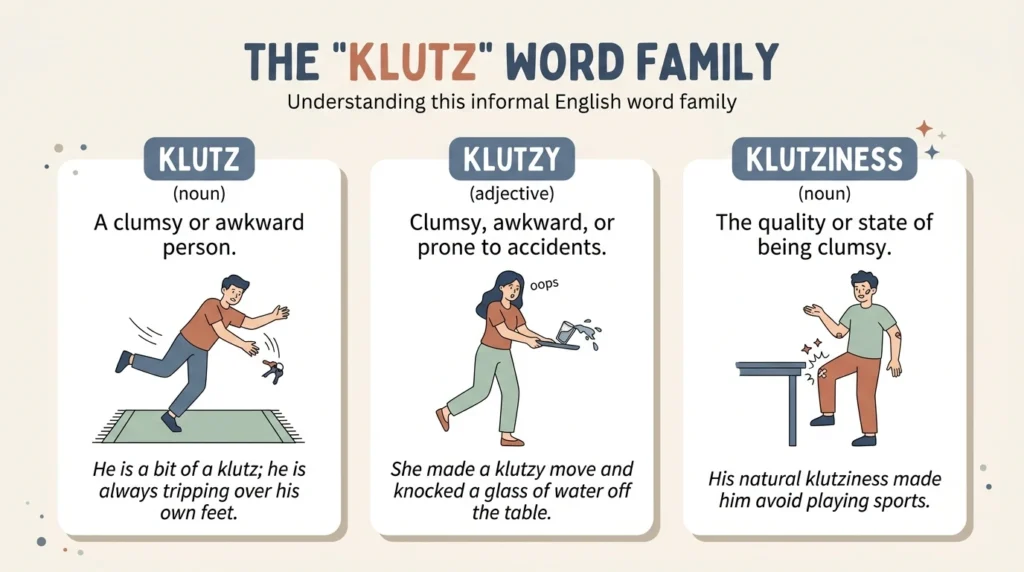
A klutz is a person who is clumsy, awkward, or frequently makes physical mistakes, often by accident.
The word is generally informal and can be used humorously to describe someone who drops objects, bumps into things, trips, spills food, or struggles with physical coordination.
For example:
- He is such a klutz that he dropped his phone twice in one hour.
- I felt like a klutz when I knocked over the glass.
- She’s a lovable klutz who always manages to spill her coffee.
- Don’t be a klutz when carrying those fragile boxes.
The word is often used in a playful or self-deprecating way rather than as a serious insult. However, depending on the situation and tone, calling someone a klutz can still sound rude or critical.
Klutz as a Noun
Klutz is a noun because it names a person.
Examples:
- My brother is a klutz.
- I was a complete klutz in the kitchen.
- He’s an adorable klutz.
- The poor klutz tripped over his own shoelaces.
Klutzy as an Adjective
Klutzy is the adjective form of klutz. It describes a person, action, or movement that is clumsy or awkward.
Examples:
- That was a klutzy move.
- He can be a little klutzy sometimes.
- Her klutzy attempt to catch the ball made everyone laugh.
- I felt klutzy walking in those oversized shoes.
Klutziness as a Noun
Klutziness refers to the quality or behavior of being clumsy.
Examples:
- His klutziness caused the plates to fall.
- She laughed about her klutziness.
- My klutziness is the reason I avoid carrying too many things at once.
These related forms are useful because they allow you to describe the person, their behavior, or the quality of being awkward.
Why Does Clutz vs Klutz Matter?
Although both spellings are accepted, choosing the more widely recognized spelling can help your writing look polished and consistent.
The word is informal, but it appears in everyday conversations, messages, entertainment, storytelling, social media captions, and casual writing.
Using klutz is especially useful when:
- Writing informal conversations or dialogue.
- Creating humorous social media captions.
- Describing a character in a story.
- Writing casual blog content.
- Using the word in American English.
- Wanting to use the more commonly recognized spelling.
The word itself is not appropriate for every situation. Calling a colleague, customer, or employee a klutz may sound insulting, even if you intend it as a joke.
In professional settings, words such as awkward, careless, uncoordinated, or inexperienced may be more suitable, depending on what you mean.
Read More: Nitch vs Niche: Which Spelling Is Correct?
The Core Rule: Both Are Correct, but Klutz Is Preferred
The simplest rule is:
Use klutz as your default spelling. Clutz is also acceptable, but klutz is the more widely preferred form.
You do not need to change the meaning, pronunciation, or sentence structure when switching between these spellings.
| Situation | Recommended form |
|---|---|
| American informal writing | Klutz |
| Casual conversation | Klutz |
| Social media | Klutz |
| Humorous storytelling | Klutz |
| Alternative spelling | Clutz |
| Formal professional writing | Prefer a more neutral word |
The difference is not grammar. It is spelling preference and usage.
How to Use Klutz Correctly
The word klutz is easy to use once you understand that it describes a person who is physically clumsy or awkward.
1. Use Klutz for Someone Who Drops Things
This is one of the most common situations in which the word is used.
Examples:
- He’s such a klutz; he dropped the keys again.
- I felt like a klutz when I spilled water on the table.
- My cousin is a klutz who can never hold onto his phone.
- She called herself a klutz after knocking over the lamp.
2. Use Klutz in Humorous Situations
The word is often used when someone makes an accidental physical mistake that is harmless or funny.
Examples:
- I’m a complete klutz when I try to dance.
- What a klutz! He walked straight into the door.
- I was being a klutz and spilled the popcorn everywhere.
- He laughed at himself for being such a klutz.
3. Use Klutz to Describe Yourself
Calling yourself a klutz is often a way of admitting a mistake without taking it too seriously.
Examples:
- I’m such a klutz today.
- Sorry, I’m a klutz when I’m tired.
- I made a mess of everything. I’m a real klutz.
- I dropped my coffee again because I’m a klutz.
Self-deprecating language means making a light joke about yourself or your own shortcomings.
4. Use Klutz in Fiction and Storytelling
Writers often use klutz to describe characters who are physically awkward, accident-prone, or comically uncoordinated.
Examples:
- The young detective was a klutz, but surprisingly good at solving crimes.
- Everyone loved the klutz because he never pretended to be perfect.
- She played the klutz in the school comedy.
- The character was written as a lovable klutz who constantly caused accidental chaos.
5. Use Klutz Carefully When Describing Other People
Although the word can be humorous, it can also sound judgmental.
Examples:
- He’s a klutz, but he means well.
- Don’t call her a klutz just because she made one mistake.
- I jokingly called myself a klutz after dropping the tray.
The tone and relationship between the speakers matter. A word that sounds funny between friends may sound insulting to someone who does not know you well.
Correct Examples of Klutz and Clutz in Everyday English
Both klutz and clutz can be used in sentences because both spellings are recognized. However, klutz is the spelling generally preferred in standard writing.
The following examples show how the word can be used naturally in different situations.
| Situation | Example |
|---|---|
| Conversation | I’m such a klutz. I just dropped my keys again. |
| Email to a friend | Sorry about the mess. I was being a klutz in the kitchen. |
| School | The character is portrayed as a lovable klutz who constantly makes mistakes. |
| Workplace | I felt like a klutz when I knocked over the display. |
| Social media | Officially the biggest klutz of the day. |
| Family | My little brother is a klutz, but he always makes us laugh. |
| Storytelling | The klutz tripped over his own feet while rushing toward the door. |
| Text message | I’m such a klutz 😂 I dropped my phone again. |
| Movie review | The main character is a charming klutz with a good heart. |
| Daily life | I can be a real klutz when I’m trying to do too many things at once. |
| Self-description | I’m a klutz, so please don’t ask me to carry all those glasses. |
| Humor | Only a klutz like me could spill coffee before the first meeting. |
These sentences are informal and conversational. They are suitable for situations where the writer wants to sound relaxed, humorous, or self-aware.
Clutz vs Klutz: Incorrect vs Correct Examples
Because both spellings are accepted, the following are not strict wrong-versus-right comparisons. Instead, they show which spelling is preferred and which alternative is also acceptable.
| Preferred spelling | Alternative spelling | Why |
|---|---|---|
| He is such a klutz. | He is such a clutz. | Both spellings are accepted; klutz is generally preferred. |
| I’m a klutz when I dance. | I’m a clutz when I dance. | Both communicate the same meaning. |
| She felt like a klutz. | She felt like a clutz. | Both forms describe someone feeling clumsy. |
| What a klutz! | What a clutz! | Both are valid spellings in informal use. |
| My brother is a klutz. | My brother is a clutz. | The meaning and pronunciation are unchanged. |
| Don’t be a klutz. | Don’t be a clutz. | Both forms can be used in this sentence. |
| I can be such a klutz. | I can be such a clutz. | Both are accepted; the preferred form is klutz. |
| He acted like a klutz. | He acted like a clutz. | There is no grammatical difference between them. |
| She’s a lovable klutz. | She’s a lovable clutz. | Both spellings convey the same description. |
| The movie features a clumsy klutz. | The movie features a clumsy clutz. | Both are possible, though repeating the idea of clumsiness may sound redundant. |
Editorial note: The alternative spelling “clutz” should not be labeled categorically incorrect. It is an accepted variant of “klutz.”
Why People Confuse Clutz and Klutz
1. They Sound Exactly the Same
The two spellings have the same pronunciation: /klʌts/.
When someone hears the word without seeing it, there is no sound-based clue that tells them whether it begins with C or K. Both letters can represent the same /k/ sound in English, so writers may guess the spelling.
2. C Seems Like a More Familiar Choice
English has many common words beginning with cl, including:
- Clumsy
- Clever
- Clean
- Climb
- Closer
- Clumsy
Because clutz describes a clumsy person, some writers instinctively associate it with the spelling of clumsy and choose C.
That association feels logical, but it is not a reliable way to determine the established spelling of a word.
3. K at the Beginning Looks Unusual
The letter K is less common than C in many English words beginning with the /k/ sound.
Words such as klutz, knack, and knock have spelling patterns that learners may not expect. When a word looks unfamiliar, writers may replace its first letter with a more familiar spelling.
4. People Copy What They See Online
A writer may see clutz in a social media post, message, comment, or website. Because the alternative spelling is accepted, it can reinforce the belief that the two forms are equally preferred in every writing context.
Exposure can make a spelling feel more familiar, but frequency and preference still matter when choosing a form for edited writing.
5. Autocorrect and Spellcheck Do Not Explain Everything
Writing tools are useful, but they do not always explain which spelling is preferred or why two forms are accepted.
Even when both spellings pass a spelling check, the writer may still want to choose the more widely recognized form for consistency.
6. Translation and First-Language Interference
English learners may use their first language’s spelling patterns when writing unfamiliar English words.
If a language represents the /k/ sound with a particular letter in similar situations, the learner may naturally choose C or K based on that pattern. This is understandable, but English words sometimes have spellings that must be learned individually.
Common Mistakes Checklist
Before publishing, check the following:
- Do I know that klutz is the preferred spelling?
- Have I avoided claiming that clutz is always wrong?
- Have I used one spelling consistently throughout the article?
- Have I recognized that both spellings have the same meaning?
- Am I using klutz in a situation where the tone is appropriate?
- Have I avoided using the word as a serious insult?
- Have I chosen a more professional alternative if the context is formal?
Mistake 1: Assuming Clutz Is Always Wrong
What happens: Writers believe clutz is an incorrect spelling in every situation.
Why it happens: They learn klutz as the preferred spelling and assume the alternative cannot be accepted.
How to avoid it: Understand that clutz is an accepted variant. Use klutz as your default, especially in edited writing.
Mistake 2: Assuming the Two Words Have Different Meanings
What happens: A writer thinks clutz and klutz describe different types of people.
Why it happens: Seeing two different spellings can make them appear to be separate words.
How to avoid it: Remember that both forms mean a clumsy or awkward person. They are spelling variants, not words with separate definitions.
Mistake 3: Using the Word in Formal Professional Communication
What happens: Someone calls a colleague or employee a klutz in a formal email or workplace report.
Why it happens: The writer focuses on the meaning and forgets the informal, potentially insulting tone.
How to avoid it: Use more neutral words such as clumsy, uncoordinated, or awkward, depending on the situation.
Mistake 4: Changing Spelling in the Same Article
What happens: A writer uses klutz in one paragraph and clutz in another without a reason.
Why it happens: The writer is unaware that spelling consistency is an editorial choice.
How to avoid it: Choose klutz as your primary spelling and stick with it throughout the article unless you are discussing the variant itself.
Read More: Coma vs Comma: The Spelling Mistake That Changes Everything!
Mistake 5: Confusing Klutz With Klutzy
What happens: A writer uses klutz where an adjective is required.
Incorrect: That was a klutz move.
Better: That was a klutzy move.
Why: Klutz is a noun, while klutzy is an adjective that describes an awkward or clumsy action.
Clutz vs Klutz in Real English
Grammatically Correct
Both klutz and clutz are grammatically correct nouns. You can use either spelling as the subject or object of a sentence. For example, “He’s a klutz” and “He’s a clutz” are both correct. The word is mainly informal American English, so it works particularly well in friendly conversations, humorous stories, and casual writing where the tone is relaxed.
Grammatically Possible but Unnatural
A sentence can be grammatically correct but still sound awkward because of its tone or word choice. For example, “The klutz demonstrated a lack of professional coordination during the executive presentation” is grammatically possible, but it sounds unnecessarily insulting and informal for a professional report. A more natural choice would be “The employee struggled with handling the equipment safely.”
Natural, Everyday English
In everyday English, klutz is often used humorously, especially when someone makes a small physical mistake. “I’m such a klutz” sounds natural when a person accidentally drops their phone or spills a drink. The word is also common in lighthearted descriptions of fictional characters. It is less suitable when discussing serious accidents, workplace performance, or someone else’s physical limitations.
American vs. British English
There is no strict American-versus-British spelling rule that makes clutz British and klutz American.
Both spellings exist. Klutz is the preferred spelling.
| Feature | American English | British English |
|---|---|---|
| Preferred spelling | Klutz | Klutz |
| Alternative spelling | Clutz | Clutz |
| Pronunciation | /klʌts/ | /klʌts/ |
| Meaning | Clumsy or awkward person | Clumsy or awkward person |
| Tone | Informal | Informal |
| Common alternatives | Clumsy, butterfingers | Clumsy, butterfingers |
The word klutz is mainly associated with American informal English. British English speakers understand it, but depending on the situation, may prefer more familiar expressions such as clumsy or butterfingers.
The spelling clutz does not become correct simply because someone is writing for a British audience. It remains an accepted alternative spelling rather than a regional spelling rule.
Formal vs. Informal Usage
Klutz is an informal word. It is most appropriate in relaxed conversations, humorous writing, casual storytelling, and friendly messages.
| Context | Example | Suitability |
|---|---|---|
| Conversation | I’m such a klutz. | Natural |
| Text message | What a klutz 😂 | Natural |
| Social media | Professional klutz at work today. | Casual, humorous |
| Fiction | The hero was a lovable klutz. | Natural |
| Friendly email | Sorry, I’m a klutz and spilled the coffee. | Informal |
| Business report | The employee is a klutz. | Inappropriate or unprofessional |
| Academic writing | The participant was a klutz. | Usually too informal |
| Professional feedback | The employee needs to improve coordination when handling materials. | More appropriate |
More Professional Alternatives
If you want to describe an awkward mistake without sounding insulting, use a word that matches the situation.
| Instead of klutz | Consider using |
|---|---|
| Physically awkward | Clumsy |
| Lacking coordination | Uncoordinated |
| An awkward movement | Awkward |
| Making accidental mistakes | Accident-prone |
| Handling something carelessly | Careless |
| Making a mistake during a task | Inexperienced |
The best replacement depends on whether you are describing physical movement, lack of skill, carelessness, or simply an isolated accident.
Clutz vs. Klutz: Comparison Table
| Feature | Clutz | Klutz |
|---|---|---|
| Spelling | Alternative | Preferred |
| Meaning | Clumsy person | Clumsy person |
| Pronunciation | /klʌts/ | /klʌts/ |
| Word type | Noun | Noun |
| Accepted in English | Yes | Yes |
| Preferred in edited writing | Less commonly preferred | Generally preferred |
| Informal usage | Yes | Yes |
| Formal writing | Usually avoid | Usually avoid |
| American English | Accepted variant | Preferred form |
| British English | Accepted variant | Preferred form |
Memory Trick: Keep the K in Klutz
K stands for Keep the preferred spelling.
Keep the K in KLUTZ — when in doubt, choose K.
Both spellings are accepted, but remembering the K helps you choose the more widely preferred spelling whenever you’re writing.
A second way to remember it is to connect the K in klutz with the K in awkward. When you think of someone being awkward or clumsy, remember the unusual K at the beginning of klutz.
The word may describe someone who drops things, but don’t drop the K when spelling it.
Clutz vs. Klutz in Real-Life Situations
Situation 1: A Job Interview
You accidentally knock over a pen while sitting across from the interviewer.
Natural response:
“Sorry, I’m a bit of a klutz sometimes.”
This sounds casual and self-deprecating. It may help lighten a minor awkward moment, although it is better not to overuse jokes during a formal interview.
Read More: Payed vs Paid: Which Spelling Is Correct?
Situation 2: A Workplace Meeting
You accidentally spill water while arranging documents on a table.
Casual response:
“I can’t believe I did that. I’m such a klutz.”
Professional response:
“Sorry about that. Let me clean it up.”
The professional response is better if the situation requires responsibility rather than humor.
Situation 3: An Email to a Friend
You accidentally send a message with a typo or attach the wrong photo.
Example:
“Sorry, I’m a total klutz today. I attached the wrong picture!”
This is a natural use of the word in a relaxed conversation.
Situation 4: A Text Message
Your friend sees you drop your phone for the third time.
Example:
“I’m officially a klutz 😂 I need to stop trying to do everything at once.”
The word works naturally here because the tone is playful and informal.
Situation 5: A School Assignment
You are writing a story about a character who constantly makes physical mistakes.
Example:
“Daniel was a lovable klutz who somehow managed to trip over the smallest things.”
Klutz works well in creative writing because it quickly communicates a character’s awkward, accident-prone behavior.
Expert Tips for Using Klutz and Clutz
- Choose klutz as your default spelling. It is the more widely preferred form and the safest choice for edited content.
- Don’t label clutz as universally wrong. It is an accepted alternative spelling, even though klutz is generally preferred.
- Know the tone before using it. The word can be affectionate among friends but insulting in a professional setting.
- Use klutzy when you need an adjective. For example, “That was a klutzy mistake.”
- Use clumsy when you want a more neutral word. It is suitable for both formal and informal situations.
- Avoid describing people unfairly. Someone who drops something once is not necessarily a klutz.
- Keep your spelling consistent. If you use klutz throughout your article, do not randomly switch to clutz unless discussing the spelling variant.
- Remember that it is mainly an informal American word. In formal reports, professional feedback, or academic writing, a more precise description is usually better.
Quick Summary
Klutz and clutz are two accepted spellings of the same English word. Both describe a clumsy, awkward, or accident-prone person who may drop things, stumble, or make physical mistakes. The difference is not meaning, grammar, or pronunciation. Klutz is the preferred and more widely recognized spelling, while clutz is an accepted alternative. The word is mainly informal American English and is commonly used in conversations, humorous stories, text messages, and casual writing. It can sound playful when used about yourself or among friends, but may be insulting when directed at someone in a professional setting. When in doubt, use klutz. If you need a more formal alternative, choose clumsy, uncoordinated, or a more precise description.
FAQ: Clutz vs Klutz
1. Is clutz or klutz correct?
Both spellings are accepted. Klutz is the more widely preferred spelling, while clutz is an accepted alternative. Both mean a clumsy or awkward person.
2. Is clutz a real word?
Yes. Clutz is a recognized alternative spelling of klutz. It is not accurate to label it universally incorrect. However, klutz is the more established spelling and is generally the better choice for standard writing.
3. What does klutz mean?
A klutz is someone who is physically clumsy, awkward, or prone to accidental mishaps, such as dropping things, bumping into objects, or stumbling.
4. How do you pronounce klutz?
Klutz is pronounced /klʌts/. It rhymes with cuts and nuts. The word has one syllable.
5. Is klutz an insult?
It can be, but it is often used playfully. Calling yourself a klutz after spilling coffee is usually self-deprecating humor. Calling someone else a klutz may sound rude, especially if the person is embarrassed or the situation is serious.
6. Is klutz American or British English?
Klutz is mainly associated with informal American English. It is also understood in British English, although British speakers may prefer words such as clumsy or butterfingers in certain situations.
7. What is the plural of klutz?
The usual plural is klutzes.
Examples:
- Those two klutzes dropped the box.
- We were a couple of klutzes in the kitchen.
8. What is the adjective form of klutz?
The adjective is klutzy, meaning clumsy or awkward.
Examples:
- He made a klutzy move.
- I can be klutzy when I’m nervous.
9. Can I use klutz in formal writing?
It is generally better to avoid klutz in formal writing because it is informal and may sound insulting. Depending on your meaning, use clumsy, uncoordinated, awkward, or a more precise description.
10. Is clutz more common in British English?
It is not a formal British spelling distinction. Clutz is an alternative spelling of klutz, not a British-only spelling. The preferred spelling remains klutz regardless of whether you are writing for an American or British audience.
11. Is klutz the same as clumsy?
They have similar meanings, but they are not exactly the same grammatically. Klutz is a noun referring to a person, while clumsy is an adjective describing a person or movement.
- He’s a klutz.
- He’s clumsy.
12. Which spelling should I use in an article or blog?
Use klutz. It is the preferred spelling and the safer choice for professional content, blog posts, educational writing, and edited articles. You can mention clutz when explaining the spelling difference, but keep the primary spelling consistent.
Clutz vs Klutz Quiz
Test your understanding of the spelling, meaning, usage, and tone of clutz and klutz.
| # | Question | Answer | Explanation |
|---|---|---|---|
| 1 | Multiple choice: Which is the preferred spelling? A) Clutz B) Klutz C) Kluts | B) Klutz | Klutz is the preferred and more widely recognized spelling. |
| 2 | Fill in the blank: I dropped my coffee again. I’m such a ___. | Klutz | Klutz describes a clumsy or accident-prone person. |
| 3 | Correct the sentence: He’s a clutz who always drops things. | He’s a klutz who always drops things. (Preferred) | Clutz is also accepted, but klutz is the preferred form. |
| 4 | Multiple choice: What does klutz mean? A) A clever person B) A clumsy person C) A lazy person | B) A clumsy person | A klutz is someone who is physically awkward or accident-prone. |
| 5 | Fill in the blank: She made a ___ move while trying to catch the ball. | Klutzy | Klutzy is the adjective form of klutz. |
| 6 | Correct the sentence: I’m a klutz when I try to dance. | The sentence is already correct. | Klutz is naturally used in informal English to describe someone who is physically awkward. |
| 7 | Multiple choice: Is clutz an accepted spelling? A) No, never B) Yes, it is an alternative spelling C) Only in British English | B) Yes, it is an alternative spelling | Clutz is recognized as an alternative form of klutz. |
| 8 | Fill in the blank: The plural of klutz is ___. | Klutzes | The usual plural form is klutzes. |
| 9 | Correct the sentence: The employee is a klutz and should be criticized in the report. | The employee struggled with coordination and handling the equipment. | Klutz is informal and judgmental. Neutral, specific language is better in professional reports. |
| 10 | Multiple choice: Which is more appropriate for a formal report? A) He is a klutz. B) He is uncoordinated when handling the equipment. C) What a clutz! | B) He is uncoordinated when handling the equipment. | A neutral and specific description is more professional than an informal label. |