

Both unorganized and disorganized are correct English words. They are closely related, and in some sentences they can be used interchangeably. The main difference is emphasis: unorganized often means that organization is absent, incomplete, or not yet established, while disorganized more often suggests poor order, planning, coordination, or arrangement. The distinction is a matter of meaning and context, not a simple grammar rule.
What Is the Difference Between Unorganized and Disorganized?
Unorganized means not organized or not arranged into an organized structure. It can describe something that simply lacks organization, without necessarily suggesting chaos.
Disorganized means lacking effective order, structure, planning, or coordination. It often suggests that something is messy, confused, poorly arranged, or badly managed.
For example:
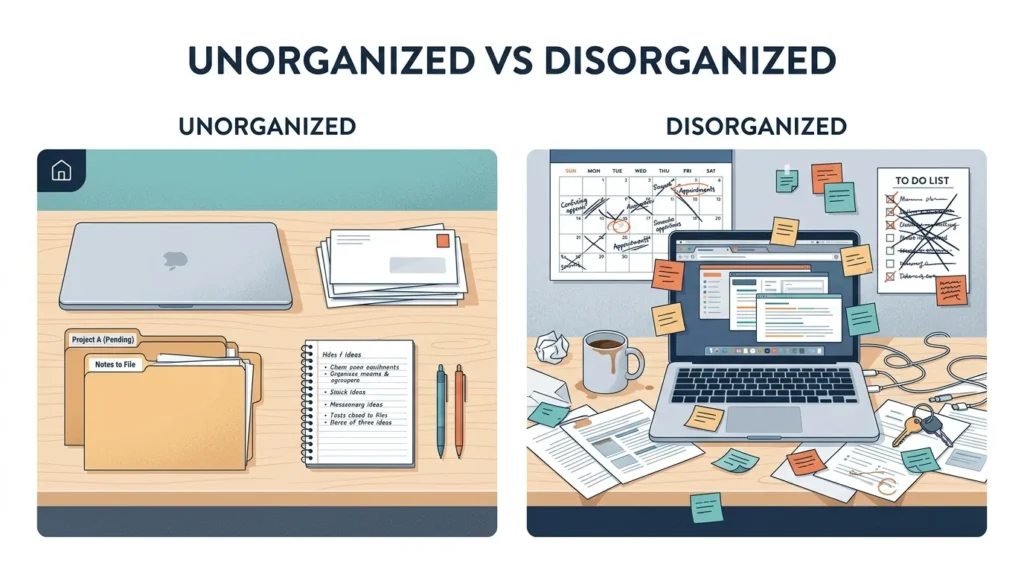
- The files are unorganized. → The files have not been sorted or arranged into a system.
- The files are disorganized. → The files are poorly arranged or difficult to manage.
- The new committee is unorganized. → It does not yet have a clear structure.
- The meeting was disorganized. → The meeting was poorly planned or managed.
The important point is that these are tendencies, not absolute rules. Both words can describe a lack of organization, and context determines the exact meaning. Oxford lists unorganized as both a synonym-like alternative to disorganized and as meaning “not having been organized,” while its entry for disorganized specifically emphasizes being badly planned or unable to organize well.
Why It Matters
Choosing between these words can change the impression your sentence gives.
Consider these two sentences:
The documents are unorganized.
This can simply mean that nobody has arranged them yet.
The documents are disorganized.
This more strongly suggests that the documents are poorly arranged, confusing, or difficult to work with.
That difference matters in professional writing.
Calling a person’s work disorganized can sound like criticism of their planning or working method. Saying that some data is unorganized can sound more neutral because the data may simply need to be sorted.
The distinction is especially useful in:
- Business emails
- Reports
- Academic writing
- Project management
- Data analysis
- Workplace communication
- Descriptions of people
- Descriptions of rooms, files, and systems
Using the wrong word will rarely make a sentence grammatically impossible. The bigger issue is precision.
Read More: Loosing vs Losing: Meaning, Difference & Correct Use.
The Core Rule
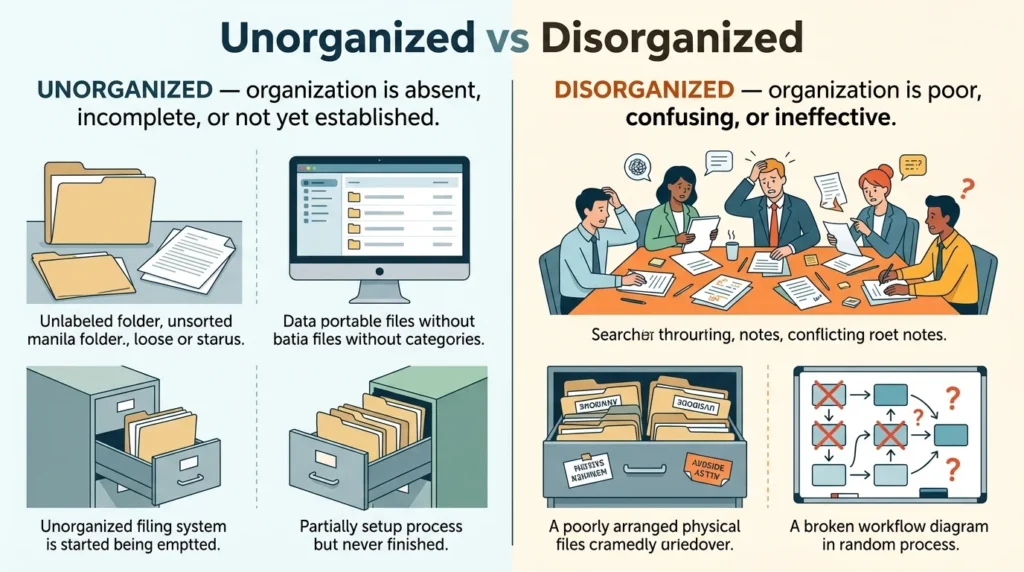
Unorganized = organization is absent, incomplete, or not established.
Disorganized = organization is poor, ineffective, confusing, or lacking order.
A useful question is:
Am I simply describing a lack of organization, or am I pointing out that the organization is poor?
If you mean a lack of structure, unorganized may fit.
If you mean poor organization, confusion, disorder, or bad planning, disorganized will often fit better.
But do not turn this into an absolute rule. Something can be described as disorganized even if it was never properly organized in the first place. Likewise, unorganized can sometimes describe a person, activity, or situation that is poorly organized. Dictionary definitions support this overlap.
How to Use Unorganized
Use unorganized when your main idea is that something lacks an organized structure or has not been organized.
1. When something has not been sorted
The research notes are still unorganized.
The notes exist, but they have not yet been arranged into categories.
2. When a system has not been established
The new volunteer group is still unorganized.
The group may simply be at an early stage and may not yet have assigned roles or procedures.
3. When describing raw material
We received a large amount of unorganized data.
The data exists, but it has not yet been arranged into a useful system.
4. In established expressions
Unorganized also has specific meanings in contexts such as workers who are not represented by a labor union and certain descriptions of territories or structures. These are specialized uses, so disorganized would not automatically be an equivalent replacement.
How to Use Disorganized
Use disorganized when you want to emphasize poor organization, disorder, ineffective planning, or confusion.
1. For a messy place
Her desk is extremely disorganized.
The word suggests more than simply “not arranged.” It suggests a lack of useful order.
2. For poor planning
The project became disorganized after the manager left.
The project is no longer being handled in an effective or orderly way.
3. For confusing communication
His presentation was disorganized and difficult to follow.
The ideas may be present, but they are not arranged effectively.
4. For a person’s habits
She is usually disorganized at work.
This describes a recurring tendency and is a common use of the word. Oxford specifically gives examples of disorganized describing people who are poor at planning or organizing.
Correct Examples
Here are examples showing how the two words work in everyday and professional English.
| Situation | Example |
|---|---|
| Conversation | “My room is completely disorganized today.” |
| “The files are still unorganized, so I need another hour to sort them.” | |
| Workplace | “The department became disorganized after the restructuring.” |
| School | “My notes are unorganized, but I can sort them before the exam.” |
| Academic writing | “The raw observations remained unorganized until the data was classified.” |
| Business | “The company’s purchasing process is disorganized.” |
| Social media | “My photo collection is totally unorganized.” |
| Meeting | “The meeting was disorganized, with several people speaking at once.” |
| Project management | “The project files were disorganized, so the team wasted time searching for documents.” |
| Personal planning | “I have an unorganized list of ideas that I want to develop later.” |
| Research | “The researcher first collected the unorganized responses.” |
| Customer service | “The complaint-handling process is disorganized and needs a clearer workflow.” |
Notice that the choice depends on what the sentence is trying to communicate.
Incorrect vs. Correct
Neither word is automatically “wrong” in every situation. Some pairs below are better understood as less precise or less natural for the intended meaning rather than grammatical errors.
| ❌ Less suitable | ✅ Better choice | Why |
|---|---|---|
| The meeting was unorganized and nobody knew what to do. | The meeting was disorganized and nobody knew what to do. | The sentence emphasizes confusion and poor management. |
| The raw data was disorganized because nobody had sorted it yet. | The raw data was unorganized because nobody had sorted it yet. | The main idea is that sorting had not happened. |
| She is an unorganized person who constantly misses deadlines. | She is a disorganized person who constantly misses deadlines. | Disorganized is more natural for a person’s poor planning habits. |
| The presentation was unorganized and jumped between unrelated subjects. | The presentation was disorganized and jumped between unrelated subjects. | The problem is poor arrangement and coherence. |
| The documents are unorganized because they have never been classified. | The documents are unorganized because they have never been classified. | The documents simply lack a classification system. |
| Our workflow is unorganized, causing repeated mistakes. | Our workflow is disorganized, causing repeated mistakes. | The focus is ineffective organization and resulting problems. |
| The new club is disorganized because it has not created its structure yet. | The new club is unorganized because it has not created its structure yet. | The emphasis is on the absence of an established structure. |
| His desk is unorganized, with papers scattered everywhere. | His desk is disorganized, with papers scattered everywhere. | Scattered materials suggest disorder. |
| The survey responses are disorganized because they have not been entered into categories. | The survey responses are unorganized because they have not been entered into categories. | The information has simply not been organized yet. |
| The event was unorganized because the schedule kept changing and staff were confused. | The event was disorganized because the schedule kept changing and staff were confused. | The sentence describes poor coordination and confusion. |
Why People Make This Mistake
The confusion is understandable because both words are built from organized and both can describe a lack of organization.
1. The words look almost identical
The only visible difference is the prefix:
- un- + organized
- dis- + organized
Because the base word is identical, learners naturally assume the two prefixes create two completely separate meanings.
They do not.
Their meanings overlap.
2. The prefixes can suggest different ideas
In many contexts, un- can indicate the absence of something.
So:
unorganized = not organized
The prefix dis- can indicate separation, reversal, or a negative condition.
So:
disorganized = lacking effective organization or order
But English prefixes do not always create perfectly predictable meanings. You cannot determine every word’s meaning by applying a fixed mathematical rule to its prefix.
3. People learn an oversimplified rule
A common explanation says:
“Unorganized means it was never organized, while disorganized means it was organized before and then became disordered.”
That explanation can be useful in certain situations, but it is not a universal rule.
A newly created project can be disorganized from the beginning if its planning is poor. You do not need to prove that it was previously well organized.
Similarly, unorganized can sometimes describe something that is simply in a poor state of organization.
The safer approach is to focus on meaning and context, not a rigid timeline. Current dictionary definitions support this broader interpretation.
4. Spellcheck cannot understand every nuance
Both unorganized and disorganized are legitimate English words.
A spellchecker may therefore accept either one.
That does not mean both communicate exactly the same idea in every sentence.
Spelling software can identify many spelling errors, but choosing between two valid words requires understanding the sentence.
5. Translation can cause interference
Some languages use one word where English uses several related words.
An English learner may therefore translate “not organized” directly and choose unorganized every time.
But English speakers often use disorganized when they want to describe confusion, poor planning, or disorder.
The solution is not to memorize one translation. Learn the meaning and context of each word.
Common Mistakes Checklist
Mistake 1: Thinking “disorganized” always means “previously organized”
It does not.
How to avoid it: Think about the current condition. If something is poorly planned, confusing, or disorderly, disorganized can work even when there is no clear evidence that it was previously organized.
Mistake 2: Thinking “unorganized” is always more correct
It is not.
Both words are standard English.
How to avoid it: Choose according to the meaning you want.
Mistake 3: Using “unorganized” for every person who lacks planning skills
This is possible in some contexts, but disorganized is generally the more natural choice when describing a person’s poor planning or working habits. Oxford specifically lists disorganized for someone who is unable to plan or organize well.
Mistake 4: Assuming “unorganized” always sounds neutral
Not necessarily.
He is an unorganized employee.
can still sound critical.
How to avoid it: Look at the whole sentence, not just the prefix.
Mistake 5: Treating the distinction as a strict grammar rule
This is one of the biggest mistakes.
The difference is primarily semantic—it concerns meaning—not a simple grammar rule.
Unorganized vs. Disorganized in Real English
Unorganized: absence or incompleteness of organization
Unorganized is especially useful when something simply has not been arranged into an organized system. For example, “The survey responses are unorganized” can mean that the responses have been collected but have not yet been categorized. The word does not necessarily tell us that the material is chaotic or badly managed. The main information is that organization is absent, unfinished, or not yet established. This meaning is directly supported by dictionary definitions such as “not having been organized.”
Disorganized: poor or ineffective organization
Disorganized is more natural when the organization itself is a problem. If a meeting jumps between topics, people do not know their responsibilities, or a process repeatedly breaks down, disorganized communicates that problem well. It can describe people, plans, meetings, systems, rooms, documents, and activities. Oxford’s examples include both badly planned events and people who are poor at organizing.
When both can work
Sometimes there is no important difference.
For example:
The files are unorganized.
and
The files are disorganized.
can both describe files that lack a useful arrangement.
The first can focus on the absence of organization.
The second can focus more on poor or confusing organization.
If the context does not require that distinction, either may be understood correctly.
Grammatically possible does not always mean equally natural
A sentence can be grammatically acceptable while another version sounds more precise or idiomatic.
For example:
She is unorganized.
may be understood, but:
She is disorganized.
is a very established way to describe someone who has poor organizational habits.
This is why vocabulary choice should not be reduced to “correct” versus “incorrect.” Sometimes the better question is:
Which word expresses the intended meaning more naturally?
American vs. British English
There is no major meaning difference between American and British English that requires choosing unorganized instead of disorganized or vice versa.
There is, however, a spelling difference in British English:
- American English: unorganized, disorganized
- British English: unorganised, disorganised
Oxford lists both the -ized and British -ised forms.
The choice between unorganized and disorganized is therefore primarily about meaning and context, not American versus British vocabulary.
Formal vs. Informal Usage
Both words can appear in formal and informal English.
Formal writing
Use disorganized when discussing poor planning, inefficient systems, or unclear processes.
The department’s disorganized reporting system delayed the publication of the results.
Use unorganized when describing material that has not yet been structured.
The researchers reviewed the unorganized responses before coding the data.
Informal writing
Both words are common in everyday conversation.
My closet is disorganized.
I have a bunch of unorganized notes on my phone.
The important issue is not formality. It is what you mean.
Comparison Table
| Feature | Unorganized | Disorganized |
|---|---|---|
| Basic meaning | Not organized | Poorly or ineffectively organized |
| Main emphasis | Absence or incompleteness of organization | Disorder, poor planning, or ineffective organization |
| Can describe people? | Yes | Yes |
| Common for people with poor planning habits | Less typical | Very common |
| Can describe data? | Yes | Yes |
| Can describe messy rooms? | Yes | Very natural |
| Can describe poor planning? | Sometimes | Very natural |
| Requires previous organization? | No | No |
| Usually neutral? | Often, but not always | Often more critical |
| Always interchangeable? | No | No |
Memory Trick
Use this simple distinction:
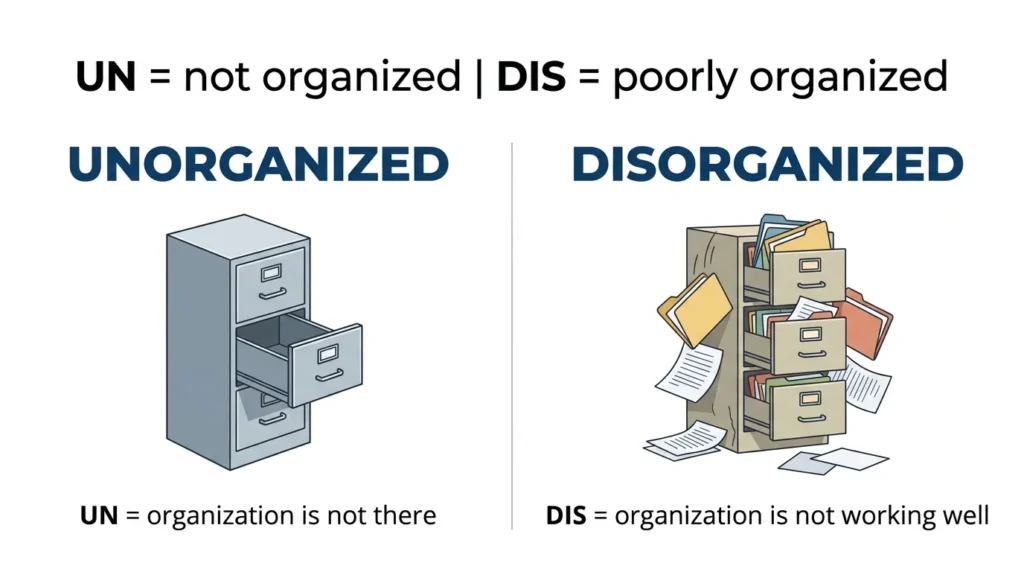
UN = organization is not there.
DIS = organization is not working well.
Think:
Unorganized → unfinished structure
Disorganized → dysfunctional structure
For example:
The files are unorganized because nobody has sorted them.
But:
The filing system is disorganized because nobody can find anything.
If you remember only one thing, remember this:
Unorganized focuses on the absence of organization. Disorganized focuses on the failure of organization to create useful order.
Read More: Fliers vs Flyers: Which Spelling Is Correct?
Real-Life Situations
In an interview
Better:
“I used to be somewhat disorganized, so I created a daily planning system.”
This describes a personal habit of poor organization.
In a workplace meeting
Better:
“The meeting was disorganized because there was no clear agenda.”
The problem is poor planning and coordination.
In an email
Better:
“The documents are currently unorganized. I will categorize them before Friday.”
The documents simply need to be arranged.
In a text message
Natural:
“My room is so disorganized right now.”
This sounds more natural when describing visible mess.
In an academic paper
Natural:
“The researchers initially collected unorganized responses from several participants.”
The responses had not yet been categorized.
In project management
Natural:
“The project became disorganized after several deadlines were changed.”
The project suffered from poor coordination.
Mini Quiz
| # | Question | Answer | Explanation |
|---|---|---|---|
| 1 | The files have never been sorted. They are ______. A) unorganized B) disorganized | A) unorganized | The main idea is that the files have not yet been arranged. |
| 2 | The meeting had no clear agenda and everyone was confused. | disorganized | The sentence emphasizes poor planning and confusion. |
| 3 | Choose the more natural description of someone who constantly forgets appointments: A) unorganized B) disorganized | B) disorganized | Disorganized is a common description of poor personal planning. |
| 4 | “The new database contains unorganized information.” Correct or incorrect? | Correct | The information can simply be awaiting classification or arrangement. |
| 5 | “The manager gave a disorganized presentation that jumped between topics.” Correct or incorrect? | Correct | The presentation lacks effective order and coherence. |
| 6 | Fill in the blank: “The volunteers have not yet created roles or procedures, so the group is still ______.” | unorganized | The group lacks an established structure. |
| 7 | Which word better emphasizes a chaotic workflow? A) unorganized B) disorganized | B) disorganized | Disorganized more strongly expresses poor or ineffective organization. |
| 8 | Correct the sentence: “She is an unorganized person who frequently misses deadlines.” | She is a disorganized person who frequently misses deadlines. | Disorganized is more natural for recurring poor planning habits. |
| 9 | Fill in the blank: “The archive contains thousands of ______ records that have not been classified.” | unorganized | The records have not yet been organized into a classification system. |
| 10 | Correct the sentence: “The conference was unorganized because speakers kept changing the schedule and attendees were confused.” | The conference was disorganized because speakers kept changing the schedule and attendees were confused. | The sentence describes poor coordination and confusion. |
Expert Tips
1. Do not ask whether one word is “correct” in isolation
Ask what you want the reader to understand.
Both words are valid. The context determines which one communicates your meaning better.
2. Use “disorganized” for people carefully
When describing someone’s habits, disorganized is usually the clearer choice:
He is disorganized.
It naturally suggests difficulty with planning, arranging, or managing things.
3. “Unorganized data” is a useful phrase
When data exists but has not yet been categorized, sorted, or structured, unorganized can communicate exactly that situation.
4. Do not invent a timeline
You do not need to know whether something was organized yesterday, last year, or never.
Instead, ask:
Is my emphasis on absent organization or poor organization?
5. Context can make both words reasonable
Compare:
The files are unorganized.
with:
The files are disorganized.
Neither sentence is automatically grammatically wrong. The first can emphasize that the files lack arrangement. The second can emphasize that their arrangement is poor or confusing.
6. Choose precision over artificial rules
English vocabulary often contains overlapping words.
Trying to force every pair into a perfectly separated definition can actually create new mistakes.
The goal is not to memorize:
“Never organized = unorganized.”
The goal is to understand the difference in emphasis.
FAQ
Is unorganized a correct word?
Yes. Unorganized is a standard English adjective. It can mean not organized, not arranged into an organized system, or, in certain contexts, not represented by an organization such as a labor union.
Is disorganized a correct word?
Yes. Disorganized is a standard English adjective commonly used for things or people that lack effective order, planning, or organization.
Is disorganized more common than unorganized?
In many everyday contexts, disorganized is the more familiar choice, especially when describing people, poor planning, confusion, or disorder. Oxford explicitly identifies unorganized as less frequent in one of its definitions and gives disorganized as the more common alternative.
Can I use unorganized for a person?
Yes, it is possible, but context matters. If you mean that someone has poor planning or organizational habits, disorganized is often the more natural choice.
Does disorganized mean something was organized before?
Not necessarily. This is a useful way to understand some examples, but it is not a strict requirement. Something can be disorganized from the beginning because it was poorly planned or coordinated.
Does unorganized always mean something is neutral?
No. Unorganized can still sound critical depending on what you describe and how you phrase the sentence.
Are unorganized and disorganized synonyms?
They overlap significantly, but they are not perfect synonyms in every context. Unorganized can emphasize the absence of organization, while disorganized often emphasizes poor or ineffective organization.
Which word should I use for messy files?
Disorganized is often the more natural choice when you mean that the files are confusing, poorly arranged, or difficult to manage.
Which word should I use for data that has not been sorted?
Unorganized can be a precise choice when the data simply has not yet been arranged or categorized.
Is “unorganised” correct?
Yes. Unorganised is the British spelling of unorganized. Similarly, British English uses disorganised, while American English normally uses disorganized.
Is there a simple rule I can always follow?
Use this as a guide rather than an absolute rule:
Unorganized = not organized.
Disorganized = poorly organized or lacking effective order.
Then check the sentence’s context.
Quick Summary
Unorganized and disorganized are both correct English words, but they can emphasize different ideas. Unorganized generally focuses on the absence, incompleteness, or lack of an established organization. Disorganized more often describes poor planning, disorder, confusion, or ineffective organization. For example, unorganized data may simply need to be sorted, while a disorganized system may actively make work difficult. The two words sometimes overlap, so it is inaccurate to treat the distinction as an absolute rule. Disorganized is especially natural when describing people with poor planning habits, messy systems, confusing meetings, or poorly arranged work. When choosing between them, focus on the meaning you want to communicate rather than memorizing a rigid “never organized versus previously organized” rule.