
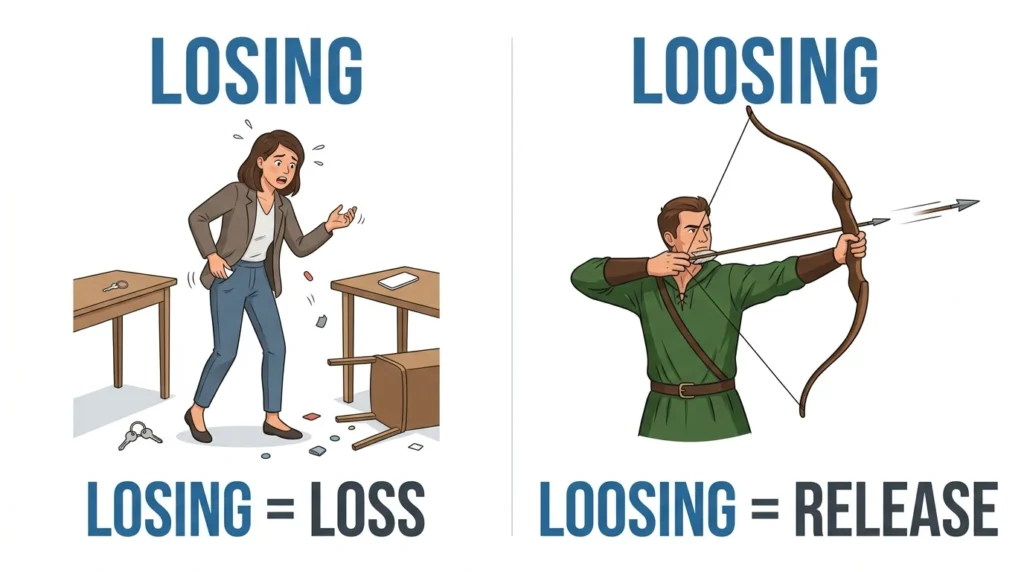

Quick Answer: Use losing when you mean failing to win, misplacing something, no longer having something, or experiencing a decrease. Use loosing only when you mean releasing, setting something free, or letting something fly. For example, “I am losing my keys” is correct, while “The archer is loosing an arrow” can also be correct. The two words come from different verbs: lose → losing and loose → loosing.
What Is the Difference Between Loosing and Losing?
Losing and loosing are both English words, but they come from different base verbs and have different meanings.
Losing is the present participle of lose. It is used when someone is failing to win, no longer has something, cannot find something, or is experiencing a reduction.
Examples include:
- losing a game
- losing money
- losing your keys
- losing weight
- losing patience
- losing confidence
Loosing is the present participle of the verb loose. In this less common verb use, it means releasing, freeing, or letting something go.
For example:
The archer is loosing an arrow.
Here, the archer is releasing the arrow.
The important point is that loosing is not automatically a spelling mistake. It is a real word. The mistake happens when it is used where losing is required.
Why It Matters
One extra o can change the meaning of a sentence.
Compare:
I am losing my phone.
This means the phone is being misplaced or is no longer in the speaker’s possession.
Now compare:
I am loosing my phone.
This would suggest that the speaker is releasing or freeing the phone. That is probably not what the writer means.
This distinction matters in everyday writing because loosing can pass a basic spell-check. Since it is a legitimate English word, software may not identify it as an error when the problem is actually one of meaning.
A wrong word can make an email, report, essay, social media post, or business message look careless even when the sentence is otherwise grammatically correct.
The Core Rule
Losing = lose + ing → loss, failure, misplacement, or reduction.
Loosing = loose + ing → release, set free, or let go.
The easiest way to choose between them is to identify the base verb first.
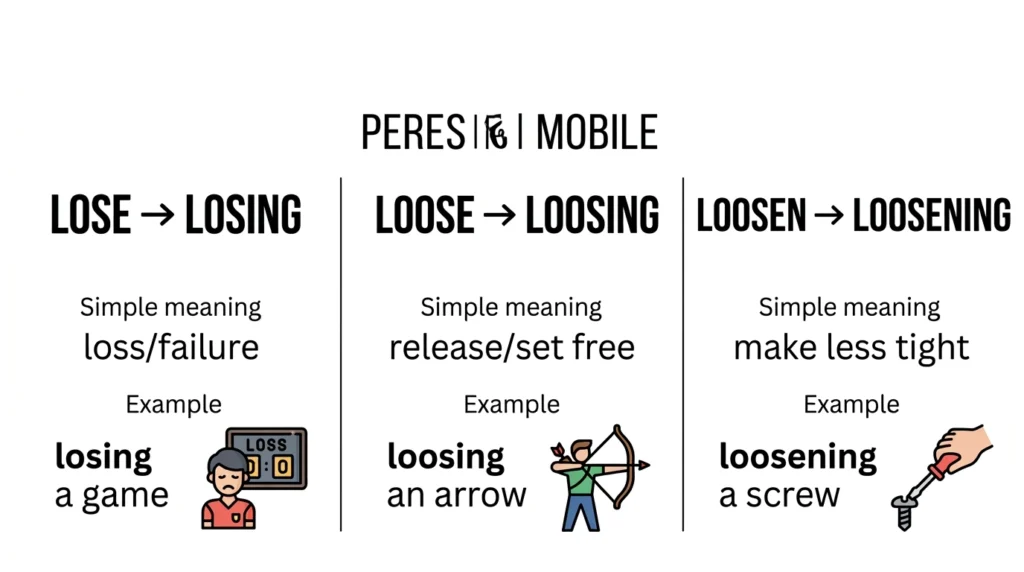
- lose → losing
- loose → loosing
- loosen → loosening
Do not decide based only on how the word looks.
Ask:
Do I mean “lose” or “loose”?
If you mean loss, failure, misplacement, or no longer having something, choose losing.
If you mean releasing or setting something free, loosing may be correct.
How to Use Losing
Losing is used in many common situations.
Losing Something
Use losing when someone can no longer find or keep something.
I keep losing my keys.
She is losing her phone again.
We are losing important documents.
Losing a Competition
Use losing when someone is not winning a game, race, contest, or competition.
Our team is losing the match.
He is losing the race.
They are losing the championship game.
Losing Money
Use losing when money or financial value is decreasing or being lost.
The company is losing money.
We are losing customers every month.
The business is losing revenue.
Losing Weight
Use losing when someone’s weight is decreasing.
She is losing weight gradually.
He has been losing weight since January.
Losing Feelings or Qualities
English also uses lose with abstract things such as patience, confidence, interest, hope, focus, and control.
I am losing patience.
She is losing confidence.
He is losing interest in the project.
We are losing focus.
In all these examples, losing is the correct form.
How to Use Loosing
Loosing is much less common, but it is a legitimate form of the verb loose.
The verb loose can mean to release, set free, or let something go.
Releasing an Arrow
The archer was loosing an arrow.
The arrow is being released from the bow.
Releasing Animals
The hunters were loosing the hounds.
Here, loosing means releasing the animals.
Releasing Something From Restraint
The guard was loosing the prisoner.
The intended meaning is that the prisoner is being released.
Releasing or Unleashing Something
The storm loosed its full force against the coast.
This use is more literary than ordinary conversation, but the verb is still possible.
The important distinction is that loosing describes an act of release, while losing describes an act or experience of loss.
Correct Examples
Here are examples showing how losing and loosing work in different settings.
| Situation | Correct sentence |
|---|---|
| Conversation | “I think I’m losing my phone again.” |
| Sports | “Our team is losing the match.” |
| “We are losing valuable customers because of the delay.” | |
| Workplace | “The company is losing money on this product.” |
| School | “I keep losing concentration during long lectures.” |
| Social media | “I’m losing track of time scrolling through videos.” |
| Academic writing | “The study suggests that the region is losing population.” |
| Personal life | “She is losing confidence after several setbacks.” |
| History | “The archer was loosing arrows from the castle wall.” |
| Literature | “The king ordered his men to loose the prisoners.” |
| Business | “We cannot afford to keep losing potential clients.” |
| Everyday life | “He is losing his wallet far too often.” |
Incorrect vs. Correct
| ❌ Incorrect | ✅ Correct | Why |
|---|---|---|
| I am loosing my keys. | I am losing my keys. | You mean you cannot find or keep your keys. |
| She is loosing weight. | She is losing weight. | Weight is decreasing; nothing is being released. |
| We are loosing the game. | We are losing the game. | The team is failing to win. |
| He is loosing money. | He is losing money. | Money is being lost. |
| I am loosing patience. | I am losing patience. | Patience is decreasing. |
| They are loosing customers. | They are losing customers. | Customers are no longer being retained. |
| She is loosing confidence. | She is losing confidence. | Her confidence is decreasing. |
| I keep loosing my glasses. | I keep losing my glasses. | The glasses are being misplaced. |
| The company is loosing sales. | The company is losing sales. | Sales are declining or being lost. |
| He is loosing focus. | He is losing focus. | His ability to concentrate is decreasing. |
| The archer is losing an arrow. | The archer is loosing an arrow. | If the archer is deliberately releasing the arrow, loosing is correct. |
| The handler is losing the dogs. | The handler is loosing the dogs. | If the handler is deliberately releasing the dogs, loosing fits. |
The final two examples show why context matters. Neither spelling is automatically correct or incorrect. Meaning decides the word.
Why Do People Make This Mistake?
The Words Look Almost Identical
The difference is only one letter:
losing
loosing
That makes the words easy to confuse when typing quickly.
Lose and Loose Are Already Confusing
The problem begins with the base words:
- lose = no longer have, fail to win, misplace, or experience a loss
- loose = not tight; as a verb, release or set free
When a writer knows that loose contains two o’s, they may incorrectly carry that spelling into losing.
The Pronunciation Can Be Confusing
The words are not pronounced exactly the same.
Losing has a /z/ sound:
LOO-zing
Loosing has an /s/ sound:
LOO-sing
Because both words begin with the same long “oo” sound, a listener may not notice the difference in fast speech.
People Overgeneralize the Spelling
A learner may reason:
loose → loosing
therefore lose → loosing
But that is incorrect.
The correct forms are:
lose → losing
and
loose → loosing
The spelling follows the actual base verb.
Autocomplete and Spellcheck Are Not Enough
A spell-checker may accept loosing because loosing is a real English word.
That creates a special problem.
The software may recognize the spelling while missing the meaning.
For example:
I am loosing weight.
The word may not trigger a spelling warning, but the intended expression is:
I am losing weight.
Meaning-based proofreading is therefore more reliable than relying entirely on automatic correction.
Translation Interference
Learners who think primarily in another language may translate the idea of “loss,” “failure,” or “release” directly and then choose a visually similar English word.
The safest approach is not to translate the spelling.
Instead, identify the English meaning first:
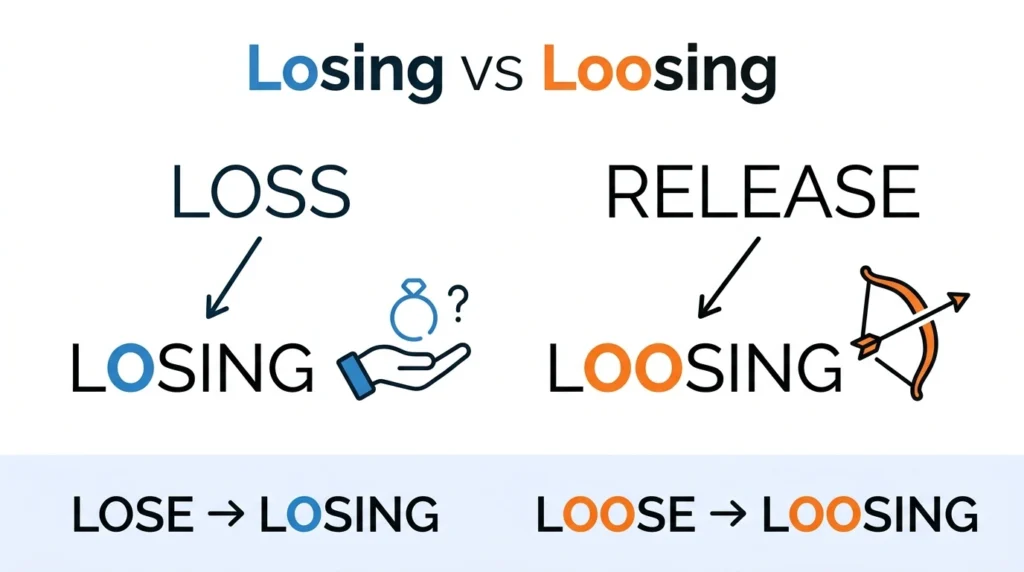
loss → lose → losing
release → loose → loosing
Common Mistakes Checklist
1. Writing “loosing weight”
Problem: The writer adds an unnecessary o.
Correct: “She is losing weight.”
Avoid it: Remember that weight loss comes from lose, not loose.
2. Writing “loosing the game”
Problem: The writer connects the long “oo” sound with the spelling loose.
Correct: “The team is losing the game.”
Avoid it: A team loses when it fails to win.
3. Writing “loosing money”
Problem: Money is being lost, not released.
Correct: “The company is losing money.”
Avoid it: Use losing for financial loss.
4. Assuming “loosing” is never a word
Problem: This goes too far in the other direction.
Correct: Loosing is a valid verb form in appropriate contexts.
Avoid it: Do not label every occurrence of loosing as an error. Check the meaning.
5. Confusing “loosing” with “loosening”
These words are related but not identical.
Loosening usually means making something less tight.
She is loosening her shoelaces.
Loosing can mean releasing or setting something free.
The archer is loosing an arrow.
When you mean “make less tight,” loosening is usually the clearer modern choice.
Loosing vs Losing in Real English
Losing: Natural and Everyday
Losing is completely natural in ordinary English when the meaning involves loss, failure, disappearance, reduction, or no longer having something.
I keep losing my keys.
We are losing customers.
She is losing patience.
They are losing the match.
These expressions are normal in conversation, workplace writing, education, journalism, and everyday digital communication.
Loosing: Grammatically Correct but Uncommon
Loosing is grammatically possible when loose is being used as a verb meaning to release or set free.
The archer was loosing arrows.
This is correct, but many modern speakers would choose a more direct alternative such as firing, releasing, or letting loose, depending on the context.
So a word can be correct without being the most natural everyday choice.
Loosening: Usually Better for “Making Less Tight”
If your meaning is “make something less tight,” loosening is usually the natural choice.
She is loosening her belt.
He is loosening the screw.
The mechanic is loosening the bolt.
Using loosing in these situations may suggest release rather than simply reducing tightness.
American vs. British English
There is no major American-versus-British spelling difference between losing and loosing.
The basic distinction is the same in both varieties:
- lose → losing
- loose → loosing
Both varieties recognize loosing as a possible form of the verb loose, although it is far less common than losing in everyday writing.
The important issue is therefore meaning, not regional spelling.
Read More: Fliers vs Flyers: Which Spelling Is Correct?
Formal vs. Informal Usage
Losing is appropriate in virtually every register.
You can use it in:
- casual conversation
- text messages
- emails
- business reports
- academic writing
- professional communication
- formal documents
Loosing is grammatically possible but much more specialized. In many modern contexts, a clearer alternative may be preferable.
For example:
The archer was loosing arrows.
is correct.
But depending on the context, a modern writer might simply say:
The archer was releasing arrows.
or:
The archer was firing arrows.
The choice depends on the intended meaning and the style of the writing.
Comparison Table
| Feature | Losing | Loosing |
|---|---|---|
| Base verb | Lose | Loose |
| Grammar | Present participle / gerund | Present participle / gerund |
| Main meaning | Experiencing loss or failure | Releasing or setting free |
| Commonness | Very common | Much less common |
| Losing a game | ✅ Correct | ❌ Wrong |
| Losing money | ✅ Correct | ❌ Wrong |
| Losing keys | ✅ Correct | ❌ Wrong |
| Losing weight | ✅ Correct | ❌ Wrong |
| Releasing an arrow | ❌ Wrong for that meaning | ✅ Correct |
| Setting something free | ❌ Wrong for that meaning | ✅ Possible |
| Making something less tight | ❌ | Usually loosening |
| Everyday writing | Natural | Uncommon |
| Basic memory | Loss → losing | Release → loosing |
Memory Trick
Remember:
Lose = Loss = Losing
One o in lose, one o in losing.
Then:
Loose = Release = Loosing
Two o’s in loose, two o’s in loosing.
A second shortcut is even simpler:
If something is going away from you → losing.
If you are deliberately letting something go → loosing.
For example:
I am losing my keys.
You cannot find them.
The archer is loosing an arrow.
The archer is deliberately releasing it.
Real-Life Situations
In an Interview
A candidate says:
“I don’t want to keep loosing opportunities.”
The correct sentence is:
“I don’t want to keep losing opportunities.”
The candidate means that opportunities are being missed, not released.
In a Business Meeting
A manager says:
“We are losing customers because our response time is too slow.”
Correct.
The company is failing to retain customers.
In an Email
“We are concerned about losing several major clients.”
Correct.
The clients may leave, so the company risks losing them.
In a Text Message
“I’m losing my mind trying to find these keys!”
Correct.
The expression describes frustration, not physical release.
In an Exam
“The team is losing the final.”
Correct.
The team is not winning the competition.
In a Historical Description
“The archer was loosing arrows from the tower.”
Correct if the intended meaning is that the archer was releasing arrows from a bow.
This is an excellent example of why loosing should not simply be marked as “wrong.”
Expert Tips
1. Check the Base Verb
When uncertain, remove -ing.
Ask:
Is it lose or loose?
If it is lose, write losing.
If it is the verb loose, loosing is possible.
2. Do Not Use Sound Alone
Pronunciation can help, but meaning is more reliable.
Ask what is actually happening in the sentence.
Is something being lost?
Or is something being released?
3. Watch for “Loosening”
If you mean “make less tight,” stop and check whether loosening is the word you need.
loosening a knot
loosening a belt
loosening a screw
These are different from deliberately releasing something.
4. Be Careful With Spellcheck
A spelling checker may accept loosing because the word exists.
That does not mean it is the right word for your sentence.
5. Remember the Sound Difference
losing → /z/ sound
loosing → /s/ sound
This can help when proofreading aloud.
Quick Summary
Losing and loosing are both real English words, but they come from different verbs. Losing comes from lose and is used for loss, failure, misplacement, defeat, reduction, or no longer having something. Loosing comes from the verb loose and can mean releasing, setting free, or letting something fly. Therefore, “losing the game,” “losing money,” and “losing weight” are correct. “Loosing an arrow” can also be correct when the meaning is releasing it. If you mean making something less tight, however, loosening is usually the natural choice. When unsure, identify the base verb first: lose → losing; loose → loosing.
Frequently Asked Questions
Is “loosing” a real word?
Yes. Loosing is a real word. It is the present participle of the verb loose and can mean releasing, setting free, or letting something fly.
Is “losing” always spelled with one “o”?
Yes. The present participle of lose is losing, with one o.
Is “loosing weight” correct?
No, not when you mean reducing body weight. The correct phrase is losing weight.
Is “loosing the game” correct?
No, if you mean that a person or team is failing to win. The correct expression is losing the game.
Is “loosing an arrow” correct?
Yes. Loosing an arrow can mean releasing or firing an arrow from a bow.
Is “loosing” the same as “loosening”?
No. Loosing can mean releasing or setting something free. Loosening normally means making something less tight or less firmly fixed.
Why does spellcheck sometimes accept “loosing”?
Because loosing is a legitimate English word. A spelling checker may recognize the word even when it does not fit the meaning of your sentence.
Which is more common, losing or loosing?
Losing is much more common in ordinary English because people frequently talk about losing games, money, possessions, time, confidence, patience, opportunities, and other things.
Can “loosing” be used in formal writing?
Yes, when its meaning is appropriate. However, because it is relatively uncommon, a clearer word such as releasing may sometimes be preferable.
How can I quickly remember losing vs. loosing?
Think:
Loss → losing
Release → loosing
Then check the base verb: lose → losing and loose → loosing.
Is “losing” a verb?
Yes. Losing is the present participle of the verb lose. It can also function as a gerund or adjective depending on the sentence.
What is the easiest way to choose between them?
Ask one question:
Am I talking about loss or release?
Loss → losing.
Release → loosing.
Mini Quiz
| # | Question | Answer | Explanation |
|---|---|---|---|
| 1 | The team is ___ the final match. (losing / loosing) | losing | The team is failing to win. |
| 2 | I keep ___ my phone. (losing / loosing) | losing | The phone is being misplaced. |
| 3 | She is ___ weight. (losing / loosing) | losing | Her weight is decreasing. |
| 4 | The archer was ___ an arrow. (losing / loosing) | loosing | The archer was releasing the arrow. |
| 5 | Correct the sentence: “We are loosing customers.” | We are losing customers. | Customers are being lost, not released. |
| 6 | The mechanic is ___ the bolt. (losing / loosing / loosening) | loosening | The mechanic is making the bolt less tight. |
| 7 | He is ___ patience with the delays. (losing / loosing) | losing | His patience is decreasing. |
| 8 | Choose the correct form: “The hunters were ___ the hounds.” | loosing | They were releasing the hounds. |
| 9 | Which base verb produces “losing”? lose / loose | lose | Lose + -ing gives losing. |
| 10 | Correct the sentence: “I am loosing my keys again.” | I am losing my keys again. | The speaker means the keys are being misplaced. |
Final Rule to Remember
Lose → losing → loss, failure, misplacement, defeat
Loose → loosing → release, set free
Loosen → loosening → make less tight
If you remember those three relationships, most loosing vs. losing mistakes become easy to solve.